Respiratory System
0.0(0)
Studied by 1 person Call Kai
 Learn
Learn Practice Test
 Spaced Repetition
 Match
Match Flashcards
 Knowt Play
Card Sorting
1/39

Earn XP
Description and Tags
Last updated 4:25 AM on 3/10/23
Name | Mastery | Learn | Test | Matching | Spaced | Call with Kai | Chat |
|---|
No analytics yet
Send a link to your students to track their progress
40 Terms
1
New cards
oxygen absorption
Pulmonary Functions \n • _________________ & CO2 removal (main function) \n • Defence
2
New cards
Oxygen absorption & CO2 removal
Pulmonary Functions
______________;
– Ventilation (brain, muscles, airways, compliance) \n – Gas exchange across the air-blood barrier \n – Perfusion
______________;
– Ventilation (brain, muscles, airways, compliance) \n – Gas exchange across the air-blood barrier \n – Perfusion
3
New cards
Defence
Pulmonary Functions
__________________:
* against airborne micro-organisms
* Biotransformation, endocrine functions
__________________:
* against airborne micro-organisms
* Biotransformation, endocrine functions
4
New cards
Arterial blood gas; ventilation
Pulmonary disease causes failure of lung function
1. ____________________ analysis:
* decreased paO2 : hypoxemia
* increased paCO2 : hypercapnia
2. _____________ mechanics:
* airflow & volume measured using a spirometer
1. ____________________ analysis:
* decreased paO2 : hypoxemia
* increased paCO2 : hypercapnia
2. _____________ mechanics:
* airflow & volume measured using a spirometer
5
New cards
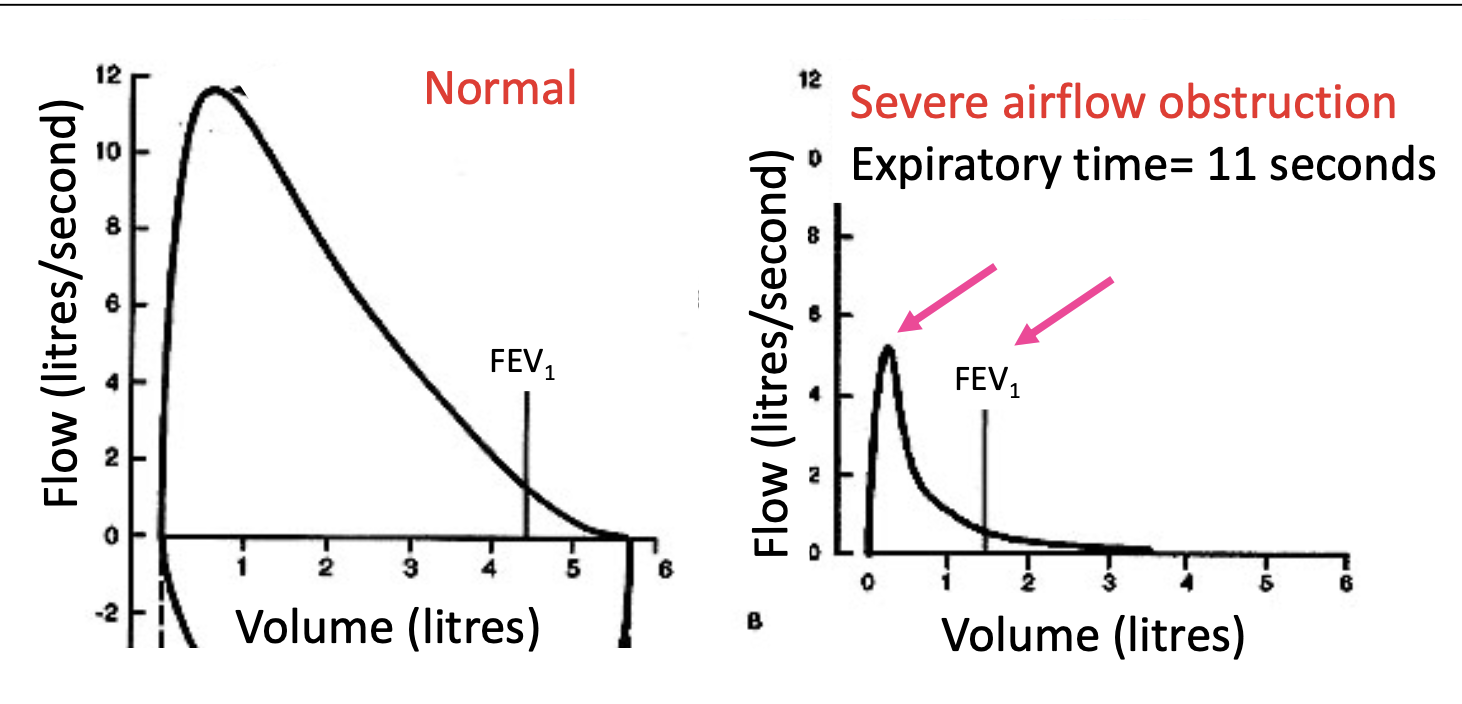
Forced vital capacity
Lung Function: Ventilation Mechanics \n • _____________________: total volume of exhaled air \n • FEV1: forced expiratory volume in 1 second
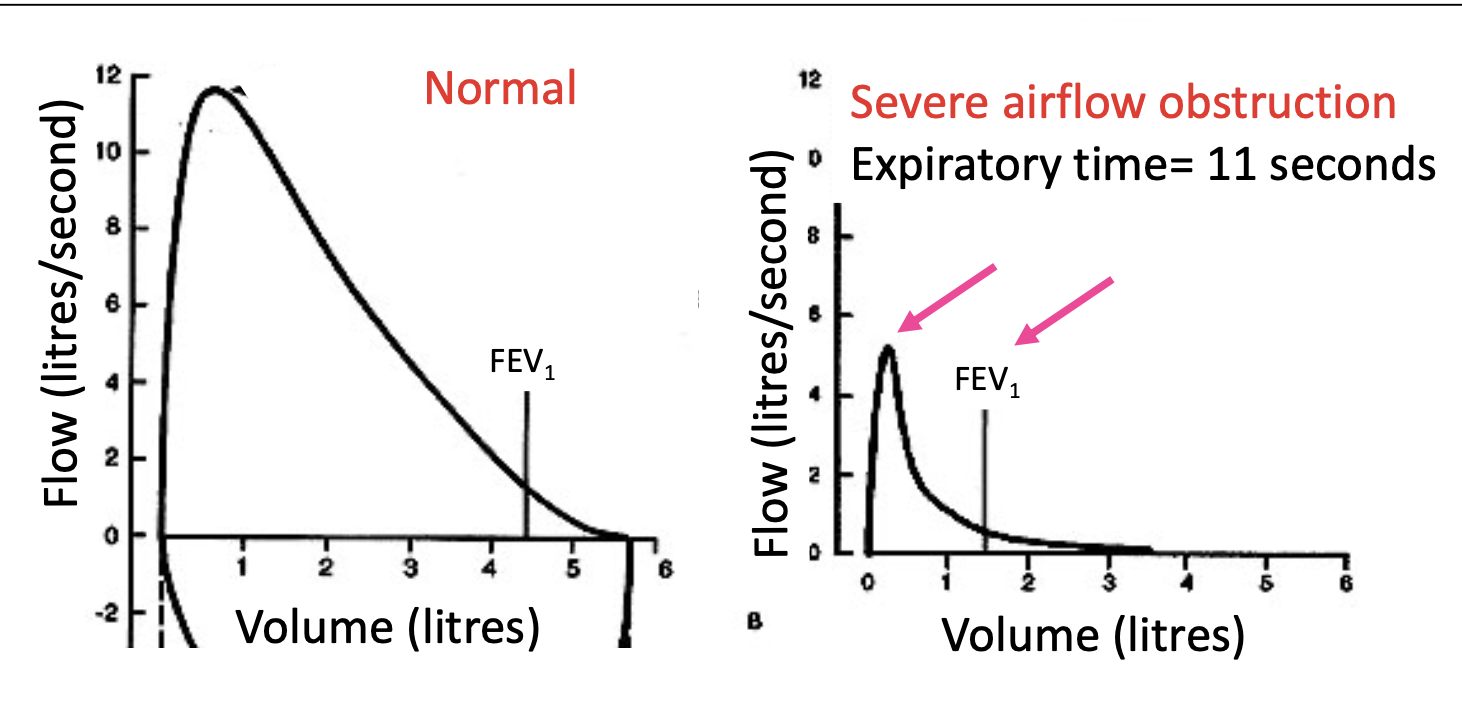
6
New cards
pulmonary edema
Major consequence of ________________
* Obstructs alveolar ventilation
* Impairs surfactant, decreases lung compliance
* Obstructs alveolar ventilation
* Impairs surfactant, decreases lung compliance
7
New cards
Compliance
_____________ = ΔV/ΔP
8
New cards
Bronchopneumonia
* a type of pneumonia that causes inflammation in the alveoli
* Air-borne/inhaled infection with opportunistic bacterial pathogens
* Air-borne/inhaled infection with opportunistic bacterial pathogens
9
New cards
sterile
The Problem of Lung Defence
* Many bacterial respiratory pathogens are carried by apparently healthy individuals
* The lungs are constantly challenged with pathogens from the nasopharynx and in inhaled particles
* The lung must remain “________” for optimal function
* Many bacterial respiratory pathogens are carried by apparently healthy individuals
* The lungs are constantly challenged with pathogens from the nasopharynx and in inhaled particles
* The lung must remain “________” for optimal function
10
New cards
__Mucociliary clearance & cough__
Lung defence #1. ____________________________
* Size-dependent impacting of particles
* Trapping of particles by mucus
* Clearance of mucus to the nasopharynx
* sweep material out of lung
* Size-dependent impacting of particles
* Trapping of particles by mucus
* Clearance of mucus to the nasopharynx
* sweep material out of lung
11
New cards
Innate defence proteins
Lung defence #2. __________________ & peptides from airway epithelium
* **β-Defensins**: eg. tracheal antimicrobial peptide
* Cathelicidins
* Lysozyme
* **Lactoferrin**
* Lactoperoxidase
* **Surfactant proteins** A & D
* Complement proteins
* **β-Defensins**: eg. tracheal antimicrobial peptide
* Cathelicidins
* Lysozyme
* **Lactoferrin**
* Lactoperoxidase
* **Surfactant proteins** A & D
* Complement proteins
12
New cards
Alveolar Macrophages
Multi-layered system of lung defence. 3. ________________
* Phagocytosis of particles & bacteria
* Killing pathogens
* Recruitment of inflammatory cells
* “Housekeeping” in the alveoli
* Phagocytosis of particles & bacteria
* Killing pathogens
* Recruitment of inflammatory cells
* “Housekeeping” in the alveoli
13
New cards
Recruited Cells
Multi-layered System of Lung Defence. 4._____________
..enhance lung defences
* Neutrophils, macrophages: phagocytosis and killing of bacteria
* B lymphocytes: antibody blocks colonization, kills bacteria, opsonization
* T lymphocytes: activate macrophages→ increased microbicidal functions
..enhance lung defences
* Neutrophils, macrophages: phagocytosis and killing of bacteria
* B lymphocytes: antibody blocks colonization, kills bacteria, opsonization
* T lymphocytes: activate macrophages→ increased microbicidal functions
14
New cards
Host; infectious; environment
Predisposing causes of bacterial bronchopneumonia
_____ factors: Stress, Vaccination, Genetics
__________ Agents: Bacteria, viruses, mycoplasma
______________: Chilling, Organic dust in barn air, Air pollutants
_____ factors: Stress, Vaccination, Genetics
__________ Agents: Bacteria, viruses, mycoplasma
______________: Chilling, Organic dust in barn air, Air pollutants
15
New cards
Pulmonary carcinoma
Lung Cancer: ___________________
* malignant epithelial cancer
* malignant epithelial cancer
16
New cards
Human Lung Cancer
_____________________:
* #1 cause of cancer death in North America
* #2 cause of preventable mortality in North America
* Association with cigarette smoking
* Older patients, poor prognosis \n – <50% 1-year survival \n – <15% 5-year survivall
* #1 cause of cancer death in North America
* #2 cause of preventable mortality in North America
* Association with cigarette smoking
* Older patients, poor prognosis \n – <50% 1-year survival \n – <15% 5-year survivall
17
New cards
Blood air interface:
* Type I pneumocyte
* Basement membrane
* Endothelium
* __Critical for efficient gas exchange__
* __Effects on compliance__
* Type I pneumocyte
* Basement membrane
* Endothelium
* __Critical for efficient gas exchange__
* __Effects on compliance__
18
New cards
hyaline; alveolar
Acute: ___________ membranes & ________ edema
pink membranes that line the alveoli
* damage to epi or endothelial cells
pink membranes that line the alveoli
* damage to epi or endothelial cells
19
New cards
Subacute: proliferation of type II pneumocytes
* \
* \
20
New cards
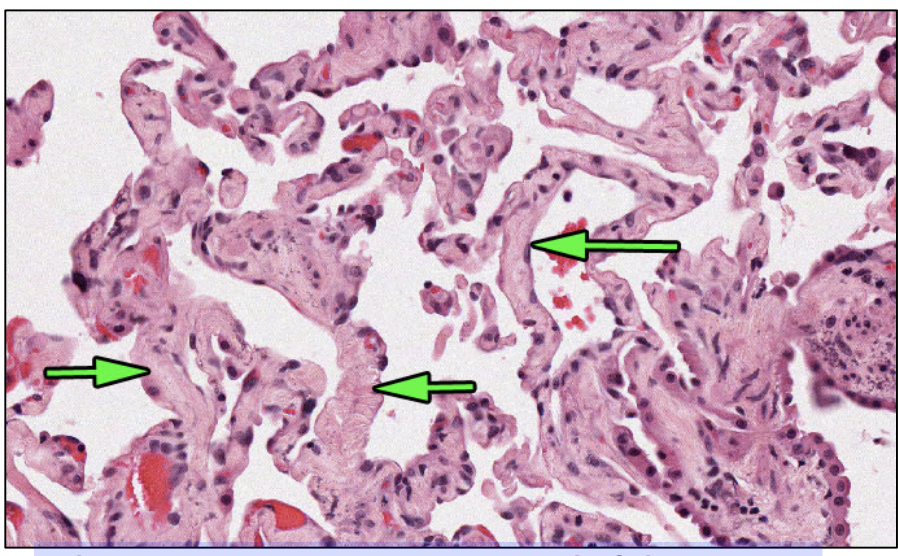
Chronic: Interstitial fibrosis
* \
* \
21
New cards
Acute respiratory Distress syndrome
_________________________; (ARDS)
Common cause of severe respiratory disease, \n in patients hospitalized for other diseases \n • 36% mortality \n • Return to normal lung function in survivors
Common cause of severe respiratory disease, \n in patients hospitalized for other diseases \n • 36% mortality \n • Return to normal lung function in survivors
22
New cards
Pneumocytes
Acute Respiratory Distress Syndrome \n Pathogenesis: Injury to type I _____________ or endothelium
23
New cards
lung; pleural
Lung Cancer
* Fills function space within _______
* Impinges on a vital structure (eg bronchus)
* Erodes a blood vessel → hemorrhage
* Metastasis within _________ cavity
* Lymph node and distant metastasis
* Paraneoplastic effects
* Fills function space within _______
* Impinges on a vital structure (eg bronchus)
* Erodes a blood vessel → hemorrhage
* Metastasis within _________ cavity
* Lymph node and distant metastasis
* Paraneoplastic effects
24
New cards
Interstitial Lung Injury
Cellular Targets in _________________
* Type I Pneumocytes
* Type II Pneumocytes
* Endothelial cells
* Alveolar Macrophages
* Type I Pneumocytes
* Type II Pneumocytes
* Endothelial cells
* Alveolar Macrophages
25
New cards
Type I
______ Pneumocytes
* Gas exchange
* Susceptible to injury
* Gas exchange
* Susceptible to injury
26
New cards
Type II
________ Pneumocytes
* Stem cell: regeneration
* Production of surfactant
* Metabolism/detoxification
* Stem cell: regeneration
* Production of surfactant
* Metabolism/detoxification
27
New cards
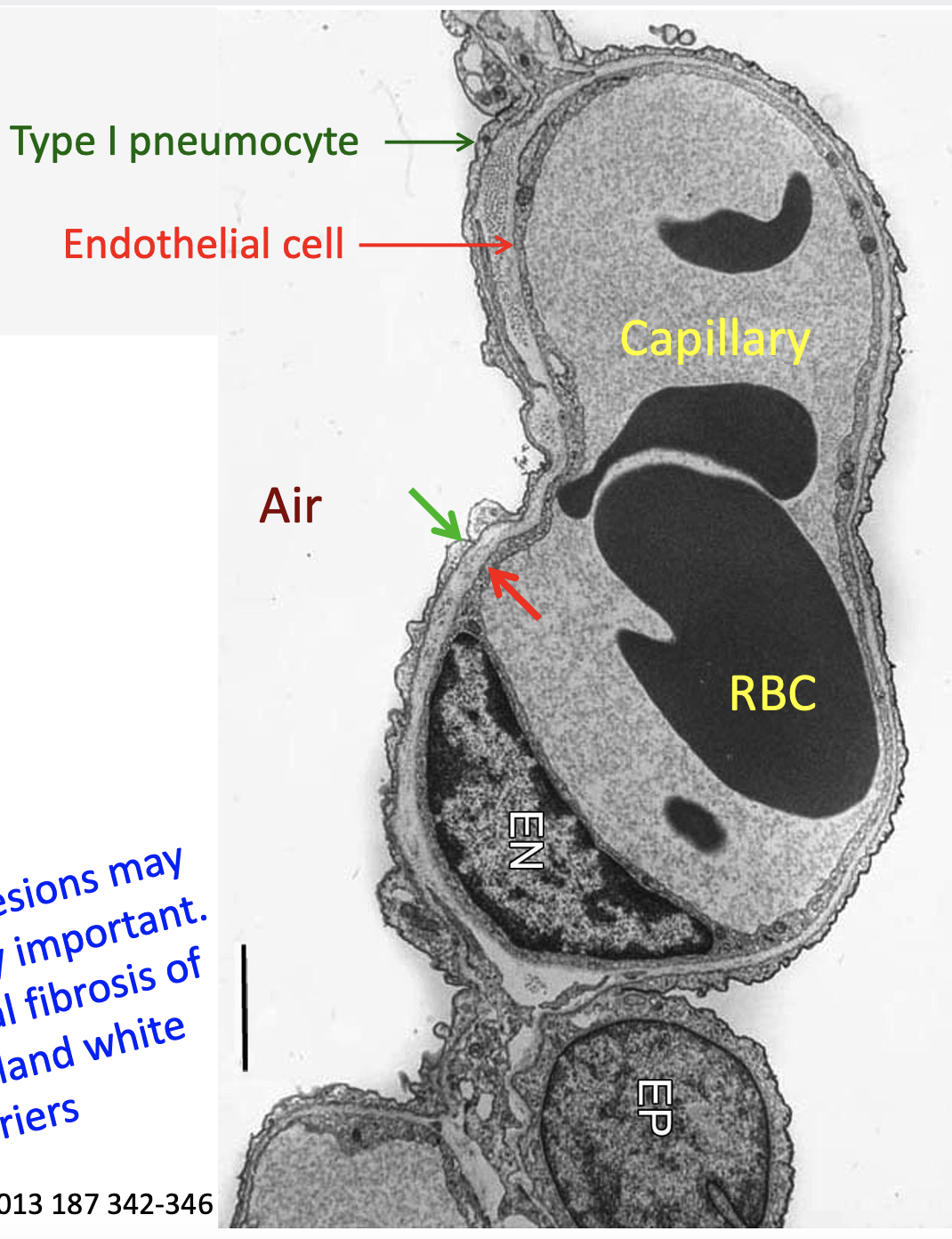
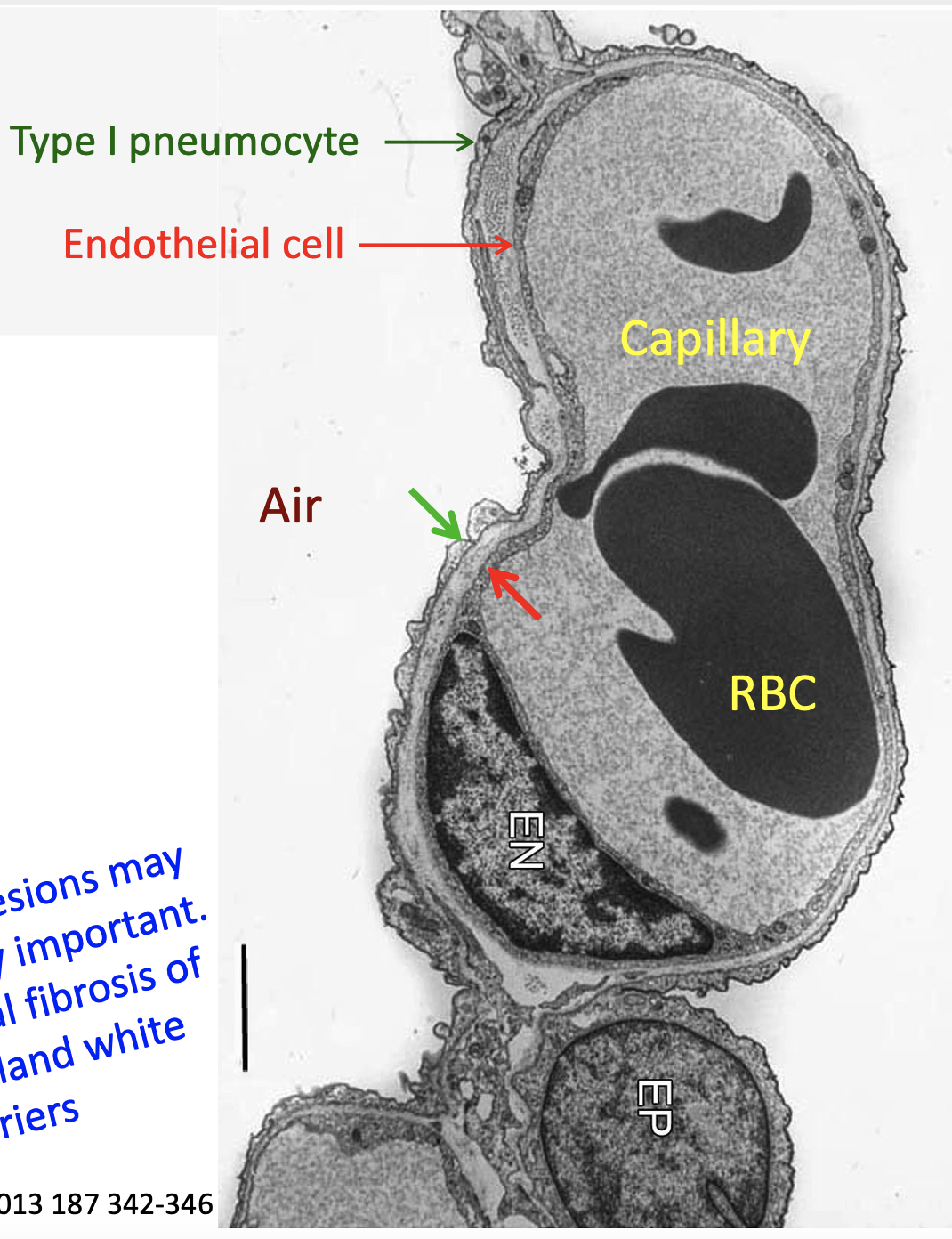
gas exchange; compliance
Blood-air interface:
* Type I pneumocyte
* Basement membrane
* Endothelium
Critical for efficient __________ \n Effects on ___________
* Type I pneumocyte
* Basement membrane
* Endothelium
Critical for efficient __________ \n Effects on ___________
28
New cards
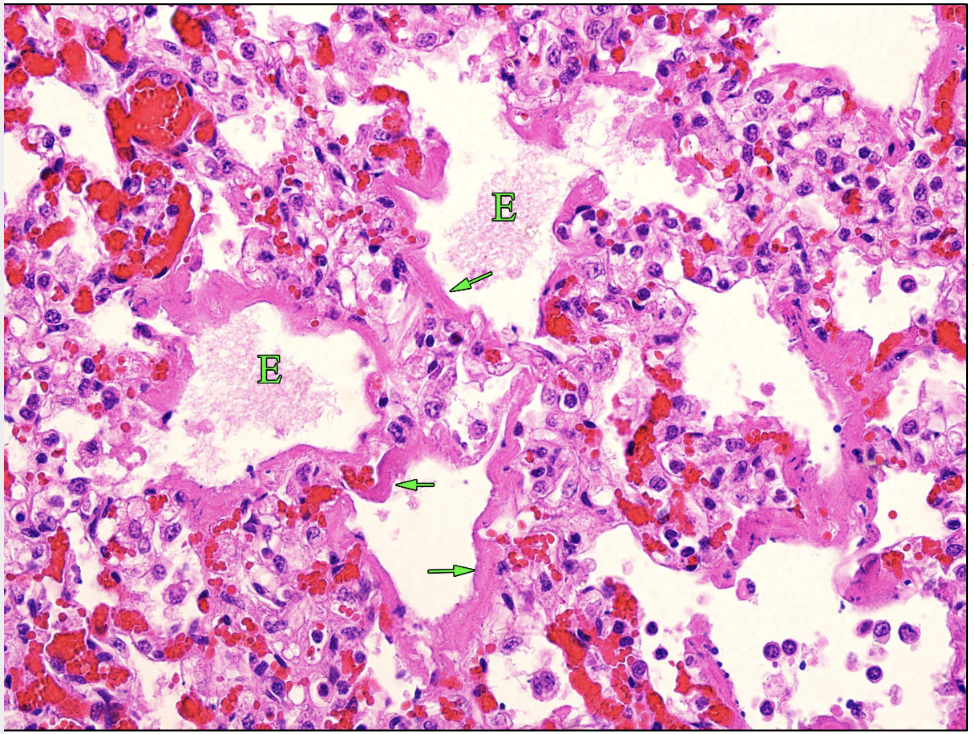
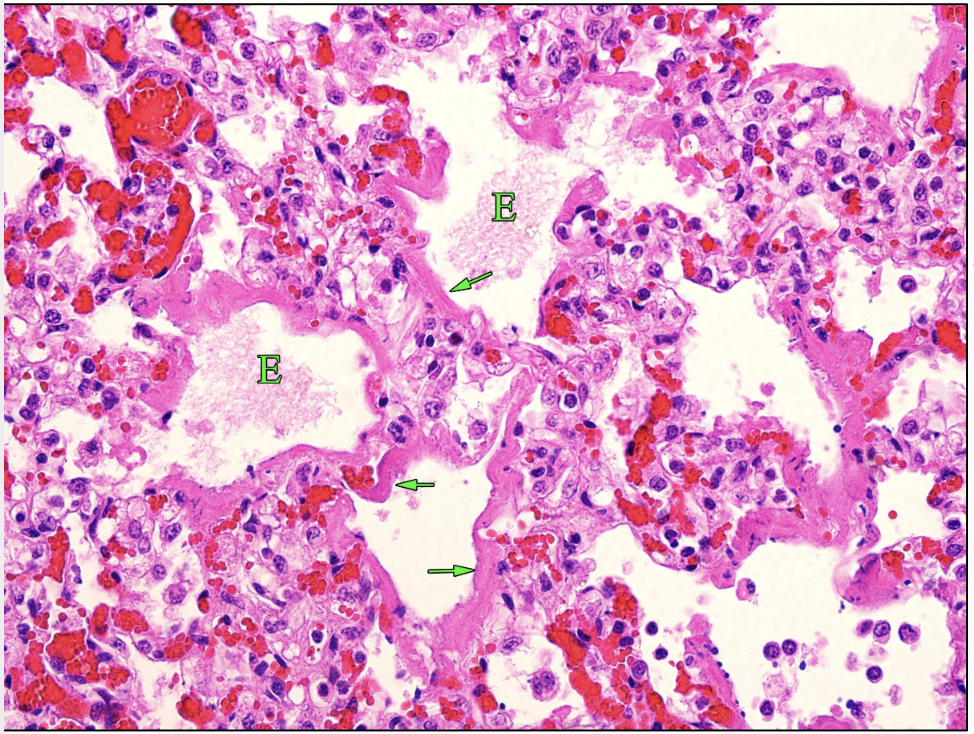
hyaline; edema
Evolution of Alveolar Injury
Acute: _____ membranes & alveolar ________
Acute: _____ membranes & alveolar ________
29
New cards
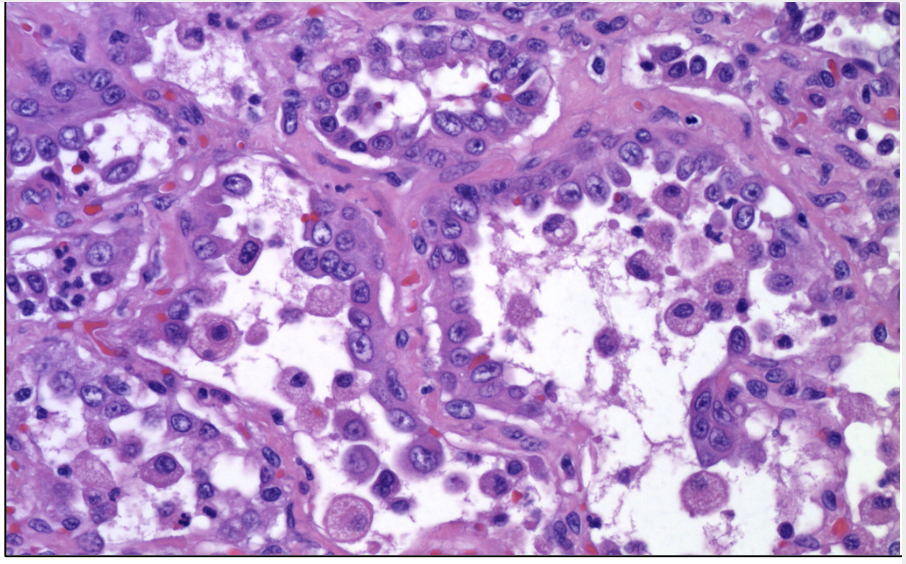
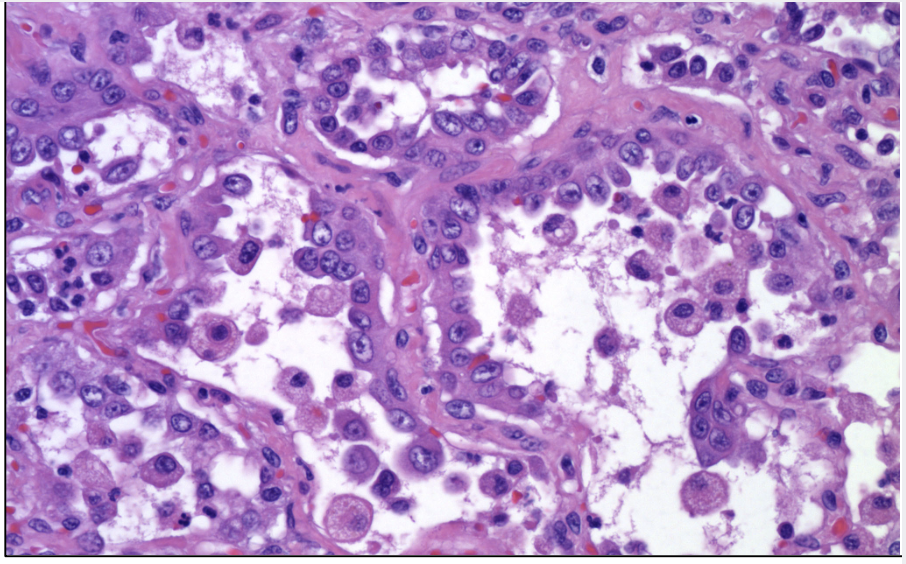
subacute
Evolution of Alveolar Injury
___________: proliferation of type II pneumocytes
___________: proliferation of type II pneumocytes
30
New cards
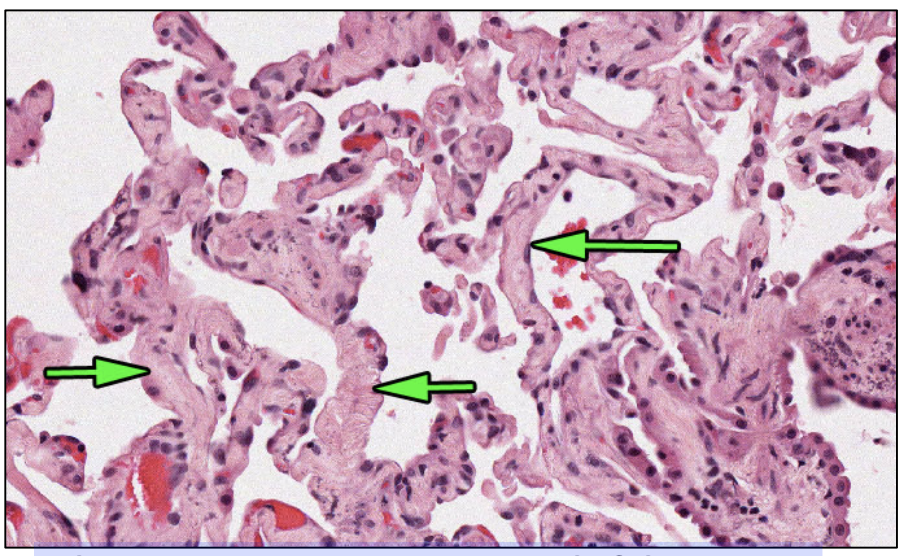
fibrosis
Evolution of Alveolar Injury
Chronic: Interstitial ___________
Chronic: Interstitial ___________
31
New cards
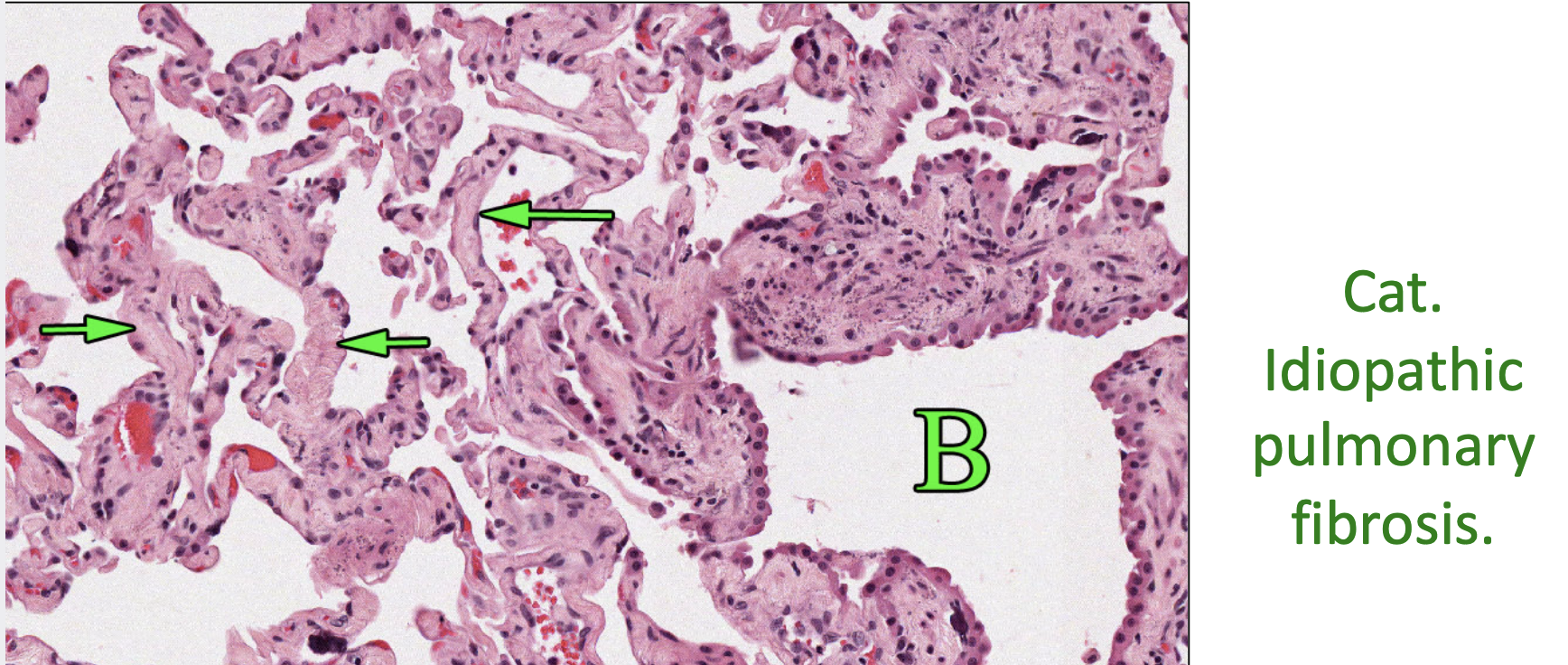
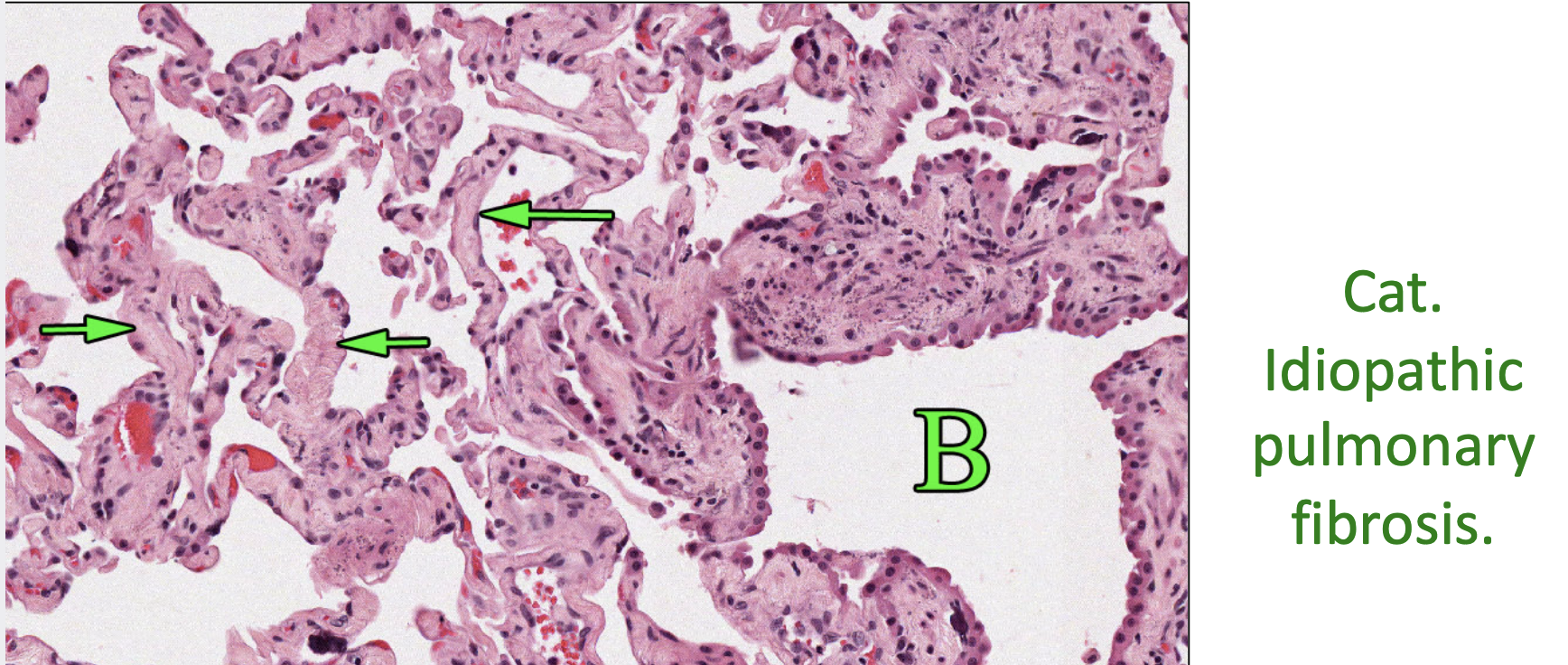
compliance; tidal volume
Alveolar Injury and Restrictive Lung Disease
* Obstruct oxygen exchange in alveoli
* Reduce pulmonary _____________ — stiff & inelastic
* Reduce lung capacity — reduced ____________
* Obstruct oxygen exchange in alveoli
* Reduce pulmonary _____________ — stiff & inelastic
* Reduce lung capacity — reduced ____________
32
New cards
Acute Respiratory Distress Syndrome
_______________________ “ARDS”
* Common cause of severe respiratory disease in patients hospitalized for other diseases
* 36% mortality
* Return to normal lung function in survivor
* Common cause of severe respiratory disease in patients hospitalized for other diseases
* 36% mortality
* Return to normal lung function in survivor
33
New cards
endothelium
Acute Respiratory Distress Syndrome
Pathogenesis: Injury to type I pneumocytes or ___________
* Sepsis or endotoxemia
* Viral or mycoplasmal infection
* Aspiration of vomitus
* Trauma
* Toxins
Pathogenesis: Injury to type I pneumocytes or ___________
* Sepsis or endotoxemia
* Viral or mycoplasmal infection
* Aspiration of vomitus
* Trauma
* Toxins
34
New cards
mucociliary clearance
Large airways: trachea, bronchi - Ciliated epithelial cells
* Function: ______________
* Vulnerable to injury
* ex. Goblet cells, basal cells, mucosal glands
* Function: ______________
* Vulnerable to injury
* ex. Goblet cells, basal cells, mucosal glands
35
New cards
regeneration; inflammatory
__Small airways: bronchioles__ \n Club cells: non-ciliated, bronchiolar, epithelial cells \n Function \n – Stem cell for _____________ \n – Metabolism and detoxification of chemicals \n – Dampening of the ____________ response
36
New cards
viruses; toxic
Causes of Airway Disease
* _____________: eg. influenza
* Hypersensitivity disease: eg. asthma
* _______: eg. cigarette smoke pollutants
* _____________: eg. influenza
* Hypersensitivity disease: eg. asthma
* _______: eg. cigarette smoke pollutants
37
New cards
Asthma
______________
* Hyper-reactive airways → episodes of reversible bronchoconstriction leading to airway obstruction
* Inflammatory airway disease
* Triggering factors \n •Allergen exposure \n •Drug exposure \n •Exercise \n •Cold, heat, stress \n •Pollutants
* Hyper-reactive airways → episodes of reversible bronchoconstriction leading to airway obstruction
* Inflammatory airway disease
* Triggering factors \n •Allergen exposure \n •Drug exposure \n •Exercise \n •Cold, heat, stress \n •Pollutants
38
New cards
Chronic Obstructive Pulmonary Disease
_____________________________
* 4th most common cause of death (Strong association with smoking) \n • Chronic bronchitis \n • Emphysema
* 4th most common cause of death (Strong association with smoking) \n • Chronic bronchitis \n • Emphysema
39
New cards
Chronic bronchitis
_______________
* Airway irritation : “smoker’s cough”... \n ...may lead to permanent damage to airway
* Airway irritation : “smoker’s cough”... \n ...may lead to permanent damage to airway
40
New cards
Emphysema
_________________ \n Destruction of alveolar wall → enlargement and dysfunction of the alveoli