P/S Pankow
 Call Kai
 Learn
 Practice Test
 Spaced Repetition
 Match
 Flashcards
 Knowt Play
1/1097

There's no tags or description
Looks like no tags are added yet.
1098 Terms
Appearence of prenatal reflexes in adults
Exist in infants and should disappear with age. Most primitive reflexes serve (or served, in earlier times) a protective role. They can reappear in certain nervous system disorders.
Auto-communication
Takes place whenever senders act as receivers of the messages that they are conveying
--Bats using echolocation

Anthropomorphism
Attributing human characteristics to non-human animals
--cats sleep with us because they love us not for warmth
--robot having consciousness

Pheromones
Animals communicate with chemical signals
--Chemical signals released by a species to trigger an innate response in another member of the species
--Often linked to mating, fighting, and communication

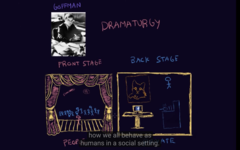
Dramaturgy
When interacting, people are assumed to act in accordance with the expectations of their audience
Random mating
All individuals within a species are equally likely to mate with each other
--large amount of genetic diversity

Assortative Mating
Non-random mating where individuals with certain phenotypes tend to mate with each other
--Mate only with someone similar to you

Dis-assortative Mating (Non-Assortative Mating)
Non-random mating where individuals with different or diverse traits mate tend to mate with each other
--Mate only with someone different from you

Inclusive fitness
The number of offspring equivalents that an individual rears, rescues or otherwise supports through its behavior (regardless of who begets them), includes direct fitness and indirect fitness
--Direct fitness is when an individual behaves in ways that increase their own fitness
--Indirect fitness is when an individual behaves in ways that increase the fitness of others that carry the same genes
Evolutionary game theory
Those best fit to the environment will survive and pass on to offspring
--reproduction and environment
--Those genes will become more common in successive generations
--Predicts the availability of Resources and Social behavior
--Strategy of each individual depends on strategy exhibited by other players
--Decisions without conscious intent

Geographical proximity
Most powerful predictor of friendships and relationship

Mere exposure effect
Repeated exposure to novel people or objects increases our liking for them
--More often we see something, the more often we like it
--Advertisements
Similarity bias
We will not befriend people different from us

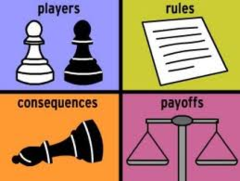
Game Theory
Involves intention, and reasoning the behaviors of others
Perceived similarity
Thinking another person (often SO) is similar to them but they aren't actually similar
Projection bias
We assume others share the same beliefs we do
--everyone has the same beliefs as you
--cognitive and affective states
--Researchers imposing their own beliefs onto subjects

False consensus
We assume everyone else agrees with what we do, even if they do not
--Everyone agrees with your opinion or action
Attachment
Bond between mother and child
--Harlow monkey experiments showed that attachment bias is due to comfort not food
--Harlow Monkey Experiments, the cloth mother acts as a secure base
--Once abnormal behavior was should, it could not be corrected

Stranger Anxiety
The fear of strangers that infants commonly display, beginning by about 8 months of age
Mary Ainsworth's Strange Situation
Experiment done to try to understand why some kids have stranger anxiety and some don't
--Mothers sensitive to child and responsive had secure attachment
--Mothers insensitive or unresponsive formed insecure attachments

Secure attachment
Child explored when mother was present, cried when she was gone, went to her when she returned
Insecure attachment
Child clung to mom when she was present, cried when she was gone, and continued to cry when she returned
--Even avoidant behaviors when she returned
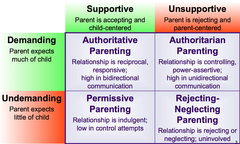
Authoritarian parenting
Very strict, break will of child, punishment
--Demanding and parent centered (unsupportive)
--considered bad parenting

Authoritative parenting
Strict, consistent and loving but more pragmatic and issue-oriented and listen to children's arguments
--Balance responsibility with rights of child
--demanding and child centered (supportive)
--considered good parenting
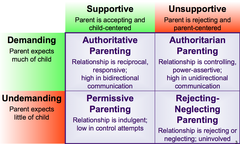
Permissive parenting/Indulgent parenting
Non-directive and lenient, few behavioral expectations for child
--undemanding and child centered (supportive)
Reinforcement-modeling
Kids model their behavior based on reinforcement
--Parents who give into demands of child during temper tantrums lead to more temper tantrums in future
Social scripts
Instructions provided by society on how to act
--sets of behaviors for a specific interaction
Altruism
Caring about welfare of other people and acting to help them
--Beneficial to society and also individuals
Kin-selection
People act more altruistically to close kin than distant/non-kin people
Reciprocal altruism
People are more cooperative if they will interact with that person again in the future
--We feel more obliged to help someone else if they have helped us
Cost signaling
Helping out others because you want to let them know you are a big deal/rich/have resources
--allows altruist to establish a "better than you reputation"
Empathy-Altruism Hypothesis
Some people are altruistic due to empathy
Emotional support
Affection, love, trust, caring
--The type that involves listening and emphasizing
--Can include physical support (hugs/pats on back)
--Provided by those closest to you (family/close friends)
--"You are loved"
Esteem support
Expressions of confidence or encouragement
--Things people say to let you know they believe in you
--Can come from family and friends but also therapists, teachers, coaches
--"You can do it"
Informational support
Sharing information with us or giving us advice
--Can come from family/friends or even articles online
--"This is what you should do..."
Tangible/instrumental support
Financial support, material goods, or services
Companionship support
When someone engages in a behavior with an individual to give a sense of belonging
--Mere presence or sharing in an activity

Ascribed status
Status you can't change, given from birth
Achieved status
Status you earn yourself after working for it

Master status
Your dominating status over all your other statuses

Discrimination
Different treatment and harmful actions against minorities (BEHAVIOR taken on negative attitude)
--Individual discrimination: Individual person acting to discriminate based on something (teacher or coach)
--Institutional discrimination: Organization discriminating (government or school)
--Unintentional discrimination: How policies can discriminate unintentionally
--Side-effect discrimination: One institution, organization, or sector can influence another negatively (unfair trial leads to no job because of criminal record)
--Past-in-Present discrimination: How things done in the past, even if no longer allowed, can have consequences for people in the present
Prejudice
A negative ATTITUDE toward an entire category of people
--Make same assumptions about everyone in a group without considering their differences
Utilitarian Organization
Members are paid or rewarded for their efforts
--job
Normative Organizations
Members come together through shared goals
--religious groups or MADD
Coercive organizations
Members don't have choice about membership
--prison
Bureaucracy
Rules, structures, and rankings that guide organizations
--Organizations achieve maximum efficiency through rules, structures, and rankings
Bureaucratization
Process by which organizations become increasingly governed by laws and policy
Iron rule of Oligarchy
Any human organization will inevitably become controlled by a ruling elite, no matter how democratic it is in the start

Oligarchy
A small group of people having control of a country, organization, or institution
McDonaldization
Policies of fast food organizations have come to dominate other organizations of society
--efficiency, calculability, predictability, uniformity, and control
Structure of Organizations
Max Weber
5 main characteristics of an ideal bureaucracy, regardless of the goal of the organization
Extrapolation of Karl Marx conflict theory
Max Weber's Division of Labor
People are trained to do specific tasks
Trained incapacity: workers are so specialized in tasks they lose touch with overall picture
Max Weber's Hierarchy of Organization
Each position is under supervision of higher authority
--Not all people of an organization are equal
Max Weber's Written Rules and Regulations
There are written rules and regulations
--Goal displacement: Rules become more important than goals of organization
Max Weber's Impersonality
How individuals and officials conduct activities in unbiased manners
Max Weber's Employment based on Technical Qualifications:
Hiring in bureaucracy is based on qualifications that the person has and not favoritism or personal rivalries
Macrosociology
Looking at big phenomena that affect big portions of population
--Social structures, institutions, and whole civilizations or populations
Functionalism
Society is in dynamic equilibrium and is adaptive
--Looks at society as a whole and how institutions that make up the society, adapts to keep society stable and functioning
--Society is always trying to come to an equilibrium
--Each aspect of society has an intended and unintended function
--Problem with Functionalism: Focuses entirely on Institutions without regard for Individual
--Macrosociology
Conflict theory
Inequality between social classes and this social inequality will eventually lead to social change
--Social classes fighting each other
--Two opposing positions would merge to create a new society where both are content
--Society evolves thru several stages: Feudalism → Capitalism → Socialism
--How society changes
--Macrosociology
Microsociology
Face to face interactions
--Families, schools, and social interactions
Symbolic interactionism
Focuses on individuals and significance they put on things in their lives; describes how individuals label things and change how they act towards things in response to societal labels
--Society is a byproduct of everyday interactions of individuals and looking at everyday behaviors helps us better understand and define deviance
--Explains social phenomena in terms of the meaning that they hold when people interact with one another
--How individuals act
--Microsociology
Conservative View of Institutions
Institutions are natural by-products of human nature
--Typically upholds traditional values and practices
Progressive View of Institutions
Institutions are artificial creations that need to be redesigned if they are not helpful
--Emphasizes embracing change, being receptive to new ideas and promoting innovation
Hidden Curriculum
Learning normative cultural values, socialization, etc. through the educational system
--typically not explicitly expressed: LATENT

Ecclesia
Dominant religious organizations that includes most members of society
Modernization in terms of Religion
More info available to public and less emphasis on religion
Secularization
Weakening of social and political power of religious organizations
--Usually as religious involvement declines
Religious Fundamentalism
Religious movement whose objectives are to return to the foundations of the faith and to influence state policy
--Reaction to secularization
Communism
Classless, moneyless community where all property is owned by the community
Capitalism
Private ownership of production with market economy based on supply and demand
Socialism
Motivated by what benefits society as a whole, common ownership of production that focuses on human needs and economic demands
Functionalist
Division of labor in government and economy
--Everyone is required to have responsibility in society
Sick Role
You're allowed to take a break if ill
Rights
--Exempt from normal social roles
--Lack of accountability for the illness
Obligations
--Must attempt to get well
--Must seek and comply with treatment
If obligations are not followed, you are deviant and harmful to society

Role strain vs. Role conflict vs. Role exit
Role strain: when multiple roles within a single status are competing
--When you can't carry out all obligations or roles of a status
Role conflict: when the roles of multiple statuses are incompatible
--one role from one status interferes with another role from another status
--Conflict between roles of two or more different statuses
Role exit: when an individual stops engaging in a role previously central to their identity and process of establishing new identity

Illness experience
Process of being ill and how people cope with illness
Social epidemiology
Research that calls attention to the ways in which health and disease are conditioned in a social context
Social Facts
Ways of thinking and acting formed by society that existed forever
Manifest functions
Obvious and intended consequences from social institutions or practices
--Attending college to get a good education that leads to better career opportunities
Latent functions
Unintended or unrecognized consequences from social institutions or practices
--Making lifelong friends from attending a college
Social dysfunction
Process that has undesirable consequences and may reduce the stability of society
--Social instability
Small societies are held together by
Similarities
In large societies there is
Forced Mutual Interdependence
--People or things that are interdependent all depend on each other
Lower class united to create
Class consciousness
the Thesis
Existing generally accepted state
--The thesis was that bourgeoisie ran factories and working class provided labor
the Antithesis
Reaction to the thesis, push-back from those unhappy with the status quo
the Synthesis
Thesis and Antithesis creating a new state
--Eventually becomes new thesis
Ludwig Gumplowicz
Expanded on Marx
Proposed that society is shaped by war and conquest
--Cultural and Ethnic conflicts lead to dominant groups
Max Weber 3 independent factors
Class: person's economic position in a
society
Status: a person's prestige, social honor, or popularity in a
society
Power: a person's ability to get his way despite the resistance of others (influence)
Social construct
A concept that everyone in society agrees to treat a certain way regardless of its inherent value
--money
Social constructionism
Emphasizes how social interactions and language shape knowledge and explain what parts of the world are created by society
--What society is rather than how it exists or changes
--Everything is created from the mind of society
--How things are given value
--Facts are either brute or institutional
--Microsociology and Macrosociology
Weak social constructionism
Proposed that social constructs are dependent on brute facts, which are most basic and fundamental facts
--forces, particles, mountains, etc.
--Brute facts and institutional facts are a part of weak social constructionism
Institutional facts
Created by social conventions and rely on other facts
--Money depends on the paper we have given value
Strong social constructionism
Reality is dependent on language and social habits
--No facts that just exist
Feminist Theory
Focuses on gender inequalities inherent to patriarchal capitalist societies, socially constructed via process of socialization
Gender differences
--Women subordination is viewed as inherent feature
Gender Inequality
--Oppressed, subordinated, and abused
Gender oppression
--Women's oppression and inequality are due to capitalism, patriarchy, and racism (Structural oppression)
--Macrosociology and Microsociology
Rational choice theory
People always take rational actions, weighing costs and benefits to each other to gain most benefit; People are motivated by money and do what's best to get more goods
--Completeness: Every action can be ranked
--Transitivity: Transitive property (A>B>C, therefore A>C)
--Independence of irrelevant alternatives: Adding other options won't affect previous options rankings
(A>B>C, and B>X>C, therefore: A>B>X>C)
Social Exchange theory (stopped here)
People are rational and make decisions in social interactions that maximize benefit and minimize harm
--People behave with the goal of maximizing own rewards while minimizing punishments
--Addresses decision making via cost-benefit analysis
--Application of rational choice theory to social interactions
--Microsociology
Sexual selection
Natural selection arising through preference for one sex characteristics in individuals of the other sex
--Evolution leads to behavior
Social Selection
Individual's health can influence their social mobility and therefore status
--Behavior leads to evolution
--health → social mobility → status
Medicalization
Patient/Doctors construct illness out of ordinary behavior
Culture
A way of life shared by a group of individuals
--all the shared products of a society
1) People share culture in society
2) Culture is adaptive
3) Culture builds on itself
4) Culture is transmitted