GenChem I—Chapter 4: Chemical Reactions Vocab
 Call Kai
 Learn
Learn Practice Test
 Spaced Repetition
 Match
Match Flashcards
 Knowt Play
1/36

There's no tags or description
Looks like no tags are added yet.
Name | Mastery | Learn | Test | Matching | Spaced | Call with Kai | Chat |
|---|
No analytics yet
Send a link to your students to track their progress
37 Terms
Electrolyte
a substance, such as sodium chloride, that dissolves in water to give an electrically conducting solution
Nonelectrolyte
a substance, such as sucrose, or table sugar ( C12H22O11), that dissolves in water to give a nonconducting or very poorly conducting solution.
Strong electryolye
an electrolyte that exists in solution almost entirely as ions.
Weak electrolyte
an electrolyte that dissolves in water to give a relatively small percentage of ions.
Molecular Equation
a chemical equation in which the reactants and products are written as if they were molecular substances, even though they may actually exist in solution as ions.

Complete ionic equation
a chemical equation in which strong electrolytes (such as soluble ionic compounds) are written as separate ions in the solution.

Spectator Ion
an ion in an ionic equation that does not take part in the reaction.
Net Ionic Equation
an ionic equation from which spectator ions have been canceled.
Precipitate
an insoluble solid compound formed during a chemical reaction in solution.
Acid base indicator
a dye used to distinguish between acidic and basic solutions by means of the color changes it undergoes in these solutions.
Acid
Arrhenius- a substance that produces hydrogen ions, H+ (hydronium ion, H3O+ ), when it dissolves in water.
Bronsted-Lowry- the species donating a proton in a proton-transfer reaction.
Base
Arrhenius- a substance that produces hydroxide ions, OH− , when it dissolves in water.
Bronsted Lowry- the species accepting a proton in a proton-transfer reaction.
Strong acid
an acid that ionizes completely in water; it is a strong electrolyte.

Weak acid
an acid that is only partly ionized in water; it is a weak electrolyte.

Strong Base
a base that is present in aqueous solution entirely as ions, one of which is OH− ; it is a strong electrolyte.

Weak Base
a base that is only partly ionized in water; it is a weak electrolyte.

Neautralization reaction
a reaction of an acid and a base that results in a weak electrolyte.

Salt
an ionic compound that is a product of a neutralization reaction.
Polyprotic acid
an acid that yields two or more acidic hydrogens per molecule.
Oxidation number (state)
a number that represents the charge of an atom.
Oxidation reduction reaction (REDOX)
a reaction in which electrons are transferred between species or in which atoms change oxidation number
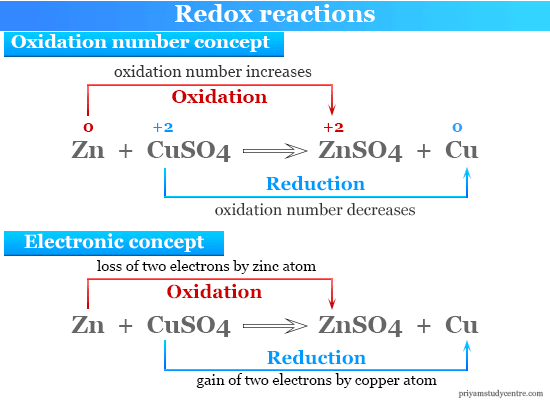
Half -reaction
one of two parts of an oxidation–reduction reaction, one part of which involves a loss of electrons (or increase of oxidation number) and the other a gain of electrons (or decrease of oxidation number).
Oxidation
The half-reaction in which there is a loss of electrons by a species (or an increase in the oxidation number of an atom).
Reduction
the half-reaction in which there is a gain of electrons by a species (or a decrease of oxidation number of an atom).
Oxidizing Agent
a species that oxidizes another species; it is itself reduced.
Reducing agent
a species that reduces another species; it is itself oxidized.
Combination reaction
a reaction in which two substances combine to form a third substance.

Decomposition reaction
a reaction in which a single compound reacts to give two or more substances.
Displacement reaction (single replacement reaction)
a reaction in which an element reacts with a compound, displacing another element from it.
Combustion reaction
a reaction of a substance with oxygen, usually with the rapid release of heat to produce a flame.
Molarity (M)
the number of moles of solute dissolved in one liter (cubic decimeter) of solution.
Quantitative analysis
the determination of the amount of a substance or species present in a material.
Gravimetric analysis
a type of quantitative analysis in which the amount of a species in a material is determined by converting the species to a product that can be isolated completely and weighed.
Titration
a procedure for determining the amount of substance 𝐴 by adding a carefully measured volume of a solution with known concentration of 𝐵 until the reaction of 𝐴 and 𝐵 is just complete.
Volumetric analysis
a method of analysis based on titration.
Equation of Molarity (M)
Moles of solute / liters of soluton
M1v1=
M2v2