Inorganic Chemistry Exam II
 Call Kai
 Learn
 Practice Test
 Spaced Repetition
 Match
 Flashcards
 Knowt Play
1/51

There's no tags or description
Looks like no tags are added yet.
52 Terms
What are Arrhenius Acids & Bases
Arrhenius Acids: Increases concentration [H+]
Arrhenius Bases: Decreases concentration [H+] ; Increases concentration [-OH]
This is only valid in H2O
What are Bronsted-Lowry Acids & Bases
Bronsted-Lowry Acids: H+ Donors
Bronsted-Lowry Bases: H+ Acceptors (lone pairs)
What are Lewis Acids & Bases
Lewis Acids: Lone pair Acceptors (Electrophile)
Lewis Bases: Lone pair Donors (Nucleophile)
What are Lux-Flood Acids & Bases
Lux-Flood Acids: Oxygen Acceptors
Lux-Flood Bases: Oxygen Donors
As pKa decreases, acid strength _______
increases
Binary Acids
2 atoms that make acid (HX)
ex) HF, HCl, HBr, HI, etc.
pKa decreases as bond strength decreases
Oxyacids
Acids include oxygen in a polyatomic ion
What’s Bell’s/Pauling’s rule to write Oxyacids
OnX(OH)m ; n = number of O atoms without an H
pKa = 8 - 5n
How to Find pKa of Polyprotic Oxyacids
Calculate parent acid pKa using pKa = 8 - 5n
Each lost H+ add 5 to calculate parent pKa
What affects the lone pair ability to react at a Basic Site?
Inductive Effect
Steric Effect
Inductive Effect
Pull electron density towards lone pair
More electron density that available, the more electron rich the lone pair becomes
Steric Effect
Large substituents may block access to lone pair
Hard-Soft Acid & Base Theory
Consider Size and Charge/Polarizability
Ratio of Charge / Radius
If the ratio is large (large charge / small radius) = Hard
If the ratio is small (small charge / large radius) = Soft
Characteristics of Hard Acids/Bases
Highly charged
Relatively small
Difficult to polarize
Have large electronegativity
Higher oxidation states
More ionic in bonding

Characteristics of Soft Acids/Bases
Low charge
Relatively large
Easier to polarize
Smaller electronegativity
Lower oxidation states
More covalently bonded

Coordination Number (CN)
Number of Ligands bound to metal
Number of Ligands bound to central atom
Predicts Geometry based on Coordination Number
Predicted Geometries by Coordination Number (CN)
CN / Geometries
2 / linear
3 / trigonal planar
4 / tetrahedral, square planar
5 / trigonal bipyramidal, square pyramidal
6 / octahedral, trigonal prismatic
7 / monocapped octahedron, monocapped trigonal prism, pentagonal bipyramidal
8 / cube or square antiprism
9 / tricapped trigonal prism
The ones in green are important!
CN = 2
Common M = d10 metals
M = Metal
X = Ligand

CN = 4
M is usually small in Tetrahedral & Larger M in Square Planar

CN = 5
Inter conversions
Berry pseudo-rotation

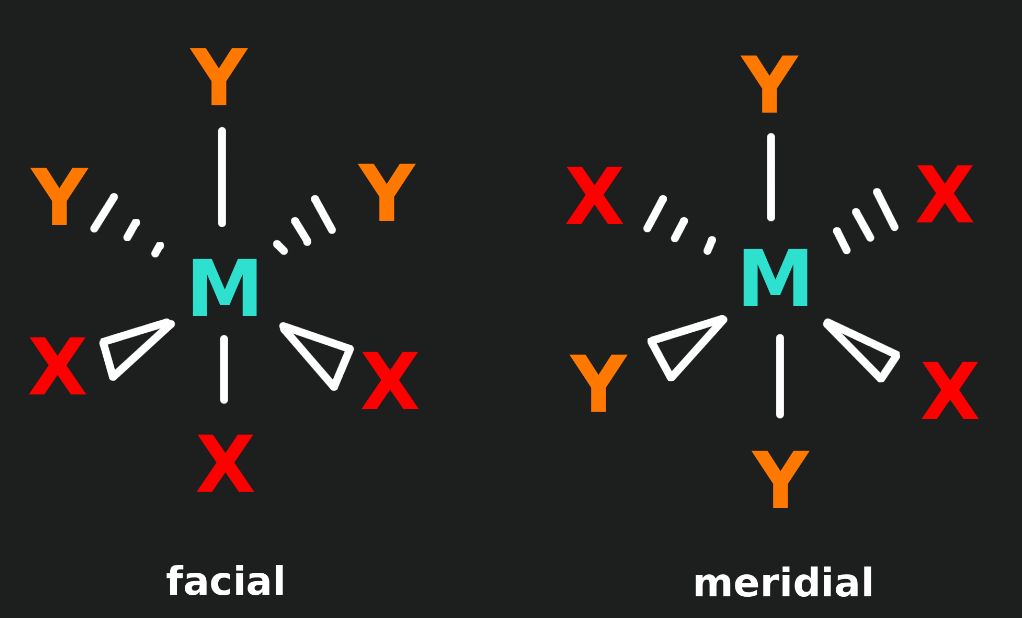
CN = 6
67

Isomers: cis- vs trans-
Y = Other Ligand

Isomers: fac- vs mer-
Only works with 2 groups of 3 identical ligands
Isomers: delta (Δ) vs lambda (Λ)
Only works with bidentate ligands
Delta: Right-handed chirality
Lambda: Left-handed chirality

Hapticity
How many continuous atoms on ligand to metal
Denticity
How many sites ligand binds to metal
Monodentate
NH3, X, H2O, -OH, phosphanes (PR3)
Bidentate
Ethylenediamine (en)
Catecholate (cat2-)
Phenanthroline (phen)
Bipyridine (bipy)
Acetylacetonate (acac)
Know how to draw these!
Other Multidentate
Tridentate
9-crown-3
triazacyclonane (TACN)
Me3TACN
scorpionates
Tetradentate
porphyrin
Chelate Effect
Greater affinity and stability that multidentate ligands have for a metal ion compared to similar monodentate ligands
Reduction
is gain e-
Oxidation
is loss e-
Rules of Balancing Redox Reactions
Split into half-rxn
Balance non H + O atoms
To Balance O, add H2O
To Balance H, add H+
To Balance charge, add e-
If in base add -OH to balance H+
Find ratio to balance e-
Combine
Ecell = ?
Ecell = (n1E1 + n2E2 + …) / (n1 + n2 + …)
Disporportionation
Two identical species simultaneously undergo redox to give two different products
2 A → A+ + A-If species on right has a greater Ecell than that on left, unstable with disproportionation
Comproportionation
Two species undergo redox simultaneously to give a single species
A+ + A- → 2AIf Ecell of species on left is larger than Ecell on right, unstable to comproportionation
d Orbitals
dz2
dx2 - y2
dxy
dzx
dzy
Crystal Field Theory (CFT)
Understand interactions between d metal orbitals & ligands
Treat ligands as negative point charges

CFT: Octahedral


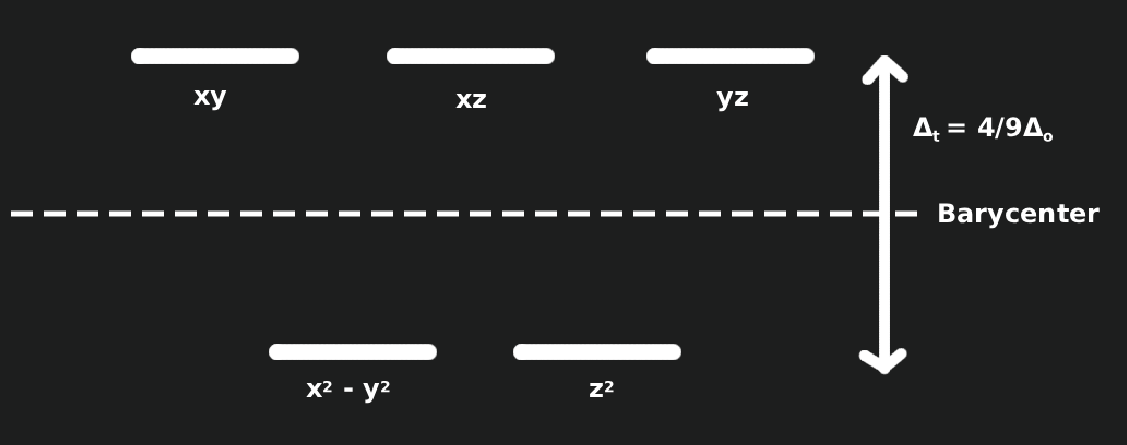
CFT: Tetrahedral
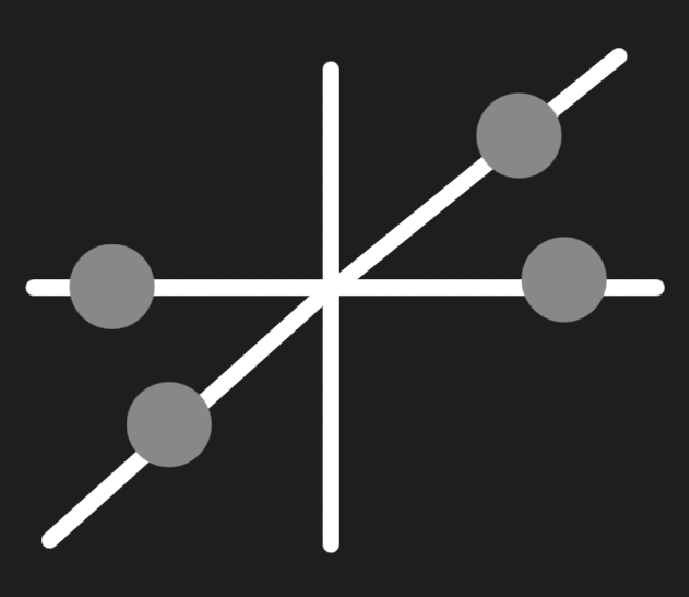
CFT: Square Planar

If Δo is small…
treat all d orbitals like they’re degenerate when filling.
weak field
high spin compound
If Δo is large…
fill xz, yz, xy orbitals before filling z2, x2 - y2
stronger field
low spin compound
Δo Trend
Δo increases as metal ox. state increases
Δo increases down a group
3d depends on Ligand, ox. state
4d, 5d generally strong field, low spin
Ligand Field (LFT)
Essentially a merger of CFT & MO Theory
Break down ligands into 3 Classes
σ-donors, π-donors, π-acceptors
σ-donor
Almost all ligands have some σ-donor capacity

π-donor
Ligands has filled p orbitals

π-acceptor
Low lying empty p orbitals
Ligand need to have π* orbitals

First Step of Making MO Diagram for σ-donors, π-donors, or π-acceptors
This section of the MO is the SAME for all whether it’s σ-donors, π-donors, or π-acceptors

MO Diagram for σ-donor
Special Notes: nonbonding t2g
6L is fully filled with 12 e-
Examples: OH2, SCN, NH3, en, bipy, phen

MO Diagram for π-donor
Special Notes: small Δo
6L is fully filled with 18 e-
Examples: I-, Br-, SCN-, Cl-, F-, -OH

MO Diagram for π-acceptor
Special Notes: large Δo
6L is fully filled with 12 e- at ag1, t1u, eg while t2g remains vacant
Examples: CN-, CO, NO
