Parkinson's Disease
 Call Kai
 Learn
Learn Practice Test
 Spaced Repetition
 Match
Match Flashcards
 Knowt Play
1/75

There's no tags or description
Looks like no tags are added yet.
Name | Mastery | Learn | Test | Matching | Spaced | Call with Kai | Chat |
|---|
No analytics yet
Send a link to your students to track their progress
76 Terms
What is Parkinson’s disease?
slow, progressive condition
prognosis is likely to be impaired as the disease progresses inside the body before it can be diagnosed.
first described as “the shaking palsy” by Dr. James Parkinson in 1817.
Parkinson’s Disease is a progressive disorder of the CNS with both motor and non motor symptoms.
The 1st identification of PD for many patients is:
shaking tremor
It is the second most common neurodegenerative disorder (what is the #1 disorder _________ ?).
Alzheimer’s
Is PD a neurochemical or a neurodegenerative disorder?
both are correct
__% of patients have idiopathic (spontaneous) PD
Genetic forms less than __%; Other causes include environmental toxins, and industrial chemicals
78%
10%
Idiopathic
no known cause
Two clinical subgroups for PD:
(1) PIGD phenotype (postural instability gait disorder)
(2) TD phenotype (tremor dominant)
*both are movement based findings
both show a cardinal sign
likely that one of these two features will be a dominant feature
PD affects parts of the brain that _________ ___________ ____________.
directs voluntary movement
PD affects _% of the population under 65 years of age
Only ____% under 50.
2%
5-10%
____ - ____ x more in males than females
1.2-1.5
Incidence _________ dramatically with increasing age
increases
<10/100,000 under 50 years old
300/100,000 over 80 years old
With an aging population, both the prevalence and incidence of PD are expected to increase by more than 30% by 2030.
PD risk factors
Age
Heredity: Having a close relative with Parkinson's disease increases the chances, risks are still small unless you have many relatives in your family.
Gender: Men are more likely to develop PD than women.
Exposure to toxins: Ongoing exposure to herbicides and pesticides.
Protective factors
vigorous exercise (breaking a sweat, breathing hard)
Caffeine (stimulatory effect?) - coffee or tea
Cigarette smoking (less neurodegeneration)
non-steroidal anti inflammatory drug use (aspirin, ibuprofen)
What part of the brain is involved?
The Basal Ganglia (BG)
The Basal Ganglia (BG)
The basal ganglia is made up of large subcortical (deep) structures that are interconnected and interposed between the cortex and the thalamus.
There are also connections to the frontal cortex (via the thalamus), indirectly the cerebellum and brainstem.
The BG is actively involved in almost all types of movements (including postural responses, spontaneously occurring movements, and voluntary movements).
Direct & Indirect Motor Control
plan for an action starts in cortex → must communicate to basal ganglia before the message is sent down.
If the basal ganglia is affected, so are a lot of other things!
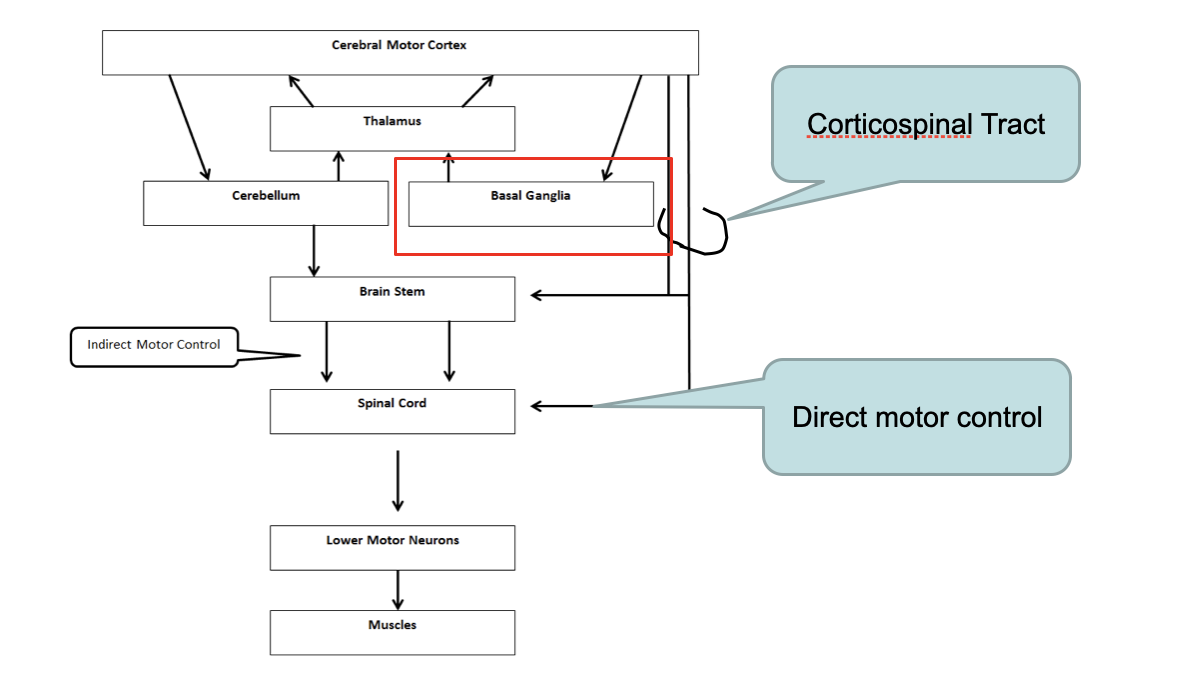
The Basal Ganglia diagram
Caudate and Putamen work together (we group them into the corpus striatum)
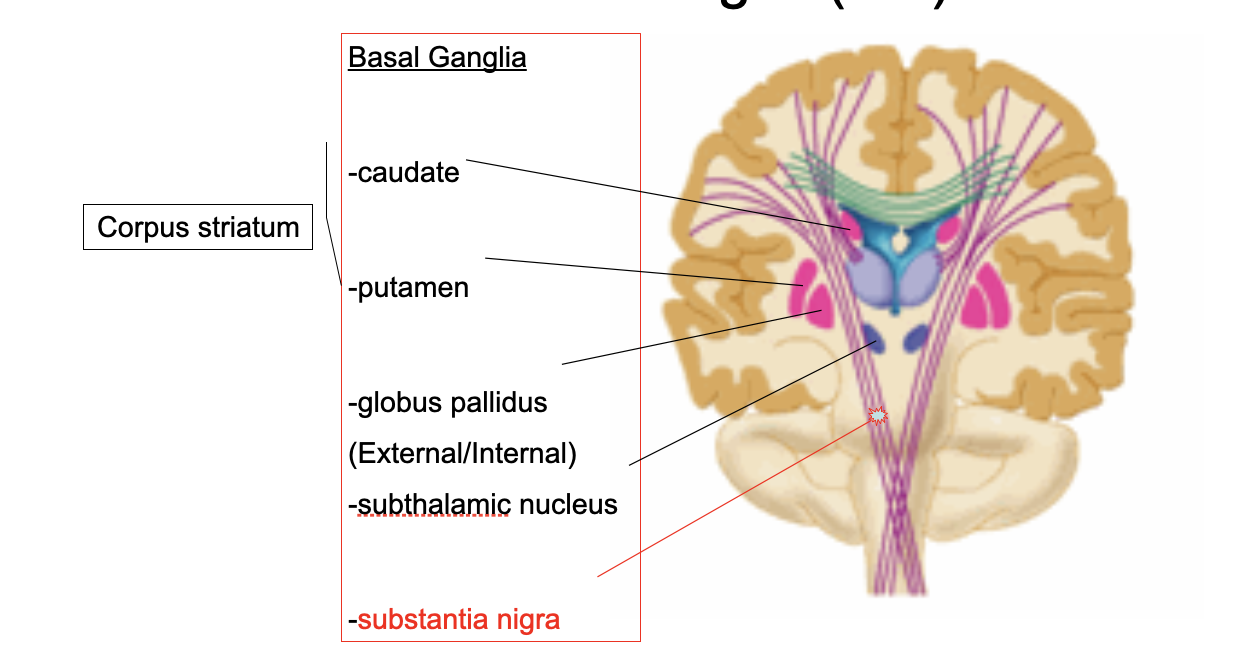
Where is dopamine found in the brain?
Substantia Nigra
BG and Dopamine
Our motor pattern, thoughts and behaviors, and memory processes are all initiated through the cerebral cortex.
Multiple sections of the cortex send off projections to the striatum (caudate and putamen).
Dopamine is produced in the substantia nigra, and is used to increase the efficiency or decrease the effect of cortical input to the striatum.
makes it as efficient as possible for a movement to occur.
Through long-term potentiation and long-term depression, dopamine may be involved in the neural mechanism of _________
habit learning
Habits are quick and instant → happens with the use of dopamine beacuse it has been done so many times
Also meaning that depletion of dopamine in the striatum impairs the learning of new movement sequences.
This is why PD patients have a hard time learning new patterns and movements
Dopamine
Dopamine goes from the striatum to the internal globus pallidus and the external globus pallidus.
The external globus pallidus sends inhibitory input to the internal globus pallidus.
The primary basal ganglia output comes from the internal globus pallidus, leading to the Thalamus, which then completed the feedback loop back to the motor cortex.
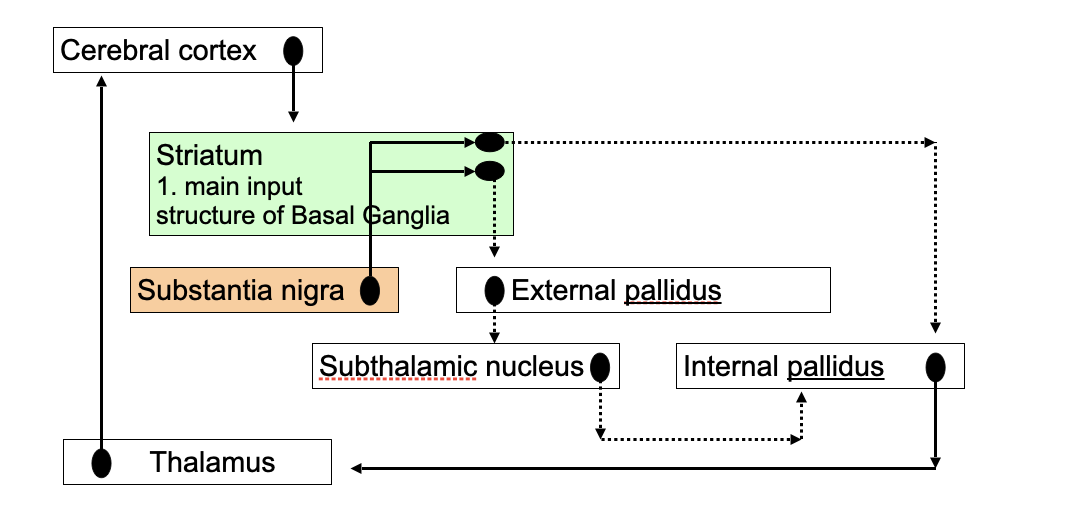
Dopamine makes the _______ process nice and smooth
striatum
Where does the cerebral cortex end?
The Internal Pallidus
→ by the time the information gets here, the action should be fine tuned.
What does the basal ganglia do?
The basal Ganglia is inhibitory and acts as a brake on the motor pattern generators in the cerebral cortex
movement interactions between BG and dopamine
The interaction among these pathways allows for a planned movement to be executed, while competing movements are prevented.
It increases precision without altering the power necessary to perform the activity.
Parkinson’s development
The signs and symptoms of Parkinson’s are neurochemical in origin. (they lack dopamine)
The pathologic hallmark is the degeneration of the substantia nigra, thereby losing its ability to produce dopamine.
A depletion of ___% to ___% of the dopamine is estimated to occur before clinical signs of disease are noted.
70%-80%
Parkinson’s research
Despite significant research in this area, many observations of cause of PD are correlative in nature and a precise process has not been identified.
There are many possible triggers for the programmed cell death, with some overlap of degeneration that is similar to the processes seen in dementia:
Protein misfolding, aggregation and toxicity
Mitochondrial dysfunction
Neuroinflammation (NSAIDs may be helpful)
NSAID’s
Nonsteroidal anti-inflammatory drugs
Parkinson’s development
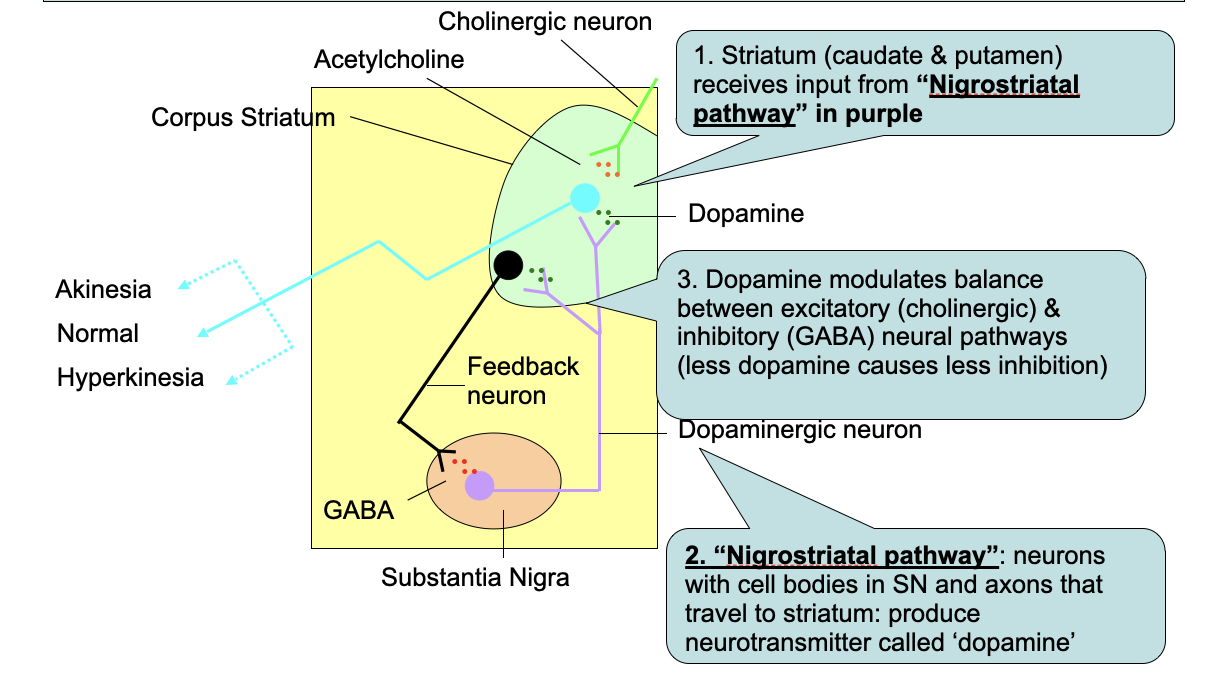
Neurons with cell bodies in SN and axons that travel to striatum produce neurotransmitter called ‘dopamine’
Dopamine: modulates balance between excitatory & inhibitory neural pathways
PD clinical features result from degeneration of Nigrostriatal pathway
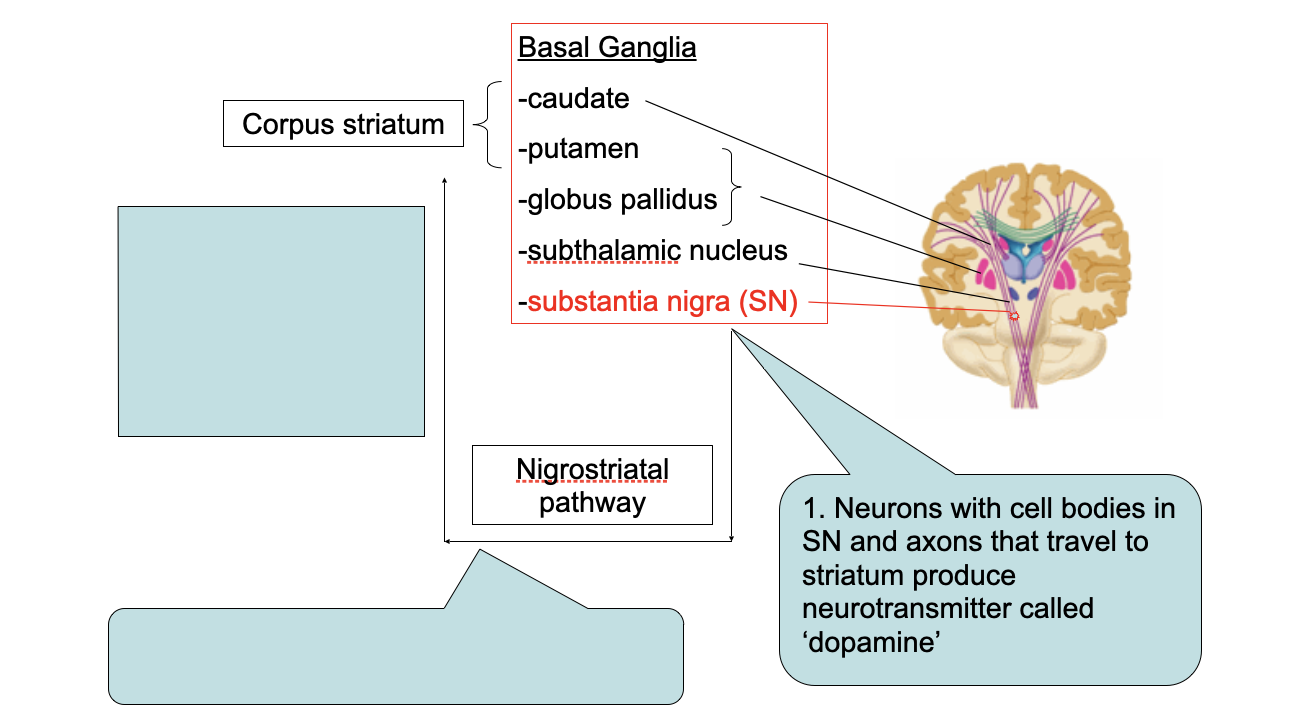
how dopamine regulates
Striatum (caudate & putamen) receives input from “Nigrostriatal pathway” in purple
“Nigrostriatal pathway”: neurons with cell bodies in SN and axons that travel to striatum: produce neurotransmitter called ‘dopamine’
reduces activity
Dopamine modulates balance between excitatory (cholinergic) & inhibitory (GABA) neural pathways (less dopamine causes less inhibition)
How does a tremor happen?
too much acetylcholine (excitatory) and no dopamine to balance it out
Clinical Features:
with 30-60% loss of nigrostriatal neurons you get:
Imbalance between excitatory neurotransmitters & inhibiting dopamine neurotransmitters
relative excess of acetylcholine produces dyskinesia & rigidity
Parkinson’s development
Striatum receives input from the cerebral cortex
Striatum also receives input form SN
“Nigrostriatal pathway” Get gradual denervation of striatum
The output from internal pallidus to thalamus completes feedback loop back to motor cortex.
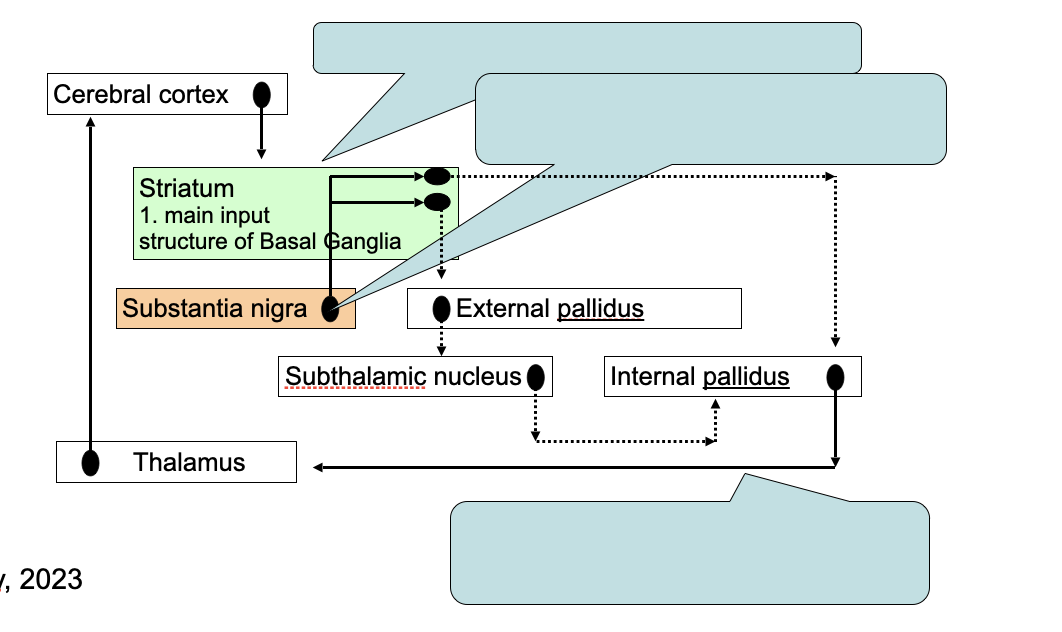
When dopamine stimulation is decreased or withdrawn, the overall effect is…
increased inhibition of input from the internal pallidus into the thalamus.
When you inhibit the thalamus…
decrease the ability of the thalamus to send excitatory input back to the cortex.
The ultimate outcome:
less activity in the cortex, resulting in slowed movement and less power generated through the musculoskeletal system.
This explains the contrasting presentations in PD:
Excessive excitation
the relationship of the substantia nigra and the striatum (caudate and putamen)
Excessive inhibition
the influence of internal pallidus, to thalamus, and ultimately the cerebral cortex
In PD, ypu will have ___________ and _________ at the same time
Excessive excitation and excessive inhibition
*cardinal symptom
Parkinson’s summary
Imbalance between excitatory and inhibitory mechanisms
Key pathologic feature:
excessive loss of dopaminergic neurons in the substantia nigra
If overall effect is increased inhibitory input to thalamus, what does this mean for cortex?
It means ultimate outcome of PD disease is less activity in cortex (slowed movement and less power)
Why does PD happen?
We don’t know.
There are currently no blood or laboratory tests to diagnose nongenetic cases of Parkinson's disease.
Diagnosis is based on a person's medical history and a neurological examination.
this could change very soon…
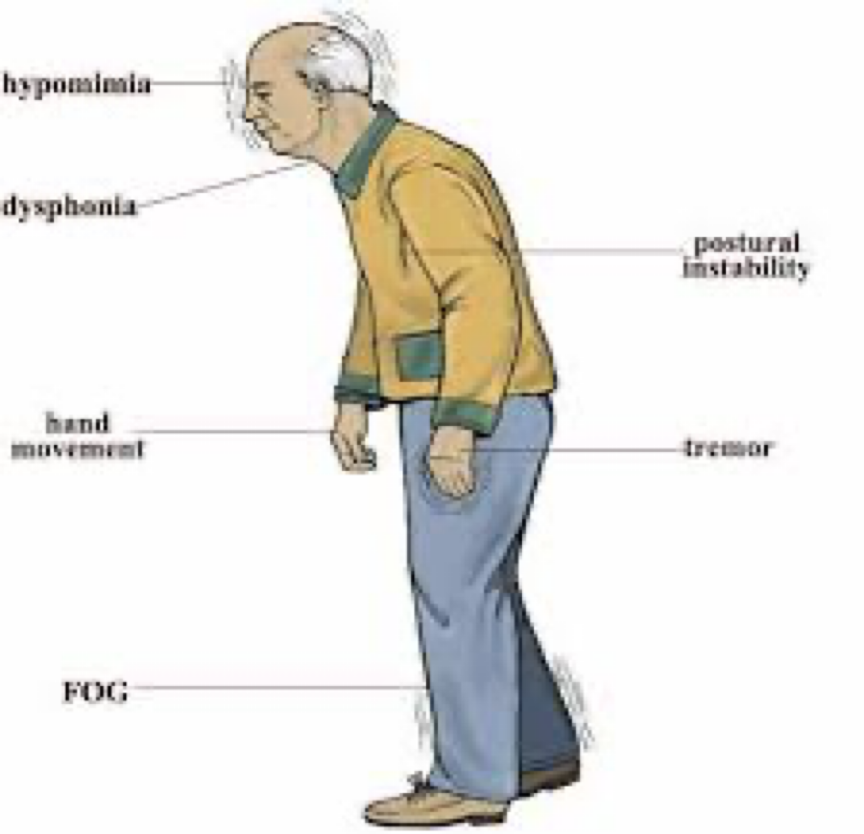
What does FOG stand for?
Freezing of Gait
4 Characteristic (cardinal) signs in PD
1. Rigidity
2. Bradykinesia (slowed movement)
Akinesia (inability to move)
3. Tremor
4. Postural instability
Cardinal
signs that stand out the most and are looked for first in terms of the condition
Rigidity
Due to increased resting muscle activity
Not spasticity
Is a lesion/defect in the basal ganglia (such as parkinson’s)
Q1. What might someone with PD develop, because of increased resting muscle activity?
Decreased ROM - contracture formation
Q2. How might increased resting muscle activity affect fatigue?
Never truly at rest - markedly affects fatigue
Bradykinesia
Failure of the mechanism that programs movement patterns
Defect in the voluntary production of smooth motions at different speeds
Hypokinesia
Akinesia
Hypokinesia
Decreased frequency of or absence of associated movements (e.g. micrographia, arm swing)
Parkinson’s walk = no arm swing
Akinesia
Inability to initiate or execute movement (hypomimia, freezing of gait)
eg.
can’t walk on carpet but can walk on tile (so you stop -. your gait freezes)
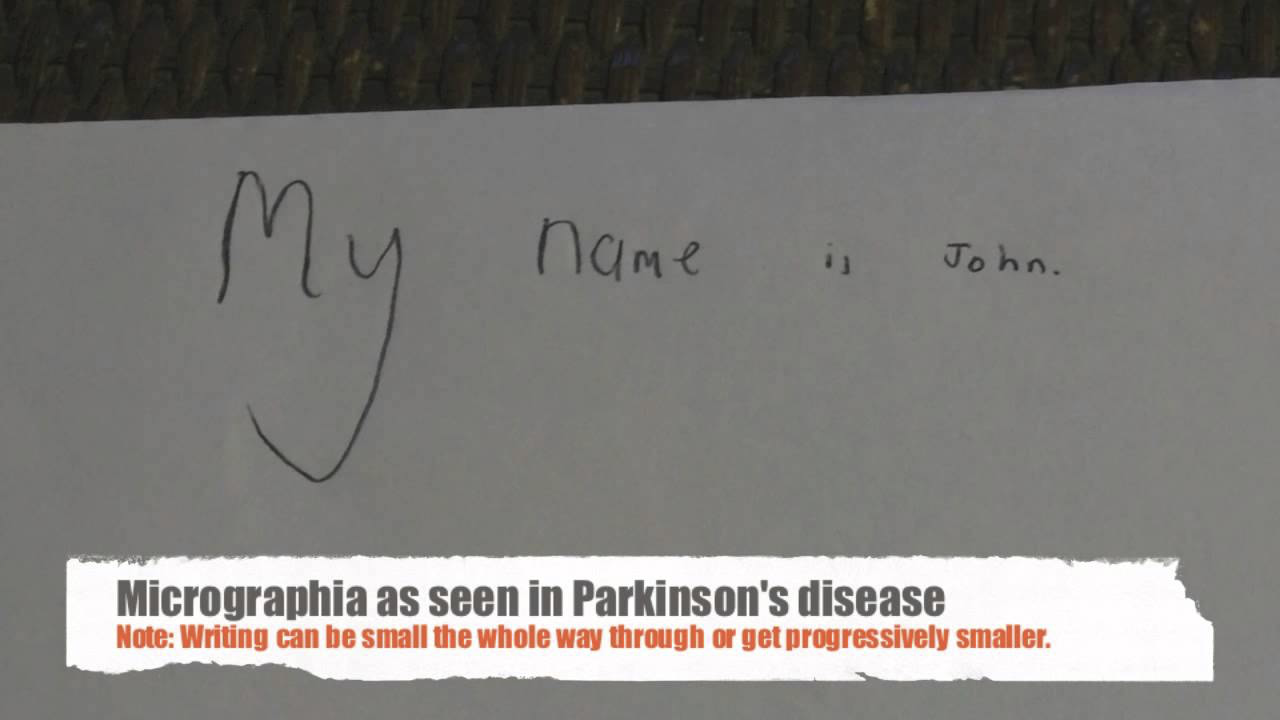
Micrographia
Writing gets smaller or is small all the way through
(a form of bradykinesia)
Hypomimia
A medical sign where there is a reduced degree or absence of facial expression which is caused by motor impairment (weakness or paralysis of the facial muscles).
socially restrictive
Persons receiving excessive ____ treatments and thereby losing facial expression features may be incorrectly identified as suffering from hypomimia.
Botox (based around paralysing facial features)
What is the first symptom to appear
Tremor
hard to brush off a tremor (like you can the other symptoms)
Tremor
Caused by loss of the inhibitory influence of dopamine in the basal ganglia.
Usually 1 sided initially, the symmetric later
Usually disappears upon voluntary movement
patients are asked to run, jog, be active to offset the tremor
like boxing (variety of movements and works upper and lower extremity)
Tends to affect arm more than leg
(is this because arm has less voluntary movement
Increased by stress or anxiety (increases acetylcholine)
Disappears with sleep
Postural Instability
Loss of normal postural reflexes
Takes about 5 yrs
Disorders of:
Postural fixation
Equilibrium
Righting
Postural Fixation
Involuntarily flexes the head and neck
Characteristic posture: stooped, flexed, forward leaning
How does this affect centre of gravity?
It goes forward → stability compromised
Equilibrium
Unable to adjust to tilting or falling: falls like a post if starts to tilt (no protective reactions)
See this in gait, to stop from falling forward.
Righting
Can’t change from inclining to a standing position: can’t right themselves
What risk do all these postural disorders suggest?
falls
injuries (specifically head and fractures)
Parkinson’s patients have higher likelihood of:
Falls: 70%
Injuries: 40%
Fractures: 25%
Falls: 70%
Injuries: 40%
Fractures: 25%
Muscle performance
Weaker muscles in PD
Fatigue is a very common symptom
Off/on with dopamine replacement medication
Motor Learning
‘Procedural learning’ deficits most common
Can learn facts by conscious awareness (declarative learning)
But can’t learn a motor skill by ‘practice’
Can’t learn to crochet but can learn the capital of france
Gait
Up to 1/3rd of patients with PD have postural instability and gait disturbances.
Cane, walker
Gait changes occur in later stages (5 years after diagnosis)
Sensation
No primary sensory loss (tactile).
May experience intermittent numbness ( ? dyskinesis, ? rigidity)
numbness however, is not a direct result of parkinson’s
Speech
Impaired in 75-90% of patients
Voice
‘Hypokinetic dysarthria’ (decreased volume, monotone, distorted articulation, uncontrolled speech rate)
cannot generate an emotive vocal pattern
impacts ability to socially engage
Dysphagia (impaired swallowing)
occurs in up to 95% of patients
often an early symptom (but can be ignored - oh im just getting old…)
Affects multiple phases of swallowing
abnormal tongue control
difficulty with chewing and bolus formation
delayed swallow response and peristalsis (inability for swallowing muscles to work)
often get excessive drooling (sialorrhea)
Risk:
Choking or aspiration pneumonia
Dementia
In 20-40% of patients
Dementia risk among PD patients over 80, is 4x greater than those under 80 years
Usually within 10 years of PD onset
Olfactory dysfunction: Up to __% of patients with PD lose sense of smell
Up to 100%!!! of patients with PD
We dont know why
Parkinson’s is: (summary)
Degeneration of dopaminergic nigrostriatal pathway causes dopamine depletion in the basal ganglia.
results in imbalance between excitatory and inhibitory mechanisms.
PD lead to… (summary
Primarily motor effects, but other impairments are possible.
Rigidity, NOT spasticity
Progressive disease