Topic 6 - Atmosphere and climate change
 Call Kai
 Learn
 Practice Test
 Spaced Repetition
 Match
 Flashcards
 Knowt Play
1/54

There's no tags or description
Looks like no tags are added yet.
55 Terms
What is the atmosphere?
A thin envelope of gas and suspended particles that surround the Earth.
Held in place by Earths gravitational pull.
The outer limit of the Biosphere and its composition and processes support life on Earth.
What are the 4 main gases that compose majority of the atmosphere?
Nitrogen - 78% of the atmosphere
Oxygen - 21% of the atmosphere
Argon - Almost 1% of the atmosphere
Carbon Dioxide - 0.04% of the atmosphere
What type of system is the atmosphere? diagram
The atmosphere is dynamic system (with inputs, outputs, flows and storages) that has undergone changes throughout geological time.
Dynamic - Ability to change
System - Individual parts working together
Inputs - Short wavelength radiation from the Sun or gases from pollution.
Flows - Gases (N2, O2, CO2)
Storages - Wind (advection - the transport of a substance, heat, or other properties by the bulk motion of a fluid)
Changes - Biotic changes —> Evolution of photosynthesis. Abiotic changes —> Volcanic eruption or human population.
What are the layers of the atmosphere?
From closest to earth:
Troposphere
Stratosphere
Mesosphere
Thermosphere
Different because of changes in temperature and pressure.
Troposphere
Closest to Earth surface (10-15km thick)
Constantly in motion
Determines Earth weather pattern’s
Stratosphere
Above troposphere (40km thick)
Composed of dry and stable air
Pollutants do not disperse and tend to remain in this layer for longer periods of time.
Where the Ozone layer.
What does the tricellular model explain?
It explains how energy circulates in the atmosphere, creating distinct climate region.
Climate
How the atmosphere behaves over relatively long periods of time.
Tri Cellular model
Explains how energy circulates in the atmosphere, creating distinct climate regions.
At 0°N the heat from the sun causes the air to rise quickly in a circular current.
This brings moisture up into atmosphere which falls back down as rain. It is hot and wet (Tropical Rainforests).
At 30°N the hot air cools slightly and falls.
It is still warm but has no moisture. It is hot and dry (Desert).
At 60°N the air has travelled over the northern oceans - Atlantic, Pacific and Indian. It has collected moisture. It rises back up into the atmosphere getting colder and turning moisture into rain. (Temperate)
At 90°N the air has travelled through the upper atmosphere and has cooled rapidly. (Polar)
Greenhouse gases (GHGs)
Atmospheric gases that trap heat in the atmosphere in the form of infrared radiation from sunlight being re-radiated out into the atmosphere from the surface of the Earth.
Greenhouse Effect steps and its importance
Visible light passes through the atmosphere mostly unobstructed.
Earth absorbs visible light and re-emits it as infrared.
GHGs absorb IR and re-emits it as IR in all directions including back into the Earth.
Helps create a habitable temperature on the planet. The temperature of the Earth depends on the concentration of GHGs in the atmosphere.
Types of GHGs
Major ones like water vapour, carbon dioxide, methane, and nitrous oxide, and Minor ones like CFCs and black carbon.
Water vapour is the most common GHG, creates a positive feedback loop by increasing warming and evaporation.
Why water usually excluded from climate models?
As it is dynamic (evaporation/precipitation) and is essential for life, so cannot be mitigated against.
Where do each of the GHGs come from?
Carbon dioxide - from respiration and combustion of fossil fuels, is mitigated by plants through photosynthesis
Methane - from livestock, agriculture, melting of permafrost and wetland microbial activity.
Nitrous oxide - produced by industrial activities, and fertilisers
CFCs and HFCs - refrigeration and aerosols,
Black carbon, from incomplete fossil fuel burning, absorbs significant heat, contributing more to climate change than previously thought.
Enhanced greenhouse effect
The accumulation of GHGs by human activity leading to global warming (increasing mean global temperature).
Climate change
The broader range of changes that are happening to the planet as a result of global warming.
Climate
The atmospheric conditions expected in a particular area over a long period of time. Result from physical process in the atmosphere.
What are the two main factors affecting climate change?
Average temperature
The average amount of distribution of precipitation
Weather
The specific conditions being experienced at a particular time or over a short period.
Includes:
Temperature, humidity, air pressure, and wind speed.
Weather conditions can change rapidly, even on the same day.
Climate change
The long term sustained changes in the average global weather conditions.
It encompasses global warming but refers to the broader changes that are happening in the planet as a result.
What has driven CO2 concentrations to increase in the atmosphere over the past 50 years?
Anthropogenic CO2 emissions have caused CO2 conc to increase significantly due to the spread of industrialisation and human population increase.
What can we use to gain data in order to indicate a positive correlation between the concentration of CO2 in the atmosphere and global temperatures?
Analysis of ice cores
Tree rings
Deposited sediments
Tree rings as a method indicate positive correlation between
Need to take multiple trees, as can be prone to disease. Thicker rings, imply hotter wetter weather.
Deposited sediments as a method indicate positive correlation between
Deposited during the ice age.
Reveal information about past ocean oxygen levels.
Their relationship with atmospheric carbon dioxide.
Ice core as a method indicate positive correlation between
Winter snow compresses into ice layers that accumulate over thousands of years.
Scientists extract ice cores containing dust, pollen, ash and gas bubbles to analyse post ocean conditions, volcanic eruptions, solar intensity and atmospheric conditions.
What are some Local ecological impacts of climate changes? Give real world examples
Coral bleaching - Great Barrier Reef, Australia: Rising sea temperatures cause coral bleaching, reducing coral survival and reef biodiversity.
Desertification - Sahel, Africa: Higher temperatures and changing rainfall can increase drought stress and land degradation, reducing vegetation cover and soil productivity.
What are some Global ecological impacts of climate changes? Give real world examples
Changes in ocean circulation - North Atlantic: Greenland ice melts → freshwater enters the North Atlantic → salinity and density decrease → GOCB weakens → global heat distribution and marine ecosystems are disrupted.
Sea-level rise - Maldives: Rising sea levels, caused by thermal expansion of seawater and melting land ice, increase coastal flooding and threaten low-lying islands.
How does climate change affect societies and their resilience?
Health: Heatwaves increase heat-related illness and deaths — Europe, 2022.
Water supply: Drought reduces freshwater availability — Cape Town, 2018.
Agriculture: Droughts and floods reduce crop yields, increasing food insecurity — Horn of Africa.
Infrastructure: Flooding and sea-level rise damage homes, roads and electricity supplies — Bangladesh.
Resilience: Wealth, healthcare, infrastructure, technology and governance affect a society's ability to adapt. Wealthier societies generally have greater adaptive capacity.
Draw a systems diagram and explain Ice albedo as a positive feedback loop?
A positive feedback climate process.
Ice has a high degree of albedo.
Larger ice caps on the Earth reflect more of the Sun’s energy back out.
Reducing these caps and ice levels on Earth leads to more absorption of the Sun’s energy by the Earth’s surface resulting in a warmer planet.

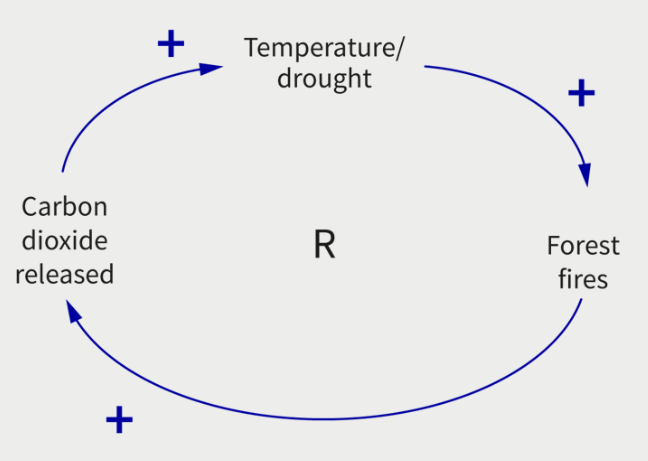
Draw a systems diagram and explain forest fires as a positive feedback loop?
Forests absorb and store carbon dioxide.
Increased temperatures and droughts lead to more frequent and intense forest fires.
Burning trees release stored carbon dioxide, enhancing the greenhouse effect, causing further warming that increases the risk of forest fires.
What evidence suggests Earth has exceeded the climate change planetary boundary?
The climate change planetary boundary model is determined by CO2 conc and radiative forcing → the balance of incoming and outgoing solar energy.
CO₂ concentration: Boundary = 350 ppm; actual = 420 ppm (2023).
Radiative forcing: Boundary = +1.0 W/m²; actual = +2.91 W/m² (2022).
How might different perspectives view climate change and what are personal perspectives effected by?
Ecocentric → reduce consumption and energy use.
Anthropocentric → governments introduce carbon taxes and emissions targets.
Technocentric → invest in carbon capture and renewable energy technology.
Personal perspectives: An individual's EVS can be influenced by their upbringing, education, culture, wealth, political beliefs and personal experiences of climate change.
Why is global cooperation difficult to achieve?
Due to the differing perspectives on the necessity of action. This is counterproductive because global issues require global solutions and cooperation.
State sovereignty and how can conflict with global cooperation?
State sovereignty - A government's right to rule over its land and people and decide what is best with all things connected to it.
Conflict with global cooperation: Countries may resist international climate agreements because they prioritise national interests, economic growth and energy security. For example, countries reliant on fossil fuels may oppose rapid emissions reductions because of potential economic costs.
Examples of global action to avoid the risk of catastrophic climate change
Montreal Protocol → Near-universal approval, reducing the use of ODS. Provided a model for addressing other global challenges, including climate change.
Paris agreement 2015 → aims to reduce GHG emissions, showed its possible to balance global goals with state sovereignty by allowing countries to set their own emission reduction targets while collectively aiming to limit global warming to 1.5°C.
UN Framework Convention on Climate Change (UNFCCC) → International convention providing a framework for global cooperation on climate change. Has 3 main principles:
HICs have the most responsibility for cutting emissions
HICs should provide funding for LICs
All countries should provide regular reports progress and goals
Mitigation strategies
Strategies that address the causes of climate change directly by reducing greenhouse gas emissions or increasing carbon sinks. E.g. Switching from fossil fuels to renewable energy
Aim to decrease the causes of climate change.
Decarbonisation of the economy
Reducing or ending the use of energy sources that result in CO2 emissions and their replacement with renewable energy sources.
Carbon neutrality
When a country reaches the point where carbon emissions do not exceed the amount sequestered. (achieved via decarbonisation of the economy)
Three main mitigation strategies
Reducing the production of greenhouse gases:
Changing consumer behaviour - renewable energy
Government regulation and financial incentive
Removing CO2 from the atmosphere:
Carbon capture and storage (CCS)
Nature-based solutions to remove carbon dioxide
Reducing the process of global warming:
Geoengineering - The deliberate, large-scale manipulation of Earth's climate system to counteract climate change. E.g. Reflecting more solar radiation away from the Earth.
Household changes
What is the aim of adaptation strategies?
To reduce adverse effects of climate change and maximise any positive consequences.
What are the two main adaptation strategies? List 2 examples for each.
Structural adaptation → physical changes to infrastructure and the environment.
Flood defences, desalination plants and movable infrastructure
Non - structural adaptation → changes in practices, policies and behaviour.
Building codes, vaccination programmes and adapting agricultural practices (such as
drought-resistant crops),
What are NAPAs, and what is their purpose?
National Adaptation Programmes of Action identify the urgent climate change adaptation priorities of least developed countries (LDCs).
They focus on addressing the immediate impacts of climate change on vulnerable communities
What role does the UN Development Programme (UNDP) play in climate change adaptation?
Helps developing countries obtain assistance to develop local priority activities.
These activities address the immediate consequences of climate change.
What adaptation strategies does the Netherlands use to address climate change? (rising sea levels)
Maeslant Barrier: Movable flood barrier protecting Rotterdam from North Sea storm surges.
Sandmotor: Artificial peninsula that uses natural currents to distribute sand, strengthening beaches and dunes against erosion and sea-level rise.
Approach: High-tech engineering, supported by significant financial resources and expertise
What adaptation strategies does Bangladesh use, and how do they differ from those in the Netherlands? (rising sea levels)
Raised homes: Elevate houses above flood levels.
Mangrove plantations: Reduce coastal erosion and help protect against storm surges.
Early-warning systems and cyclone shelters: Give communities time to prepare and provide safe refuge.
Approach: Greater emphasis on community-based and relatively low-cost strategies due to limited resources.
Ozone layer
The ozone layer is part of the Earth's atmosphere which contains relatively high concentrations (10 ppm) of ozone (O3). Average in the entire atmosphere is 0.3 ppm.
Ozone layer considered to be in steady state equilibrium because it is balanced between two ongoing processes (formation and destruction)
Which type of ozone is beneficial, stratospheric or tropospheric?
The Stratosphere – considered to be ‘beneficial’
Troposphere – considered to be harmful (SMOG)
How does stratospheric ozone protect us from UV rays?
UV radiation has more energy and can pose an increased danger to life. Stratospheric ozone protects Earth by absorbing all incident UVC (which has the shortest wavelength) and most UVB rays, protecting living organisms from its harmful effects.
Harmful effects of UV
Damages human living tissues
Increases the incidence of cataracts
Mutation during cell division
Skin cancer
Reduces productivity in photosynthetic organisms.
Especially phytoplankton – basis of many aquatic food webs.
Reduced photosynthesis rates
Altered plant metabolism
Decreased crop yields
Benefits of UV
In animals stimulates the production of Vit D.
Treat psoriasis and vitiligo (skin diseases)
Steriliser, water purifier
Forensics, lighting, lasers
Why has the relative concentration of ozone molecules stayed the same over long periods of time?
Ozone layer considered to be in steady state equilibrium because it is balanced between two ongoing processes (formation and destruction)
When unequal, equilibrium will tip to the other end to negate change/deviation.
Ozone depletion
The result of air pollution by chemicals (ODSs) reacting with ozone or oxygen to prevent the creation of more ozone.
Does not cause global warming.
Allows increasing amounts of UVB radiation to reach the Earth’s surface which impacts ecosystems and human health.
At the poles, ozone ‘holes’ with greater depletion appear every spring due to the effects of ODSs and seasonal atmospheric weather patterns.
CFCs vs HCFCs
CFCs: Very stable, remain in the atmosphere for decades to centuries and destroy the ozone layer.
HCFCs: Replaced CFCs in some uses because they have similar practical properties but a shorter atmospheric lifetime. However, they still deplete ozone, although generally less than CFCs.
Successes of the Montreal Protocol?
Near-universal participation .
Legally binding ODS phase-outs.
Scientific consensus and international cooperation.
Flexible amendments; financial/technical support for LEDCs.
Outcome: ozone layer recovery; helps protect the ozone planetary boundary.
Limitations of the Montreal Protocol?
Enforcement depends on national governments.
Illegal ODS production/trade.
Long atmospheric lifetimes delay recovery.
Old equipment still contains ODS.
LEDCs may lack resources to comply quickly.