Wk2 - Production Posibility Frontier (PPF), comparative advantage, and gains from trade
 Call Kai
 Learn
 Practice Test
 Spaced Repetition
 Match
 Flashcards
 Knowt Play
1/15

There's no tags or description
Looks like no tags are added yet.
16 Terms
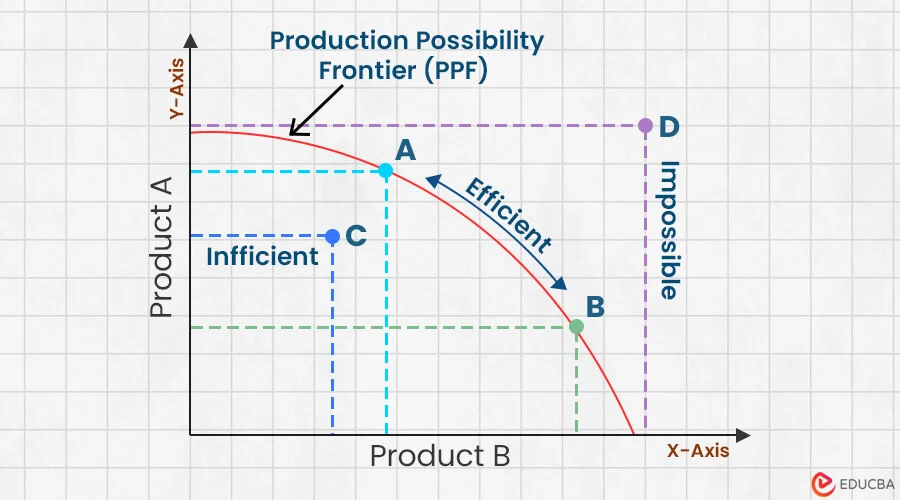
Production Possibility Frontier (PPF)
A boundary curve showing the maximum combinations of two goods an economy can produce using fixed resources and technology under full efficiency. It bows outward because resources are not equally suited to producing both goods.
Opportunity Cost
The value of the single next-best alternative given up when making a choice, including non-monetary implicit sacrifices like time.
Sunk Cost
An unrecoverable past expense that has already occurred and must be completely ignored in forward-looking decisions.
Absolute Advantage
The ability to produce more total output of a good than another producer using the exact same quantity of resources or time.
Comparative Advantage
The ability to produce a good at a lower opportunity cost than another producer, acting as the foundation for specialisation and mutually beneficial trade.
Choke Price
The exact price where quantity demanded falls to zero (Q=0), plotted as the vertical intercept on a standard demand graph.
Market Demand (Horizontal Sum)
The total quantity demanded across all consumers at each price level (Qtotal(P)=∑ni×qi(P)), calculated by adding only positive quantities and treating negative quantities as zero.
Willingness to Pay (WTP)
The maximum dollar amount a buyer is prepared to pay for a good or service, reflecting their personal valuation and determining the height of their demand curve.
Correlation
A statistical pattern where two variables move together, which does not prove that one variable causes changes in the other.
Causation
A direct relationship where changing one variable actively triggers an observable change in another variable.
Confounding Variable
A hidden third factor that influences two related variables at the same time, creating a misleading impression of cause and effect.
Combined PPF Kink Point
The sharp bend on an economy-wide production boundary where the lowest-opportunity-cost producer hits full capacity, forcing a switch to a higher-cost producer.
Market Demand Kink
A bend along an aggregate demand curve that occurs at a consumer group's choke price, marking the exact price where they enter or exit the market.
"Willing but Not Anxious" Buyer
A hypothetical rational consumer who pays only up to their true valuation without urgency or distress, used in Australian constitutional law to determine fair market value.
Resident Benefits (Valuation Theory)
Intangible public gains from hosting major events (such as civic pride and community spirit), quantified by estimating how much locals would hypothetically pay for them.
Implicit Costs
Non-monetary sacrifices—such as forgone wages or lost leisure time—that must be counted alongside direct expenses to find total economic cost.