I 23- Drugs used in treatment of parasite infections - malaria
 Call Kai
 Learn
 Practice Test
 Spaced Repetition
 Match
 Flashcards
 Knowt Play
1/22

There's no tags or description
Looks like no tags are added yet.
23 Terms
How is malaria transmitted
Malaria is transmitted by the infected female Anopheles mosquito
• Plasmodium species that infect humans: P. falciparum, P. vivax, P. malariae, P. ovale and P. knowlesi
• Untreated infection causes anaemia, renal failure, cerebral malaria and death.
Why has eradication failed?
Infection gives only limited immunity
5,500 genes and antigenic variation
Resistance has defeated every drug so far
Vaccines reduce severity, not infection
In the UK, malaria is an imported disease of returning travellers
What is the life cycle of a Plasmodium parasite ?
Plasmodium has two stages of its life cycle: humans and female Anopheles mosquitoes.
1. In humans (asexual reproduction):
An infected mosquito bites a human, injecting sporozoites into the skin.
Sporozoites enter the bloodstream and travel to the liver, infecting hepatocytes (liver cells).
They multiply over approximately one week, producing 10,000–30,000 merozoites per infected liver cell.
Merozoites enter the bloodstream and infect red blood cells, where they multiply.
Some parasites develop into gametocytes (sexual forms).
2. In mosquitoes (sexual reproduction):
Another female mosquito bites the infected human and takes up gametocytes.
Gametocytes form gametes, which fuse to produce a zygote.
The zygote develops into an ookinete → oocyst → sporozoites.
Sporozoites migrate to the mosquito's salivary glands, ready to infect another human.

How are antimalarials classified?
1. What is it chemically?
Quinoline, aryl amino alcohol, endoperoxide, antifolate, antibiotic
2. What does it hit?
Haem, mitochondrion, folate enzymes, apicoplast
3. Where does it act in the life cycle?
Liver, hypnozoite, blood, gametocyte
What are the main drug targets in the Plasmodium life cycle, and why are they targeted?
1. Active liver schizonts: Kill developing parasites before they reach the blood → causal prophylaxis.
Drugs: Atovaquone/proguanil, primaquine.
2. Dormant liver hypnozoites: Eliminate inactive parasites → prevent relapse.
Drugs: Primaquine, tafenoquine.
3. Asexual blood stage: Kill parasites multiplying in red blood cells → treat malaria symptoms.
Drugs: Artemisinin derivatives, chloroquine, quinine.
4. Gametocytes: Kill sexual parasite forms → reduce transmission to mosquitoes.
Drug: Primaquine.
Key takeaway: Most antimalarial drugs do not target every stage, so combination treatments may be needed to treat infection, prevent relapse and reduce transmission.
Liver = prevention and relapse
Blood = illness and treatment
Gametocytes = transmission

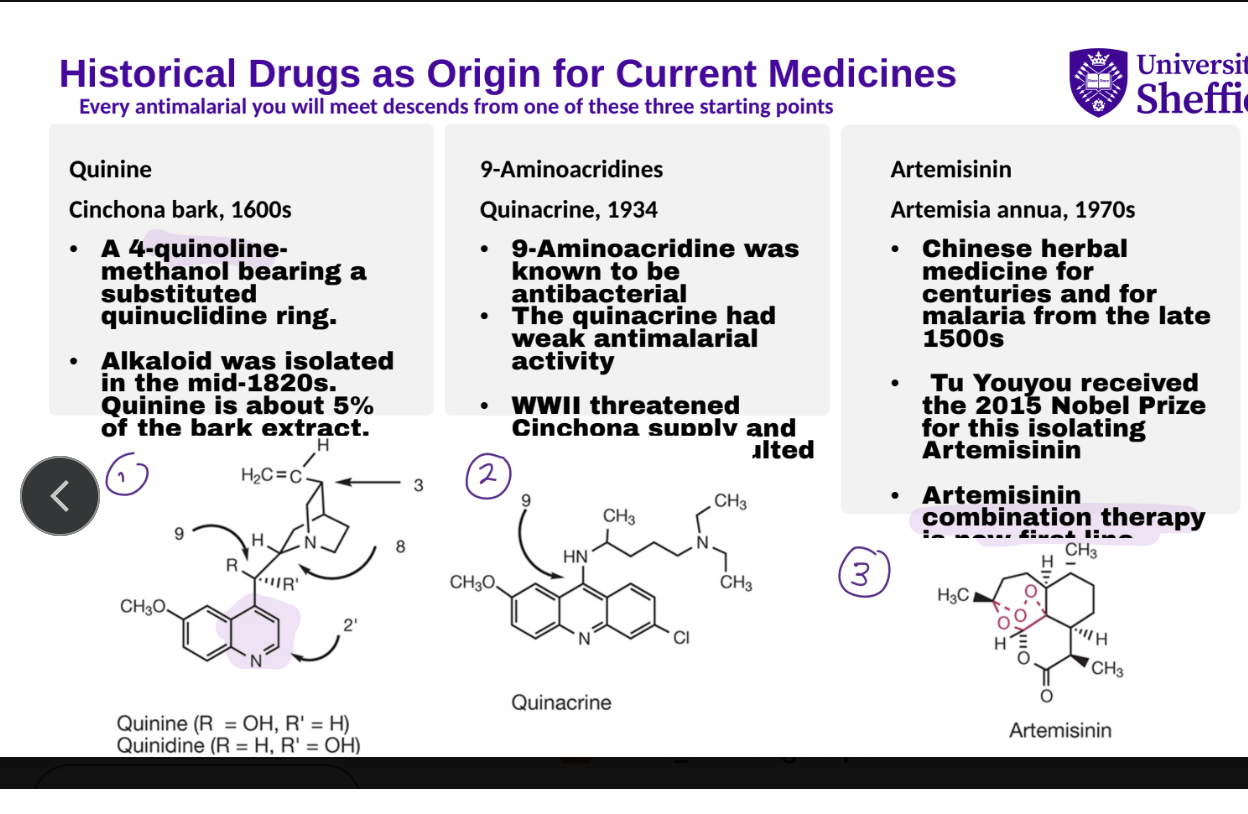
What are the 3 historical origins of antimalarial drugs, and what structural features are important?
Drug | Important structural characteristics | Why are they important? |
|---|---|---|
1. Quinine (1600s) | Contains a quinoline ring, an alcohol (-OH) group and a basic nitrogen in a quinuclidine ring. | Quinoline ring is important for antimalarial activity. Basic nitrogen contributes to accumulation in acidic parasite compartments. |
2. Quinacrine (1934) | Contains a 9-aminoacridine ring (3 fused aromatic rings) and a basic aminoalkyl side chain. | Flat aromatic ring system can interact with DNA. Basic side chain contributes to antimalarial activity. |
3. Artemisinin (1970s) | Contains a 1,2,4-trioxane ring with an endoperoxide bridge (O–O). | The peroxide bridge is essential for antimalarial activity. Iron-mediated activation generates reactive species that damage the parasite. |
Key structural features to remember
Quinine: Quinoline ring + basic nitrogen + OH group.
Quinacrine: Three fused aromatic rings + amino side chain.
Artemisinin: Endoperoxide bridge (O–O) is essential for activity.
What are the key structure–activity relationships (SAR) of quinine derivatives?
Structural feature | SAR – Why is it important? |
|---|---|
1. C-9 secondary alcohol (-OH) | Essential for quinine-like activity. Oxidation or esterification significantly reduces activity. |
2. Quinuclidine ring | The bicyclic ring itself is not essential and can be replaced with simpler structures. |
3. Basic nitrogen (amine) | A basic centre is important for activity. It can be provided by an alkyl tertiary amine rather than the quinuclidine ring. |
4. Aromatic ring system | Provides an important structural framework for antimalarial activity, but can be modified in different derivatives. |
A suitable secondary alcohol (-OH).
A basic nitrogen centre.

What usually happens in the food vacuole?
The malaria parasite (trophozoite) digests haemoglobin inside an acidic food vacuole (pH 4.8–5.2).
Digestion releases free haem (haematin), which is toxic to the parasite.
The parasite converts haematin into haemozoin, an insoluble, non-toxic crystal, to protect itself.
How do antimalarial drugs act on the parasite's food vacuole?
Drugs such as chloroquine are weak bases.
At physiological pH (~7.4), some drug molecules are uncharged, allowing them to cross cell membranes.
Inside the acidic vacuole, they become protonated (positively charged).
They cannot easily diffuse back out, so they accumulate at high concentrations.- prevent biocrytalisation = trapping
What are the features of the molecule that allow trapping
The drug's flat aromatic ring interacts with haematin through π-stacking.
This inhibits the conversion of toxic haematin into harmless haemozoin crystals.
Toxic haematin accumulates, damaging and killing the parasite
Basic amine: Allows protonation and trapping in the acidic food vacuole.
Flat aromatic ring: Enables interaction with haematin, helping inhibit haemozoin formation.
Key takeaway: Antimalarial drugs with suitable basic and aromatic groups can accumulate in the parasite's acidic food vacuole and interfere with haem detoxification, causing toxic haematin to build up and kill the parasite.

What are the key structure–activity relationships (SAR) of chloroquine and hydroxychloroquine - Quinacrine derivatives?
Structural feature | SAR – Why is it important? |
|---|---|
4-Aminoquinoline ring | Important for antimalarial activity. The aromatic ring system helps interact with haematin, preventing haemozoin formation. |
C-7 chlorine (Cl) | Markedly increases antimalarial activity, but is not absolutely essential. |
Basic tertiary amine | Becomes protonated in the acidic food vacuole, causing drug accumulation through ion trapping. |
Aminoalkyl side chain | Helps position the basic amine and contributes to antimalarial activity. |
Extra -OH in hydroxychloroquine | Replacing one N-ethyl group with N-hydroxyethyl increases polarity and reduces toxicity compared with chloroquine. |
Both drugs are metabolised by N-dealkylation by CYP2D6 and 3A4

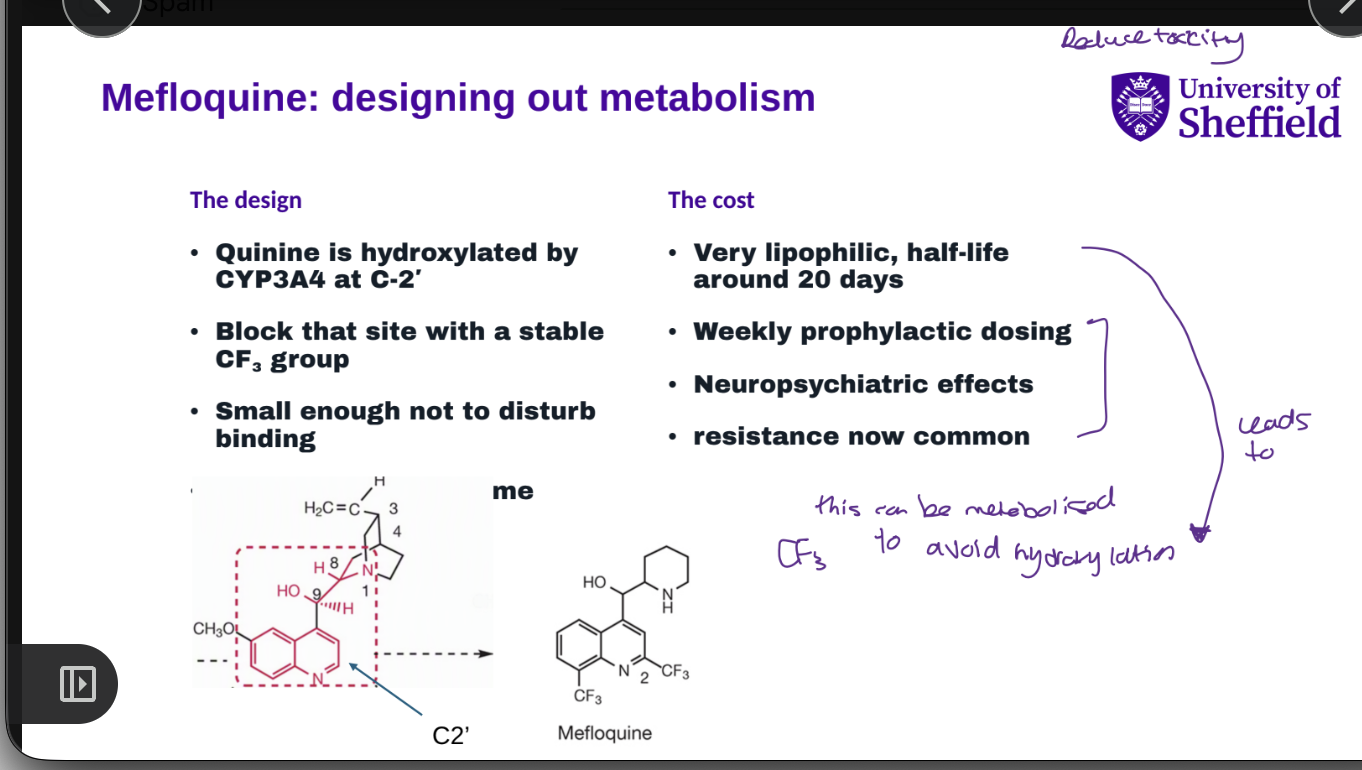
How was mefloquine structurally modified from quinine to reduce metabolism- quinacrine derivatives ?
Mefloquine is a quinolinemethanol antimalarial designed to resist metabolism and have a longer duration of action.
1. Key structural modifications (SAR)
Structural feature | Modification and effect |
|---|---|
C-2′ position of quinine | Quinine undergoes hydroxylation by CYP3A4 at this position → contributes to metabolism. |
CF₃ group (trifluoromethyl) | Added at C-2 of mefloquine to block hydroxylation → increases metabolic stability. |
CF₃ group at C-8 | Increases lipophilicity and contributes to the drug's properties. |
Secondary alcohol (-OH) | Retained because it is important for antimalarial activity. |
Basic nitrogen | Retained in a simpler piperidine ring instead of quinine's bicyclic quinuclidine ring. |
2. What are the consequences of these modifications?
Reduced metabolism → longer duration of action.
Increased lipophilicity → long elimination half-life of approximately 20 days.
Long half-life → allows once-weekly dosing for malaria prophylaxis.
Disadvantages: Neuropsychiatric adverse effects and resistance in some regions.
What are the key structural features (SAR) of artemisinin?
Artemisinin is a sesquiterpene lactone antimalarial containing a 1,2,4-trioxane ring. ( pharmacophore)
1. Key structure–activity relationships (SAR)
Structural feature | Importance |
|---|---|
Endoperoxide bridge (O–O) | Essential for antimalarial activity. Removing it causes loss of activity. |
1,2,4-Trioxane ring | Contains the peroxide bridge responsible for activation. |
No nitrogen atoms | Unlike quinine and chloroquine, artemisinin does not require a basic nitrogen for activity. |
Stable peroxide | Stable enough to be administered as a drug but activated when it reacts with Fe(II). |

What is the mechanism of action of artemisinin
The malaria parasite digests haemoglobin, releasing haem containing Fe(II).
Fe(II) reacts with artemisinin's endoperoxide bridge (O–O), breaking the bond.
This generates an oxygen-centred radical, which rearranges into a highly reactive carbon-centred radical.
These radicals damage parasite proteins and membranes, killing the parasite.
Artemisinin acts through iron-mediated activation of its essential endoperoxide bridge, producing reactive radicals that damage and kill the malaria parasite.
What are some Key structural modifications that can be made to artemenisin derivatives to improve delivery ?
Key structure–activity relationships (SAR)
Endoperoxide bridge (O–O) → must be retained for antimalarial activity.
Ester group (artesunate) → increases water solubility., rapid delivery by injection
Ether group (artemether) → increases lipid solubility., suitable for oil based - im and orally
Free -OH (DHA) → provides a site for ester/ether modification.

What is Primaquine ( 8-amionoquinolones) ?
A prodrug needing CYP2D6 activation
Carboxy-primaquine is an inactive dead end
Poor metabolizers may fail treatment
Half-life ~7 h
Active against the hypnozoites (liver stage), not the blood stage, by generating reactive oxygen species (ROS)
What is Tafenoquine ( 8-aminoquinolones) ?
• Tafenoquine
• Also CYP2D6-activated to the 5,6- quinone
• Half-life ~2 weeks
• Not a routine UK option
What are 8-aminoquinoline antimalarials, their key structural features (SAR) and mechanism of action?
8-Aminoquinolines are quinacrine-related synthetic antimalarials that mainly target dormant liver parasites (hypnozoites) to prevent malaria relapse.
Examples: Primaquine and tafenoquine.
1. Key structural features (SAR)
Structural feature | Importance/effect |
|---|---|
8-Aminoquinoline ring | Core structure of this drug class, with an amino group at position 8. |
Aminoalkyl side chain | Important for antimalarial activity and undergoes metabolism. |
CYP2D6 activation | Produces active metabolites that contribute to parasite killing. |
5,6-Quinone metabolites | Reactive metabolites, particularly associated with tafenoquine, that contribute to oxidative stress. |
. How do they kill the parasite?
Drugs undergo metabolism, involving CYP2D6.
Active metabolites are formed, including quinone-related metabolites.
These contribute to the generation of reactive oxygen species (ROS).
ROS cause oxidative damage to parasite components, helping eliminate liver-stage parasites.
Key points of 8-aminoquinolones
Based on: Quinacrine-related aminoquinoline chemistry.
Core structure: 8-aminoquinoline ring + aminoalkyl side chain.
Activation: CYP2D6 is particularly important for primaquine.
Mechanism: Reactive metabolites → ROS → oxidative parasite damage.
Target: Dormant liver hypnozoites of P. vivax and P. ovale.
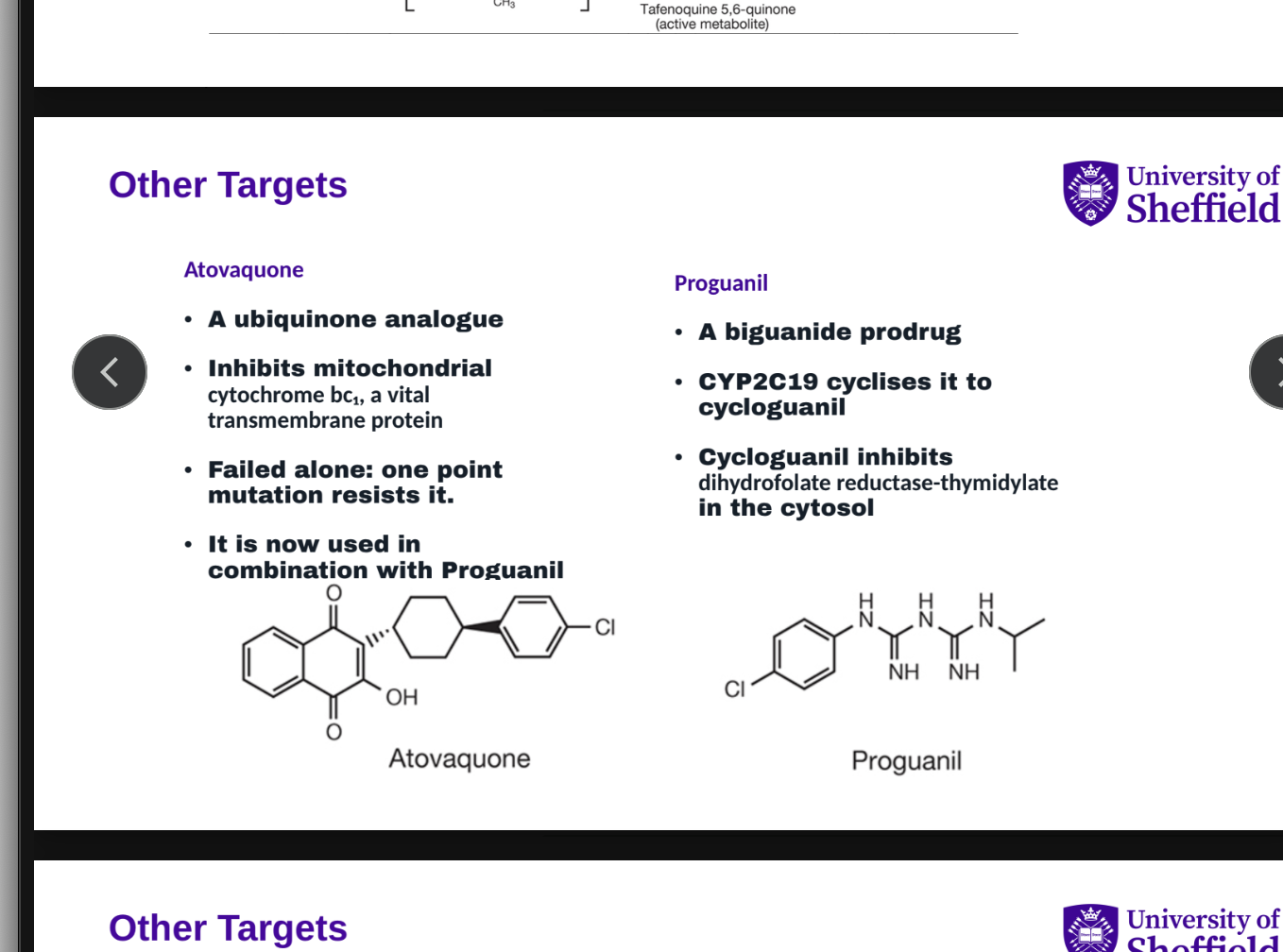
What are the structural features of atovaquone and proguanil?
Atovaquone and proguanil are antimalarial drugs that target parasite mitochondrial function and folate metabolism, rather than haem detoxification.
. Key structural features and mechanisms
Drug | Structure/characteristics | Mechanism of action |
|---|---|---|
Atovaquone | Hydroxynaphthoquinone, structurally similar to ubiquinone (coenzyme Q). | Inhibits mitochondrial cytochrome bc₁, disrupting electron transport and mitochondrial function. |
Proguanil | Biguanide prodrug, containing nitrogen-rich biguanide groups. | Converted by CYP2C19 into cycloguanil. |
Cycloguanil | Contains a cyclic triazine ring, formed from proguanil. | Inhibits dihydrofolate reductase (DHFR) → reduces tetrahydrofolate production → disrupts DNA synthesis. |
Why are atovaquone and proguanil combined?
Atovaquone alone: Resistance can develop rapidly through a single mutation in cytochrome bc₁.
Proguanil: Enhances atovaquone disruption of the parasite's mitochondrial membrane potential, helping improve antimalarial activity.
Combination: Improves effectiveness and reduces the risk of resistance compared with atovaquone alone.

Why can antibiotics be used to treat malaria, and how do they work?
1. Why do antibiotics work against malaria?
The malaria parasite contains an apicoplast, an organelle derived from bacteria.
It contains 70S ribosomes, similar to bacterial ribosomes.
Human cells do not have an apicoplast → allows selective targeting.
2. How do antibiotics kill the parasite?
Antibiotics inhibit protein synthesis in the apicoplast.
This disrupts the organelle's essential functions.
Daughter parasites inherit a damaged apicoplast.
Parasites die in the second generation → called the delayed-death effect.
3. Which antibiotics are used?
Antibiotic | Mechanism |
|---|---|
Doxycycline | Binds to the 30S ribosomal subunit → inhibits protein synthesis. |
Clindamycin | Binds to the 50S ribosomal subunit → inhibits protein synthesis. |
summary - why antibiotics work
Key points to remember
Target: Apicoplast (bacterial-like organelle).
70S ribosomes: Allow antibiotics to inhibit protein synthesis.
Delayed death: Parasites die in the second generation.
Clinical use: Not used alone for acute malaria because their action is too slow; combined with faster-acting antimalarials.