Entrepreneurship and business planning - ch 11
 Call Kai
 Learn
 Practice Test
 Spaced Repetition
 Match
 Flashcards
 Knowt Play
1/33

There's no tags or description
Looks like no tags are added yet.
34 Terms
Why is marketing important for entrepreneurial firms, and what are the four main objectives of Chapter 11?
Marketing is essential because businesses must create, attract, and retain customers.
Peter Drucker identified marketing and innovation as the two basic functions of a business that produce results, while other activities represent costs.
The four chapter objectives are:
Explain market segmentation, targeting, and positioning (STP).
Define branding and its importance.
Explain the 4Ps of marketing.
Describe the seven-step sales process.
What fundamental question must every start-up answer, and what three steps are used to identify and appeal to customers?
Every start-up must answer: Who are our customers, and how will we appeal to them?
The three-step STP process consists of:
Segmentation: Divide the market into distinct customer groups.
Targeting: Select the most attractive customer group to serve.
Positioning: Establish a unique position in customers' minds that differentiates the firm from competitors.
What is market segmentation, and what are three common ways to segment a market?
Market segmentation involves studying an industry and dividing its market into distinct groups of customers with similar characteristics, wants, or needs.
Markets can be segmented by:
Product type
Geography: City, state, region, etc.
Demographic variables: Such as age, income, or other population characteristics.
What five criteria must an effective market segment satisfy?
Customers within a segment should have homogeneous wants and needs.
Differences between customers within the segment should be small.
The segment must be sufficiently distinct for members to be easily identified.
The size of the segment must be measurable.
The segment must be large enough to generate profits.
How does the dance studio example illustrate market segmentation?
The slides divide the dance studio market into three customer segments:
Professional dancing: Serious dancers aspiring to earn a living through performances, such as Broadway productions.
Adult dancing: Adults learning ballroom or other dances for recreation and enjoyment.
Youth dancing: Young girls learning ballet or other dances to develop poise and grace.
What is target market selection, and what criteria should entrepreneurs use when choosing a target market?
Target market selection occurs after segmentation and involves choosing the specific group of customers the firm intends to serve.
The market must:
Be sufficiently attractive and potentially profitable.
Be a market the company has the capabilities to serve.
Focusing on a clearly defined market allows a firm to develop expertise and provide a high level of customer service.
What is market positioning, and how does a firm establish a unique position?
Market positioning involves establishing a distinctive place in customers' minds relative to competitors.
A position is the part of the market a company claims as its own.
A firm creates a unique position by emphasizing two or three important product attributes that differentiate it from rivals.
What is a product attribute map, and what does the fitness center positioning example illustrate?
A product attribute map visually compares competitors based on important product or service characteristics.
The example uses two dimensions:
Vertical axis: Range of amenities provided (low to high).
Horizontal axis: Extent to which the fitness center is affordable and convenient (low to high).
The map shows:
Gold's Gym / LA Fitness: High range of amenities, lower affordability/convenience.
YMCA: Relatively broad amenities but lower affordability/convenience.
Community Center Fitness Clubs: More limited amenities and lower affordability/convenience.
Snap Fitness: Fewer amenities but high affordability/convenience.
It illustrates how competitors occupy different positions in the market.

What is a tagline, why do firms use one, and what example is given?
A tagline is a memorable phrase consistently used in a company's communications.
Its purpose is to reinforce the company's market position and create an association in customers' minds.
Example: Nike's tagline, Just do it.
What is a brand, and why is it important for an entrepreneurial firm?
A brand is the set of positive or negative attributes that people associate with a company.
Examples:
Positive: Trustworthy, dependable, easy to deal with.
Negative: Cheap, unreliable, difficult to deal with.
A strong brand helps create customer loyalty, which is one of a company's most valuable assets.
Start-ups must generally build their brands from scratch.
What is brand management, and why is it important?
Brand management refers to the activities companies use to monitor and maintain the integrity of their brands.
It helps ensure that the company's image, reputation, and associated attributes remain consistent with its intended identity.
What are the eight different ways of understanding a brand presented in the chapter?
brand can be understood as:
A promise to serve stakeholders' interests.
A guarantee of a certain level of performance.
An indication of promises made to customers and other stakeholders.
An expression of the firm's reputation.
A representation of the firm's credentials.
An indicator of trust and reduced risk.
A description of the company's nature.
A handshake between the company and its customers.
How can an entrepreneurial firm establish a strong brand?
A firm must create meaning and value in customers' lives, offering something customers are willing to pay for.
Brands can be built through:
Advertising
Public relations
Sponsorships
Supporting social causes
Good product or service performance
Brand identity is also communicated through the company's name, logo, website design, social media pages, and even its letterhead.
Why is a strong brand valuable, and what statistics about branding are mentioned in the slides?
A strong brand increases trust, customer loyalty, pricing power, and potentially company value.
According to the slides:
88% of consumers consider authenticity important when purchasing.
46% of consumers are willing to pay more for a brand they trust.
Brands account for approximately 19.5% of a company's market value on average, potentially exceeding 50%.
A strong brand also allows companies to charge prices consistent with their image.
What is brand equity, and what are its five components?
Brand equity refers to the assets and liabilities linked to a firm's brand that influence its value.
The five components identified in the slides are:
Brand loyalty
Name recognition
Perceived quality
Brand associations
Other proprietary brand assets
What is the marketing mix, and what are the four Ps of marketing?
The marketing mix is the combination of marketing activities a company uses to reach and influence its target market.
The four Ps are:
Product: What the firm offers customers.
Price: What customers pay.
Promotion: How the company communicates its offering.
Place: How products reach customers through distribution.
After segmentation, targeting, and positioning, the firm adjusts its marketing mix to generate a favorable customer response.
What does product mean in the marketing mix, and why is the initial product rollout particularly important for start-ups?
A product is the good or service a firm offers to its target market.
The initial rollout is critical because:
New companies are generally unknown.
Customers may hesitate to purchase an unfamiliar product.
Early customers must take a leap of faith when buying from a start-up.
What is a reference account, and how does it help a start-up?
A reference account is an early customer who uses a firm's product and is willing to provide a testimonial about the experience.
Reference accounts can help build trust and credibility, reducing potential customers' hesitation to purchase from an unfamiliar company.
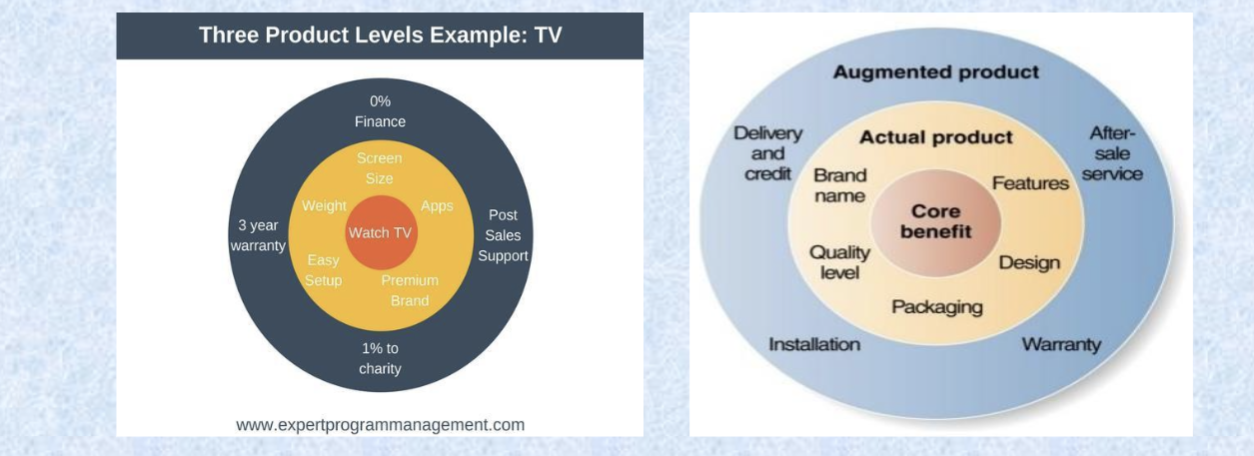
What is the difference between a core product, an actual product, and an augmented product?
Core product: The product itself or its central benefit, e.g., antivirus software providing protection.
Actual product: The product together with attributes such as quality, features, design, packaging, brand name, and warranty.
Augmented product: Additional services and benefits surrounding the product, such as delivery, installation, credit, and after-sales service.
What is price in the marketing mix, and why is it different from the other three Ps?
Price is the amount of money consumers pay to purchase a product.
Price is the only P that directly generates revenue.
The other three Ps — product, promotion, and place — involve costs.
Price also communicates an important message about the product's positioning, quality, and image.
How does pricing communicate product positioning, and what example is given?
Price communicates how a product is positioned in the market.
Example: Oakley positions its sunglasses as innovative, high-quality, technologically advanced, and visually appealing.
This positioning supports a premium price.
What is the difference between cost-based pricing and value-based pricing?
Cost-based pricing: The selling price is determined by adding a markup percentage to the product's cost.
Value-based pricing: The selling price is determined by estimating what customers are willing to pay.
Key distinction: Cost-based pricing starts with production costs; value-based pricing starts with perceived customer value.
What is price-quality attribution, and how can it influence customers' purchasing decisions?
Price-quality attribution refers to customers using price as an indicator of product quality.
Consumers may associate a higher price with superior quality, particularly when they have limited information about the product.
This helps explain why premium pricing can reinforce a high-quality market positio
What is promotion, and what are its main objectives?
Promotion refers to marketing activities used to communicate the merits of a company's products or services to its target market.
Its main objectives are to increase:
Awareness
Sales
Visibility of the product, service, or company
Start-ups must generally build awareness from scratch with limited promotional budgets.
What promotional techniques can entrepreneurial firms use, and why are digital analytics important? 8
Promotional techniques include:
Advertising
Social media
Newsletters
Press releases
Influencer marketing
Viral marketing
Guerrilla marketing
Word-of-mouth marketing (creating buzz)
Digital analytics help firms measure and evaluate the results of promotional activities.
What are the five main promotional tools shown in the integrated promotion diagram, and what is its central message?
The five tools are:
Advertising
Personal selling
Public relations
Direct marketing
Sales promotion
The diagram emphasizes a carefully blended promotional mix that produces consistent, clear, and compelling company and brand messages.

What is place in the marketing mix, and what is a distribution channel?
Place includes all activities that move a product from its point of origin to the final consumer.
A distribution channel is the route a product follows from the producer to the end user.
The firm's first major distribution decision is whether to sell directly to consumers or through intermediaries.
What is the difference between direct distribution and distribution through intermediaries, and what determines a firm's choice?
Direct distribution: Producer → Consumer
Indirect distribution: Producer → Wholesaler/distributor → Retailer → Consumer
The decision depends mainly on:
How the target market prefers to purchase the product.
How much control the firm wants to maintain over the distribution and sales process.
What is a sales process (or sales funnel), and why should entrepreneurial firms use a formal sales process?
A sales process is the sequence of steps a firm follows to identify prospective customers and close sales.
A formal sales process:
Provides employees with a standardized approach.
Helps identify missed or mishandled steps.
Allows analysis and continuous improvement.
Can significantly improve sales performance through proper follow-through.
Simply improvising or winging it is not recommended.
What are the seven steps of the sales process in the correct order?
Prospect for (or gather) sales leads
Make the initial contact
Qualify the lead
Make the sales presentation
Meet objections and concerns
Close the sale
Follow up
What happens during the first three steps of the sales process, and what examples does the Prime Adult Fitness case provide?
Prospecting: Identify potential customers. Prime Adult Fitness uses member referrals, direct mail, physician and physical-therapy referrals, website downloads, and responses to advertising.
Initial contact: Approach prospects and build rapport. The company trains employees to interact with prospects and provides product information.
Qualifying leads: Determine whether prospects meet the firm's criteria for suitable customers. Qualified leads receive a facility tour, and some prospects may be contacted later.
What happens during steps four and five of the sales process, and how does Prime Adult Fitness apply them?
Step 4 — Sales presentation:
Present the product or service to qualified prospects.
Prime Adult Fitness gives facility tours, shows a short film, and uses customer testimonials.
Step 5 — Meet objections and concerns:
Address questions and purchasing concerns.
Employees learn to respond to common objections.
The fitness center uses brochures explaining pricing and benefits and makes amenities available to prospective customers.
What happens during steps six and seven of the sales process, and why is follow-up important?
Step 6 — Close the sale:
Ask the qualified prospect to purchase or join.
Prime Adult Fitness trains employees to ask prospects to become members.
Step 7 — Follow up:
Maintain contact after the sale.
The company follows up with members after approximately 30 days, monitors missed visits, and encourages feedback.
Follow-up supports customer satisfaction, retention, and continuous improvement.
What does the Prime Adult Fitness example demonstrate about using a structured sales process?
The example shows how a business can translate the seven sales stages into concrete actions, assign responsibilities, and train employees to follow a consistent approach.
It demonstrates that:
Sales activities can be planned systematically.
Each stage has a specific purpose.
Standardized procedures make it easier to identify problems.
Customer follow-up continues after the sale.
An organized sales process can improve sales performance and customer relationships.