Sociology Exam 3
 Call Kai
 Learn
 Practice Test
 Spaced Repetition
 Match
 Flashcards
 Knowt Play
1/75

There's no tags or description
Looks like no tags are added yet.
76 Terms
Sex
Biological and based on anatomy, chromosomes, and hormone levels.
Gender
Refers to the roles and behaviors a society attaches to being a man, woman, or another [blank].
Consists of identity and expression.
Gender versus Sex
Gender is a social and cultural construct whereas sex is biological.
Sex and Gender Overlap
Societies attach social meanings and expectations to biological differences between males and females.
Sexuality
Refers to patterns of sexual attraction, desires, and behaviors.
Influenced by biological and social factors.
Sources of Gender and Sexuality Socialization
Parents, peers, schools, and media.
Society tends to normalize heterosexuality.
Workplace Inequality
Men working full-time earn about $71K a year compared to $58K for women.
Unequal Household Responsibilities
Women tend to do more housework and caregiving than men in married and cohabiting relationships.
Gender-Based Violence
About 50% of women are killed by a current or former romantic partner. Compared with 7% of men.
Discrimination Based on Sexual Orientation and Gender Identity
50% of transgender and nonbinary students reported experiencing verbal harassment at school because the were LGBTQ+/
Race
A system of classifying people based on perceived physical characteristics and shared ancestry.
Ex. White, Black, Asia, American Indian
Ethnicity
A system of classifying people based on shared cultural heritage, traditions, and ancestry.
Ex. Irish, Korean, Jewish, Latino, Navajo
Nationality
A person’s membership in or identification with a particular nation, often based on citizenship.
Ex. American, Canadian, Mexican, Japanese
Social Construction
An idea created and accepted by members of society rather than grounded in nature.
—> Sociologists argue that race is a social construct b/c racial categories are created and defined by societies and can change over time.
Essentialist View of Race
Assumes racial groups are natural biological categories based on inherited, unchanging characteristics.
—> Sociologists argue against this view.
Why do we see race?
Physical differences are real and ancestry is real.
Race is the social choice of particular physical traits used to distinguish groups of people.
—> Societies decide which differences matter when classifying people.
Human Variation
Skin color and pigmentation
Body size and proportions
Hair color and texture
Ability to digest lactose or certain foods
Blood types
Vary across populations, but they do not all follow the same geographic patterns.
Scientific Conclusion
Racial categories do not accurately capture the complexity of human biological variation.
Racial Categories
Serve a social purpose (justify inequality, maintain power and privilege, justify inequality)
Have real consequences (shape experiences, opportunities, and treatment in society)
Can change across time and place
How racial categories change
Irish Americans were once treated as a distinct racial group
US Census once included categories such as Mulatto and Quadroon, now it uses categories like Black or African American
Different countries classify race differently (someone who is Black in the US may be classified differently in Brazil)
The One-Drop Rule once classified anyone with known Black ancestry as Black, regardless of physical appearance.
Jefferson and Hemings; Jefferson’s children were born enslaved and classified as black.
Forensics
Forensic classifications reflect society —> scientists are not discovering a person’s biological race; instead, they are interpreting biological evidence through socially constructed racial categories.
Social Construction of Ethnicity
Emphasizes shared culture and heritage
Identities and boundaries can change across generations/time as people assimilate, maintain traditions, or form new cultural identities.
Slavery
Enslaved Black Americans were denied freedom,
economic opportunities, and the ability to accumulate
wealth.
Jim Crow
Laws and practices enforced racial segregation
and restricted Black Americans' rights and opportunities
Redlining
Discriminatory housing and lending practices
limited Black and Latino families' access to
homeownership and wealth accumulation.
Historical Discrimination
Slavery, Jim Crow, Redlining
—> Contribute to racial and ethnic inequalities that persist today.
Continuing Inequalities
Wealth and Education
Wealth
In 2022, median White family wealth was
approximately $285,000, compared with $61,000 for
Hispanic families and $45,000 for Black families.
Education
Racial and ethnic disparities in academic skills
are already evident when children enter kindergarten.
Prejudice and Discrimination Today
Racial and ethnic discrimination can occur even without explicit discriminatory laws.
Apartment rentals
Employment
Voting
Racial Exclusion
Can operate through individual decisions, institutional practices, and public policies.
Apartment Rentals
Studies find that prospective tenants with
Black-associated names receive approximately 17% fewer responses
from landlords than those with White-associated names.
Employment
A landmark study found that applicants with White-
associated names received 50% more interview callbacks than
equally qualified applicants with Black-associated names.
Voting
Some efforts to restrict Sunday early voting could
disproportionately affect Black voters
—> particularly those participating in church-organized voting efforts
known as Souls to the Polls
Social Class Role
Plays an important role in shaping who we
are, how we're treated, and the opportunities available to
us.
Social Class
Refers to a group of people who
share a similar social and economic position
in society.
Measures of social class
Income and wealth are:
***education, occupation, and status also matter
Income
The amount of money received by an individual or household over a specific period of time, typically through wages, salaries, investments, or other sources.
Wealth
The total value of assets owned by an individual or family (such as homes, cars, savings, and stocks), minus any debts owed.
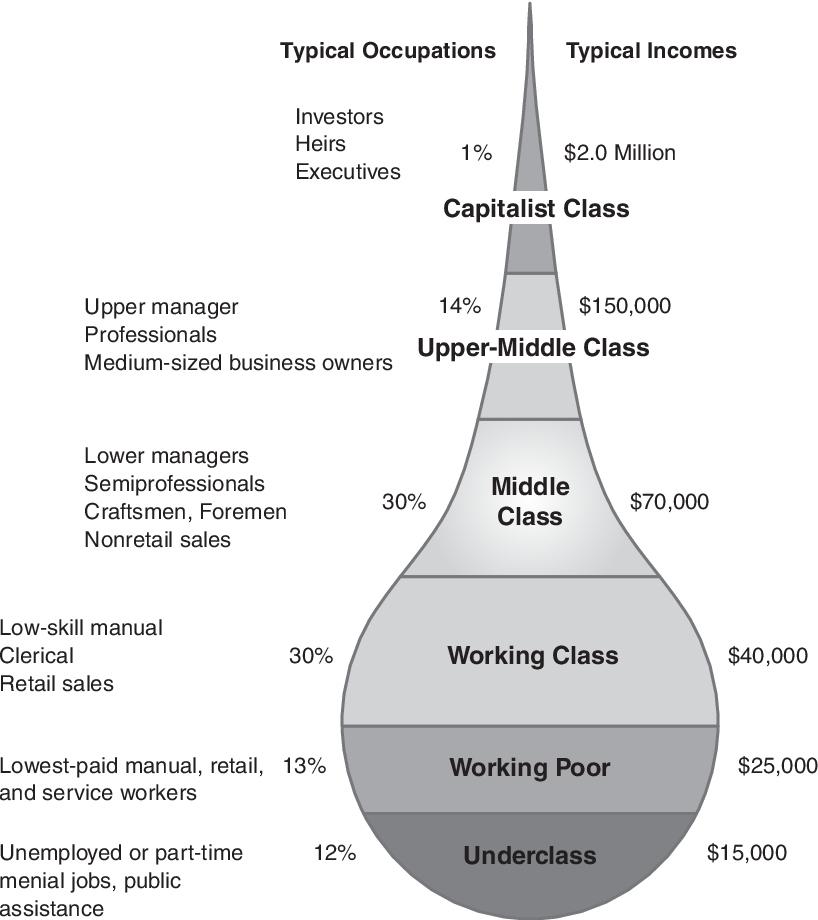
The American Social Class Structure
Follows the Gilbert-Kahl Model:
Upper-class
Middle-class
Lower-class
Belief versus Reality
Most Americans believe they are middle-class, but in reality most are working-class or poor. The middle class is shrinking!
Economic Inequality
The unequal distribution of income and wealth across individuals and households.
Wealth in US
Highly concentrated among the richest Americans. The wealthiest 1% own a ton more wealth than the bottom 50% combined.
—> Wealth inequality has increased over recent decades.
Common Justifications for Social Inequality
Talent, economic incentives, and individual responsibility.
Talent
People with exceptional abilities and skills deserve
greater rewards for their contributions to society.
Economic Incentive
Greater financial rewards encourage
ambition, risk-taking, and innovation
Individual Responsibility
People who work hard and
contribute to society deserve greater rewards than those
who do not.
Distribution of wealth in the US
Wealth has grown a lot since the 90s
Most of the wealth belongs to the richest Americans
The bottom 50% of Americans own a tiny share of the country’s wealth
The Top 1% received a growing share of the nation's income over the
last 50 yearsThe share going to middle and lower-income Americans has significantly decreased
Causes of growing economic inequality
Education and technology (computers and automation make many jobs obsolete, while higher-paying jobs require more skill and education)
Decline of manufacturing and rise of service jobs
Decline of labor unions (reduces bargaining power and wages)
Government Policies (lower tax rates on rich)
Tax Policy in US
The amount of taxes the rich pay has significantly gone down since the 60s
Social Mobility
Movement of individuals or families up or down the social class hierarchy.
Intergenerational Mobility
Changes in social class between parents and their children.
US and Social Mobility
The US has low intergenerational mobility compared to other wealthy nations
Poverty
A condition in which individuals or families lack the financial resources necessary to meet basic needs.
• food, housing, clothing, and healthcare
Federal Poverty Threshold
The income level used by the U.S. Census Bureau to determine whether an individual or family is living in poverty.
Used to measure poverty in the U.S.
Varies by family size and composition
Does not account for differences in the cost of living across the country
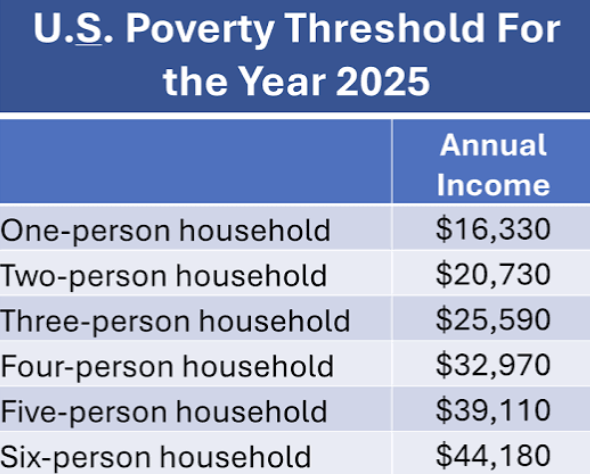
US Poverty Thresholds
Who is most likely to experience poverty
Children
Single parent households
Certain racial and ethnic minority groups
Individuals with lower levels of education
Consequences of Poverty
Greater risks of poor physical and mental health
• Fewer educational opportunities and resources
• Increased exposure to unsafe housing and neighborhoods
• Reduced opportunities for upward social mobility
Theory
Ideas and explanations that help us understand how and why social phenomena occur.
—> must be testable using empirical evidence
Empirical Evidence
Information gathered through systematic observation and data collection.
Independent Variable
An element of social life that varies and causes a specific outcome in another variable—the cause of something.
Dependent Variable
An element of social life that depends on the levels of another variable (the independent variable)—the effect of something.
Conceptualization
Providing precise definitions for the abstract concepts we’re studying as part of our research question.
Operationalization
Developing specific procedures that allow us to observe and measure our concepts.
Qualitative Methos
Focus on understanding people’s experiences, behaviors, and social interactions
ex. interviews and ethnography.
Quantitative Methods
Use numerical data and statistical analysis to identify patterns and relationships
ex. Statistical analysis
Qualitative versus Quantitative Methos
Neither approach is inherently better
both methods are complementary
both are used to collect and analyze data
Research Methods: Interviews
Researchers talk with people to learn about their experiences, behaviors, and perspectives.
Can be recorded and transcribed.
Strength: Allows researchers to explore personal experiences in depth and ask follow-up questions
Limitation: Can be time-consuming and participants may not represent broader population
Ex. Ghost Study; ask people about their experiences with ghosts.
Research Methods: Ethnography
Qualitative method where researchers observe people in their natural social environments to understand their behaviors and interactions.
Take field notes about what they observe and analyze them to identify patterns and themes.
Strength: Allows researchers to study social behavior as it occurs in everyday life.
Limitation: Findings may not apply to other settings or populations and the researcher’s presence may influence behavior.
Ex. Gig Musicians; how do they save face when audiences ignore their performances?
Research Methods: The Classic Experiment
Test cause-and-effect relationships by manipulating an independent variable and seeing how it affects the dependent variable.
Includes:
Independent and Dependent Variables
Treatment and Control Groups
Pre-test and Post-test (measure outcomes before and after the experiment)
Ex. The Plant Experiment; same care but one plant receives sunlight the other does not.
Research Methods: Surveys
Method of collecting and analyzing information by asking people a series of standardized questions.
Can be conducted online, OTP, by mail, or in person
Strength: Allows researchers to collect information from large samples and can generalize findings to a broader population
Limitation: Standardized questions may oversimplify complex issues and getting people to respond can be difficult
Ex: Public Opinion Surveys
Research Methods: Quantitative Analysis
Quantification converts observations into numerical data that can be measured and analyzed
uses statistical methods to identify relationships in numerical data
Commonly involves data collected from: surveys, experiments, and big data (like social media or govt records)
Careers for Sociology Majors
HR, marketing, criminal justice, social services, business management, govt, research, public policy
$88,028
Estimated average earnings for a Sociology and Anthropology major.
Skills Sociology Teaches You
Understanding human behavior
Critical thinking: evaluating evidence, questioning assumptions, and solving complex problems
Communication: working effectively with people from different backgrounds
Adaptability: applying skills across different jobs, industries, and changing technology
Sociology Degree Benefits
Career flexibility: Sociology opens doors to a wide variety
of professions and industries.Earning potential: Sociology graduates can build financially
rewarding careers.Skills for the future: Understanding people, organizations,
and society is increasingly important in an AI-driven world.Follow your interests: Sociology allows you to study issues
you care about while preparing for your future