Bio 281 exam 4
 Call Kai
 Learn
 Practice Test
 Spaced Repetition
 Match
 Flashcards
 Knowt Play
1/51

There's no tags or description
Looks like no tags are added yet.
52 Terms
Primary succession (glacier bay alaska)
Community changes following a catastrophic disturbance that kills virtually all life and starts from bare ground with no soil. At Glacier Bay, retreating glaciers leave bare substrate colonized by pioneer mosses and lichens intermediate shrubs (willow/alder) conifer climax forest. (Fausti's tree-core study showed older sites near refugial forests formed dense spruce/hemlock forests without an alder phase, proving multiple successional pathways exist.)
secondary succession
The pattern of community recolonization following a disturbance where some organisms and organic soil survive. The recovery pathway (pioneer→intermediate→climax) depends heavily on disturbance severity (e.g., Yellowstone fires where soil and select trees survived).
climax
A stable (but not static) biotic community representing the final stage of ecological succession. Fausti's tree-core study challenged the idea of a single, deterministic climax by showing variable tree species composition (e.g., western hemlock in older sites vs. cottonwood in younger sites).
holistic and individualistic community concepts
Holistic (Frederic Clements): Views communities as interdependent "superorganisms" developing deterministically toward a single, predictable climax.
Individualistic (Henry Gleason): Proposes species act independently based on environmental tolerances and dispersal, making climax composition less predictable.
pioneer species
The first species to colonize and modify an environment after a disturbance (e.g., mosses and lichens on bare glacial till in primary succession, or fast-growing, light-demanding trees in forest treefall gaps)
fire disturbance
A discrete physical disturbance that disrupts ecosystem structure by burning vegetation (e.g., 1988 Yellowstone fires). It creates a spatial mosaic of damage severity; lightly damaged areas can recover plant cover in as little as 1 year.
treefall gap disturbance
A localized canopy disturbance that increases understory sunlight and releases limiting nutrients (nitrogen and phosphorus) from fallen decomposing leaves, creating a hotspot for fast-growing, light-demanding pioneer species and microbial symbioses.
rhizobium - legume symbiosis (nitrogen fixation)
A mutualistic association in root nodules where Rhizobium bacteria convert limiting nitrogen into usable forms for the plant in exchange for plant-derived carbon. Highly beneficial in light-rich forest gaps where rapid plant growth requires high nitrogen input.
arbuscular mycorrhizal fungi (AMF) associations
A mutualism between plant roots and fungi that aids plants in acquiring soil phosphorus (a limiting nutrient during rapid gap growth) in exchange for plant-derived carbon.
Chronosequence
when you study habitats that are at different time since a major disturbance (e.g., terrain exposed at varying distances from retreating glaciers at Glacier Bay) to reconstruct long-term successional timelines.
use this study when you dont have hundreds of years to measure something
Wallace’s line
A distinct biogeographic boundary identified by Alfred Russel Wallace between Asia and Australia (near Borneo/Philippines and New Guinea), separating Asian wildlife from Australian wildlife.
observed in Borneo and Philippines that the animals (specifically mammals that were found in Asia were more like those in Africa than the nearby in New Guinea
Biogeographic regions
Six global landmass divisions originally established by Sclater and Wallace based on shared species composition and taxonomic similarity of biota rather than simple geographical latitude or longitude. (put in picture)

Disjunctions
Geographic distribution patterns where closely related species or fossils (e.g., Glossopteris trees) occur in widely separated global regions (e.g., South America, Africa, India, Antarctica, Australia), explained by vicariance or long-distance dispersal.
Vicariance
A biogeographic process where a continuous ancestral species range is split into isolated fragments by a newly formed physical barrier (e.g., continental drift, mountain uplift), leading to allopatric speciation (put in picture)
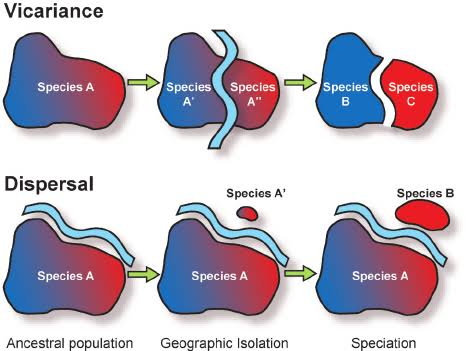
Long distance dispersal
A biogeographic process where an organism crosses a pre-existing physical barrier (such as an ocean) to establish a new range. Supported by Darwin's experiments showing seeds floated >220 days and remained viable after 10 months in saltwater.
Island Biogeography Theory
MacArthur and Wilson's model predicting equilibrium species richness on islands (and isolated habitat fragments like mountaintops) based on the dynamic balance between colonization/immigration rates and extinction rates, alongside species turnover.
MacArthus and Wilson - theory of island biogeography
Everything can be islands if they are isolated? -> mountaintops, fragments - study them like islands

Lecythidaceae study (Diana’s study group)
Phylogenetic research on the Amazonian Brazil nut family using herbarium and field DNA. Showed Neotropical Lecythidaceae originated via oceanic dispersal from Africa (~51 Ma in the Eocene) and expanded in the Miocene, driven by vicariance (Andean uplift) and dispersal (Isthmus of Panama
Plate tectonics
The movement of rigid plates over Earth's upper mantle, causing continental drift, mountain building, earthquakes, and volcanic island formation, serving as a primary driver of vicariance.
explained why glossopteris trees are in so many diff areas
Latitudinal gradient of diversity and the hypotheses to explain this pattern
The pattern where species richness peaks in the tropics and declines toward the poles (>1,000 tree spp./sq. mile in the Amazon vs. 41 in Michigan). Explained by: (1) higher tropical speciation rates (competition), (2) lower tropical extinction rates (stable climate), and (3) higher dispersal from poles to tropics.
Fragmentation definition
The breaking of continuous habitat (e.g., IMPA Brazil Amazon rainforest study using 1, 10, and 100 ha fragments) into smaller, isolated habitat patches surrounded by a human-altered matrix.
Fragmentation hypothesis
Theoretical frameworks explaining species loss in fragments, including the Patch-Size/Island Biogeography Hypothesis (smaller, isolated patches suffer higher extinction and lower immigration), Habitat Amount Hypothesis (total habitat in the surrounding landscape matters most), and Edge Effects Hypothesis (higher perimeter-to-area ratio alters microclimate and favors edge generalists)
Alpha, beta and gamma diversity & fragmentation
Alpha (alpha) = local richness within one patch; Beta (beta) = species turnover (compositional difference) between patches; Gamma (gamma) = total regional richness across all patches. Fragmentation reduces alpha and gamma diversity; beta$ diversity can either increase (random species loss across patches) or decrease (biotic homogenization).
Controlling for spatial distance for comparing diversity metrics
ccounting for geographic distance between sample plots (since closer sites naturally share more species via dispersal and similar environments—distance decay of similarity) so spatial autocorrelation does not skew beta-diversity comparisons between fragmented and continuous habitats.
Remember that beta-diversity measures how different species composition is between sites. Suppose an ecologist measures beta-diversity in a fragmented landscape where the remaining forest patches are 50 km apart, and compares it to a continuous forest where their sample plots are only 1 km apart. The fragmented landscape will appear to have huge species differences (beta-diversity)—not necessarily because of fragmentation, but simply because the plots were much farther apart!
Sampling effort
Standardizing the area surveyed or number of individuals sampled (using equal-area plots, rarefaction, or species accumulation curves) so larger fragments do not appear artificially more species-rich simply because more individuals were counted.
Species area and species richness idea (SAR)
The ecological pattern where species richness (S) increases with habitat or island area (A), driven by greater habitat heterogeneity and larger population sizes in larger areas. (review)
Role of landscape on fragment diversity
How the surrounding matrix quality (permeable regrowth/shade crops vs. hostile pavement/row crops), habitat connectivity/corridors (enabling dispersal and the rescue effect), and total surrounding forest cover buffer small patches against extinction and edge effect
hostile matrix (highways) vs pereable matric (secondary forest regrowth)
island area, extinction and colonization
In MacArthur and Wilson's equilibrium model, island area primarily controls extinction rate (larger islands support larger populations and lower extinction), while island isolation/distance from the mainland primarily controls colonization/immigration rate (nearer islands receive more colonists).
Guild
A group of species that depend on and exploit the same class of resources in a similar way for survival and reproduction (e.g., over 7,000 species of dung beetles all relying on dung as a resource).
Functional group
A group of species that perform the same ecological role or ecosystem process within a community (e.g., dung beetles split into different functional groups: tunnelers that bury dung underground for nutrient cycling vs. rollers that roll dung balls and sustain invertebrates).
Food chain
A simplified, linear representation of feeding relationships showing energy and nutrient transfer from primary producers through herbivores and carnivores to top predators, with only ~10% of energy transferred between each trophic level.
Food webs
Complex visual networks of multiple interconnected food chains showing all dietary interactions in an ecosystem, where most organisms consume or are consumed by multiple species (e.g., marine zooplankton migrating vertically each day to feed on phytoplankton at night and avoid fish predation by day).
Trophic cascade
An indirect ecological effect across multiple trophic levels where introducing or removing a top predator alters herbivore abundance or behavior, cascading down to change primary producer biomass and the broader ecosystem (e.g., wolves in Yellowstone).
Top-down vs Bottom up control
Top-down control: Predators regulate the abundance and behavior of prey and lower trophic levels (often via keystone predators).
Bottom-up control: Primary producers (resource availability/quality) regulate the biomass of higher trophic levels (e.g., dominant spruce trees in the taiga; note that not all dominant species exert bottom-up control).
Keystone species
A species with a disproportionately large impact on community diversity, structure, and function relative to its abundance or biomass (e.g., Paine's 1966 removal of Pisaster starfish allowed mussels to dominate the intertidal zone, dropping species richness from 17 to 8 species in 1 year). (Contrast with dominant species, which influence communities due to their high abundance or biomass.)
Wolves in yellowstone
Classic trophic cascade and rewilding case study with important ecological caveats: because Yellowstone has no replicated control ecosystem, causation is harder to isolate; recovery has been heterogeneous (some aspen stands have not regrown despite a ~60% elk decline), and studies show elk rarely altered their feeding behavior in response to wolves.
Rewilding
A conservation and restoration approach focused on rebuilding self-regulating ecosystems and natural trophic processes by reintroducing extirpated apex predators or keystone species (such as gray wolves in Yellowstone).
Dirzo reading
Anthropocene defaunation—the human-driven loss of animal species, local populations, and individual abundances—is both a defining component of Earth's sixth mass extinction and a primary driver of global ecological change in its own right. Unlike deforestation, which is easily monitored from space, defaunation is largely cryptic (occurring even inside intact, protected habitats) and size-selective (disproportionately wiping out large-bodied animals first), triggering cascading disruptions across ecosystem functions and human well-being.
Estes reading
Estes et al. (2011) argue that trophic downgrading—the global decline and loss of large apex consumers (both top predators and megaherbivores)—may be humankind's most pervasive influence on the natural world. Historically, ecologists viewed large animals as passive passengers riding atop the food pyramid, but decades of empirical evidence reveal that removing apex consumers triggers unexpected, far-reaching trophic cascades that alter not only food webs and biodiversity, but also wildfires, infectious diseases, invasive species, soil fertility, and global carbon cycles.
is the wolf a real american hero?
Middleton (2014) argues that the popular narrative portraying reintroduced gray wolves as "saviors" that single-handedly restored Yellowstone’s ecosystem is an oversimplified ecological fairy tale. Comparing the viral "wolves fixed Yellowstone" story to a static museum diorama, wildlife biologist Arthur Middleton contends that while the 1995 wolf reintroduction was a major conservation milestone, newer field research shows that Yellowstone’s ecological changes are driven by multiple interacting forces—including drought, human hunting, other predators, and the historical loss of beavers—and that exaggerating wolves' ecological powers ultimately undermines real-world wildlife conservation.
Rewilding is the new Pandora’s box in conservation
Nogués-Bravo et al. (2016) caution that rewilding—while appealing as a bold, optimistic conservation strategy—is being implemented far faster than the scientific evidence supporting it. Comparing premature rewilding to opening Pandora’s box, the authors argue that reintroducing lost megafauna or non-native functional proxies without rigorous empirical data risks unleashing unforeseen ecological surprises, biological invasions, novel diseases, and major financial opportunity costs.
functional extinction
A state in which a species' local abundance drops so low that, although individuals still exist, it no longer performs its ecological role (such as seed dispersal, pollination, or predation) at a meaningful level.
Differential (Size-Selective) Defaunation
the nonrandom removal of specific animal groups based on traits—most notably large-bodied, slow-reproducing vertebrates—reshaping food webs and allowing smaller generalists to proliferate.
Defaunation
The human-driven loss of animal biodiversity—encompassing global species extinctions, local population extirpations, and declines in local abundance of individuals (defined as the animal equivalent of deforestation).
Trophic Cascade
Indirect, multi-level ecological changes triggered when removing or reducing animals at one trophic level (e.g., predators or large herbivores) alters the abundance, behavior, and biomass of species at lower trophic levels.
estes reading key points
Why Trophic Downgrading Went Unnoticed for So Long (Its "Cryptic" Nature):
Invisible at equilibrium
long time lags
mismatch is spatial scale
early historical loss
Trophic Cascades Reshape Earth's Physical & Chemical Cycles:
Wildfire Regimes
introduced rinderpest virus decimated wildebeest pops. uneaten grasses accumulated → intense fires
Carbon Sequestration & Atmospheric CO2
Marine ecosystems: Sea otters suppress sea urchins, allowing kelp forests to thrive and absorb massive amounts of atmospheric carbon
phytoplankton
Soil & Nutrient Cycling
Soil & Nutrient Cycling: On the Aleutian Islands, introducing non-native Arctic foxes decimated nesting seabird colonies, cutting off the flow of nutrient-rich marine guano to land and converting lush grasslands into nutrient-poor tundra.
Loss of Apex Consumers Fuels Disease & Biological Invasions:
infectious Disease → reduced lions and leopards surged baboon pops → encroached on human settlement → transmission of parasites to people
Invasive Species → Ecosystems with intact top-down predator control are far more resistant to non-native species invasions than degraded, predator-free communities.
Synergy with Other Human Impacts & Conservation Implications
Conservation must prioritize large-scale connectivity and rewilding (restoring apex predators and megaherbivores) rather than focusing solely on bottom-up habitat protection.
dizro reading key points
key points
Massive Losses Across Both Vertebrates and Invertebrates
Population & Abundance Declines Matter More Immediately Than Global Extinction
Defaunation Is Nonrandom and Size-Selective (k selected species more at risk)
Multiple Synergistic Drivers Are Accelerating (overexploitation, habitat destruction, fragmentation, invasives, climate disruption and human introduced disease)
Cascading Consequences for Ecosystem Functions & Human Services:
Pollination
seed dispersal and carbon storage
pest control
nutrient cycling and decomposition
human health and food security
trophic downgrading
global reduction or loss of large apex consumers (top predators and megaherbivores), resulting in shortened food chains and widespread ecological disruption.
Rewilding is the new Pandora’s box in conservation key points
Unintended Ecological Consequences ("Opening Pandora's Box"):
Trophic cascades are context-dependent and unpredictable
Risk of creating invasive species
Pathogen and parasite spillover
High Financial & Conservation Opportunity Costs
wolf american hero? key points
Multiple Forces—Not Just Wolves—Drove the Elk Decline:
Pleistocene Rewilding
to restore ecosystems to pre-human, Late Pleistocene conditions (~11,000+ years ago) by introducing surviving megafauna or extant relatives as substitutes for extinct Pleistocene animals
dominant species
influence community structure by virtue of their great abundance or biomass
In charge of
Structural diversity
Influence understory plants
Nutrient cycling
Spruce species in the taiga biome
The most abundant species in a community, or the one with the highest total biomass (mass of living organisms)
trophic downgrading
Trophic downgrading is the loss or decline of top consumers (apex predators) in a food web