Chapter 11.2: Modes of Orbital Overlap and the Types of Covalent Bonds
0.0(0)
Studied by 0 people Call Kai
 Learn
 Practice Test
 Spaced Repetition
 Match
 Flashcards
 Knowt Play
Card Sorting
1/3

4 Terms
1
New cards

Sigma bond (σ bond)
A bond formed by the end-to-end overlap of orbitals, with highest density along the bond axis
Includes all single bonds
2
New cards
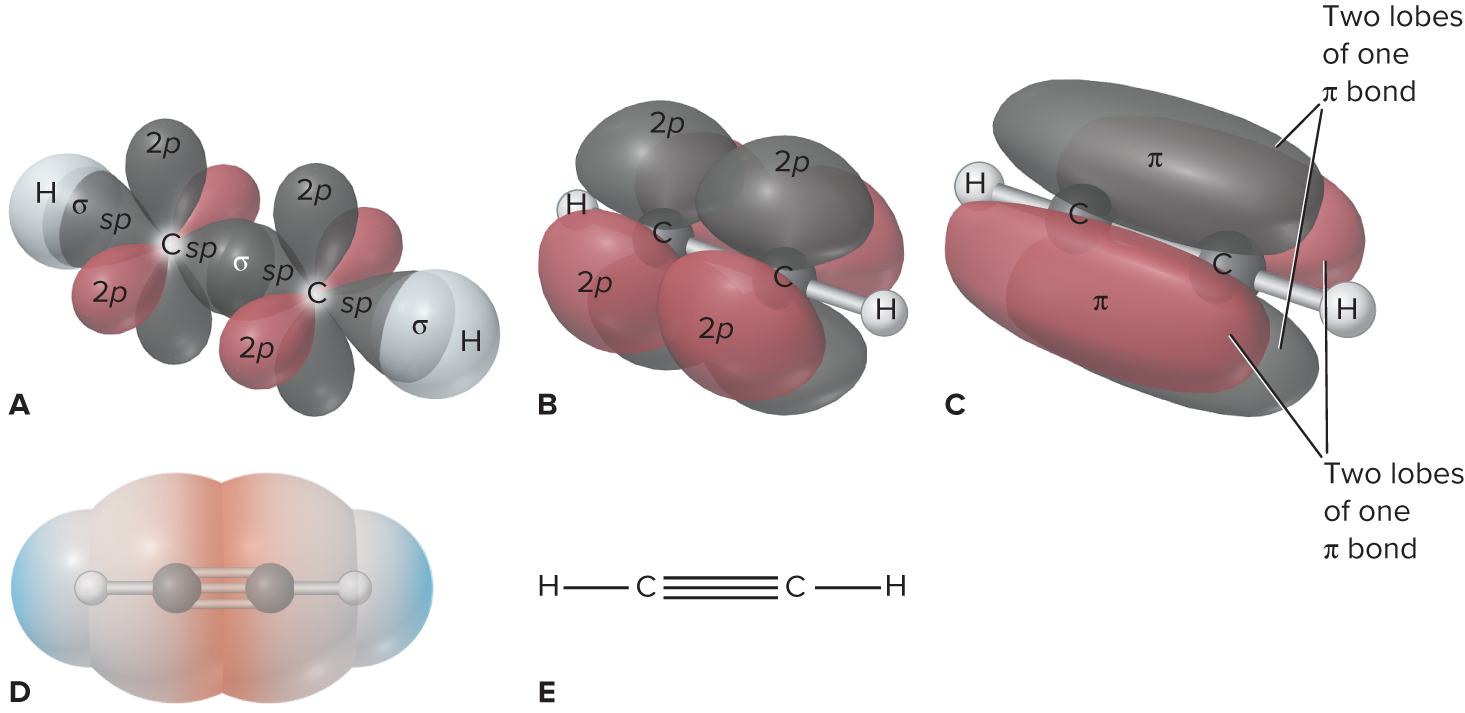
Pi bond (π bond)
A bond formed by the side-to-side overlap of orbitals, increasing electron density between two nuclei
Includes the bonds formed after a single σ bond, such as double and triple bonds
Has two equally-occupied lobes of electron density, above and below the σ bond axis
Utilizes the unhybridized p orbitals, but is weaker due to less overlap
3
New cards
Free rotation
This is permitted in σ bonds due to overlap not being affected
4
New cards

Restricted rotation
This occurs in π bonds (if trying to rotate just one atom) due to overlap being reduced
Results in the creation of distinct isomeric structures for certain molecules