ACC 450: Exam 2
 Call Kai
 Learn
 Practice Test
 Spaced Repetition
 Match
 Flashcards
 Knowt Play
1/110

There's no tags or description
Looks like no tags are added yet.
111 Terms
How long do financial statement audits take? (List of Process)
Study the image

Step 1
Plan the audit
Establish an understanding with the client as to the nature of the engagement.
Develop an audit:
Strategy
Plan
Program
Step 2
Obtain understanding of client, its environment, and internal control
Perform risk assessment procedures, including:
Inquiries of management and others within entity
Analytical procedures
Observation and inspection of activities, operations, etc.
Inquiries of others outside the company (e.g., legal counsel, valuation experts)
Review information from external sources
Step 3
Assess the risks of material misstatement & design further audit procedures
Identify & assess risks of material misstatement for account balances, classes of transactions, and disclosures; consider:
What can go wrong?
The magnitude involved?
Likelihood of a material misstatement?
Design further audit procedures
Step 4
Perform further audit procedures
Approaches:
Tests of controls
Analytical procedures
Tests of details of transactions & balances
Audit procedures:
Inspection
Observation
Inquiry
Confirmation
Recalculation
Reperformance
Step 5
Complete the audit
Audit procedures:
Search for unrecorded liabilities
Review minutes of meetings
Perform final analytical procedures
Perform procedures to identify loss contingencies
Perform review for subsequent (after something happened) events
Obtain representation letter
Evaluate audit findings
Step 6
Form an opinion & issue the audit report
Public company reporting requires reporting on internal controls & on the financial statements.
Nonpublic company reporting ordinarily involves only reporting on the financial statements.
Client acceptance (What are auditors most concerned about when accepting new clients?)
A. Engagement risk of auditors is the overall risk to the CPA firm of association with a particular audit client. The primary elements are the risk that a particular client will damage the firm’s reputation and/or result in litigation.
B. Client acceptance checklists
1. What about the “bad” (near bankruptcy) clients? No one talks about them. Bad clients and bad firms find each other. Must have a “good” client checklist.
C. Is the client auditable?
What circumstances would make the client less auditable?
- Financial problems or risk of going bankrupt soon. If management does not help get the information you need or have poor internal controls.
- Management integrity
- Litigation problems
- Files & records incomplete
Determine the reason for audit
3. The CPA firm may be asked to prepare a proposal and oral presentation.
A. Audit committee
Communication with predecessor auditor
REQUIRED
Auditor must attempt to communicate with predecessor auditor (the auditor who got fired)
A. Why is this important? Need to get as much information as you can
B. What to do first? Ask the prospective client if you can talk to the predecessor auditor
C. What if the client refuses?
If client refuses, auditor moves on, nothing else to do
D. What if predecessor auditor refuses?
If predecessor declines to communicate, successor should consider this lack of cooperation and the reasons behind it (as best s/he can tell) when deciding whether to accept client.
If predecessor auditor refuses, they may be penalized and auditor may be unable to make an accurate judgment
E. Who has to take the initiative? You (the auditor) must take initiative
F. Questions asked?
- How long were you with the client?
- Any issues in previous audits?
- What issues led to your firing?
- Was the client & management helpful? Cooperative?
- Integrity management?
- Any disagreements on accounting rules?
- How come you are no longer with the client?
G. At this stage the auditor will not generally review working papers of predecessor. Later, the successor may review the predecessor's working papers; this while helpful and often done, is not required.
Establish understanding with the client regarding services to be performed. Understanding must include:
A. Management is responsible for
1. Financial statements
2. Effective internal control (IC) over financial reporting
3. Compliance with laws and regulations
4. Providing representation letter to auditor at conclusion of audit
5. Adjusting financial statements for material misstatements
B. Audit of financial statements includes obtaining understanding of IC sufficient to plan audit and determine nature, timing and extent of procedures to be performed;
C. This communication is normally done in an engagement letter.
1. To: Client
2. From: Auditor
3. Nature: Offer of Service- If Signed & Returned, Becomes Contract
4. Items included:
A. Timing, client assistance
B. Reasonable assurance (not guarantee)
D. Arrangements with predecessor auditor
E. Specialists to be used
F. Limitations of liability
G. Fees and billing arrangements (lowballing).
H. Other services.
External to Entity- Data bases (Information Sources)
A) Data bases
1) EDGAR
2) Compustat
3) Financial Accounting Research System
4) Dun & Bradstreet
5) Standard & Poors
6) Value Line
B) Industry, Regulatory, and Other External Factors
Internal to Entity (Information Sources)
A. Tour client operations
B. Corporate bylaws / Minutes to meetings of Board of Directors
C. Inquiries (Ask a lot of questions)
D. Prior year information (Tax returns, etc.)
Business Perspective- Understanding the client
1. Auditors obtain in-depth knowledge needed to develop rich mental models of the client and their business before they gather and evaluate information about current operations.
A. Investors, Regulators, and Other external and internal parties.
B. What is the client’s business model?
What is the financial structure of the client?
What are the client’s products and business lines?
Whose are its major customers and suppliers?
What types of transactions does the client engage in?
What are the client’s accounting policies?
C. Example: (Warranty Expense)
Traditional | Business Perspective |
|
|
Last year’s warranty expense | Look at business processes |
Inquire of management | Quality of products |
Look at industry norms | New products? |
Come up with your own independent estimate | Changes to manufacturing processes
|
Engagement Characteristics- Understanding the client
1. Difficult Accounting/Auditing Issues
2. Errors Found in Prior Audits
3. New Client -- First Year (big learning curve) vs. Recurring Client
Auditor’s Variables
1. Experience of Personnel Assigned to Audit -> associate, partner, senior
2. Time Budgets
Example: Audit Partner: 25 hours at $600 = $15,000
Audit Manager: 50 hours billed at $400 = $20,000
Audit Senior: 200 hours billed at $250 = $50,000
Audit Associate: 250 hours billed at $150 = $37,500
A. Adherence to the time budget is one of the most heavily weighted performance measures used to evaluate seniors and associates.
B. Auditors are more likely to underreport when time budgets (1) Become more difficult to meet, (2) When they face pressure from their superiors to do so, or (3) When they believe their peers are underreporting.
Example: Budget: 1) 20 hours, 2) 18 hours 1) Actual: 25 hours, 2) 22 hours 1) Report: 21 hours, 2) 19 hours -> firm loses when budgets don’t match actual and reports
3. Use of Specialist – About 79% of audits utilize specialists.
A. The most common use of specialists relates to Estimates and Valuations (e.g., assets acquitted in business combinations, financial instruments, goodwill impairments, impairment of long-term assets, intangible assets) and Evaluations of Physical Items (e.g., inventory, mineral and oil & gas reserves, PPE useful lives / salvage values).
B. Specialists can be hired by the client or the auditor, or they may be employed by the client or auditor.
4. Use of Internal Auditors
Materiality
1. In our opinion, the financial statements referred to above present fairly, in all MATERIAL respects, the financial position of XXX Company as of December 31, 2009, and the results of its operations and its cash flows for the year then ended in conformity with generally accepted accounting principles.
2. Definition: “Magnitude of an omission or misstatement of accounting information that, in the light of surrounding circumstances makes it probable that the judgment of a reasonable person relying on the information could have been changed or influenced by the omission or misstatement,” AU 312.06
or simply the relative importance of a F/S item to fair presentation.
3. Select a measure (percentage) of a base. Some examples follow.
A. 5 to 10% of income before taxes.
B. .5 to 1% of total revenues.
C. .5 to 1% of total assets.
D. 1% of owner's equity.
- CPA firm chooses which base to use (want to pick something that is more stable rather than something where the number fluctuates)
Note -- Robert Elliot of KPMG came up with 1.62/3greater of assets or revenues.
Example: Let’s say you use 5% of net income. If you use one single year, this measure may not be very stable. Auditors might be better to use “normalized earnings” or an average over multiple years. Suppose a company has net income of $3,000,000 one year and the auditors decides that 5% of that amount, $150,000, would be material. Let’s say the following year the company has net income of $250,000. If the auditors use the 5% benchmark again, the overall materiality would be $12,500 and the auditor would have to do a much more extensive audit.
Uses of Materiality
A. Planning—largely quantitative. To help determine sample sizes.
1. Must plan the audit to obtain reasonable assurance of detecting misstatements that he/she believes could be large enough, individually or in the aggregate, to be quantitatively material to the financial statements.
2. Helps to determine audit scope.
3. Materiality levels generally include an overall level for each statement (e.g., $150,000 for balance sheet and $100,000 for income statement).
4. After determining a planning materiality level, an auditor must in some manner relate it to individual financial statement accounts. Ordinarily it is disaggregated into smaller amounts for individual accounts referred to as tolerable misstatement for each account. To illustrate, assume the materiality base has been determined to be 5% of net income. For this year, net income is $3,000,000. So the overall materiality amount for the income statement is $150,000. At that point one would have to allocate the $150,000 to each of the income statement accounts to determine the tolerable misstatement for each account.
Materiality- Understanding numbers & amounts
A lower amount means you need to search for smaller misstatements (this will be more work).Assume that there is a bowl of M&Ms for which you need to obtain an approximate count. If you need to know within ± 2 M&Ms, you probably have to count the M&Ms in the bowl (i.e., 2 is a “low materiality measure” which requires a count). But if you only need to know the number of M&Ms within ± 100 M&Ms, you probably can effectively make a close enough guess (i.e., 100 is a “high materiality measure” which requires less work).
- The smaller the materiality amount, the more work you will need. -> There is not much buffer.
Examples:
A. Materiality is inversely related to audit effort (cost) if audit risk is held constant:
AR = .05 Materiality = 50,000 Effort = Higher (Materiality # lower)
AR = .05 Materiality = 100,000 Effort = Lower (Materiality # higher
B. Audit risk is inversely related to audit effort (cost) if materiality is held constant:
AR = .05 Mat. = 50,000 Effort = Higher (more work required to get AR to 5% vs AR at 10%)
AR = .10 Mat. = 50,000 Effort = Lower (less work required)
Evaluation
Used for determining opinion at the end of the audit. An auditor aggregates misstatements to determine whether there is a material misstatement of the financial statements.
Question: Revenues are materially overstated, but this is offset by materially overstated expenses. Are we OK here?
- No, we are not only concerned about net income, but we are also concerned about revenue and different types of expenses.
Question: Should material thresholds be disclosed in the audit report?
Example: Income statement $1,000,000 net income threshold
- This would be useful; however, the client will read this and know the threshold. Clients could make it to where their income could be $950k more than it is. Therefore, can’t disclose this
Question: Since fixed assets are often a large dollar number (and very material to the financial statements), should a lot of time be spent auditing this account?
- No, we don’t spend much time on this. We spend more time on accounts with high volume transactions and high inherent risk.
Assessing the risks of material misstatements & Designing further audit procedures
Overall Approach
A) What could go wrong?
B) How likely is it that it will go wrong?
C) What are the likely amounts involved?
Assessing the Risks of Material Misstatements
A. Use all evidence obtained about the client and its environment to:
1. Identify risks (e.g., inventory obsolescence)
2. Relate risks to what can go wrong at the relevant assertion level (e.g., inventory value misstated)
3. Consider whether magnitude of impact could result in a material misstatement (e.g., impact on inventory and cost of goods sold)
4. Consider the likelihood that the risk would occur (e.g., consider compensating controls)
Assessing the risks of Material Misstatement Due to Fraud (AU 316)
An audit should be planned and performed to obtain reasonable assurance of whether the financial statements are free of material misstatements, whether caused by error or fraud.
Identifying Fraud Risks
A. Discussion among Engagement Personnel (“brainstorming”).
Brainstorming is a group discussion designed to encourage auditors to creatively assess client risks, particularly those relevant to the possible existence of fraud in the organization. Brainstorming sessions occur predominantly during the early planning phases of the audit. Brainstorming sessions are attended by the entire engagement team and should be led by the audit partner or manager.
Recent research studies indicate that the typical group “brainstorming” approach produced social loafing. CPA firms are concerned that brainstorming may not be having the desired effects.
To encourage interactive and constructive group dialogue and idea exchange, the following guidelines are typically followed during the brainstorming session:
· Need to discuss how and where could fraud occur?
· Emphasize need to exercise professional skepticism-A state of mind that is characterized by appropriate questioning and critical assessment of audit evidence. Auditors should not assume that management is dishonest nor honest. Skepticism involves the validation of information through probing questions, the critical assessment of evidence, and attention to inconsistencies.
· Suspension of criticism
· Freedom of expression
· Quantity of idea generation
· Respectful communication
Examples of Risk Factors
A. Fraudulent financial reporting
1. Rapid growth or unusual profitability when compared to companies in the industry.
2. A complex or unstable organizational structure.
3. Inadequate monitoring of controls.
4. High turnover rates of accounting, internal audit, or IT staff.
5. Management compensation tied to EPS, stock price.
B. Misappropriation of Assets
1. Known or anticipated future employee layoffs.
2. Inventory items that are small in size, of high value.
3. Inadequate segregation of duties or independent checks on performance.
4. Inadequate record keeping.
Responding to Fraud Risks
A. Overall (as risks increase)
1. Assign personnel with needed skills to respond to risks, and more supervision.
2. More attention to accounting policies.
3. Less predictable auditing procedures (e.g., timing, sampling techniques, perform procedures at locations on an unannounced basis)
4. Specific responses—Consider need to increase scope of procedures—nature, timing and extent
5. Consider management override responses.
Communications about Fraud
A. All fraud should be reported to an appropriate level of management.
B. All management fraud should be reported to the audit committee.
C. All material fraud should be reported to management and the audit committee.
D. Disclosure of fraud beyond the company— May be required in some circumstances.
Using AI for Fraud Risk Assessment
A. This study examines the potential of generative artificial intelligence (GenAI) to improve auditors’ fraud risk assessments.
B. Results from six studies showed that:
1. GenAI significantly enhances fraud risk identification, enabling auditors to identify more total and highly-relevant fraud risks without increasing irrelevant risks, while also improving task efficiency.
2. Novice auditors with access to GenAI identified more relevant fraud risks than experienced auditors without GenAI.
3. No clear benefits to human use of GenAI for audit planning adjustments in response to identified fraud risks.
Developing An Audit Plan- Internal Control Structure Part of the Program
A. Organized around major transaction cycles such as financing cycle, payroll cycle, expenditure cycle, fixed asset cycle, inventory cycle, revenue cycle, investments cycle.
Substantive Test Part of the Program
A. Often organized around balance sheet accounts. -> balance sheet items easier to audit. Spend more time on balance sheet vs income statement.
B. Balance sheet accounts relationship to income statement accounts.
The Audit Trail- Directional Testing
Source Docs → Journals → Ledgers → Trial Balance → Financial Statements
A. Vouching backward — existence (overstatements) -> assets & revenues
B. Tracing Forward — completeness (understatements) -> liabilities & expenses
C. Either direction (a or b) when proper valuation of recorded transactions is the issue.
Must do both vouching & tracing
Assertions (PCAOB)
A. Existence and occurrence—assets, liabilities, and equity interests exist and recorded transactions and events have occurred.
· More important for Assets and Revenues
· Gets more at Overstatements
· Vouching
B. Rights and obligations—the company holds rights to the assets, and liabilities are the obligations of the company.
· Titles, deeds, lease agreements, consignments, etc.
C. Completeness—all assets, liabilities, equity interests, and transactions that should have been recorded have been recorded.
· More important for Liabilities and Expenses
· Gets more at Understatements
· Tracing
D. Cutoff. Transactions and events have been recorded in the correct period.
E. Valuation, allocation and accuracy—all transactions, assets, liabilities, and equity interests are included in the financial statements at proper amounts.
· Fair market values
· Specialists
F. Presentation and disclosure—accounts are described and classified in accordance with generally accepted accounting principles, and financial statement disclosures are complete, appropriate, and clearly expressed.
· Notes to the financial statements
· Related party transactions
· Subsequent events
Why do auditors consider internal control?
A. To assess control risk and determine the nature, timing and extent of audit procedures.
Audit Risk = Risk of material * Risk auditor doesn't
Misstatement detect misstatements
Inherent risk * Control Risk * Detection Risk
Control Risk: The risk that the internal control will fail to prevent, or detect and correct, material misstatement that occur.
B. Because auditors are required by the PCAOB and AICPA.
Defining Internal Control (IC)
Process, effected by the entity’s board of directors, management and other personnel designed to provide reasonable assurance regarding the achievement of objectives in the following categories:
A. Reliability of financial reporting.
B. Effectiveness and efficiency of operations.
C. Compliance with applicable laws and regulations.
Cost of internal control should not exceed expected benefit.
5 Components of Internal Control
1) Control Environment
2) Risk Assessment
3) The Accounting Information & Communication System
4) Control Activities
5) Monitoring
Control Environment
Management's and directors' attitudes, awareness & actions
A. Integrity and ethical values.
B. Board of directors independence of management and oversight of internal control.
C. Organizational structure.
D. Individual accountability.
Risk Assessment
The organization’s process of identifying potential risks to its financial reporting objectives and developing actions to address those risks. Note: This is not the risk assessment we’ve been talking about with the “audit risk model.”—i.e., audit risk is composed of inherent risk, control risk, and detection risk.
A. Changes in the organization’s operating environment.
B. New personnel.
C. New or revised information systems/new technology.
D. Rapid growth within the organization including new products.
E. New/changes in accounting principles.
The Accounting Information & Communication System
An information system that should include methods & records that:
A. Identify and record all valid transactions.
B. Provide, on a timely basis, sufficient detailed information about transactions to permit proper classification for financial reporting.
C. Allow for the recording of transactions at their proper monetary value in the financial statements.
D. Provide sufficient information to permit recording of transactions in the proper accounting period.
E. Properly present the transactions and related disclosures in the financial statements.
Control Activities
An organization will establish policies and procedures to help ensure management directives are carried out. These policies and procedures represent control activities. They cover a range of activities and may include the following:
P Performance reviews.
I Information processing controls.
P Physical controls.
S Segregation of duties (Authorization, Recording, and Custody).
Example of Segregation of Duties:
Assume a client of your CPA firm has the following accounting-related functions:
1. Maintain general ledger.
2. Maintain accounts payable ledger.
3. Maintain accounts receivable ledger.
4. Maintain cash disbursements journal and prepare checks for signature.
5. Reconcile the bank account.
6. Handle and deposit cash receipts.
Undesirable combinations are as follows:
Cash receipts and accounts receivable
Cash receipts and credit memos on sales returns and allowances
Cash disbursements and accounts payable.
Cash receipts and bank reconciliation
Cash disbursements and bank reconciliation
General ledger and cash receipts
Monitoring
Due to changes among personnel and within an organization, it is essential that internal controls be monitored over time to determine whether they continue to be relevant and able to address new risks of the organization.
Internal Control Concepts
To understand this area you need to understand the distinction between what an auditor's understanding of a control being "implemented" as compared to his/her assessment of its "operating effectiveness."
Implemented (Placed in operation)
To obtain this understanding, for example, an auditor may have obtained a flowchart of the revenue cycle, and s/he simply observes employees performing the duties outlined on that flowchart.
1. Auditors must on all audits determine that the IC has been implemented (placed in operation).
2. Auditors use this knowledge of whether the IC has been placed in operation to:
A. Identify types of potential misstatements.
B. Consider factors that affect the risk of material misstatement.
C. Design tests of controls, when applicable
D. Design substantive procedures.
Operating Effectiveness
Relates to tests of controls. Tests of controls address operating effectiveness. Operating effectiveness is concerned with
1. How a control was applied
2. The consistency with which it was applied
3. By whom.
Auditors perform tests of controls to evaluate operating effectiveness. For example, recall our "approved customers list." An auditor may select a sample of 50 sales invoices to determine that the credit sale is to a properly approved customer. Evidence on operating effectiveness is always necessary to assess control risk at a level lower than the maximum.
Tests of Controls Example
Purpose of the Control: Prevent misstatements arising due to errors in the billing of customers and the recording of sales transactions.
Control Description: Client has implemented the control of requiring a second person to review the quantities and prices on each sales invoice.
When would an auditor decide to perform tests of controls or not to perform them?
When control risk is low and detection risk is high.
When they expect the client’s internal controls are operating effectively or when substantive procedures alone cannot provide enough evidence.
2 Control Risks
1) Planned assessed level of control risk
2) Assessed level of control risk
Planned assessed level of control risk
This level is lower than the maximum level (the maximum level means the highest risk) when the assessed level of the risk of material misstatement presumes that controls operate effectively.
The planned assessed level of control risk is at the maximum unless the auditor plans to perform tests of controls to obtain evidence on whether internal control operates effectively. Planning and assessing control risk below the maximum level requires:
1. Identifying IC policies and procedures relevant to specific assertions that are likely to prevent or detect misstatements in assertions.
2. Performing tests of controls to evaluate the effectiveness of such policies and procedures.
Again-- if no tests of controls have been performed, control risk must be assessed at the maximum level If some tests of controls have been performed it may be possible to assess it at a level lower than the maximum.
Assessed level of control risk
The level at which control risk is assessed for purposes of determining the scope of substantive procedures. If no tests of controls are performed this is at the maximum level. If tests of controls have been performed the results of these tests determines its levels. For example, if tests of controls found:
1. Few or no exceptions the auditor will conclude that the controls operate effectively, and assess control risk at a low level.
2. More exceptions, the auditor will conclude that controls operate less effectively, and assess control risk at a level above the low level (perhaps “moderate.”).
3. If many exceptions were found, the auditor will conclude that controls do not operate effectively, and assess control risk at the maximum level.
Level of Understanding Needed
A. Required— Whether controls have been implemented (or placed in operation). This means the entity is using the control.
B. In planning the audit, such knowledge should be used to:
1. Identify types of potential misstatements
2. Consider factors that affect the risk of misstatements
3. Design tests of controls, when applicable
4. Design substantive procedures
NOTE: Because of the above auditors must always obtain an understanding of internal control on all audits. They can't simply say, "I don't worry about internal control—my clients don't have any and I just assess control risk at the maximum."
C. Level of knowledge required: Controls have been placed in operation (implemented). For the accounting information system, auditors perform a walk-through in which they trace one or two transactions of each major type through the system. For example, one might begin with a customer of the client’s purchase order and follow the revenue cycle all the way through when that purchase is shipped, billed and cash is collected.
D. Not required, but possible: The auditor may at this point choose to perform various tests of controls to obtain evidence on operating effectiveness.
Documentation Required
Understanding obtained to plan the audit must be documented. Form and extent affected by size and complexity of client and nature of internal controls. Documentation techniques include:
A. Internal control questionnaire
B. Checklists
C. Written narrative of IC
D. Flowcharts
Auditors' Risk Assessment and Consideration of Internal Control
Planned assessed level of risk.
1. Planned and assessed control risk below maximum level requires:
A. Identify Internal Control procedures relevant to account or assertion.
B. Test the Controls
2. If no tests of controls have been performed, control risk must be assessed at...... maximum or 100%.
B. As the assessed level of control risk increases, the acceptable level of detection risk decreases. The auditor may modify the nature, timing and extent of substantive tests as follows:
1. Nature – More effective audit procedures
2. Timing – Year-end instead of interim
3. Extent – Larger sample size
Why would an auditor have a planned assessed level of control risk at the maximum level?
When internal controls are ineffective, missing, or when testing them is inefficient.
When would an auditor perform tests of controls?
The controls appear to be working as effectively & testing them is cost justified.
What do you mean by tests being cost justified?
Test controls may increase costs and work but can greatly decrease audit risks.
No tests of controls performed
Assessed Level of Control Risk → Maximum or 100%
Tests of controls performed, system found not to be operating effectively
Assessed Level of Control Risk → Maximum
Tests of controls performed, system operating somewhat effectively, but not as well as anticipated
Assessed Level of Control Risk → Higher than planned assessed level (auditor must raise the risk assessment & expand substantive testing)
Tests of controls performed, system operating as anticipated
Same as planned (initial lower risk assessment is supported & maintained)
Communication of Control Related Matters
To management and those charged with governance (ordinarily the audit committee). The auditor’s objective in an audit of financial statements is to form an opinion on the financial statements, not to identify significant deficiencies. But when an auditor becomes aware of significant deficiencies or material weaknesses they must be communicated in writing to those charged with governance (as well as to management).
A. Deficiency—When the design or operation of a control does not allow management or employees, in the normal course of performing their assigned functions, to prevent or detect material misstatements on a timely basis.
B. Significant Deficiency—A deficiency in internal control (or combination of deficiencies) that is less severe than a material weakness, yet important enough to merit attention by those responsible for oversight of the company’s financial reporting.
C. Material Weakness—A deficiency in internal control (or combination of deficiencies) such that there is a reasonable possibility that a material misstatement of the company’s financial statements will not be prevented or detected on a timely basis.
Deficiency
Severity: Not considered
Required communication to management & those charged with Governance: No, but professional judgment may dictate communication is appropriate.
Significant
Severity: Less severe than a material weakness
Required communication to management & those charged with Governance: Yes, unqualified opinion
Material Weakness
Severity: Reasonable possibility of a material misstatement
Required communication to management & those charged with Governance: Yes, no unqualified opinion (adverse opinion)
The best internal controls may break down due to
Misunderstandings, mistakes of judgment, carelessness, and collusion and/or management override.
If internal control is strong, can the auditor entirely omit substantive testing?
NO, no matter how good client’s internal controls are, management can still go in there and create misstatements.
Areas difficult to control
Non-routine transactions and accounting estimates.
Assume you have audited the client for a few years. If the controls have changed over time then the new controls should be tested. However, if the controls have NOT changed then you may be able to rely on evidence of operating effectiveness obtained in previous audits.
In these situations, tests of controls must be performed every third audit. [Again this would be the case only for nonpublic companies]. The PCAOB does not allow this.]
Service Organizations
Provide processing services to companies, referred to as user entities, that decide to outsource a portion of their processing. Outsourced services include payroll, IT systems, accounts payable, internal audit, accounts receivable, etc.
For example, a CPA’s client (the user entity) may outsource its payroll function to a service organization. AICPA AU 402 (PCAOB 324) requires that the auditors of the user entity obtain an understanding of how the user entity uses the services of the service organization, including their nature, significance and effect on internal control.
Obtain the report of a service auditor on the service organization’s controls.
Audits of Internal Control of Financial Reporting (ICFR)- Public Companies
PCAOB reports indicate that flaws persist in the auditing of U.S. companies, especially in internal control over financial reporting (ICFR), reporting on revenue, accounting estimates, inventory tracking and auditor independence.
1. For publicly traded companies, Section 404 of the Sarbanes-Oxley Act requires an integrated audit.
A. Management to perform an assessment and evaluation of internal control over financial reporting (ICFR), and to issue its own report;
B. The company’s external auditors to audit and report on internal control over financial reporting. The auditors should evaluate:
1. Adequacy of management’s assessment
2. Results of auditor’s evaluation of design
3. Results of tests of operating effectiveness
4. Negative results of substantive procedures performed during fin. statement audit
5. Any identified control deficiencies
C. An audit of ICFR is designed to obtain reasonable assurance that deficiencies, that, individually or in aggregate, would represent material weaknesses are identified. It is not designed to detect less severe deficiencies
D. To perform an audit of ICFR the auditor must also audit the financial statements.
Overall Approach- Stages of audit of ICFR
A. Plan the engagement
B. Use a top-down approach to identify controls to test. Key emphasis:
1. Begin at the financial statement level
2. Identify significant accounts & disclosures
3. Identify relevant assertions
4. Identify & evaluate entity level controls first before drilling down to process level controls
5. Test and evaluate design effectiveness of ICFR
6. Test and evaluate operating effectiveness of ICFR
7. Form an opinion on effectiveness of ICFR
1. The focus is primarily on significant accounts and disclosures and relevant assertions; an account is significant and an assertion is relevant if there is a reasonable possibility that the account/assertion could contain material misstatement.
2. The auditor should design his/her testing of controls to accomplish the objectives of both audits simultaneously: -> 1 team, both at the same time (financial and internal)
The audit of ICFR should be integrated with the audit of the financial statements, although the objectives are not identical.
1) Audit ICFR -- All significant controls tested. (When the auditors perform an integrated audit, the option of not testing controls for a significant account is not available, because controls over all significant accounts must be tested to provide a basis for the opinion on internal controls.)
2) Financial statement audit -- Use a combination of test of controls and substantive procedures
Opinions on Internal Control
Unqualified opinion may be issued when there have been no identified material weaknesses and when there have been no restrictions on the scope of the work.
Material weakness—requires Adverse opinion
Scope limitation—requires Qualified opinion
The reports on financial statements and ICFR may be separate, or combined, and should be dated the same.
Effects of Data Analytics on Sampling
A) Task- compare shipping data to revenue data could use a 100% sample.
B) Task- inventory observation. Can’t do a 100% sample.
Situations when the Auditor is Likely to use Data Analytics
· Evidence to support the audit test is available in electronic form.
· The auditor’s tests are supported by reliable and relevant data in digital form, making data analytics efficient.
· Relevant data is reliable and internal controls over the reliability of data are strong.
· Relevant data is clean or can be cleaned up easily.
Situation when the Auditor is Likely to use Audit Sampling
· Evidence to support the audit test is not available in digital form.
· The audit population is small and can efficiently be tested using traditional audit procedures.
· Relevant data is not reliable and internal controls over the reliability of data are weak.
· Relevant data may be in different formats and is not easy to use.
Definition of Audit Sampling
The application of an audit procedure to less than 100 percent of the items for the purpose of evaluating some characteristic of the balance or class.
What is the risk in using sampling?
The sample is not representative of the population (not a perfect representation of a population)
You want to have a low sample risk as possible
Non-representative sampling example involving the 1936 Presidential race for president. A poll was taken prior to the election that indicated that a Republican would win by an 18% margin. A Democrat ended up winning the election by a margin of 11%. How could this be?
Sample was from mainly upper & middle class which is more republican. There is too much sampling risks with this as anyone who owned a car or telephone would be included in the sample (upper & middle). This overlooked the lower class.
Non-Statistical Sampling
A. Do not use statistical calculation to express results.
B. You need to be an experienced auditor to use this. Non-statistical sampling
C. Generally use higher sample sizes to “cover” themselves.
Advantages of Statistical Sampling
A. Plan an efficient sample
B. Measure the sufficiency of the evidential matter
C. Evaluate the sample results
Primary advantage is being able to OBJECTIVELY QUANTIFY RESULTS
Sampling Risk Definition
Sampling risk relates to the possibility that a properly drawn sample may not be representative of the underlying population. The auditor may thus form a different conclusion based on the sample than s/he would have based on an examination of the entire population.
Sampling risk can be deceased by:
1) Get most representative sample possible
2) Increase sample size (increase of sampling 1000, sample 4000)
Non-sampling risk is not due to examining only a portion of the population. It is due to “human” type errors. It consists of all aspects of audit risk not due to sampling, such as:
A) Failure to select the appropriate auditing procedure
B) Failure to recognize errors in documents examined
C) Misinterpreting the results of audit tests
Random Number Selection
Every item in the population has an equal chance of being selected. Best way to obtain a representative sample.
Systematic Sampling
Calculate a sampling interval by dividing the number of items in population by the sample size.
Auditors wish to examine 150 paid checks from a population of 9,000 checks.
9,000/150 = 60 Start randomly at one of the first 60 checks.
Check #37
Check #97
Check #157
Check #217 (etc.)
Haphazard (Block) Selection
Made without any special reason for including or excluding an item. Cannot be used in statistical sampling.
Attributes Sampling
Primarily used to assess control risk, by conducting tests of controls.
A. Examples:
1. Credit only given to only to authorized customers.
2. Billing department verification of agreement of sales invoice prices with authorized prices.
Variables Sampling
Estimating dollar amounts or quantities—primarily to limit detection risk by conducting substantive testing (detailed tests of balances).
A. Examples:
1) Confirming receivables and evaluating sample results.
2) Tests of inventory quantities and amounts.
Tolerable Rate
Auditor determines the maximum rate of deviations from the control policy - he or she could accept without altering the planned assessed level of control risk.

Risk of assessing control risk too high
You thought controls weren’t good, but they turn out to be good.
Risk of assessing control risk too low
You think controls are good, but control risk turns out to be high.

Tests of Controls- Sampling Steps
A. Determine the objective
B. Define the deviation conditions - be specific
For checks -> the wrong people signed the check, not enough people signed the check
C. Define the population
All the checks
D. Specify risk of assessing control risk too low and tolerable deviation rate.
5% -> risk of assessing control risk too low, you set tolerable rate
E. Estimate the population deviation rate.
Basis for determining—Usually experience, possibly a pretest
F. Determine Sample Size
G. Select the sample
H. Perform the sampling plan
I. Evaluate the sample results
J. Document the sampling procedure
Determine Sample Size

Attributes Sampling Example
Concept: Tests of controls are designed to provide the auditors with assurance that deviation rates do not exceed acceptable levels.
2. Example:
A. 5% risk of assessing control risk too low. -> always 5%
B. 1% expected population deviation rate.
C. 6% tolerable rate.
3. What should the sample size be? (see Figure 9-4)
- 78 (1) -> what does this mean? -> means our sample size is 78 and if we get 1 or 0 deviation, we can stop and say we’re good. In other words, we leave it the way it is.

Achieved Upper Deviation Rate
Sample deviation rate + allowance for sampling risk
When the achieved upper deviation rate is in excess of the tolerable rate, the planned assessed level of control risk is not justified.
Sampling- Substantive Tests
1) Materiality Threshold
2) Tolerable Misstatement
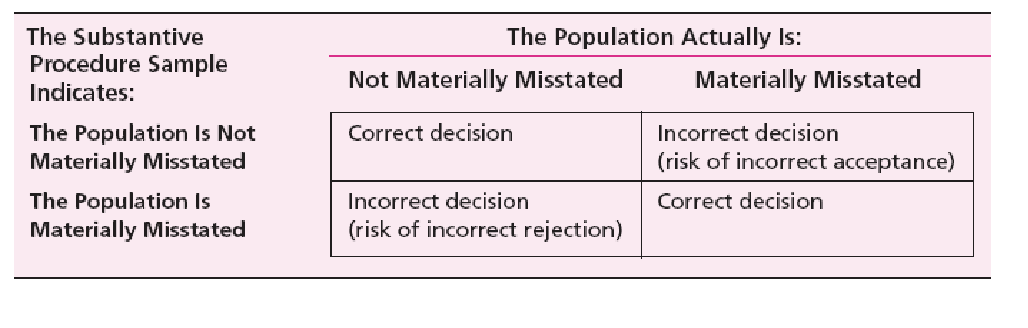
3) Substantive Tests- Sampling Risk ($ amounts on balance sheet)
A. Risk of incorrect rejection of a recorded account balance
B. Risk of incorrect acceptance of a recorded account balance More concerned about this one
Substantive Tests- Sampling Steps
A. Audit objective
B. Define population Number of items or $ amount on Financial statement
C. Audit sampling technique
D. Determine sample size
Risk of incorrect rejection
Risk of incorrect acceptance
Tolerable misstatement
Population variation
Population size
E. Sample selection method
F. Perform the sampling plan
G. Evaluate sample results
Known misstatements in sample--project to population
H. Document the sampling procedure

Classical Variables Sampling Methods
1) Mean per unit sampling
2) Difference estimation
Mean Per Unit Sampling
1. Objective: Find average dollar value of items in a sample. Project this to population by:
Sample mean (# of items in the population) = Estimated total value of population
2. Estimated total value of population +/- allowance for sampling risk should contain the true population total at a certain level of confidence.
Calculate Acceptable Interval & Compare to Book Value
If BV is in acceptable Interval, Accept
If BV is outside acceptable interval, Reject
Interval = ETAV +- ASR
Difference Estimation
1) Same approach as mean-per-unit
2) Instead of projecting the average mean-per unit of the sample to the population we project the average difference of the sample.
3) Projected Misstatement = (Average sample difference) → Book Value - Audit Value
(Average sample difference) (# of items in population)