PL3105 remaining content
 Call Kai
 Learn
 Practice Test
 Spaced Repetition
 Match
 Flashcards
 Knowt Play
1/158

There's no tags or description
Looks like no tags are added yet.
159 Terms
three components that make up attitudes
cognitive: thoughts & beliefs
affective: emotional reaction
behavioural: actions or observable behaviour
cognitively based attitudes
an attitude based primarily on people’s beliefs about the properties of an attitude oject
based on relevant facts
affectively based attitudes
based more on people’s feelings and values than on their beliefs about the nature of an attitude object
they do NOT come from examining facts
behaviourally based attitudes
an attitude based on observations of how one behaves towards an attitude
similar to the self-perception theory
explicit attitudes
attitudes that we consciously endorse and can easily report
implicit attitudes
attitudes that ar einvoluntary, uncontrollable, and at times conscious
true or false:
attitudes are good predictors of behaviour
false
studies have found the correlations between attitudes and behaviours are close to zero
which conditions under which attitudes can predict behaviour?
when attitudes are accessible and specific
A: predict spontaenous behaviours
S: predict deliberative behaviours
attitude accessibility → impact on behaviour
strength of association between attitude object & evaluation of object
high: attitude comes to mind more easily when encountering object
spontaneous behaviour
theory of planned behaviour
best predictors of people’s planned, deliberative behaviours are their behvaioural intentions
includes: attitudes toward specific behaviour, subjective norms, and perceived control of behaviour
according to the theory of planned behaviour, what are the three factors determining intention?
specific attitudes → specifc attitudes can be expected to predict behaviour
subjective norms → people’s beliefs about how people they care about will view the behaviour in question
perceived behavioural control → how easily people believe they can perform the behaviour
how do attitudes change?
behaviourally: your attitudes change in response to your behaviour
cognitively: people change their thoughts about the items
emotionally: where feelings change attitudes
behavioural attitude change
people can change their attitude after behaving in dissonant ways
when they cannot explain behaviour with external justification
when image is threatened
cognitive attitude approach change
there’s a range of conditions under which people are most likely to change their attitudes in response to persuasive messages
effective persuasion can cause people to change
elaboration likelihood model (ELM)
persuasive communications can cause attitude change in two ways
central route: motivated & able to pay attention to arguments, logical compelling facts
peripheral route: when people do NOT pay attention to arguments BUT instead surface characteristics
how does need for cognition impact cognitive attitude change?
higher: those who like to think → form attitudes through central route
low: peripheral route, relying on superficial cues
how does personal relevance impact cognitive attitude change?
if topic is:
personally relevant: central route → process deeply communication
less relevant: peripheral route → less motivation to pay attention
how does attention impact cognitive attitude change?
able to pay attention (task = simple): less focus on peripheral cues, more on informaiton at hand
UNABLE to pay attention (task=hard): swayed by peripheral cues
weak argument can still be persuasive
people who base their attitudes on a careful analysis of the argument will be:
more likely to behave consistently with this attitude
more resistant to counter-persuasion
more likely to maintain this attitude
emotive approaches in changing attitudes
ex. fear appeals: persuasive messages that attempt to change people’s attitudes by arousing their fears
moderate fear and instructions to process the problem will likely result in changed attitudes
failure if fear is strong and overwhelming
emotions as a heuristic: heuristic-systematic model
propose two ways in which persuasive communications can cause attitude change
systematically processing merits of agruments
using peripheral means, such as mental rules of thumbs
problem: can make mistakes about what is causing our mood
an external factor can cause us to shift our attitude
true or false:
studies have found that it is best to “fight fire with fire” when matching attutdes with message
if an attitude is:
cognitively based: try to change it with rational arguments
affectively based: try to change it with emotional appeals
which attitudes are more resistant to change?
attitudes tied to important values
public commitments
selective evaluation
tune in information that confirms our original hypotheses
tune out information that contradicts them
attitude inoculation
making people immune to attempts to change their attitudes by initally exposing them to small doses of the argument against their positions
small dose makes people think and come up with defending arguments
forewarning
if you are warned that you could be influenced, you think about defending arguments & become more able to resist when persuading message turns up
methods to ward off peer pressure
inoculation
central route of processing
self-affirmation
reactance theory (boomerang effect)
when people feel their freedom to perform a certain behaviour is threatened
unpleasant motivational arousal (reaction) to offers, persons, or regulations
anger induces resistance to persuasion, outright reverse attitude of intended target
persuasive messages can have unintended reverse effect
types of social influence
conformity
obedience
influence tactics
conformity
a change in one’s behaviour due to the real or imagined influence of other people
ex. behavioural mimicry
driven by:
informational influence
normative influence
behavioural mimicry (automatic conformity)
unconscious copying of another person’s gestures, behaviours, or expressions
informational social influence
rely on other people as informaiton to help you decide what to do
you believe that others’ behaviours or interpretation in ambiguous situation is correct
affected by how important it is to make an accurate judgement
occurs when situaiton is ambiguous, a crisis, or when others are experts
private acceptance
confirming to other people’s behaviour out of a genuine belief that what they are doing or saying is right
major consequence of informational conformity
public compliance
conforming to other people’s behaviour publicly without necessarily believing in what the others are doing or saying
true or false:
emphasizing the improtance make people more susceptible to informational social influence
true
social norms
implicit or explicit rules a group has for the acceptable behaviours, values, and beliefs of its members
normative social influence
when you conform to norms in order to be liked and accepted by others
results in public complaince
social impact theory
idea that conforming to social influence depends on:
strength: importance of group to person (more improtant → more likely to conform)
immediacy: closeness in time and space
number: of people in the group
minority: whether this is a dissenter (members of minority must agree with each other)
culture: collectivistic cultures increase conformity
influence tactics
social norms can be used to induce people to conform to positive socially approved behaviour
injunctive norms (more effective)
descriptive norms
injunctive norms
people’s perceptions of what behaviours are approved or disapproved by others
descriptive norms
people’s perceptions of how people actually behave in given situations
REGARDLGESS of wehter the behaviur is approved or disapproved of by others
boomerangg effect
invoking descriptive norms
may backfire
invoking descriptive + injunctive norms
most successful
foot in the door technique
getting people to agree first to a small request makes them more likely to agree later to a second larger request
door in the face technique
asking people for a large request that they will probably refuse makes them more likely to agree later to a second smaller request
that’s not all technique
while people are considering a request, an extra is offered to sweeten the deal
low balling
get commitment, reinforce the commitement
perception of free will is important
change terms of the agreement
propaganda
a deliberate systematic attempt to advance a cause by manipulating mass attitudes and behaviurs, often through misleading or emotionally charged information
obedience
a social norm in which we obey legitimate authority figures
internalized and followed even when authority figure isn’t present
allows for self-justification when reducing dissonance
loss of personal responsibilities
moral disengagement
composition and funciton of groups
social norms
social roles
group cohesiveness
group diversity
social roles
shared expectations in a group about how particular people are supposed to behave
cost: being too dedicated can lead people to commit fraud and cover up other wrong doings
group cohesiveness
qualities of a group that binds members together and promote liking between them
the more cohesive a group, the more its members are likely to:
stay in the group
take part in group activities
try to recruit new like-minded members
group diversity
tend to be alike in age, sex, beliegs, and opinions
homogenous groups are more cohesive
social facilitation
groups can facilitate activity
ex. children were faster at reeling in a fishing rod when competing
HOWEVER groups do not ALWAYS facilitate performance
mere presence theory
the mere presence of others increases physiological arousal
improves performance on easy tasks
interferes with performance on difficult tasks
according to the mere presence theory, why does the presence of others increase arousal?
other people' cause us to become particularly alert and vigilant
according to the evaluation apprehension theory, why does the presence of others increase arousal?
other people make us apprehensive about how we’re being evaluated
according to the distraction conflict theory, wh does the presence of others increase arousal?
other people distract us from the task at hand
social loafing
when in the presence of others, individual efforts often cannot be distinguished from efforts of those around them
if being with other people means becoming less noticeable than when alone, one becomes more relaxed
task complexity on social loafing
people do worse on simple tasks, BUT better on complex tasks when they are in the presence of others and their individual performance cannot be evaluated
deindividuation
loosening of normal constraints on behaviour when people cannot be differentiated in a crowd
leading to an increase in impulsive and deviant acts
does not require face to face contact
benefits of group cohesiveness
bind members together
increase commitment
encourage group activities
true or false:
group homogeneity is more significant in optimal performance
diverse groups do not perform better
false
communication deficiency
groups often fail to discuss information that only some members have
failure to share unique info
failure to share important informaiton
group tends to focus on the information they share and ignore factrs to only some members of the group
info held by a minority is often not shared
groupthink
a kind of thinking in which maintaining group cohesiveness and solidarity is more improtant than considering the facts in a realistic manner
highly cohesive group
isolated from contrary opinions
a directive leader
high stress (ex. a crisis)
poor decision-making procedure
steps to avoid groupthik
remain impartial
seek outside opinions
create subgroups
seek anonymous opinions
group polarization
tendency for groups to make decisions that are more extreme than the initial inclinations of its members
joining a group is likely to lead an individual’s attitudes to become more extreme through processes of group polarization
group polarization: informational social influence
reliance on others to know what is correct
group polarization: persuasive arguments interpretation
members bring in arguments that support the same position
some of which other individuals have no considered
group polarization: social comparison interpretation
members look and see how everyone else thinks and express similiar or slightly more extreme views to fit in
great person theory
idea that certain key personality traits make a person a good leader, REGARDLESS of the situation
SUPRISINGLY, few personality characteristics correlate strongly with leadership effectiveness
personality and leadership abilities are weakly related
transactional leaders
those who set clear short terms goals and reward people who meet them
transformational leaders
those who inspire followers to focus on common, long-term goals
fiedler’s contingency theory of leadership
idea that the effectiveness of a leader depends on:
how task oriented or relationship-oriented the leader is
amount of control & influnece the leader has over the group
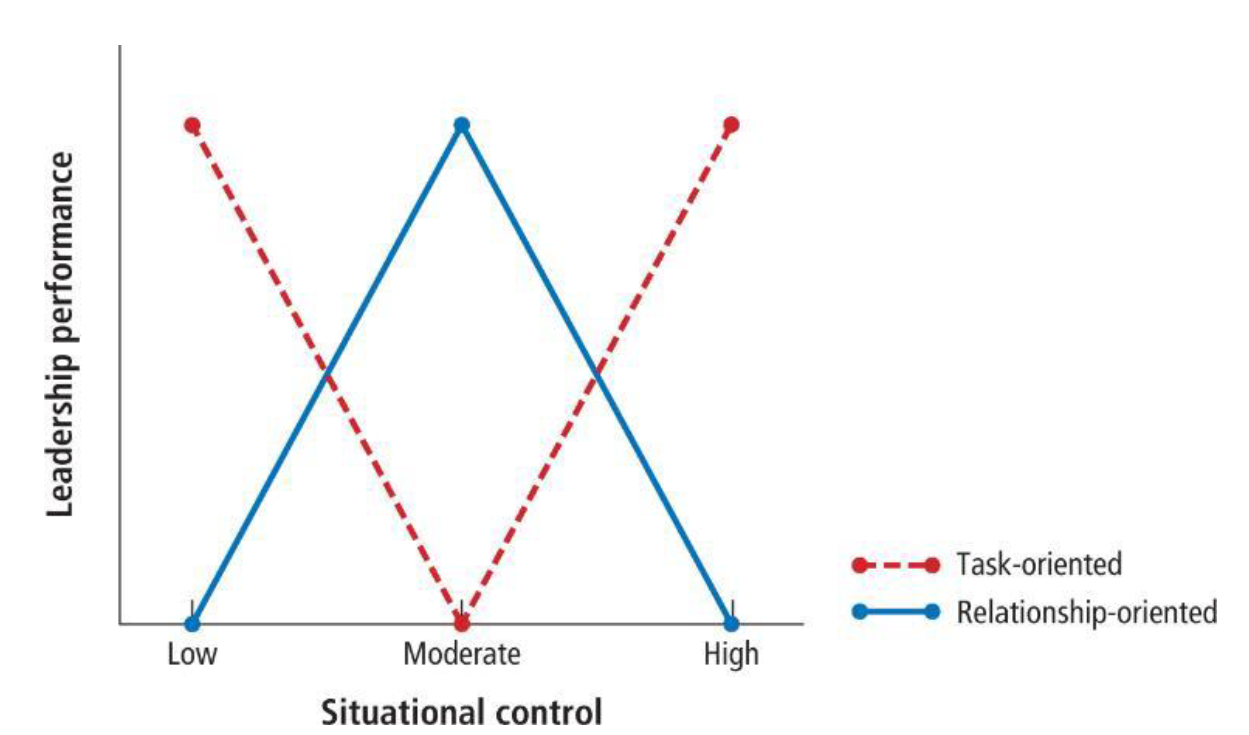
task-oriented leaders
focus more on getting the job done, most effective under:
high control work situations: work is defined and structured, leader is powerful
low control word situation: work is not clearly defined, leader is NOT perceived as powerful
relationship-oriented leaders
focus more on workers’ feelings & relations, most effective in:
moderate-control work situations:
when things are running fairly smoothly, but important work still needs to be done
when leader can promote strong relations between employees
predictors of attraction
propinquity
similarity
reciprocity
physicality
propinquity effect
the more we see and interact wiht certain people, the more likely they are tp become our friends
positive relationship between proximity and attraction
relies on actual physical and functional distance
related to mere exposure effect
mere exposure effect
the more exposure we have to a stimulus, the more likely we are to like it
we typically associate positive feelings with things that are familiar
for people we find obnoxious, the more exposure, the more dislike
similarity effect
greater similarity in views, attitudes, interests, or personality leds to more liking
ex. college men became freinds with those who were similar in demographics, attitudes, and values
matching hypothesis
when initiating romantic relationships, individuals seek out partners whose social desirability approximately equals their own
individuals assess their own value, select available candidate who are also likely to be attracted to them
similarity effect in choosing partners
committed relationship: people generally choose a similar partner
low-level: people often choose dissimilar partners
reciprocal liking
we like people who like us
for initial attraction, reciprocal liking can overcome dissimilarity in attitudes
reciprocal liking is enough to stop attention biases to attractive faces
objective standards argument
there are universal standards of beauty
true or false:
averaged composite and symmetrical faces are preferred when it comes to physical attractiveness
true
subjective standards argument of physcial attractiveness
beauty is not objective nor universal, but depends on time and place
halo effect
cognitive bias by which we tend to assume that an individual with one positive characteristic also possesses other positive characteristics
true or false:
men and women are as likely to report attraction as important in terms of attitudes
false
true or false:
men and women are as likely to be attracted to attractive partners
true
true or false:
a woman’s desires and behaviours oscillate throughout her menstrual cycle
they would lead to many odd and interesting results
false
true or false:
the more economic power the woman has, the more she values physical attractiveness
true
true or false:
being approached gives you control
impression of feeling in demand and having options
true
companionate love
intimacy and affection we feel when we care deeply for a person
do not experience passion or arousal in the person’s presence
ex. nonsexual platonic relationships
passionate love
intense longing we feel for a person, accompanied by physiological arousal
when our love is reciprocated, we feel great fulfilment and ecstasy
when we do not, we feel sadness and despair
what are the three factors of triangular theory of love?
intimacy (liking) → feelings of closeness & connectedness
commitment (empty love)
passion (infactuation): physical attraction & drives lead to sexual relationships
attachment styles
expectations people develop about relationships with others
based on relationship they had with primary caregiver
3 types
secure, anxious/ambivalent, avoidant
secure attachment
trust, lack of conern with being abandoned
more likely to develop mature lasting relationships
anxious/ambivalent attachment style
concern that others will NOT reciprocate one’s desire for intimacy
want closeness, BUT worry partner will not return affection
avoidant attachment
suppression of attachment needs, because attempts to be intimate have been rebuffed
difficulty developing intimate relationships
less able to trust others
social exchange theory
humans seek to maximize their own satisfaction
people will seek out rewards in their interactions with others
willing to pay certain costs to obtain those rewards
economic model of costs and benefits
comparison level: expectations of the levels of rewards & costs you are likely to get
alternatives: expectatios about levels of rewards and punishments you would receive in an alternate relationship