biochem lecture 12 and 13
 Call Kai
 Learn
 Practice Test
 Spaced Repetition
 Match
 Flashcards
 Knowt Play
1/53

There's no tags or description
Looks like no tags are added yet.
54 Terms
nucleotide
-building block of nucleic acid
-parts; phosphate, (deoxy)ribose sugar, heterocyclic nitrogenous base
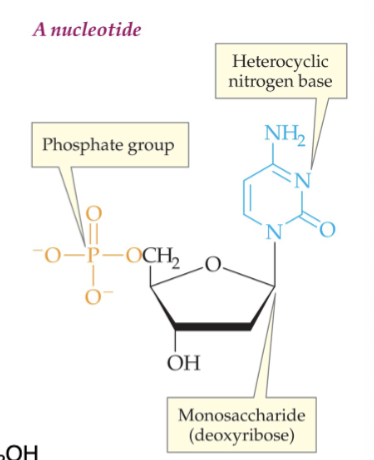
purine (nitrogenous base)
-adenine and guanine
-larger and double ringed
pyrimidine (nitrogenous base)
-thymine(DNA only), cytosine, and uracil(RNA only)
-smaller and single ringed
base structural features
-heterocyclic amine
-nitrogen containing
-H bond donors and acceptors
-Aromatic planar
condensation
molecules combine by removing water
hydrolysis
molecules split by adding water
nucleoside
-sugar+base
-condensation
-similar to acetal formation but with secondary amine

nucleotide
-phosphate+base
-condensation
-phosphate ester formation
-phosphate usually on carbon 5

multiple phosphates
-AMP→monophosphate
-ADP→diphosphate
-ATP→triphosphate
dinucleotide formation (condensation reaction)
-phosphate ester formation
-O on carbon 3 connects with phosphate on carbon 5
-phospodiester
polynucleotides
-nucleic acids
-linear chain of multiple nucleotides
-connected by phosphodiester bonds
-5 prime phosphate end to 3 prime alcohol end
DNA
-A,T, C, G
-deoxyribose
-double stranded
RNA
-A, U, C, G
-ribose
-single stranded
nucleic acid/nucleotide function
-store and decode genetic information
-cofactor, carrier, and messenger
-energy transfer
-structural/catalytic roles
3D structure of DNA
-double helix
-antiparallel
-negative phosphate backbone towards outside
-bases towards center
-bases perpendicular to backbone
-A & T= 2 bonds
-C & G= 3 bonds
structural stability
-dispersion forces between stacked planar bases stabilize helical structure
-stronger for C & G versus A & T
-dispersion forces btwn stacked aromatic electron clouds of bases provide stabilizing force
-bases form H-bonds which determines specificity
DNA and protein interactions
salt bridge form between basic amino acids and negatively charged backbone phosphates
chromatin
orderly tangle of DNA present in non-dividing cells→ chromatin is loose until supercoiled/twisted into chromatin
centromere and telomere
centromere: middle of chromosome
telomere: end of chromosome
gene
segment of DNA that directs synthesis of a single polypeptide
nucleosomes
-beads on a string
-DNA wrapped around histones
-coiled into chromatin
histones
-proteins in nucleosomes that DNA wraps around
-a lot of arg and lys
how do negatively charged phosphates pack together in DNA
the histones in nucleosomes form salt bridges with the phosphate
chargaff’s rules
complementarity
-A always bonds w/ T
-C always bonds w/G
same amounts of A and T
same amounts of C and G
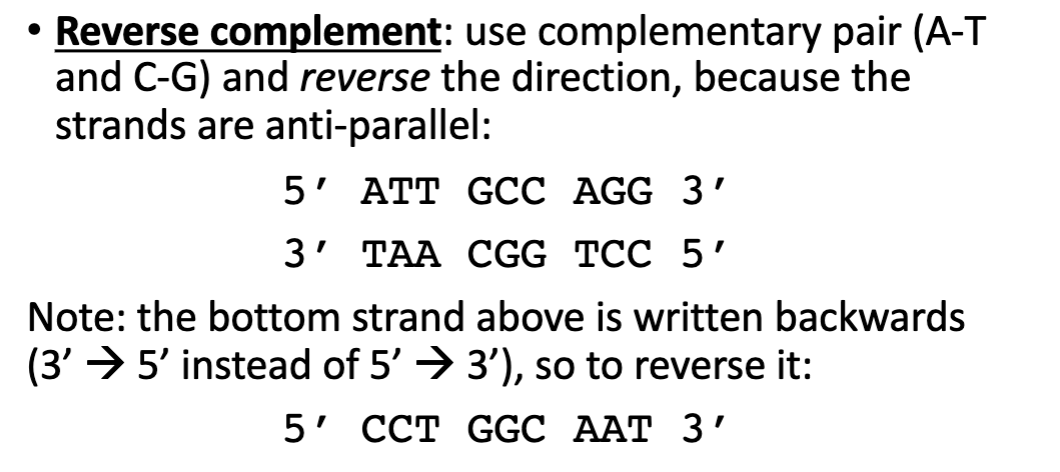
reverse complement
central dogma

DNA mutation and mutagen
mutation→ change in DNA sequence
mutagen→ substance causing a mutation
mutations can change shape or H bonding groups of the base
semiconservative replication
-2 strands split and each one makes a new copy
-each ds product had one new and one old parent strand

what provides energy for nucleic acid synthesis
phosphoanhydride hydrolysis
it is spontaneous and exergonic
DNA polymerase reaction
DNA polymerase is the enzyme that catalyzes the synthesis of new DNA (replication)
-2 ATP equivalents/phosphoanhydrides are hydrolyzed to drive the reaction
primase
makes primer made of RNA so DNA polymerase knows where to start when making the new strand
helices
unwinds DNA double helix by hydrolyzing ATP
topoisomerase
removes strain on DNA, prevents supercoil
single stranded binding protein
coats ss region of DNA so that double helix does not re form
keeps strands separated
origin of replication
site where replication begins, mostly TATA (box) in the beginning
DNA initiation, elongation, termination
initiation→ RNA polymerase binds to promoter
elongation→ RNA polymerase moves along template strand
termination→ RNA polymerase reaches termination sequence
leading vs lagging strand
leading→ continuous from 5 prime to 3 prime
lagging→ Okazaki fragments, discontinuously in segments
DNA clamp
protects processivity→ polymerase can stay on template stand and add 1000s of nucleotides before dissociating
can form consecutive reactions on substate without releasing it
proofreading
DNA polymerase checks the last base added and removes it with exonuclease if wrong
endonuclease
pushes out the RNA primer when DNA polymerase reaches it
DNA ligase
joins Okazaki fragments together
telomeres
-3 prime end of linear ds cannot be copied so telomeres are added by telomerase to extend sequence and give DNA polymerase a longer template
-repetitive DNA sequences at the ends of linear chromosomes
extended by telomerase
-room for primate to make primer
dideoxynucleotides(ddNTPs)
-missing OH groups at both 2 and 3 prime positions
-DNA polymerase uses 5 prime phosphates to addd ddNTP to growing strand
mRNA
RNA product of transcription, carries information for translation/protein building
tRNA
carries amino acids to ribosome. Has anticodons to pair with codons on mRNA
rRNA
RNA that makes up the ribosome, catalyst for protein synthesis
RNA transcription complementarity
mRNA sequence is same as coding(sense) strand (but U instead of T)
mRNA is reverse complement of noncoding(antisense) strand

template strand
noncoding, antisense strand
RNA polymerase
enzyme that catalyzes the synthesis of RNA from DNA template
needs 2 phosphoanhydrides(2 ATP equivalents) hydrolyzed to drive the reaction
transcription initiation
transcription factors bind promoter sites and recruit helices to unwind DNA
acetyl groups added to his/lys to remove positive charge and no more salt bridge
what triggers transcription elongation
-phosphorylation of RNA polymerase disrupts interactions btwn RNA polymerase and transcription factors bound to promoter, which allows elongation to begin
how are RNA and DNA polymerase similar
-adds nucleotides to 3 prime end of strand with hydrolysis of 2 ATP equivalents
-proofreads
-processive
transcription termination
-signal leads to disruption of RNA polymerase
either…
RNA dependent→ RNA product forms short helix that disrupts RNA polymerase
protein dependent→protein Rho binds a sequence in RNA product and disrupts RNA polymerase
RNA splicing
mRNA not mature for translation until spliced
exons are kept, introns are removed