9.2-9.4 Glycolysis- citric acid cycle- oxidative phosphorylation
 Call Kai
 Learn
 Practice Test
 Spaced Repetition
 Match
 Flashcards
 Knowt Play
1/70

There's no tags or description
Looks like no tags are added yet.
71 Terms
Glycolysis breaks down glucose into
two pyruvate molecules
Glycolysis takes place
in the cytosol
can glycoysis function without oxygen
yes
What are the two phases of glycolysis
1- energy investment
2- energy payoff
energy investment phase
ATP is used
Energy payoff phase
More ATP is formed than is used in investment
Energy investement uses
2 ATP
Energy payoff produces
2 NADH and 2 H+, 2 Pyruvate and 2 H2O, and 4 ATP
How much energy is gained from energy payoff
2 ATP
Is the pyruvate redundant?
no you can get more electrons from it from oxidation
Glycolysis releases less than
a quarter of the chemical energy in glucose that can be released
Most of the energy in glucose remains in
the two molecules of pyruvate
if O2 is present then pyruvate molecules
will enter the mitochondrion (in eukaryotic) where the oxidation of glucose is complete
before the citric acid cycle can begin
pyruvate must be converted to acetyl coenzyme A (acetyl CoA)
Acetyl CoA links
glycolysis to the citric acid cycle
pyruvate dehydrogenase is
a multi enzyme complex that catalyzes three reactions
during pyruvate dehydrogenase pyruvate’s
carboxyl group is removed and released as CO2 this is the first release of CO2 during cellular respiration
during pyruvate dehydrogenase the remaining two carbon fragments
are oxidized to acetate and and the extracted electrons convert to NAD+ to NADH
during pyruvate dehydrogenase Coenzyme A (CoA) a sulfur compound is attached
via its sulfur atom to the acetate forming acetyl CoA
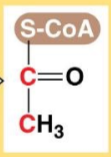
what is this
Acetyl CoA
pyruvate is a charged molecule so in eukaryotic cells
it must enter the mitochondrion via active transport
The citric acid cycle is also called
the tri carboxylic acid cycle or the Krebs cycle
the citric acid cycle oxidizes organic fuel derived from
pyruvate generating 1 ATP by substrate level phosphorylation per turn
during the citric acid cycle most of the chemical energy is
transferred to NAD+ and a related electron carrier the coenzyme FAD
During the redox reaction NAD+ and FAD in the citric acid cycle become
3 NADH and 1 FADH2 Per turn of the cycle
the citric acid cycle has
eight steps catalyzed by a specific enzyme
where are the steps of the citric acid cycle located
(except for one) mitochondrial matrix
Acetyl CoA formed from the oxidation of pyruvate has
a high potential energy which is used to transfer its two carbon acetyl group to oxaloacetate to form citrate
the seven steps following the formation of the citrate
decomposing the citrate back to oxaloacetate making the process a cycle
Following glycolysis and the citric acid cycle the electron carriers
NADH and FADH2 account for most of the energy extracted from food
NADH and FADH2 donate electrons to
series of enzymes located in the electron transport chain which powers oxidative phosphorylation
the electron transport chain is located
in the inner membrane
most of the ETCs components are proteins which
exist in the multi protein complexes numbered I-IV
The electron carriers in the chain alternate
between reduced and oxidized states as they accept and donate electrons
as they go down the electron transport chain the electrons
they drop in free energy being passed to more and more elctronegative carriers until they are finally passed to O2 forming H2O
Complex II
FADH2 adds its electrons at this stage (at a lower energy level than where NADH does) which means that the ETC provides 1/3 less energy for ATP synthesis from electrons donated by FADH2
oxygen is represented during as ½ O2 during electron transport to emphasize
that the electron chain reduces molecular oxygen (O2, not individualize oxygen)
electrons are transferred from NADH or FADH2 to
the electron transport chain
Cytochromes
a type of protein that electrons are passed through on their way down the ETC before reaching O2
The ETC generates
No ATP directly
The ETC essentially breaks up the
large free energy drop from food to O2 into smaller steps that release energy in manageable amounts instead of all at once
some of the ETC proteins
pump H+ from the mitochondrial matrix across into the intermembrane system
After crossing into the intermembrane system H+
moves back across the inner membrane (down concentration gradient), passing through the transmembrane protein complex called ATP synthase
ATP synthase uses the exergonic
flow of H+ to drive the phosphorylation of ATP
Chemiosmosis
the use of the energy in an H+ gradient to drive cellular work
During ATP synthase H+ ions flow
down their concentration gradient enters half a channel in a stator
During ATP synthase H+ ions enter
the binding sites within the rotor changing the shape of each subunit so that the rotor spins within the membrane
During ATP synthase each H+
makes one complete turn before leaving the rotor and passing through a second half channel in the stator into the mitochondrial
During ATP synthase the spinning of the rotor
causes an internal rod to spin, the rod extends like a stalk into the knob which is held stationary by part of the stator
During ATP synthase the turning of the rod
activates catalytic sites in the knob in the knob that produces ATP from ADP
electron transport and pumping of protons (H+)
this creates H+ gradient across the membrane
ATP synthases is powered by the flow
of H+ back across the membrane
The energy stored in a H+ gradient across a membrane
couples the redox reactions of the electron transport chain to ATP synthesis
Proton Motive force
the H+ Gradient that does work in ATP synthesis

What is this
the way most energy flows in cellular respiration
How much ATP is made is cellular respiration
32 ATP, approximately 34% of the energy in glucose
reasons why 32 APT is an approximation- Phosphorylation and redox reactions
are not directly coupled, NADH e- and FADH2 e- enter differently
reasons why 32 APT is an approximation- the mitochondrial inner membrane is impermeable to NADH
This means that NADH must be shuttled in and this varies often between cell types
reasons why 32 APT is an approximation-the proton motive force (H+)
Also motivates other types of work
oxidation of pyruvate is the step
before the citric acid cycle
what is the goal of the citric acid cycle
to strip remaining electrons from food and pass it on
in the citric acid cycle Acetyl CoA is
what is fed into the cycle
reduced electron carriers
gain electrons and carry them
reduced electron carriers
NADH+ and FADH2
Complex IV
the most electronegative
as they pass electrons the proteins in ETC pump
Protons (H+) out of the matrix across the inner membrane into the intermembrane and then back into the matrix, it passes through a protein in the transmembrane called ATP synthase
what drives the phosphorylation of ATP
the flow of H+
ATP synthase
the transmembrane protein that uses the exergonic flow of H+ (protons) to make ATP
what is ATP synthase comparable too
water wheel
H+ (protons) want to
Go back into the matrix, but they need help because they are charged so they go through ATP synthase
Each NAD+ can hold
2 electrons and one H+, making it NADH