BIOPHYS CHEM EX2
 Call Kai
 Learn
 Practice Test
 Spaced Repetition
 Match
 Flashcards
 Knowt Play
1/179

There's no tags or description
Looks like no tags are added yet.
180 Terms
equilibrium for dissociation of ES complex
what is Ks?
the binding follows MM and is fast (Km=Ks)
what is Km when one ES complex is present?
Km estimates Ks and it follows the complete mechanism
what is Km when more than one ES complex is present?
Km = [ES][S] / ∑[ES]
Km equation with more than one ES present?
sum of all bound species
what is ∑[ES]?
equilibrium association constant of a complex
what is Ka?
equilibrium dissociation constant of a complex
what is Kd?
number of binding sites
what is n?
ligand binding to enzyme
what is L?
we want to know how many exist and how strong they are, to find Ka
what do you want to know when binding sites are unknown?
[EL]/[E][L]
equation for Ka?
[E] + [EL]
[E]0 =
[L] [EL]
[L]0 =
f = [EL] / [E]0
what is the occupied sites fraction equation?
(1-f)= [E]/[E]0
what is the unoccupied site fraction equation?
Ka = f / (1-f) [L]
what is the binding site occupation equation for Ka?
(1/Ka [L]) + 1 = 1 / f
what is the equation for graphically representing a single binding site?
a double reciprocal plot
how do you represent a single binding site to a graph?

slope: 1 / Ka
y-intercept: 1
x axis: 1 / [L]
y axis: 1 / f
what is the double reciprocal graph for a single binding site?
f = [EL] / n [E]0 , measures the percentage of individual sites that are available
what is the equation for the fraction of occupied sites?
v = [EL] / [E]0 , tracks the average number of bound ligands per single enzyme molecule
what is the equation for bound ligands?

slope: 1/nKa
y axis: 1/v
x axis: 1/[L]
y intercept: 1/n
compression at low [L]
what is the double reciprocal graph for a multiple binding site?
1/nKa[L] + 1/n = 1/v
what is the double reciprocal equation for multiple binding sites?
extremes and limitations, conceptually identical to looking at a reactions max capacity
what does this 1/nKa[L] + 1/n = 1/v focus on?
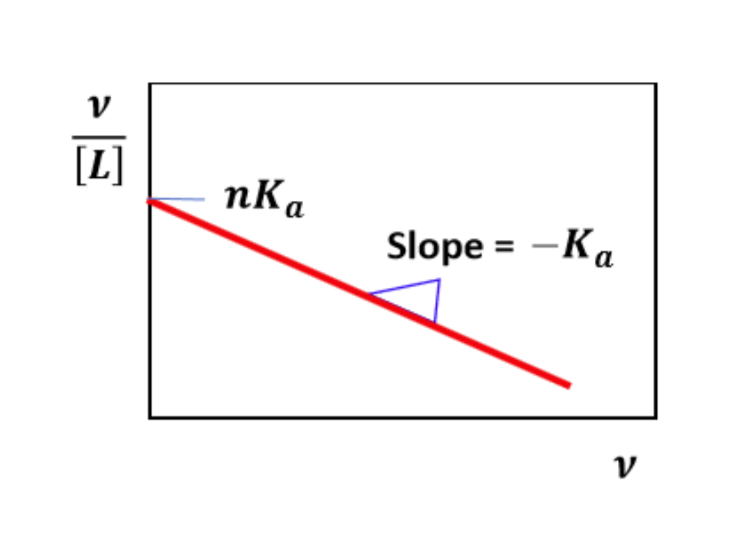
slope: - Ka
x axis: v
y axis: v / [L]
y intercept: nKa
sensitive to cooperative binding
what is the scatchard plot for multiple binding sites?
nKa - Kav = v/[L]
what is the scatchard plot equation?
the ratio of bound to free ligand against total ligand, focuses on how remaining capacity affects other sites
what does nKa - Kav = v / [L] focus on?
molecular interactions
forces between molecules and between atoms, that can be either attractive or repulsive
macromolecules and solvent environments and is highly variable
what does conformation depend on?
total # of independent coordinates or modes of motion required to fully specify the positions, orientations, and energy states of all the atoms in the system
doF
intermolecular interactions among molecules + intramolecular interactions among atoms within molecules
what is the total potential energy in a macromolecule system
total intramolecular potential energy and gives the PE landscape as a function of atom position
VTotal
V total = [ ∑Ni (Vbonding - Vnonbonding )]intra
Vtotal equation?
bonding interactions
involves covalent bonds, where atoms share electrons to achieve stability (energy changes correspond to IR region of electromagnetic spectrum and absorb IR light)
stretching
movement along bond axis, involves 2 atoms and requires 1 covalent
bending
change in bond angle between 3 atoms and requires 2 covalent bonds
twisting
rotation around bond axis involving 4 atoms and requires 3 covalent bonds
nonbonding interactions
intermolecular forces attraction between molecules rather than within them, influences physical properties
ionic bond
electrostatic attraction between opposely charged ions, is very strong
dipole-dipole
attraction between polar molecules with permanent dipoles moderate strength, moderate strength
LDFS
temporary dipoles caused by electron movement, present in all molecules, weak interactions
VanDer Waals
collective term for all weak intermolecular interactions between surfaces, atoms, and molecules
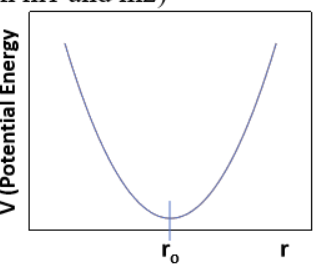
y axis: potential energy
x axis: distance between nuclei
r0 : minimum value
what is the harmonic potential graph?
F = -kr
what is the force spring constant equation?
bonding energy (E) is modeled in a force field as distance dependent function
what does the harmonic potential graph model?
Vbond = kbond (r - r0)2
equation for bond length?
r0
standard length of a bond
HPG
bonding energy is modeled in a force field as distance dependent function
Vθ = kθ (θ - θ0)2
what is the equation for V0?

bond angle and bond length graphs?
defines the dihedral angle phi around the central bond between atoms
the twisting of a bond
depends on the type of the bond connecting the central atoms
what does the potential energy function for rotation depend on?
are relatively free to rotate, while double bonds have very distinct energy minima at phi = 0, 180, 360
what is single bond rotation?
dihedral angle
measures how much one part of the molecule twists relative to another, determines molecular shape and flexibility energy function
the TYPE of bonds connecting the atoms
what is the V(ϕ) dependent on?

Torsional potential energy curves for single vs. double bond rotation (V(ϕ) vs. ϕ)
Plot A (Single bond): Shows a three-fold periodic curve with minima at staggered conformations and low energy barriers, allowing relatively free rotation.
Plot B (Double bond): Shows distinct energy minima at trans (0∘) and cis (±180∘) separated by high energy barriers, restricting rotation.
Vn:
torsion force constant (spring constant)
n:
period of the function
y (gamma);
phase angle (defines the minima occurs)
torsional potential
how energy changes as the molecule twists
peaks - unstable
valleys - stable
anharmonic function
true, nonparabolic potential energy of a molecular bond, moving beyond simple harmonic oscillator
forced toward r0 by potential energy surface
at r distance atoms are
the “spring” from r0 with K
what is Vbond dependent on deformation of
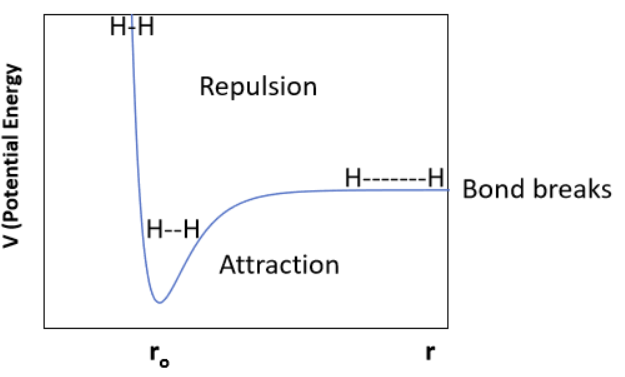
H-H repulsion
H—H attraction
H———H bond breaks
what is the graph for anharmonic function?
bond length
anatomical distance between nuclei with E at minimum (optimal)
the e-cloud overlaps gradually
what happens when the bond is compressed?
harmonic model
approximation is good around r0, it is symmetrical and shows molecules are tightly bonded than they actually are

ground vibration state, smallest amplitude, zero point energy
what does v=0 stand for?
dissociation energy from minimum to asymptote
what does De stand for?
energy and atoms vibrate with larger amplitude (farther from r0)
what increases as vibrational levels increase?
V1-3
potential for bond angle
non bonding potential
potential energy from interactions not dependent on covalent bonding and distance dependent to some power (n) of the distance between atoms {r}
Vnonbonding ∝ f (1/rn )
what is the equation for intermolecular potential energy term derived from a power-law interaction?
It describes how a specific potential energy component of a chemical bond scales with the internuclear distance between the two bonded atoms.
what does this Vn ∝ f (1/rn ) describe?
short range
when n is large the interaction is
large range
when n is small the interaction is
electrostatic
n=1 ?
dipole dipole
n=3?
London DF
n=6?
repulsion
n=12?
rn
potential energy functions are inversely related to

n=12 → n=1
non bonding potential graph?
faster the function approaches 0
the higher the n exponent the
energy drops quickly
if n is high
energy drops slowly
if n is small
electrostatic
treatment of the electrostatic potential (Ve ) between two units charges Z1 and Z2
𝑉𝑒 = 𝑍1𝑒𝑍2𝑒/4𝜋𝜖0𝑟𝐷
what is the electrostatic potential energy equation?

𝑉𝑑𝑑 = + |𝜇1||𝜇2|/ Dr3
what is the dipole dipole parallel equation?
repulsion
dipole-dipole parallel

𝑉𝑑𝑑 = - |𝜇1||𝜇2|/ Dr3
what is dipole dipole antiparallel equation?
attraction
dipole-dipole antiparallel

𝑉𝑑𝑑 = −2 |𝜇1| |𝜇2| / 𝐷𝑟3
what is the dipole dipole head to tail equation?
the dipole moment, depends on length
what is µ?
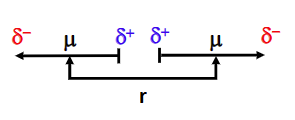
𝑉𝑑𝑑 = + 2 |𝜇1| |𝜇2| / 𝐷𝑟3
what is the dipole dipole head to head equation?
attraction
dipole dipole head to tail
repulsion
dipole dipole head to head
electrical interactions between two or more atoms or molecules that are VERY close
what are VDW forces driven by?
London dispersion forces
VL ?
Nucleus-Nucleus repulsion forces
VR ?
VL + VR
VDW =