General Surgery Instruments
 Call Kai
 Learn
 Practice Test
 Spaced Repetition
 Match
 Flashcards
 Knowt Play
1/99

There's no tags or description
Looks like no tags are added yet.
100 Terms
Army Navy Retractor

Curved Mayo Scissors (not suture scissors)
These are curved! Used for cutting heavy tissue.

Debakey forceps

Backhaus Towel CLIP (not clamp)

Edna Towel CLIP (not clamp)

Peers Towel CLIP (not clamp)
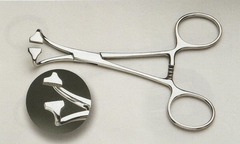
Roeder Towel CLIP (not clamp)

Foerster Sponge Stick (pay attention to the spelling)

Fraizer Suction

Poole Suction

Yankauer suction

Hemoclip applier (notice the color of the finger rings - color depicts size)

Mayo Hegar Needle holder
This is a heavy one, for large suture!

Straight Mayo scissors (suture scissors)
These are straight!

Ryder needle holder
There are needle holders with a narrowed tip (has been called a porpoise tip) - what is the correct name?

Webster needle holder
There are very short needle holders! Some of the shortest in the general surgery set!

Probe and grooved director (figure out which is which)

surgical ruler

Bovie pencil

Bovie holster

Bovie tip

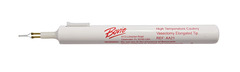
High Temp cautery
Gerald bayonet bipolar forceps
What is the name of the fourth one (last on the right)?

Gerald bayonet forceps

Bipolar cautery cord

Mayo gallstone scoop

Bakes common bile duct dilators

Bougie (or Maloney) esophageal dilators
Our are blue! Very large and heavy.

Sigmoidoscope

Anascope

Adson forcep with teeth
This one has three (two top, one bottom) teeth!

Adson forcep plain
This one has no teeth!

Adson Brown forcep (two rows of small teeth always equal a "Brown")
This one has rows of small teeth!

Rat Tooth forcep
This one is medium length teeth(two top, one bottom)
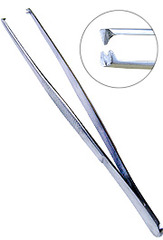
Ferris Smith forcep
Large (heavy tissue) and has a shaft flare like an adson!

Bonney forcep
Large (heavy tissue) and has a straight shaft!

Singley tissue forcep

Russian forcep
Only one of these with a rounded tooth/head design!
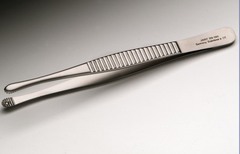
Allis forcep (NOT clamp)
This is an atraumatic instrument for GRASPING

Babcock forcep (NOT clamp)
Very unique, open, rounded tip instrument for GRASPING
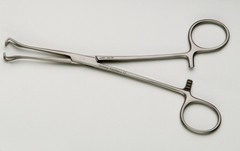
Kocher forcep (NOT clamp)
Heavy duty and used for grasping heavy tissue! Look at that tooth!

Lahey thyroid tenaculum (forcep)
Look at all those teeth! Used for grasping!

Pennington forceps
6-7.5 inches in length

Magill catheter forcep
These are used for helping with intubation!
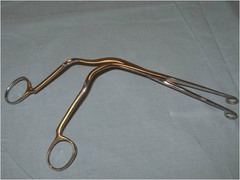
Randall Stone forcep
Used to grasp stones or polyps

Hemostat clamp (A.K.A. Crile, Snap)
Most commonly used clamp on the field!
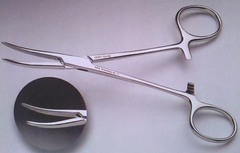
Kelly clamp
This is the big sister to the most commonly used clamp on the field!

Tonsil clamp (A.K.A. Schnidt)
This is the long, skinny version of the most commonly used clamp on the field!

Pean clamp (pronounced pee-on)
This is the super-duty, large version of the most commonly used clamp on the field!

Mosquito clamp
This is the baby, petite, annoying version of the most commonly used clamp on the field!

Right angle clamp (A.K.A. Gemni, Mixter)
Notice the tip!

Doyen intestinal forcep
Notice these springy jaws! They are forceps, not clamps.

Allen intestinal clamp
Looks like a Kocher clamp, but the serrations from from box lock to tip!

Metzenbaum scissors
Used for cutting delicate tissue!

Lister scissors (A.K.A. Bandage scissors)
Notice the shovel nose tip!

Iris scissors
Very short, VERY sharp!

Wire cutting scissors (angled)
Notice the notch near the box lock/jaws!

#3 knife handle
This fits the most common skin blade (the #10) and is the most common one.....found in almost every set!

#7 knife handle
This one fits long skinny blades!

#4 knife handle
This one looks like the most common one, but holds a much larger blade.

Beaver handle
This is a knife handle, but round and hold small blades.

#10 knife blade
This is the most common one and fits the #3 knife handle as the most common skin/incision combo blade in this specialty. What is its number?

#11 knife blade
Notice the tip design of this blade. What is its number?

#20 knife blade
This is a big one! Might be used on C-sections too! Fits the #4 handle. What is its number?

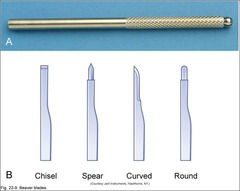
Beaver blades
What are the items on the bottom called (collectively)?
Gigli saw handle

Gigli saw
When these two items are combined, what are they called?

#15 blade
Notice the tip design of this blade. What is its number?
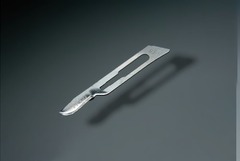
#3 knife handle (Long)
This is the long version of the most common one.....found in almost every set!

Balfour retractor

Bookwalter retractor
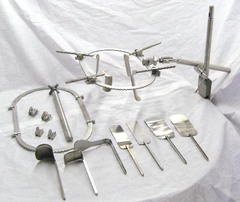
Weitlaner retractor
Flat, no curve to the shaft(s)
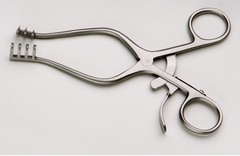
Cerebellar retractor
There is a curve to the shaft(s)

Beckmann retractor
Notice the hinge in the shaft(s)

Gelpi retractor
Can be small (baby), medium, large or HUGE!

Volkmann retractor
Can be sharp or dull (these are dull)

(Jospeh) Skin hook

(Guthrie) Skin hook
Notice the double hooks?
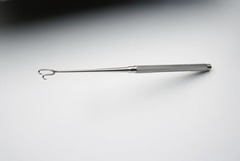
Richardson retractor
Single end, single name!

Richardson- Eastman retractor
Two ends, two names!

Goelet retractor (pronounced goo-lay)

Senn (rake) retractor
One end is a rake, one end is completely atraumatic!

S retractor

Cushing vein retractor
VERY atraumatic!

Green goiter (goy-ter) loop retractor

Dandy nerve hook

Murphy retractor
Looks like the Volkmann, but with a loop in the handle!

Israel retractor
Looks like the Murphy, but MUCH bigger!
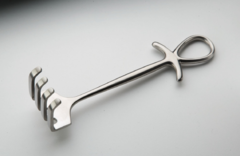
Deaver retractor
Comes in multiple sizes, the largest looks like a BEAVER tail!

Harrington retractor (A.K.A. Valentine, Sweetheart)
Has many names.....pick one in February!

Maleable retractor (A.K.A. Ribbon)
Comes in multiple sizes - bendy!

Disposable trocar

Hasson trocar
Notice the upside down Christmas tree (small-purple) component!

L Hook caturey (Laparoscopic)

Silver Scissors (Laparoscopic)

Maryland dissector (Laparoscopic)

Laparoscopic scissors

Toothed grasper (Laparoscopic)

Bowel grasper (Laparoscopic)

Kleppinger Bipolar forceps
