Organic Chemistry 3
 Call Kai
 Learn
 Practice Test
 Spaced Repetition
 Match
 Flashcards
 Knowt Play
1/44

There's no tags or description
Looks like no tags are added yet.
45 Terms
amines
N with 3 things attatched to it and a lone pair, can H bond
can be 1, 2, 3, or 4
alkaloids
natural products containing a basic N atom
quaternary amines
4 alkyl groups with a positive charge, ammonium salt, chiral
mass spec of amines
off number of atoms, base peak at 30
IR spec of animes
1 and 2 at 3400
1 peak indicates secondary
2 peaks indicates primar
teritary does not absorb here
NMR of amines
N-H from 0.5-5, aromatic is more downfield, NH is not split
SP3 carbons to amines is 30-50
naming primary amines
name as substituent of parent chain, change -e to -amine
if not on the end of a chain, indicate with number
naming secondary or tertiary amines
if identical groups use di or tri
different groups name amine as ‘N-"‘ to indicate attatchement to R, put other groups in front, still use amine at the end, if another thing takes priority use amino-
aromatic amines
amino benzenes are named as anailine derivatives
N alkyl groups on amines
increasign e- density on N increases basicity
decresing e- density on N deceases basicity
electron donating groups increse electron density to increase basicity
aryl amine basicity
ressonance allows for e- delocalization, makes it less basic
alkyl substitutions on ring make it more basic due to less ressonance
e- donor groups reduce e- delocalizaiton, increases basicity
e- withdrawing groups increase e- delocalization, decreses basicity
amides and their basicity
carbonyl group with amine group on it
e- pair can be delocalized on the c=o with ressonance, decreases basicity becuse protonation would happen at the O not N
heterocyclic amine basicity
need to determine if N’s e- pair is part of aromatic pi system or not
if apart of system - cannot react without disrupting aromaticity, no basicity
if not apart of system - can interact and be basic
hybridization of animes on basicity
s character determines
sp2 orbitals are held tighter and have more s character so they are held tighter and are hard to react
sp3 is less s character so it is more basic
ketone and aldehydes to imines
uses alkyl amine or amine to make immine
reagents - Y-NH2

alkyl halides
uses ammonia, 1, 2, 3 amines to go to next level
ammonium salt intermediate
lone pair of nitrogen reacts with alkyl and halogen dissociates, makes intermediate, amine reacts again to H and pushes C-H bond e- to N
reagents - R-X

amine synthesis - example of nucleophilic substitution
1 or 2 amines with acid chloride to amine amide functional group
uses pyridine as base for HCl
replaces Cl with anime
reagents - acid chloride, pyridine

synthesis of substituted anilines
anilines cannot do freidal craft so a multistep process is needed
3 steps
protection of adding acid chloride to aniline, makes attatched to acid chloride without the Cl
friedal craft reaction with R-Cl and AlCl3 to add aklyll group as a o,p director
deprotonation with H3O+ and OH to take off carbonyl
reagents - carboxylic acid, R-Cl and AlCl3, and H3O+ and OH

Hoffman Elimination
converts amine to alkenen between alpha and beta carbon
can happen with 1, 2, 3 amines
uses methyl idodine
reagents - 1. CH3I, Ag2O, and heat
3 steps-
make good LG by forming quanternary ammonium salt
provide strong base
elimination to form double bond
major product will form on the less substituted C=C

cope elimination
3 amines are oxidized to amine-N-oxides with H2O2 or mCBPA
replaces lone pairs with oxygen
regents - H2O2 or mCPBA or ArCO3H
can then undergo elimination to form alkenes like hoffman
formation of diazonium salts with nitrous acid
uses strong acid and nirtrous acid- formed by NaNO2 to decompose to NO+
makes diazonium salt, N triple bond N
reagents - NaNO2, H-Cl
form the nitrosonium ion with HCl
diazotination to make triple bonded N
nitrousonium ion
electrophile that can react further

diazonium salt
N triple bond N
reacts a lot with things
aryl diazonium salt reacts with nucleophiles
salt to OH group on aryl ring
reagents - H2O

aryl salt to Cl or Br
puts Cl or Br on ring
reagents - CuCl or CuBr

aryl salt to cyanide group
adds C triple bond N
reagents - CuCN

aryl salts to F or I
regents - HBF4 or NaI or KI

aryl salt to H - remove functional group
helps to add when directors are in the way, can use salt as director and then remove it
reagents - H3PO4

aryl salt removing functional group example

aryldiazonium salts to azo compounds
electrophilic aromatic substitution reactions with activated arenes
needs strong aryl e- donating group
reagents - aryl with NR2 or OH

synthesis of amines - reductive animation
aldehydes and ketone to 1, 2, 3 amines
2 steps
nuc attatck of NH3 on C=O to form imine
reduction of imine to form amine
reagents - NH3, NaBH3CN
C=O gets replaced by C-N and C-H bonds

amine reduction of other functional groups
amines to amines uses LiAlH4 and H2O
goes from 1 to 1 amine, 2 to 2 amine, etc.
reagents - 1. LiAlH4 2. H2O
works for C triple bond N to 1 amine

nitro group to amine
R-NO2 to R-NH2
reagents - H2, Pd-C or Fe, HCl or Sn, HCl

gabriel synthesis of 1 amines
2 steps to use nuc to synthesize 1 amines
uses phthalimide and alkyl halide
reagents - phthalimide, H-X, OH, H2O
becomes to carboxyl anions on ring

carboxylic acids
RCOOH, c is sp2 hybridized
acyclic carboxylic acid nomentclature
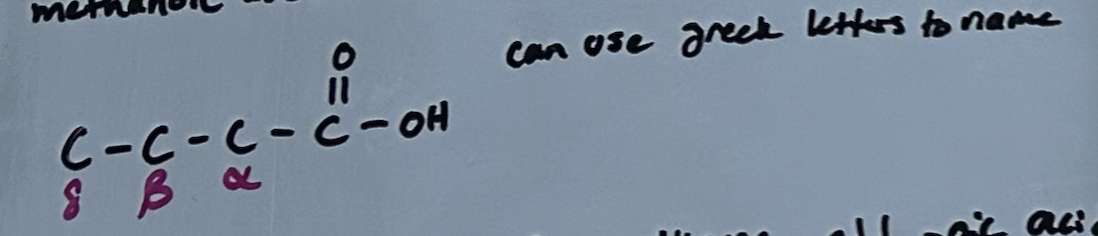
long chain, change -e to -oic acid, acid will be in 1 postition
can use greek letters to indicate things as well
cyclic carboxylic acid nomentclature
name ring and add carboxylic acid, C1 on ring
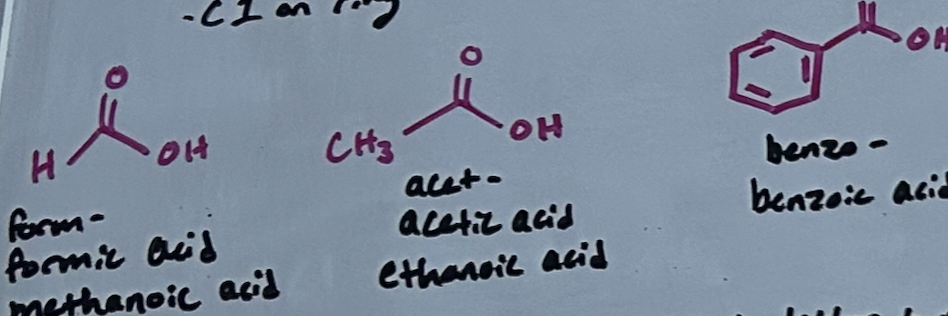
common carboxylic acids
naming unsaturated acids with double bonds
remove -e form alkene, add -oic acid, start numbering at carbonyl group, use stereochemistry
naming di acids
on both ends of the chain, named with -dioic acid with parent name at the start
naming salts - carboxylate anions
cation and parent group + suffix (-ate)

properties of carboxylic acids
H bond donors and acceptors, have dimers, high bp and mp due to IMF’s, solublity similar to alcohols - more C’s is lower solubility (think hydrocarbon chains)
acid base chemistry of carboxylic acids
good acids due to resonance stabilized conj. base, favors generation of weaker acid, pKa around 5
carboxylic aid e- withdrawing groups
decrease pka and increases acidity
carboxylic acid e- donating groups
increase pka and decreases acidity