chapter 14: leadership
 Call Kai
 Learn
 Practice Test
 Spaced Repetition
 Match
 Flashcards
 Knowt Play
1/29

There's no tags or description
Looks like no tags are added yet.
30 Terms
two career paths:
technical path: path you take early
ex: if you are an accountant = accounting
technicalities of one’s work
teachers, can you write well?
what you are evaluated for: technical expertise
entry level
leadership: moving past mid-level management
not about technical expertise
ex: ceos can move from one company to another since it is not about technical work; its about leadership
leadership
general consensus definition: the ability to guide a group toward the achievement of goals
dr. sy says that we should have our individual and personal definition of leadership
universalist theories of leadership
universalist theories look for the major characteristics common to all effective leaders
great man/woman theory
trait theory
traits
great man/woman theory
maintains that great leaders are born, not made
trait theory
attempts to discover the traits shared by all effective leaders
traits
enduring attributes associated with an individual’s personality or makeup
big five: extraversion & conscientiousness is a predictor of being perceived as a leader

behavioral theories of leadership
behavioral leadership theories: (derived from Ohio state and University of Michigan studies) focus on the behaviors common to effective leaders
both types of behaviors have been linked to effective leadership
contingency theories of leadership
fiedler’s contingency model
path-goal theory
decision making model
leader-member exchange model
fiedler’s contingency model
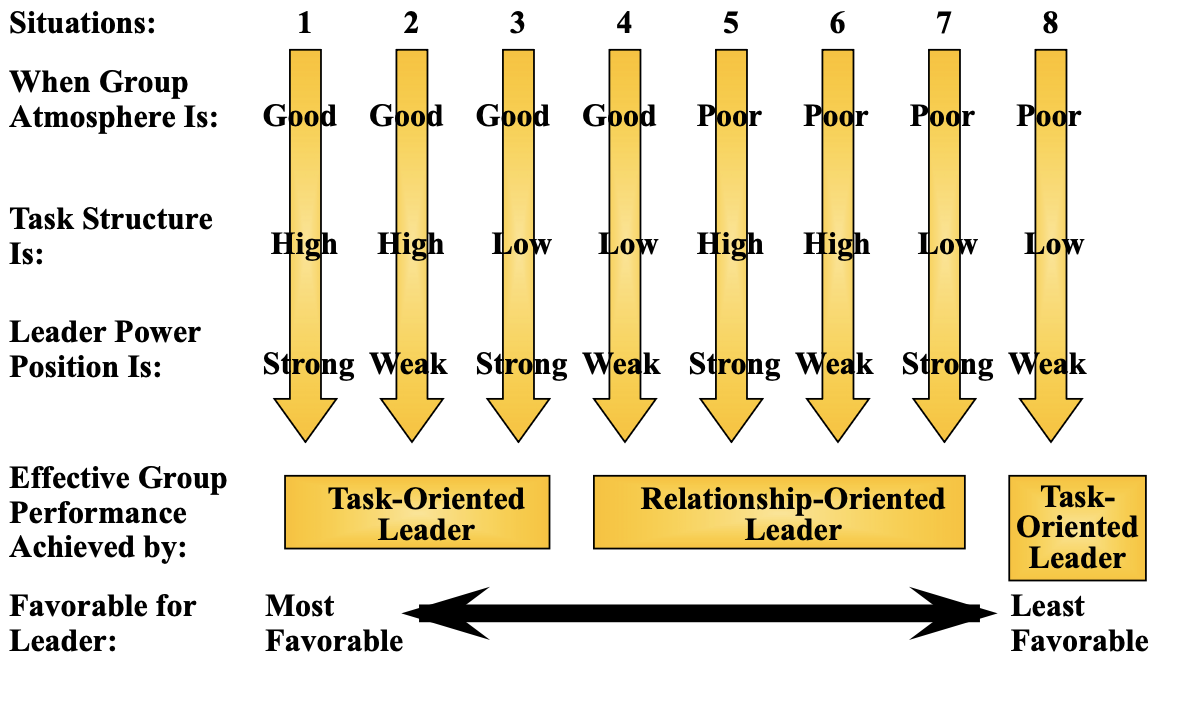
effective leadership = match between the leader’s style and leaders’ degree of control and influence in work situation
leaders may be primarily task-oriented, or primarily relationship-oriented: one is dominant
measured with LPC: low scores are task oriented and high scores are relationship oriented
work situation determined by assessing:
leader-member relations
task structure
position power
leader-member relations
refer to the quality of the relationship between leader and followers
task structure
is an assessment of how well elements of the work task are structure
position power
a leader’s authority to punish or reward
path goal
leader’s job is to help the work group achieve desired goals, using one of four categories of behavior
task oriented behaviors:
directive behavior
achievement-oriented behavior
relationship oriented behaviors:
supportive behavior
participative behavior
choice of behavior depends on:
work task (routine vs. complex)
follower characteristics (e.g., levels of work experience and motivation)

decision-making model
makes characteristics of the situation with leader-making strategies
provides different decision-making strategies
predicts proper leader behavior in making decisions and gives “prescriptions” for the decision maker to follow
decision tree

leader-member exchange
effective leadership is determined by the quality of the interaction between leaders and particular group members
worker is the situational contingency
focus is on dyads (one on one relationship between leader and follower)
leader-member exchange can range from low quality (out-group members) to high quality (in-group members)
with high quality leader-member exchange, there is frequent, positive communication between leaders and members
contemporary theories of leadership
charismatic leadership
transformational leadership
implicit leadership theories
charismatic leadership theories
leaders possess some exceptional characteristics that cause followers to be loyal and inspired
communicate shared group goals
convey confidence in their own abilities and those of followers
most effective when goals are unclear and situational conditions are unstable
some researchers suggest that charismatic leaders possess exceptionally high-quality social skills and an ability to inspire followers at a deep emotional level (Riggio, 1987)
negative and positive charismatic leaders
depends on perceiver
transformational leadership theories
focuses on the leader’s ability to provide shared values and a vision for the future of the work group
followers go “above and beyond”
four components of transformation leadership
idealized influence
inspirational motivation
intellectual stimulation
individualized consideration
make you feel special
popular current approach
implicit leadership theories
follower-centric approach
leadership based on followers’ perception of leadership
individuals have prototypes of what leaders are supposed to be like
individuals matching these prototypes are perceived as leaders
being perceived as leader is important: afforded discretionary power and influence to lead is effectively
six key factors: implicit leadership theories:
sensitivity
intelligence
dedication
dynamism
tyranny
masculinity
follower-centric approach
leadership based on followers’ perception of leadership
sensitivity
understanding, sincere, helpful
intelligence
intelligent, knowledgeable, educated, clever
dedication
motivated, dedicated, hard-working
dynamism
energetic, strong, dynamic
tyranny
domineering, pushy, manipulative, loud, conceited, selfish
masculinity
masculine and male
leaders’ implicit followership theories (LIFT)
leader and follower centric approach
leadership based on leaders’ perception of followers
leaders have prototypes of what followers are supposed to be like
six key factors of LIFT
prototype: industry, enthusiasm, good citizen
antiprototype: insubordination, incompetent, conformity
leader- and follower-centric approach
leadership based on leaders’ perception of followers