Intro to Ecology midterm exam review
 Call Kai
 Learn
 Practice Test
 Spaced Repetition
 Match
 Flashcards
 Knowt Play
1/55

There's no tags or description
Looks like no tags are added yet.
Name | Mastery | Learn | Test | Matching | Spaced | Call with Kai | Chat |
|---|
No analytics yet
Send a link to your students to track their progress
56 Terms
Abundance and distribution
how many, where they are
What is ecology?
ecology is the study of the interactions organisms have that impact/determine their abundance levels (how many there are) and where they live/are (distribution)
The more proper first -half of the -term description of ecology:
Ecology studies the relationships of organisms, their interactions, and those organism’s interactions with their environment.
■ Understanding the relationship and interaction between biotic and abiotic factors
Things ecology covers-less impor
- life processes, interactions $ adaptations
- movement of energy
- successional development
- cooperation, competition 8 predation
- abundance, biomass $ distribution
- patterns of biodiversity & their effect on ecosystem
processes

What goes at the Top/PEAK of the pyramid
Organismal
What ecological levels are there? anyhow many?
there’s four. you START at the top with… organismal. then population, community, and ecosystem
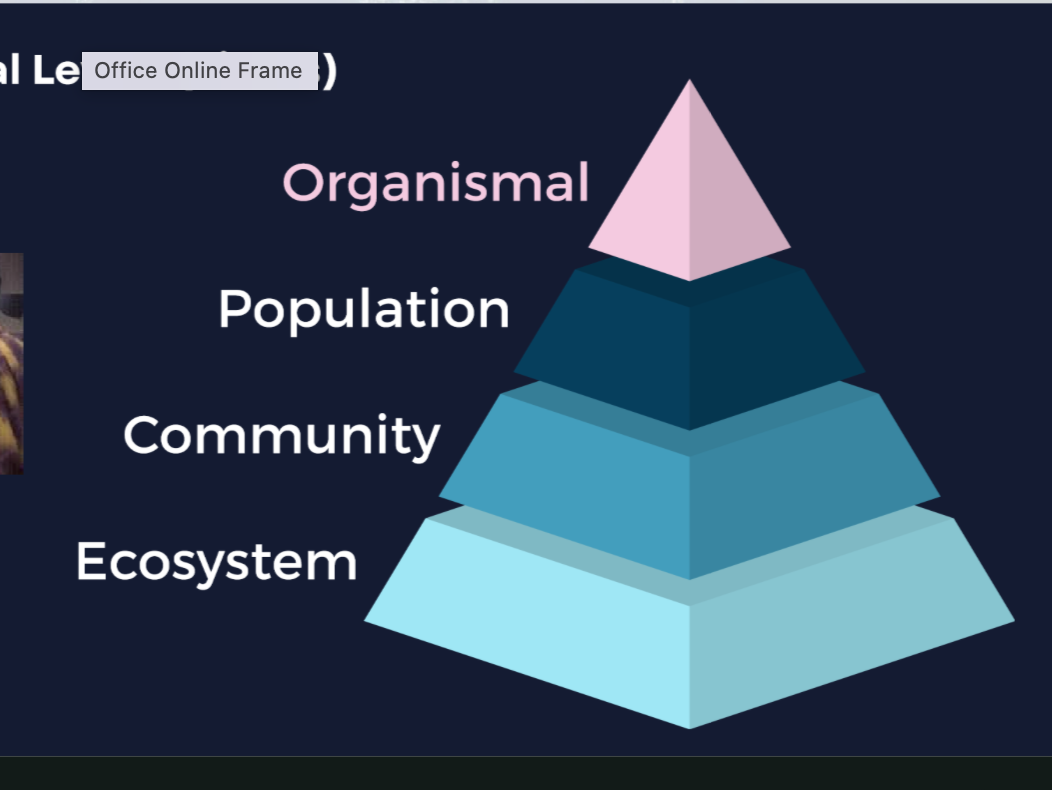
What is organismal ecology?
organismal biology! well, understanding repeating patterns and the processes that occur within organismal biology. more cont!
Extra details of the organismal level
it looks at physiology, the internal organismal mechanisms/ways
it looks at morphological (external organisms mechanisms/ways)
it looks at Behavior (how organisms react w other individuals (for food, hibernating, reproducing etc) and what effects the individual HAD that caused it’sbehaviour, and how that affects OTHER INDIVIDUAL ORGANISMS
Population
2nd level: a population is a group of INTERBREEDING SPECIES that are all the same species (single species) in a given area at the same time. (where n when type pop). What are conspecifics? Individuals of the same species.

What could you say about this or any rash or any longanwer
that it’s looking at 2 animals of th? same species! conspecific! you can also say this is not conspecific if it has more!

community
Different groups of different species interacting with one another in a given area at a given time. (WHERE N WHEN AGAIN) and understanding how these interactions determine distribution (where and how they’re dispersed) how many there are (abundance), structure and demography
-in communities they benefit and hurt each other through mutualism, competition, predation and parasitism
mutualism
both benefit
predation vs parasite
predation-happens fast, kills prey. parasite stays on a living host for month feeding off itE
Ecological networks
looking at the .. PATTERNS.. of species interactions (so diff species) within a community
3 types:
Trophic networks/Food webs
Host-parastoid networks
mutualistic networks.

Food webs
focus on FEEDING interactions specifically, between species in a community or ecosystem?
how to food webs work? what’s their bias?
food webs work by showing the transfer of energy from one belly into another, but are not what? not centered around predation.
bias: emphasizing larger organisms that dominate the
food chain. what matters too, that aren’t here, are dendrites (dentrivores), microbes and… HUMANS!
how do trophic levels work?
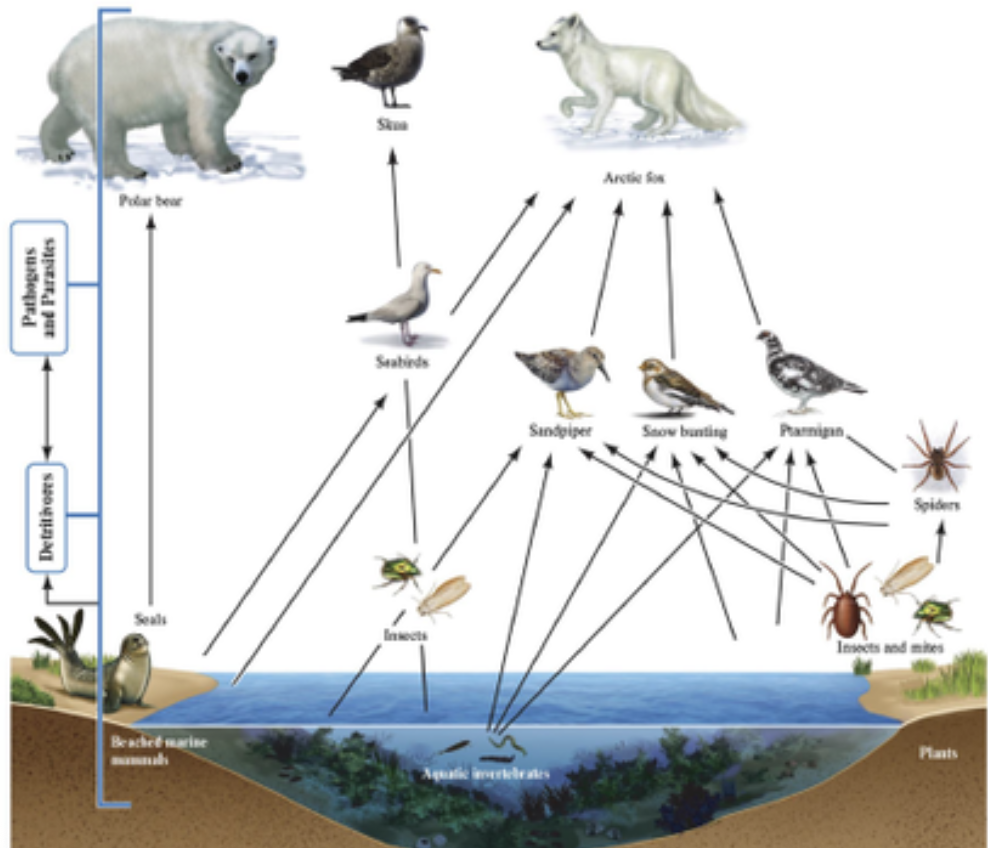
Trophic levels are measured by CHAIN LENGTH! the species in between the top and bottom of the chain
trophic levels show what level the animal is on in terms of how far away it is from the original source (plants/autotrophs that get energy from sun) these r the primary producers). oh
how do u count trophic levels
count how many arrows it takes before u get to the animal! that’s how many levels! the seal actually has a bunch its just not shown in the photo for simplicity. and this photo is NOT reliable because it omits the arrows pointing to level 1 plants and other issues
WAIT! is it not the ur supposed to count the chain lengths? is that sum diff?k
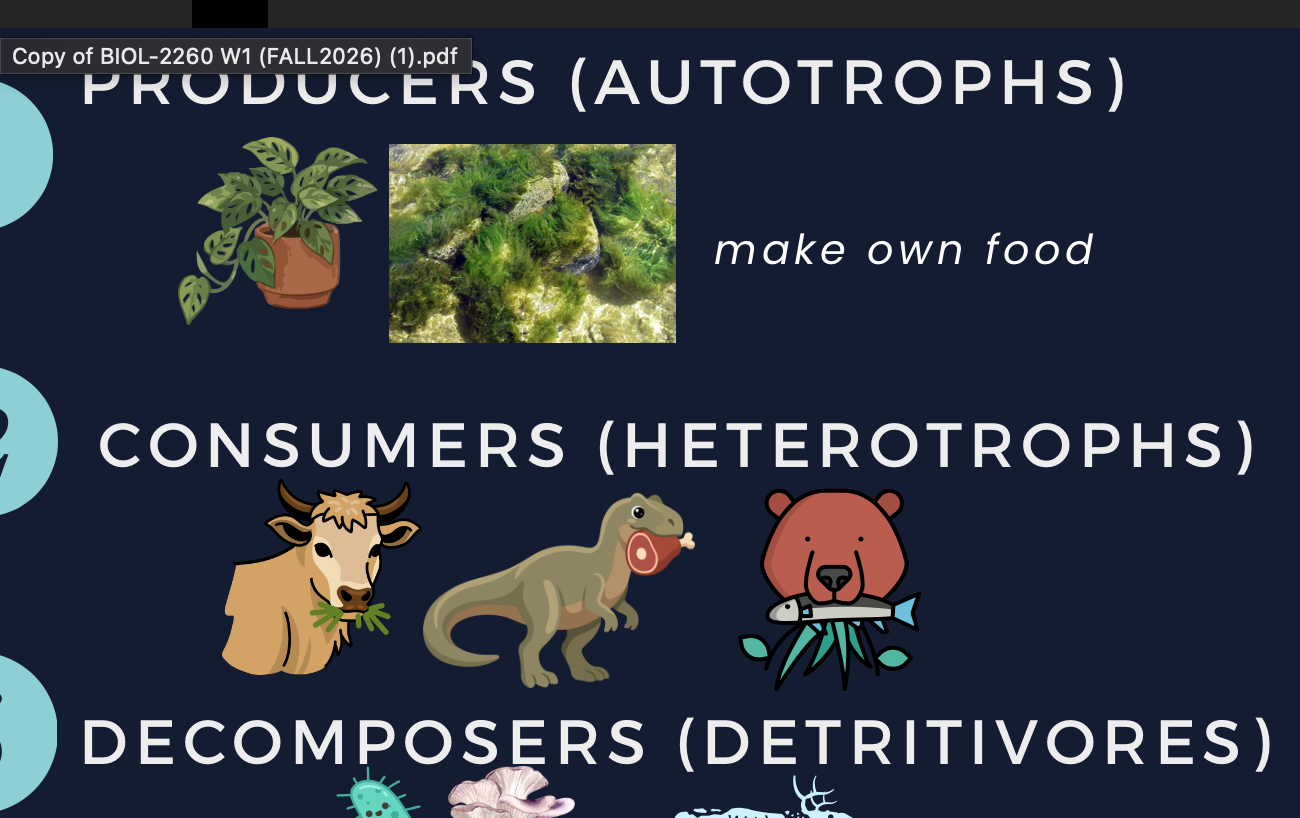
HOW DO ORGANISMS GET FOOD?
heterotrophs
detrivores
how much energy is transferred up each trophic level
10-20%

consumers can eat plants too
notice how secondary consumers only eat meat/carnivores?
not always a pyramid!
usually only 3-5 trophic levels

Chemosynthesis
converting inorganic, canon-holding molecules or nutrients into organic matter. Relies on chemical bond energy/energy from oxidation from inorganic molecules in complete darkness
how do primary prodcuers (not consumers*) get their food
photosynthesis & chemosynthesis
community level
understanding how interactions betreen species influence each
others distribution, abundance, structure & demography
second lecture slides deck
more limits of food web
doesn’t show detrivores
itt doesn’t properly look at time and behaviour of animals hat w
why is connectance important
it shows the WHY behind interactions occurring MORE or LESS (increading/decreading) based on environmental factors
How do you find the number of observed links (not “possible” links) links now?
you COUNT! 20 black arrows

why did it reduce?
The ice is melting but polar bears NEED ice to get their food. the ice melting is also habitat loss not only for them but other animals. the ice melting creates more distance between species so there’s less access to food (= less black arrow links) and there’s overall less WHAT? ……
biodiversity!
the odd time plant biomass count increases is cause of:
wildbeest grazing! they eat (well, ~graze~) the vegetation and somehow it increases biomass and vegetation?! but…. WHY?!
because some disturbance is critical/necessary for the ecosystem to stay balanced and not run out of food or have too much of it:))
Trophic cascade
cascade means down. if its bottom up-cascade, only THAT goes up. typically. be careful
anyway,
a trophic cascade is when you take away the TOP predator or TOP thing at the top of the pyramid and it has. trickle down effect on the animals and plants below it. tis often causes there to be MORE of the herbivore/secondary/primary consumers and thus they eat MORE plants now and the plants die sooner nd there’s less of them.
when the big predator is there to eat the smaller animals, it actually helps keep the whole ecosystem balanced.
Balanced food webs are important as predators keep prey numbers in check, allowing stability for
vegetation growth.
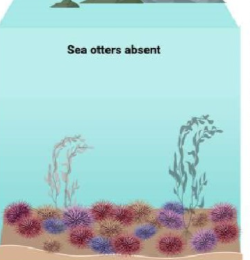
sea otter, sea urchin and kelp forests example

explain the Ex. Sea otters, sea urchins, and kelp forests.
sea otters dont eat sea urchins (ouch!). they eat kelp. if u take away the top predator, sea otters, then u have a ton of sea urchins not being eaten, and since sea urchin are herbivores (ik) they nom nom on kelp aka no more kelp bye bye
now u have shrivelled barely there kelp
application of trophic cascades
Yellowstone grey wolves were reintroduced and then there was a HUGE 3-fold increase in the amount of woody vegetation around. plus it made the vegetation taller! (cus its not getting chomped off by _elk__)
snail example
snails nom on what? fungus. snails are a…FUNGUY! they eat fungi and other plants/vegetation on the saltmarsh. crabs eat snails. so when they removed crabs, the vegetation decreased cus no carnivore/apex predator was stopping the snails from eating it all.
saltmarch “eaten” by mudflat?? what check*
can bottom up be as detrimental as top down cascade
yess
it’s not trophic when its just
competing for space, habitats/resources/food
Keystone species
a species that has a MAJOR, unproportional impact on the rest of the the ecosystem’s survival and majorly keep trophic levels in check
-mutualistic species typically r keystone species; more than big animals
-in fancier words they have an impact on ~community structure and biodiversity~
difference in trophic level and foundational species:
foundation species are there in the beginning, kind of paving the way to invite animals to eat it/to house fish/wtvr else e.g kelp! its the start of it all :) but theyre usually at the bottom or lower trophic levels
KEYSTONE species are mutualistic guys -not always predators
ecological niche
the sort of enviromental requirements a specific species needs to live/persist

Hutchinsonian niche
n-dimensional hyper volume (lots of Volume) volume has area, (abstract area- gebeunily the amount of parameters are infinite).
n number of factors important for survival and reproducing babies
fundamental niche
the kind of idealized space -ANY space that the species COULD theoretically take up if there were no other species because of its conditions! (rain, temp etc = perfect for the without other ppl around)
fundamental niche
raised niche
realized niche = the space that is ACTUALLY beneficial for them given other species being annoying/ predators etc
ecological succession
the wholee process of a change in a community where the species composition/structure/makeup changes
all species have evolved to live in what
thermoneutural zone
neuter baby
pioneer species
lichens, mini plants, small plants, ~grasses and perennials ~:)
comes from wind humans water birds etc
intermediate species
GRASS SHRUBS AND TREES THAT DONT LIKE SHADEIML
CLIMAX COMMUNITY
Shade tolerant trees.
(oak, hickory.
IMPORTANT: Glacial refugia
an area that REFUSES (has simply never been…) glaciated
disturbance and examples
an event that causes a change in the structure/composition of a community.
e.g natural disasters, human disturbances INVASIVE species
is disturbance bad
some is necessary. too much/little is bad. (intermediate disturbance hypothesis)
primary succession
start from bare rock stage, progresses into pioneer species
(lichen, grasses), then intermediate species (shrubs and shade-intolerant trees),
and then the climax community (shade-tolerant trees).
secondary succession
starts afterDISTURBANCE natural disaster or sum bad, doesn’t start w lichens s
wildfires r good start but modern day TOO bad
E.E ecosystem ecology
biological community mixing physical & chemical components
-nutrien cycling is in EE
difference in PRIM and SECO succession
prim: soil /substare = BARE ORCK
colonization = lichen
*slow growth]
seral stage pioneer, IM, climax
SECONDAYR
soil/substrate=organic soil
colonization = grasses/perenials
seral stage pioneer, IM, climax again :)
ecology levels/fields + how many
ELV = THREE!
rhymes!
Individual,
population,
community
How does fire affect nutrient availability in grassland ecosystems?
apparently this is a question from the “community” field…