Module 4: Correction of Ametropia OPT 6560
 Call Kai
 Learn
 Practice Test
 Spaced Repetition
 Match
 Flashcards
 Knowt Play
1/80

There's no tags or description
Looks like no tags are added yet.
81 Terms
define ametropia
A refractive error in which the eye which includes hyperopia, myopia, and astigmatism (anything that is NOT emmetropia)
types of myopia and hyperopia
refractive and axial
Refractive myopia/hyperopia indicates what about the eye?
myopia: cornea and lens have too much plus (+) power
hyperopia: cornea and lens do not have enough plus (+) power
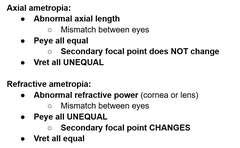
Axial myopia/hyperope indicates what about the eye?
myope: the eye is too long and/or the retina is too far from the far point
hyperope: the eye is too short, and the retina is in front of the far point

Do myopes accommodate (MORE or LESS) in their contact lens relative to their specs?
More
Do hyperopes accommodate (MORE or LESS) in their contact lens relative to their specs?
Less
true or false: refractive errors greater than 4.00D are considered axial in nature
true
true or false: refractive errors less than 4.00D are considered refractive in nature
false: RE less than 4.00D is considered as a combination of refractive and axial
Define the far point of the eye in relationship to the retina and accomodation
The object point that is conjugate with the retina when accommodation is fully relaxed.
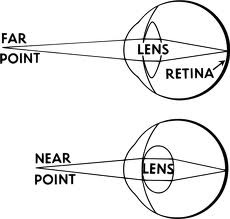
where is the far point for an emmetrope
infinity

where is the far point for a myope
Real, between positive infinity and the eye (retina)

where is the far point for a hyperope
Virtual, behind the eye (retina) and (-) infinity

Define near point (of accomodation)
the object point that is conjugate to the retina with accommodation fully in play (max accomodation)
Define range of accomodation
The linear distance traversed by the point of conjugacy in moving from the far point to the near point of accommodation...
aka the distance over which accommodation is available
Which type of accommodation measurement is used clinically?
Amplitude of accommodation
Why is range of accommodation not used clinically?
This is a linear measurement, which does not accurately compare the power that the eye can accommodate dioptrically.
Various refractive errors have drastically different ranges of accommodation.
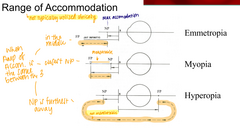
Define amplitude of accommodation
The dioptric difference between the far and near points of accommodation (measures power rather than linear distance)

Clinically, where do we measure range and amplitude of accommodation from?
from the spectacle plane, putting a fully corrected patient and emmetropic patient on the same playing field
What estimation do we make regarding amplitude of accommodation and its relationship to refractive error?
The amount of over/underestimation is equal to the patient's refractive error.
Is amplitude of accommodation over or underestimated in an uncorrected myope?
overestimated
Is amplitude of accommodation over or underestimated in an uncorrected hyperope?
underestimated
Is amplitude of accommodation over or underestimated in a corrected hyperope?
Neither -> corrected RE would reflect the correct amplitude of accommodation
ocular refraction
ametropia specified at the first principal plane of the eye (slightly behind the corneal apex)
contact lens refraction are usually considered the same to ____?
ocular refraction
the distance between the corneal apex and first principal plane is miniscule
ocular accommodation equation
O.A.= (Vd)-(Vn)
Vd: vergence for a distant object (after passing through the corrective lens) measured at the principal plane, ocular refraction, or CL Rx
Vn: vergence for a near object measured at hte principal plane
In a spectacle corrected hyperope, do they have a lower or higher accommodative demand than an emmetrope?
Higher accommodative demand

a. Does an emmetrope have lower or higher accommodative demand in comparison to a spectacle corrected myope?
b. What about a spectacle corrected hyperope?
a. Higher accommodative demand
b. Lower accommodative demand

True or false: emmetropes will require presbyopia correction before a spectacle corrected myope
True -> emmetropes have a higher accommodative demand in spectacles
What does spectacle accommodation assume for fully corrected ametropic patients?
All will have the same accommodative demand for an object at a given distance
To know the true accommodative demand, we need to calculate
the ______ Accommodation.
Ocular Accommodation (accommodation required at the
principle plane of the eye)
An object (virtual or real, image as the object through a lens) closer to the eye will require a larger __________ (2 words) than an object further from eye.
accommodative demand
- which is true regardless of refractive error/correction

When do myopes have higher accommodative demand - in specs or contact lens?
contact lens

When spec corrected, are myopes or hyperopes accommodating more in respect to an emmetrope?
hyperope
When CL corrected, are myopes or hyperopes accommodating more in respect to an emmetrope?
Neither - they both are functioning like emmetropes
Who has LESS of an accommodative demand with uncorrected refractive error, myope or hyperope?
Myopes - built in add
A chief ray passes through what two points? What do chief rays represent?
- Passes through the center of the entrance pupil and center of the retinal blur circle
- the chief rays originate from a pair of object points whose separation represents the size of the object

The chief rays remain unaffected by ______ ______ since it passes through the center of the retinal blur circle formed by the object point.
image blur

In uncorrected axial ametropia, does a myope or hyperope have a smaller retinal image size? Why?
hyperope - shorter axial length relative to a myope

The retinal image size is directly proportional to... (2)?
- The angle that the incident chief ray makes with the
optic axis
- The axial length of the eye

For an axial ametropic eye with a given object size, the retinal image of an uncorrected varies ONLY with ______?
the axial length of the eye
Compare the retinal image size of an emmetropic eye to...
a) an uncorrected axial hyperope
b) an uncorrected axial myope
a) the emmetrope will have a larger RIS than the uncorrected axial hyperope
b) the emmetrope will have a smaller RIS than an uncorrected axial myope

Compare the retinal image size of an emmetropic eye to...
a) an uncorrected refractive hyperope
b) an uncorrected refractive myope
Both with have the SAME retinal image size as the emmetrope because their axial length is normal. There is no effect on the angle of incidence of the chief ray as it passes through the entrance pupil and the axial length is the same.
Where should a correcting lens be placed for an axial ametrope if you want the ametropic eye to have the same retinal image size as an emmetrope?
The primary/anterior focal plane of the eye, which is very close to the spectacle plane
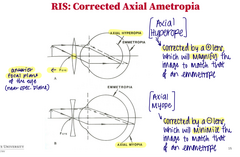
True or False: A corrected axial myope will have a smaller image size than the same eye uncorrected.
True - this comparison to the uncorrected eye applies to both refractive and axial ametropes

True or False: A corrected refractive myope will have a larger image size than the same eye uncorrected.
False - regardless of axial/refractive RE, a corrected myope will always have a smaller image size than an uncorrected.
Compare a corrected refractive myope's retinal image size to an emmetrope
A corrected refractive myope will have a smaller image than an emmetrope. The axial length of a refractive myope is the same as an emmetrope, but a (-) lens is added to correct RE, minimizing the image.
Knapp's plane
The plane containing the anterior/primary focal point of the eye.
Knapp's Law
When a correcting lens is placed with its second principal plane at the primary focal point of an axial ametropic eye, the size of the retinal image is the same as for the emmetropic eye.

Define spectacle magnification
The magnification brought about a spec lens; compares the image size with the correcting lens to the image size without the correcting lens (uncorrected)
What two aspects of a lens can determine spectacle magnification?
The power and shape/form of a lens
Relative Spectacle Magnification
The comparison of the correct eye's RIS to the RIS of an emmetrope
aphakia
without a crystalline lens in the optical system of the eye
aphakia refractive error
high hyperope (+11D, no accomodation)
In an aphakic Gullstrand eye compared to emmetropic eye, the mag will be roughly ___x as magnified.
1.28x
Problems with high + or aphakic specs (8)
"MAD DIIIR"
Motion of objects in field of view (swimming)
Appearance of wearer (large eyes)
Demands on convergence (higher convergence demand)
Decreased FOV
Increased retinal image size
Increased ocular rotations required
Increased lens aberrations
Ring scotoma (missing parts of VF)
Compared to a typical emmetrope, what kind of FOV loss does an aphakic patient have?
decreased peripheral FOV and decreased macular FOV

What causes a ring scotoma in a high hyperope/aphakic patient?
decreased macular FOV, decreased peripheral FOV, and ring scotoma
How does the prismatic effect contribute to a ring scotoma in an aphakic/high hyperope patient?
The prismatic effect creates an angular gap in object space completely around the lens

The angular size of the gap is determined by the ________ _______ at the edge of the lens
prismatic effect

How does the prismatic effect contribute to the increased ocular rotations?
The object viewed through a high plus lens is effectively being viewed through a base-down prism. This requires larger eye movements to focus on things in the periphery.

How does a ring scotoma move in relation to the head moving? In relation to eye movements?
The scotoma moves in the same direction as the head, and in the opposite direction of eye movement.
At what distance do high hyperopes/aphakic patients have the most difficulty with ring scotomas induced by their spec lens?
intermediate distances
Increased ocular rotation is caused by prismatic effects. What two factors contribute to this prismatic deviation?
Lens power and the angular separation of the two alternately fixed points

What is unfortunate about a hyperopic lens above +8.00D?
The lens can be made into an aspheric lens that will always have induced aberrations, either oblique astigmatism (aberration) or curvature of the image. Both cannot be eliminated; only one can.

Two types of aspheric lenses
zonal (drop lens) and continuous
What type of distortion would an aphakic, spectacle lens-wearing patient experience? Where is the most magnification seen?
Pincushion distortion, with the most magnification seen in the periphery

How do we try to fix distortion in a lens?
Either a steeply curved lens (thick lens) or an aspheric lens
T/F: aphakic patients see "with" motion when moving their head with gaze steady.
False - they see against, swimming motion when they keep their eyes fixed and their head moves
What is a lenticular lens?
A lens that contains a central optic zone surrounded by a non-optic peripheral portion, "carrying" lens. Creates a bullseye appearance

An aphakic patient is corrected at distance with a spectacle lens at the optical center. What binocular issue does this cause for near vision?
This increases a patient's near convergence demand because the new high-power lens induces a large amount of base-out prism (prismatic effect) when their eyes try to fixate at near. This causes the patient to appear exophoric due to the increased convergence demand. (Also decreases accommodative demand at the same time!)
A patient is ortho at near and is given a new lens that simulates base-out prism at near (high +). This patient will present with what phoria at near?
Exophoria
How would you decenter a lens to help with the base-out prism induced at near for a high hyperopic/aphakic patient?
Move the lens so you decenter nasally. This will decrease some of the convergence demand and the base-in prismatic effect.
5 parameters to think about when creating an aphakic lens
• Vertex distance
• Pantoscopic tilt
• Centration
• Lens weight & thickness
• Frame adjustment
In aphakia, we want the OC at the frame GC for
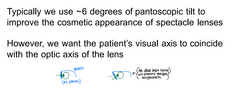
minimum lens thickness. How do we try to fix this when glasses typically have pantoscopic tilt?
We lower the frame 0.5mm per degree of pantoscopic tilt
Why must we provide UV protection to aphakic patients?
UVA is typically absorbed by the lens, but aphakes don't have a lens!
Multifocal suggestions for aspheric lens
- Fit the segment height as high as possible to avoid a base-up prism
- Trifocals are NOT recommended
What is the common issue with unilateral aphakic patients?
ANSEIKONIA - the magnification difference is too much and the patient will not be able to fuse the image
High myopia in spec lens - cosmetic issues (3)
Minification of the wearer's eye, thick edges, multiple ring effect from thick edges
How do we minimize edge thickness in a highly myopic patient's spectacle lens?
"Can I Please Leave"
Center Thickness
Index of refraction
Power
Lens diameter (semi-chord length)

At a fixed power, how do we decrease edge thickness or keep it at its minimum thickness?
- Use a small lens size
- Use a frame with frame PD = distance PD (pupil is centered
on the lens at the GC for minimum radius)
- Use a higher-index material
Minimizing Edge Reflections in Highly Myopic Lens
Goal is to eliminate the light entering through the edge of the lens
1. Edge coating
2. Edge painting
3. Using semitransparent edge
4. Buffing the edge
5. Tinting the lens
6. Hide-a-Bevel (put lens more anterior in the frame)