UNit 3 Chem- Definitions
 Call Kai
 Learn
 Practice Test
 Spaced Repetition
 Match
 Flashcards
 Knowt Play
1/23

There's no tags or description
Looks like no tags are added yet.
24 Terms
Law of conservation of energy
Energy cannot be created or destroyed; it can only be transferred or converted.
Kinetic energy
Energy of motion. A moving ball, running person, or moving molecule has kinetic energy.
Potential energy
Stored energy due to position or arrangement. A ball held above the ground has gravitational potential energy.
System
The part you're studying, such as a chemical reaction
Surroundings:
Everything outside the system, such as the water, container, or air around the reaction.
Heat is energy transferred because of a…..
temperature difference.
-Temperature tells you how hot or cold something is; heat is energy moving from one place to another.
Enthalpy
is the heat transferred by a process at constant pressure.
The symbol is ΔH, pronounced “delta H.”
Delta means change
H Means enthalpy
Endothermic vs. exothermic
Endothermic
ΔH > 0
The system absorbs heat from its surroundings.
Example: ice melting.
___________________
Exothermic
ΔH < 0
The system releases heat into its surroundings.
Example: burning fuel.
ENDO
enters the system, so \(\Delta H\) is positive.
EXO
exits the system, so \(\Delta H\) is negative.
Formula 1: Heat and temperature
q = mc Δ T
q= Heat gained or lost usually J
m= mass in GRAMS!!!
c= specific heat capicty in J
Delta T= Final temp - initial temp
q= mc Delta T example: Suppose you heat 50.0 g of water from 20.0°C to 30.0°C.
Step 1: Identify the values.
m= 50.0 g
c= 4.184 J/ (g x Celcius)
Delta T= 30.0 - 20.0 = 10.0 C
Step 2: Substitute into the formula.
q= (50.0) (4.184)(10.0)
Step 3: Calculate
q= 2092 J = 2.092 kJ
The heat is positive because the water gained energy.
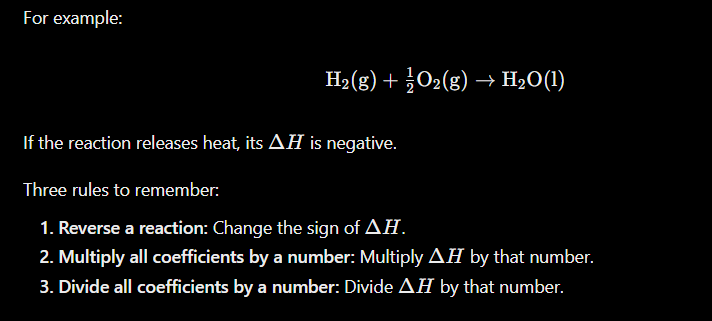
A balanced chemical equation can include an enthalpy change.
Hess's law
Hess's law says that the total enthalpy change depends only on the starting substances and final products, not on the pathway taken.
In simple terms, you can add chemical equations together to calculate an unknown \(\Delta H\).
Hess Law Equation
Write the target equation.
Find the given equations that can combine to produce it.
Reverse equations when needed, changing the sign of their \(\Delta H\).
Multiply equations when needed, multiplying their \(\Delta H\) values too.
Add the equations and cancel substances appearing on both sides.
Add the adjusted enthalpy values.
q will be positive if heat
is being absobed by the system
q will be negeative if
heat is being released by the system
Standard heats of reaction
ΔH rxn = Sigma n ΔH f (products) - Sigma n ΔH f (reactants)