Natural Enemies and Modes of Transmission (Exam 1)
 Call Kai
 Learn
Learn Practice Test
 Spaced Repetition
 Match
Match Flashcards
 Knowt Play
1/37

There's no tags or description
Looks like no tags are added yet.
Name | Mastery | Learn | Test | Matching | Spaced | Call with Kai | Chat |
|---|
No analytics yet
Send a link to your students to track their progress
38 Terms

Natural Enemy
Species of consumer that reduces the fitness of its victim
Solitary Predator
Natural enemy that kills and eats alone on more than one victim

Social Predator
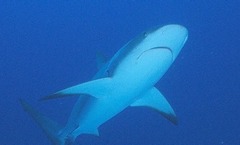
A natural enemy that kills and feeds in a group on more than one victim

Micro-predator
A natural enemy that feeds on but doesn't necessarily kill more than one victim

Parasitoid
A natural enemy that feeds on (infects) one host (where it develops) and kills its host as part of its development
Infect suggest an intimate prolonged interaction --> applied to forms of parasitism

Typical Parasite
A natural enemy that infects but not necessarily kill one host per life stage

Parasitic Castrator
A natural enemy that infects but not necessarily kill and block the reproduction of one host per life stage

Pathogen
A natural enemy that infects, but does not necessarily kill, one host per life stage
undergoes asexual reproduction within the host

trophically transmitted pathogen
Natural enemy that infects one host per life stage, reaching its next host by its current host being eaten.

Major axes of __________
variation separating natural enemies
Microparasites (historically defined)
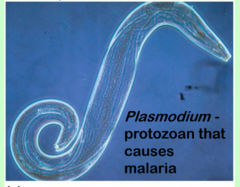
viruses, bacteria, protozoans
small, short generation time, high direct reproduction rates within host (asexual)
induce immunity to reinfection --> hosts that survive initial onslaught
infection duration typically short

Macropasites (historically defined)
parasitic helminths and arthropods
much longer lifespan

Axis of _______
simple vs. complex lifestyles

Simple life cycles (SLCs)
Parasites and pathogens that require only one host species to complete their life cycle

Complex life cycles (CLCs)
More than one host species required to complete their life cycle
Hosts of CLC parasites: definitive hosts
host in which a parasite reproduces sexually
Hosts of CLC parasites: intermediate hosts
host in which a parasite develops but does not reproduce sexually
facultative micropredator
doesn't kill hosts
multiple victims during one life stage (sometimes will eat a lil...)
(also deer)

Human evolutionary history
Trophically transmitted parasitic castrator
Same parasite genus as malaria and chagas
Finishes its life cycle when the octopus eats the castrated crab

Sapronoses
parasite/organism losing its way and causing havoc in another living organism
ex. histoplasma fungus that typically reside in caves and decompose bat/bird droppings could transmit to a human and kill everything and go crazy!

Saprophage
a free living organism that consumes organic matter derived from the decomposition of dead organisms (e.g., fungi, bacteria)
sapronotic agent
a saprophage that can establish an infection, multiplying in or on a host, causing disease
Sapronosis
an infectious disease caused by a free living organism that can circumstantially infect and multiply within a host
When multiplying within a host, its progeny rarely if ever contributes to free-living population dynamics.
Host may be able to evolve resistance of the sapronotic agent is regularly encountered

Sapronoses example: brain eating amoeba :(
Naegleria fowleri
thermophilic amoeba that typically feeds on bacteria in warm freshwater bodies
can enter humans through nose --> fatal

Sapronoses example: white nose syndrome
Pseudogymnoascus destructans --> Closest relative are all saprophages
P. destructans seems to be less of an effective saprophage than its congeners.
Likely introduced to northeastern US from Europe in 2006.
Rapid spread and millions of bat deaths
All feed on decaying cave materials (guano)
Evolution of obligate parasitism occurring?
One isolate from NA
Anthroponosis
an infectious disease primarily transmitted between humans
Sometimes can be transmitted from humans to other animals
Ex. Measles - Extremely contagious

Zoonosis
an infectious disease that can be transmitted from non human animals to human host; primary host is a non human animal
ex. Sin Nombre Virus
- hantavirus
- Typically a virus of deer mice; can be transmitted to humans from aerosolized virus from mouse excreta
vertical transmission
Transmission from parents to offspring
Ex. many lice (featherlice) are vertically transmitted
Direct contact transmission - infected host must contact an uninfected host to transmit the parasite
Direct passive transmission (vertical)
cyst, spore, or egg must contact or ingested by host
Ex. whipworm in humans (soil contaminated food or hands)
Direct active transmission (vertical)
host seeking free-living parasite stage that infects a host
Ex. hookworm caused by various nematodes
Direct contact transmission (vertical)
Infected host must contact an uninfected host to transmit the parasite
Ex. the flu
Horizontal transmission
Transmission between individuals other than parents to offspring
Far more common transmission
Vector transmission (horizontal/indirect)
a host species (typically an arthropod) transmits the parasite to different host species (often by biting)
Trophic transmission (horizontal/indirect)
a predator host becomes infected by killing and consuming a prey host
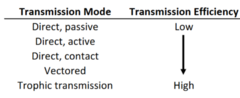
Efficiency of Transmission Strategies
How to overcome low efficiency? --> larger number of infected parasites

Competence
the capacity of a host to transmit infection after being exposed to a parasite
Competence and exposure (contact between host and parasite) are continuous variables and together determine transmission

Dead end host
hosts that are not competent at all
Ex. humans are dead-end hosts for T. gondii. (