AP Psychology Unit 1 Biological Bases of Behavior (1.1, 1.2, 1.3, 1.4, 1.5, 1.6)
 Call Kai
 Learn
Learn Practice Test
 Spaced Repetition
 Match
Match Flashcards
 Knowt Play
1/143

There's no tags or description
Looks like no tags are added yet.
Name | Mastery | Learn | Test | Matching | Spaced | Call with Kai | Chat |
|---|
No analytics yet
Send a link to your students to track their progress
144 Terms
Sensation
the process by which our sensory receptors and nervous system receive and represent stimulus energies from our environment
synesthesia
A condition in which one sense is simultaneously perceived as if by one or more additional senses.
absolute threshold
The minimum stimulus intensity required to detect a stimulus 50% of the time.
weber's law
The principle that to perceive their difference, two stimuli must differ by a constant proportion, not a constant amount.
sensory adaptation
tendency of sensory receptor cells to become less responsive to a stimulus that is unchanging
lens
the transparent structure behind the pupil that changes shape to help focus images on the retina

accommodation
The process by which the eye's lens changes shape to focus near or far objects on the retina.
retina
the light-sensitive inner surface of the eye, containing the receptor rods and cones plus layers of neurons that begin the processing of visual information

cones
Photoreceptors that detect color and detail, functioning in daylight or well-lit conditions.
rods
Photoreceptors that detect black, white, and gray; necessary for peripheral and twilight vision.
trichromatic theory
The theory that the retina contains three different color receptors—one most sensitive to red, one to green, one to blue—which, when stimulated in combination, can produce the perception of any color
opponent-process theory
the theory that opposing retinal processes (red-green, yellow-blue, white-black) enable color vision.
Transduction
The conversion of one form of energy into another. In sensory processing, it refers to transforming stimulus energies into neural impulses.
Perception
The process of organizing and interpreting sensory information, enabling us to recognize meaningful objects and events.
Just-noticeable Difference (JND)
The smallest difference in stimulus intensity that a specific sense can detect.
Blind Spot
The point at which the optic nerve leaves the eye, creating a "blind" spot because no receptor cells are located there.
Visual Nerve
Another term for the optic nerve that carries neural impulses from the eye to the brain.
Nearsightedness
A condition in which nearby objects are seen more clearly than distant objects.
Farsightedness
A condition in which far objects are seen more clearly than near objects.
Photoreceptors
Cells in the retina that respond to light.
Afterimages
Images that occur when a visual sensation persists for a brief time even after the original stimulus is removed.
Fovea
The central focal point in the retina, around which the eye's cones cluster.
Ganglion Cells
Neurons that relay information from the retina to the brain via the optic nerve.
Wavelength
The distance between successive peaks of a wave, typically used in physics and communications to specify wave frequencies.
Pitch
A tone's experienced highness or lowness; depends on frequency.
Amplitude
The height of a wave, determining the loudness of sounds.
Loudness
A sound's intensity.
Pitch Perception
How high or low a sound seems.
Sound Localization
The process by which the location of sound is determined.
Mid ear
the chamber between the eardrum and cochlea contains three tiny bones (hammer, anvil, and stirrup) that concentrate the vibrations of the eardrum on the cochlea's oval window (contains ossicles)
inner ear
contains cochlea, semicircular canals, and vestibular sacs
sensorineural hearing loss
Hearing loss caused by damage to the cochlea's receptor cells or to the auditory nerves.
conduction hearing loss
Hearing loss caused by damage to the mechanical system that conducts sound waves to the cochlea.
place theory
The theory that links the pitch we hear with the place where the cochlea's membrane is stimulated.
frequency theory
The theory that the rate of nerve impulses traveling up the auditory nerve matches the frequency of a tone, enabling us to sense its pitch.
Volley Theory
The theory that frequencies of sound are coded by the rate of firing of neurons in the auditory nerve.
Consciousness
awareness of unique thoughts, memories, feelings, sensations, and environments
Circadian rhythm
the biological clock; regular bodily rhythms that occur on a 24-hour cycle
Jet lag
a disruption of circadian rhythms due to crossing time zones
Shift work
a pattern of work in which a person sometimes works during the day and sometimes during the night
REM sleep
characterized by rapid eye movements and a high level of brain activity; accounts for about 25% of a person's total sleep
REM rebound
the tendency for REM sleep to increase following REM sleep deprivation (created by repeated awakenings during REM sleep)
NREM stage 1
a transition period between wakefulness and sleep ("nodding off") characterized by relaxation and easy arousal

NREM stage 2
characterized by continued slowing of heartbeat, breathing, muscle activity, and eye movements; accounts for about half of a person's total sleep
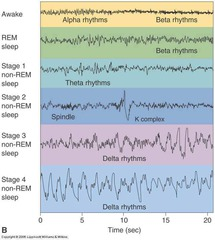
NREM stage 3
characterized by muscle relaxation, lowered blood pressure, and slower breathing; deepest sleep occurs in this stage

Hypnagogic sensations
imaginary images or sensations (e.g., falling or floating) that seem real and occur as a person is falling asleep
Activation-synthesis (dreams)
the theory that dreams are the result of the cerebral cortex interpreting and organizing random flashes of brain activity, originating in the lower brain structures, especially the pons
Consolidation theory (dreams)
the theory that during sleep, the brain is best able to integrate newly encoded memory into long-term store and that dreaming is influenced by this process
Restoration of resources
the theory that people need rest to recover energy lost throughout the day in order to be productive and healthy
Insomnia
recurring problems in falling or staying asleep. (Myers Psychology for AP 2e p. 238)
Narcolepsy
a sleep disorder characterized by unmanageable drowsiness and/or uncontrollably falling into REM sleep during the day
REM sleep behavior disorder
a disorder in which a person physically acts out vivid, often unpleasant dreams with vocal sounds and sudden, often violent, arm and leg movements during REM sleep
Sleep apnea
a disorder in which a person stops breathing for brief periods while asleep
Somnambulism
the condition of walking or performing some other activity without awakening; also known as sleepwalking
heredity
Passing of traits from parents to offspring
nature
the influence of our inherited characteristics on our personality, physical growth, intellectual growth, and social interactions
nurture
external factors that one experiences, such as family interactions or education.
Genetic predisposition
an inherited genetic pattern that makes one susceptible to a certain disease or behaviors
evolutionary perspective
explores how natural selection affects the expression of
behavior and mental processes to increase survival and reproductive success.
natural selection
A process in which individuals that have certain inherited traits tend to survive and reproduce at higher rates than other individuals because of those traits.
eugenics
study of factors that influence the hereditary qualities of the human race and ways to improve those qualities
twin studies
Research comparing the similarities between identical and fraternal twins to understand the influence of genetics versus environment.
family studies
researchers assess hereditary influence by examining blood relatives to see how much they resemble one another on a specific trait
adoption studies
assess hereditary influence by examining the resemblance between adopted children and both their biological and their adoptive parents
central nervous system
brain and spinal cord; interacts with all processes in the body.
peripheral nervous system
relays messages from the central nervous system
to the rest of the body and includes the autonomic and somatic nervous systems.
Autonomic nervous system
governs processes that are involuntary and includes
the parasympathetic and sympathetic nervous systems.
sympathetic nervous system
the division of the autonomic nervous system that arouses the body, mobilizing its energy in stressful situations
parasympathetic nervous system
the division of the autonomic nervous system that calms the body, conserving its energy
somatic nervous system
the division of the peripheral nervous system that controls the body's skeletal muscles; governs processes that are voluntary.
neurons
neural cells that transmit information
Glial cells
cells in the nervous system that support, nourish, and protect neurons
reflex arc
in the spinal cord; demonstrates how neurons within the central and peripheral nervous systems work together to respond to stimuli. Three types of neurons work together: sensory, motor, and interneurons.
sensory neurons
neurons that carry incoming information from the sensory receptors to the brain and spinal cord
motor neurons
neurons that carry outgoing information from the brain and spinal cord to the muscles and glands
interneurons
neurons within the brain and spinal cord that communicate internally and intervene between the sensory inputs and motor outputs
neural transmission
electrochemical communication within and between neurons and the final destination
action potential
a neural impulse; a brief electrical charge that travels down an axon
all-or-nothing principle
Once action potential reaches threshold, either fires or doesn't
depolarization
change in charge when neuron fired positive ions through the cell membrane
refractory period
the time following an action potential during which a new action potential cannot be initiated
reuptake
a neurotransmitter's reabsorption by the sending neuron
neural threshold
The minimum level of stimulation required to get a neuron to fire.
multiple sclerosis
A chronic disease of the central nervous system marked by damage to the myelin sheath. Plaques occur in the brain and spinal cord causing tremor, weakness, incoordination, paresthesia, and disturbances in vision and speech
Myasthenia gravis
a chronic autoimmune disease that affects the neuromuscular junction and produces serious weakness of voluntary muscles
excitatory neurotransmitters
chemicals released from the terminal buttons of a neuron that provoke the next neuron into firing
inhibitory neurotransmitters
chemicals released from the terminal buttons of a neuron that prevent the next neuron from firing
dopamine
A neurotransmitter associated with movement, attention and learning and the brain's pleasure and reward system.
Serotonin
Affects mood, hunger, sleep and arousal. Undersupply linked to depression.
Norepinephrine
A neurotransmitter involved in arousal, as well as in learning and mood regulation
Glutamate
A major excitatory neurotransmitter; involved in memory
GABA
a major inhibitory neurotransmitter; regulates sleep and wake cycles
Endorphines
natural, opiatelike neurotransmitters linked to pain control and to pleasure.
Substance P
A neurotransmitter that is involved in the transmission of pain messages to the brain.
Acetylcholine
enables muscle action, learning, and memory
Hormones
chemical messengers that are manufactured by the endocrine glands, travel through the bloodstream, and affect other tissues
Adrenaline
a hormone secreted by the adrenal glands, especially in conditions of stress, increasing rates of blood circulation, breathing, and carbohydrate metabolism and preparing muscles for exertion.
Leptin
A hormone produced by adipose (fat) cells that acts as a satiety factor in regulating appetite.
Ghrelin
A hunger-arousing hormone secreted by an empty stomach
Melatonin
A hormone manufactured by the pineal gland that produces sleepiness.