1 CBT
 Call Kai
 Learn
 Practice Test
 Spaced Repetition
 Match
 Flashcards
 Knowt Play
1/32

There's no tags or description
Looks like no tags are added yet.
33 Terms
a structured, evidence-based form of psychotherapy that explores the connection between thoughts, feelings, and behaviours.
What is Cognitive Behavioral Therapy (CBT)?
negative thought patterns = contribute to emotional distress = unhelpful behaviours
What principle is CBT based on regarding negative thought patterns?
helps individuals identify and challenge these patterns, replacing them with healthier, more constructive ways of thinking and responding.
What does CBT help individuals do with negative thought patterns?
depression
In the early 1960s, Beck developed cognitive therapy as a result of his research on ?
true
Beck observed that depressed clients had a negative bias in interpreting certain life events, which contributed to their cognitive distortions. ✅❌
true
Beck called it cognitive therapy because of the importance it places on thinking, and it is now known as CBT because it also employs behavioral techniques. ✅❌
false, CBT was originally designed to treat depression
CBT was originally designed to treat anxiety rather than depression. ✅❌

What disorders is CBT now used to treat?

What are the main components + process of Beck’s CBT model?
used as a framework to understand a person’s mental distress.
What is the CBT model developed by Aaron Beck used for?
false, is based on the observation that cognition, emotion, and behavior are reciprocally related.
Cognitive Behavioral Therapy is based on the idea that cognition, emotion, and behavior function independently and do not influence one another. ✅❌
Cognitive activity impacts behavior.
Cognitive activity can be monitored and changed.
A desired change in behavior can be accomplished through changing cognitions.
إذا:
Cognition → يؤثر على Behavior
و
Cognition → يمكن تغييره
إذن:
تغيير cognition ممكن يساعدنا نغيّر behavior.
What are the three assumptions of Cognitive Behavioral Therapy (CBT)?
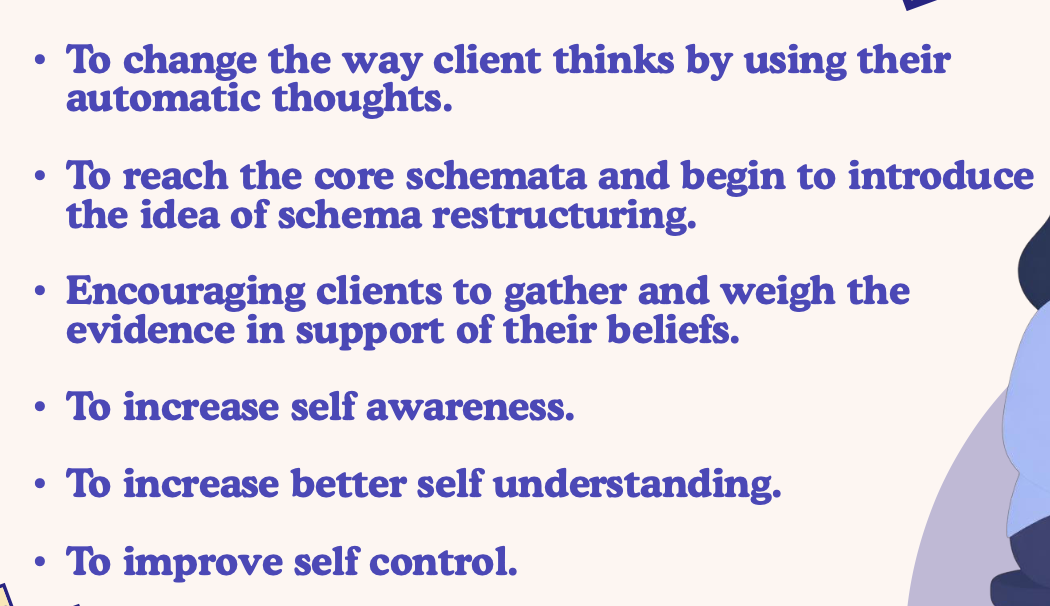
What are the goals of Cognitive Behavioral Therapy (CBT)?
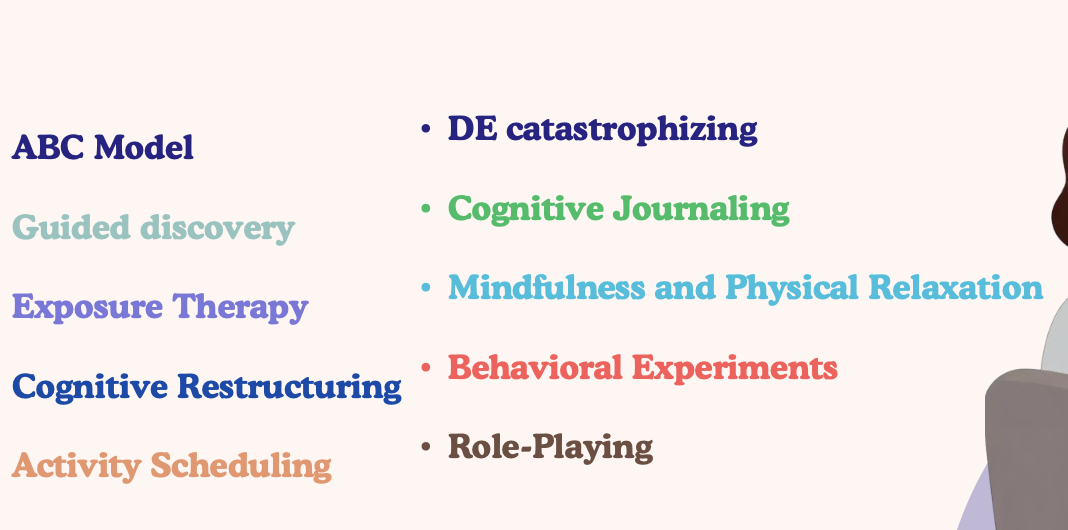
What are the techniques of Cognitive Behavioral Therapy (CBT)?
Acceptance and Commitment Therapy (ACT);
Dialectical Behavior Therapy (DBT);
Exposure Therapy;
Cognitive Behavior Modification.
Cognitive Behavioral Analysis System of Psychotherapy (CBASP);
Cognitive Processing Therapy (CPT);
Problem-Solving Therapy;
Behavioral Activation;
Rational Emotional Behavior Therapy (REBT);
What forms of cognitive behavior therapy share characteristics of Beck’s therapy but vary in their conceptualizations and treatment emphases?

Evolving formulation and individual cognitive conceptualization.
Sound therapeutic alliance.
Goal oriented and problem focused.
Collaboration and active participation.
Focuses initially on the present. ممكن صح وخطأ
Educates the patient to be her own therapist and prevents relapse.
Time limited.
Structured sessions.
Identifies, evaluates, and responds to dysfunctional thoughts and beliefs.
Uses various techniques to change thinking, mood, and behavior.
What are the basic principles of Cognitive Behavior Therapy? ممكن تعداد
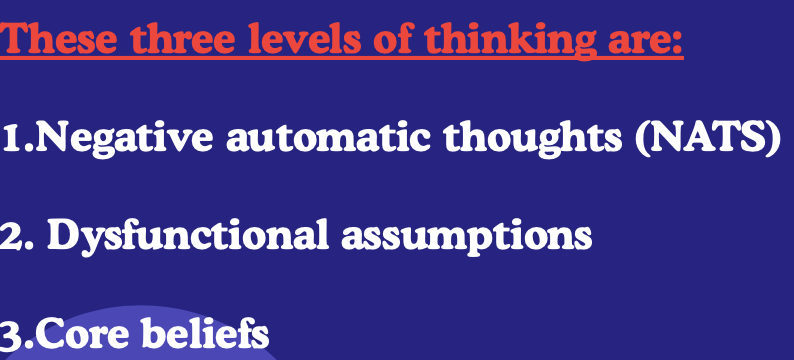
What are the three levels of thinking in Cognitive Therapy?

What are the two parts of the structure of CBT?

What is the standard CBT treatment plan? (General template)?

What is the overall intervention plan in Cognitive Behavior Therapy?
A standard CBT session lasts 45–60 minutes and follows a reliable sequence. It includes:
therapeutic relationship,
mood monitoring,
medication checking if needed,
initial information & assessment,
standard measures.
What is the structure of an individual CBT session? وش الأشياء اللي تكون موجودة في الجلسة؟

What are the main steps in planning treatment and structuring a CBT session? طيب كيف نبدأ العلاج وننظم الجلسات مع هذا المريض؟
Bridge from the previous session →
set an agenda →
review homework →
discuss the agenda and set new homework →
summarize → get client feedback.
What is the typical structure of upcoming CBT sessions?
Through empathic statements,
choice of words,
tone of voice,
facial expressions,
body language.
How can a CBT therapist demonstrate commitment and understanding of the patient? (Developing a therapeutic relationship)?
After questioning the patient to fill in the cognitive model, the therapist explains the conceptualization aloud in summary form.
What does sharing your conceptualization and treatment plan involve in CBT? (Part oa developing therapeutic relationship)

What are the main components of developing the therapeutic relationship and using the session structure in CBT?

To provide chronological evidence of change throughout therapy
an overall outcome measure indicating the efficacy of the intervention at the end of treatment.
Why are mood rating scales and psychometric questionnaires used frequently at the beginning of therapy?

Who is the patient?
Patient demographics.What is happening now?
Chief complaints and current problems.How did the problem develop?
History of present illness and precipitating events.How does the patient deal with problems?
Coping strategies (adaptive and maladaptive), current and historical.What is the patient’s psychiatric history?
Psychiatric history, including kinds of psychosocial treatments (and perceived helpfulness of these treatments), hospitalizations, medication, suicide attempts, and current status.What is the patient’s substance use history?
Substance use history and current status.What is the patient’s medical history?
Medical history and current status.What is the family psychiatric history?
Family psychiatric history and current status.What is the developmental history?
Developmental history.What is the general family history?
General family history and current status.What is the social history?
Social history and current status.What is the educational history?
Educational history and current status.What is the vocational history?
Vocational history and current status.What is the religious/spiritual history?
Religious/spiritual history and current status.What are the patient’s personal resources?
Strengths, values, and adaptive coping strategies.
What information is gathered during the initial information and assessment in CBT?
Asking how patients spend their time provides additional insight into their daily experience and facilitates setting specific goals at the first treatment session. The therapist should explore:
1. Variations in their mood.
2. Whether and how they interact with family, friends, and people at work.
3. How they are generally functioning at home, work, and elsewhere.
4. How they spend their free time.
5. What they are not doing and what they are actively avoiding
What should be explored when asking how patients spend their time during assessment?
1. Ask whether there is anything the patient is reluctant to tell you, without requiring them to disclose it immediately.
2. Involve a family member by asking what they think is most important for you to know; if they focus only on negative aspects, ask about the patient’s positive qualities, strengths, and coping strategies.
3. Go over your initial diagnostic impressions and explain how the diagnosis will be confirmed using the DSM, while being cautious in severe mental illness; then present a summary of symptoms and problems.
4. Present your tentative treatment plan.
What are the main components of the final part of the assessment?
1. Beck Depression Inventory (BDI)
2. Beck Anxiety Inventory (BAI)
3. Beck Hopelessness Scale
4. Hospital Anxiety and Depression Scale (HAD)
5. CORE (Centre for Outcomes Research and Effectiveness)
6. Spence Children’s Anxiety Scale
7. Geriatric Depression Rating
What are examples of typical standardized rating scales and mood monitoring forms used in therapy?
Non-standardised mood assessment questionnaires can be used from session to session.
Standardised questionnaires can be used as an initial measurement for comparison with outcome measurement at discharge or midway through therapy.
How can non-standardised and standardised questionnaires be used during therapy?

What are the components, therapeutic purposes, approximate durations, and key therapist actions of a standard CBT session?