chan 7: pt 2
 Call Kai
 Learn
 Practice Test
 Spaced Repetition
 Match
 Flashcards
 Knowt Play
1/30

There's no tags or description
Looks like no tags are added yet.
31 Terms
structure of mature mRNA
CAP: formed at +1 of transcription start site
5’-UTR: 5’-untranslated region
Kozak squence: ANNAUGG (-3, +1,+4)
+1: untranslation starts here
cont coding sequence
stop codons: UAG, UGA, UAA
3’-UTR: 3’untranslated region
AAAAAA: poly a tail

64 codons
61 codons for amino acids
3= stop codons
enzymatic modification of tRNA
it undergoes extensive post-transcriptional modification by enzymes
make modified bases
loops & 3’CCA after transcription
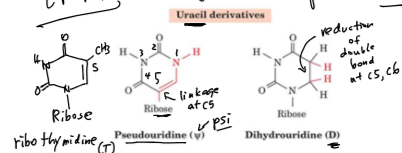
3 uracil derivatives
ribothymidine
pseudouridine (psi): linkage w/ ribose at C5
dihydrouridine (D): reduction of double bond at C5, C6
2D vs 3D of t-RNA
2D: cloverleaf (highway intersection): held via intramolecular hydrogen
fold into L-shaped 3D struc
3D: has amino acid attachment site & anticodon at oppo ends
tRNA struc
acceptor arm: 3’ACC
variable arm: TyC arm
D arm
anticodon arm
allignment of codon & anticodon
mRNA: read in 5’—>3’
3-base codon: 5’base, middle base, 3’ base
tRNA anticodon: 3’—>5’
3’ base, middle base, 5’base

wobble hypothesis
explains codon degeneracy
how a tRNA , one anticodon can recognize several codons
“wobble” in 5’anticodon position allow non-standrad base pairing
w/ wobble pairings, >31 tRNA is needed for all 61 codon
inosine at freq found at 5’ anticodon
consists of hypoxanthine base linked to sugar
can form hbond w. mulp bases of 3’ condon (UCA)
lets one tRNA read multiple synonymous codon

mutation
point mutation: a single base change
silent mutation: no change in amino acid
missense mutation: a change specifies a dif amino acid
nonsense mutation: a change that produces stop codon
insertion or deletion mutation - an addition or deletion of > 1 bases
what happens due to frame shift mutation
code for dif aa seq —> hit stop codon too quickly
what happens when a mutation places a fake/early AUG in 5’-UTR
In frame w/ endogenous AUG —>still functional
extra aa ay N-terminus
not in frame w/ endogenous AUG —> not functional
short pep w/ dif sequences
how aa are activated for protein synthesis
catalyzed by aminoacyl-tRNA synthetase
1 enzyme per aa
proofreading occurs to make sure aa on tRNA is right
each aminoacyl-tRNA synthetase has specific binding sites for
a specific amino acid
tRNA carrying anticodon for aa
ATP moc, energy for aminoacyl bond formation
catalysis of aminoacyl-tRNA synthetase
amino acid + ATP ←→ aminoacyl-AMP + PPi
aminoacyl-AMP + tRNA -3’OH —> aminoacyl-tRNA product
why does isoleucyl-tRNA synthetase sometimes accidentally make val-tRNA
share sim structure so valine can be activated (as aminoacyl-AMP) and transferred to the tRNA.
proofreading submit of enzyme uses hydrolysis to break it down —> valine + tRNA
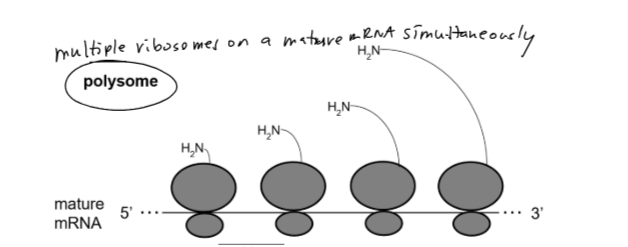
polysome
many ribosomes on the same mature mRNA & 100nt apart
eukaryotic ribosomes
ribosome 80s
40s + 60s
made of ribosomal RNA
initiation of eukaryotic translation
forming initiation complex
inv formation of complex: initiator methionyl-tRNA, mRNA, a ribosome
eukaryotic initation factors “eIFs”
proteins use for iniatiing step
steps of forming initiation complex
eiF2 + GTP escorts initiator methionyl - tRNA to 40 S
cap binding proteins escorts mRNA to 40S
scan for AUG, need ATP
GTP hydrolysis - conformation change
60S binds
Step-by-Step Initiation
Initiator methionyl-tRNA binds eIF2 & GTP
eIFs binds to 40s
40s instrinsicly has eIFs but dissociates & associates when needed
the two are brouth tgt bc favorable itxn btw eIF’s
cap-binding protein bind 5’s of mature mRNA
bring mRNA & 40s complex tgt via fav pro-pro itxn of eIFs in 40s
complex uses ATP to scan for AUG on mRNA
GTP hydrolysis —> conf change —> allow 60s to bind and complete initiation complex

elongation process during translating
1, binding of an aminoacyl-tRNA to A site on ribosome
formation of peptide bond
translocation of peptidyl-tRNA to P site on ribosoe
binding of an aminoacyl-tRNA to A site on ribosome
initiator methionyl-tRNA in P site —> mRNA codon in A site determines which aminoacyl-tRNA to bind
binidng of anticodon & codon is antiparallel & complementary
charged tRNA binds to eEF1A + GTP —> binds A site —> GTP hydrolysis
formation of peptide bond
initiator methionyl-tRNA in P site + aminoacyl tRNA in A site —> peptide bind formation
growing chain goes to A site
P site has tRNA w/o an aa = “uncharged” tRNA
3.translocation of peptidyl-tRNA to P site on ribosoe
req eEF2 complex w/ GTP —> bind to ribosome —> conf change that moves mRA abd its base-paird tRNA
uncharged tRNA is rel from ribosome
peptidyl-tRNA moves into P site —> A site is ready for another
GTP —> GDP + Pi
eEF
eukaryotic elongation factors
elongation of eukaryotic translation
binding of aminocyl-tRNA to A site
proofrreaing GTP hydrolysis
peptide bond formation by ribozyme rRNA
AUG uncharged RNA form peptide bond to chraged tRNA
eEF2/GTP bind
GTP hydrolysis
empty A site

termination of translation
a termination codon move to A site —> no tRNA w/ anticodon can pair w/ stop codons —> termination
eukaryotic release factor-1 (eRF1) rec stop codon
peptidyltransferase (ribozyme) hydrolyze bond btw peptide chain & tRNA
newly made polypeptide is rel from ribosome & dissociation of ribosome subunits & rel of mRNA
antibiotics targetting prokaryotic protein synthesis
tobramycin: binds to bacterial ribosome & prevent formation of initaion complex
doxycycline (Vibramycin): binds to bacterial ribosome & inhibits binding of aminoacyl-tRNA A site (1)
chloramphenicol: binds to bacterial ribosome & inhibits peptidyltransferase (2)
cleocin = clindamycin
azithromycin (Zithromax): binds to bacterial ribosome & prevent translocation (3)
clarithromycin
erythromycin