Becker Part 2 (R2 and R4)
 Call Kai
 Learn
 Practice Test
 Spaced Repetition
 Match
 Flashcards
 Knowt Play
1/89

There's no tags or description
Looks like no tags are added yet.
90 Terms






Choice "B" is correct. The taxpayer has a $4,500 long-term capital gain. The basis of property acquired as a gift is the same as the basis in the hands of the donor, which is $4,500 in this situation. The donor's holding period of one year also rolls over. The total holding period is more than one year, so the gain recognized is long-term.
Sales price | $9,000 |
Rollover cost basis | (4,500) |
Long-term capital gain | $4,500 |
Choice "A" is incorrect. $1,000 would be the amount of the gain if the $8,000 fair market value at the date of gift is used as the donor's basis. The taxpayer's basis in the gifted property is the donor's rollover cost basis of $4,500, not the fair market value at the date of gift. The donor's holding period of one year also rolls over. The total holding period is more than one year, so the gain recognized is long-term.
Choice "C" is incorrect. The amount of the gain is $4,500, but the gain is long-term, not short-term. The taxpayer's basis in the gifted property is the donor's rollover cost basis, so the donor's holding period of one year also rolls over. The total holding period is more than one year, so the gain recognized is long-term.
Choice "D" is incorrect. $1,000 would be the amount of the gain if the $8,000 fair market value at the date of gift is used as the donor's basis. The taxpayer's basis in the gifted property is the donor's rollover cost basis of $4,500, not the fair market value at the date of gift. Although the holding period would be short-term if the fair market value at the date of gift is used as the basis, in this case the taxpayer's basis in the gifted property is the donor's rollover cost basis so the donor's holding period also rolls over so the gain recognized is long-term.

Choice "A" is correct. The fair market value (FMV) of the stock at the time of the gift was greater than the donor's basis, so the donee-child's tax basis in the gifted property is the rollover cost basis of $120,000.
The stock is held for investment, so it is a capital asset, and the gain or loss on the disposition of the stock is a capital gain or loss. Since the donee's tax basis is the donor's rollover cost basis, the donor's holding period also rolls over. The donee's holding period for the stock is two and a half years (2 years + 6 months), so the capital gain or loss is long term.
Sales price | $110,000 |
Tax basis | (120,000) |
Long-term capital loss | ($10,000) |
Choice "B" is incorrect. The capital loss would be $15,000 if the $125,000 FMV of the stock at the date of gift was incorrectly used as the donee's basis ($110,000 sales price – $125,000 tax basis = $15,000 loss). Since the FMV of the stock at the date of gift is greater than the donor's basis, the donee's tax basis in the gifted property is the rollover cost basis of $120,000. The donee's holding period for the gifted property is long term because the donor's holding period rolls over along with the donor's cost basis.
Choice "C" is incorrect. The capital loss would be $15,000 if the $125,000 FMV of the stock at the date of gift was incorrectly used as the donee's basis ($110,000 sales price – $125,000 tax basis = $15,000 loss). Since the FMV of the stock at the date of the gift is greater than the donor's basis, the donee's tax basis in the gifted property is the rollover cost basis of $120,000. The donee's holding period for the gifted property is long term, not short term, because the donor's holding period rolls over along with the donor's cost basis.
Choice "D" is incorrect. The amount of the loss is $10,000, but it is a long-term capital loss, not a short-term capital loss, because the donee-seller's holding period includes the two years that the stock was held by the donor.


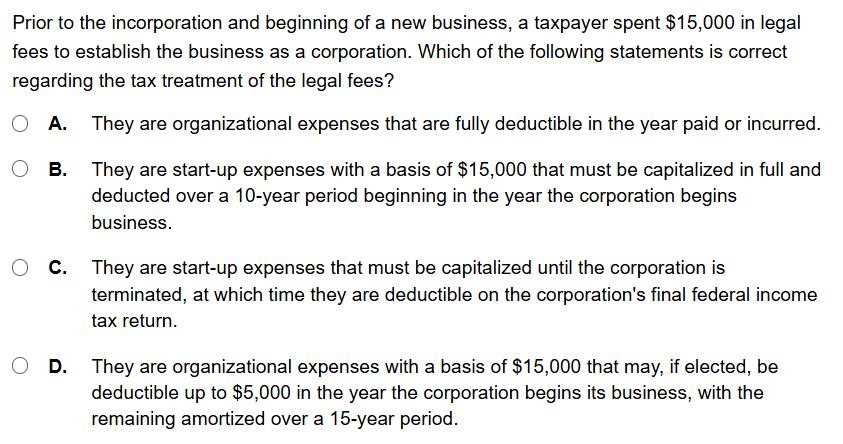
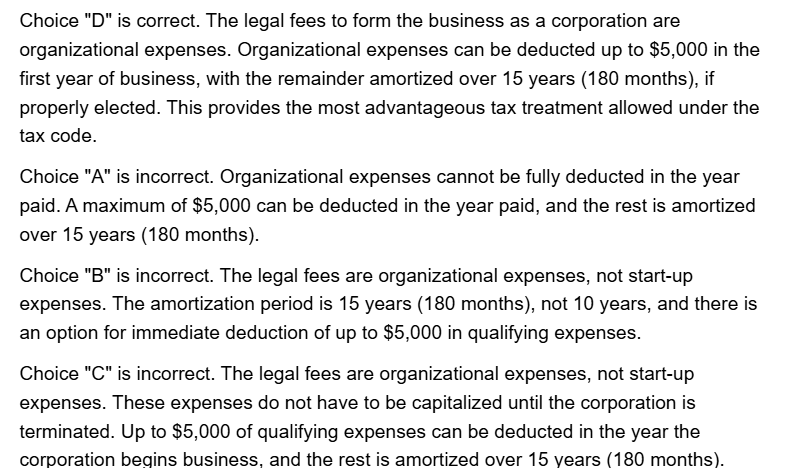

Choice "C" is correct. The amortizable start-up expenditures total $23,000:
Advertising for business opening | $7,000 |
Cost of analysis of potential markets | 4,000 |
Training of employees | 12,000 |
Total start-up costs | $23,000 |
The costs of issuing stock and interest on corporate loans are not included in start-up expenses. The costs of issuing stock are not deductible. The interest on corporate loans is separately deductible as a regular business expense.
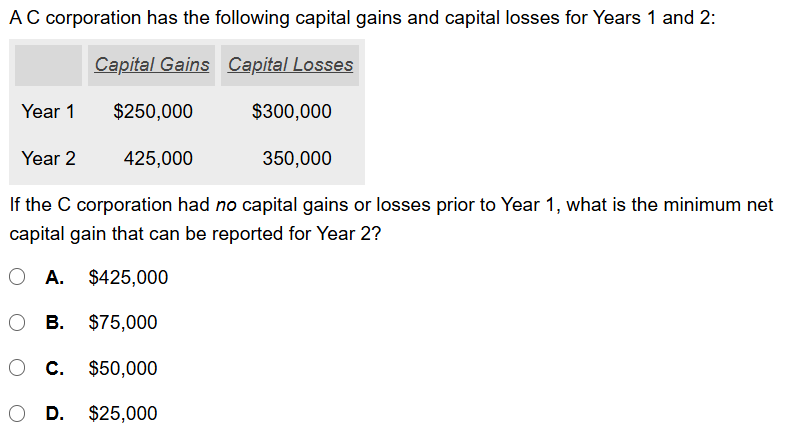
Choice "D" is correct. The minimum net capital gain reported for Year 2 is $25,000.
For C corporations, capital gains can only offset capital losses. A net capital loss can be carried back three years and forward five years to offset net capital gains in other years.
Year 1 capital gains | $250,000 |
Year 1 capital losses | (300,000) |
Year 1 net capital loss | (50,000) |
The facts provide that the C corporation had no capital gains or losses prior to Year 1, so the Year 1 net capital loss is carried forward to Year 2.
Year 2 capital gains | $425,000 |
Year 2 capital losses | (350,000) |
Year 2 net capital gain | 75,000 |
Year 1 capital loss carryforward | (50,000) |
Year 2 taxable net capital gain | 25,000 |
Choice "A" is incorrect. $425,000 is the amount of the Year 2 capital gains before deduction of Year 2 capital losses and the Year 1 net capital loss carryforward.
Choice "B" is incorrect. $75,000 is the Year 2 net capital gain before deduction of the Year 1 net capital loss carryforward.
Choice "C" is incorrect. $50,000 is the amount of the net capital loss carryforward from Year 1.
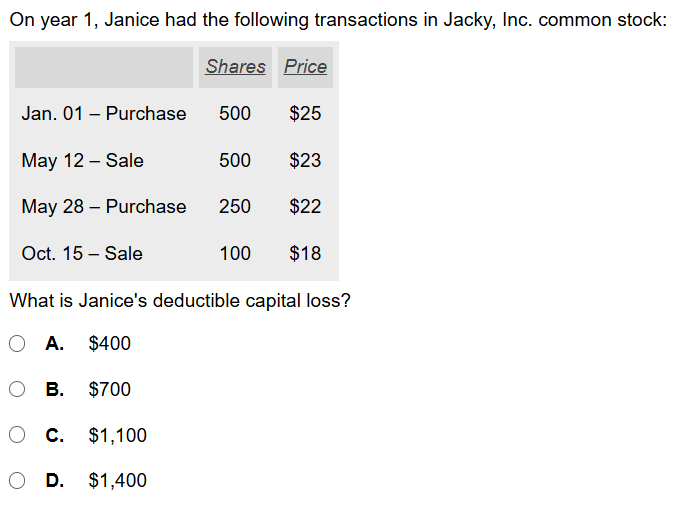
Choice "C" is correct. The wash sale rules apply to 250 shares that were sold on May 12, because they were repurchased within 30 days of the sale. The computation of Janice's total deductible capital loss is as follows:
May 12 sale of 250 shares that were not repurchased within 30 days: | |||||
250 shares × sale price of $23/share | 5,750 | ||||
250 shares × purchase price of $25/share | (6,250) | ||||
Loss on May 12 sale | 500 | ||||
October 15 sale of 100 shares: | |||||
100 shares × sale price of $18/share | 1,800 | ||||
100 shares × basis of $24/share* | (2,400) | ||||
Loss on October 15 sale | 600 | ||||
Total deductible capital loss | 1,100 | ||||
* The basis of these shares includes the purchase price of $22/share plus the loss of $2/share (sale price of $23/share less purchase price of $25/share) that was disallowed because of application of the loss disallowance rules.
Choices "A", "B", and "D" are incorrect per the explanation abov

Choice "B" is correct. The sale of Alpha Corp. stock on June 10 is a wash sale. The stock was sold at a loss ($10 sales price – $18 purchase price on May 15) and identical stock was purchased within 30 days before or after the June 10 sale date (June 1). Deduction of the $8,000 loss on the wash sale is disallowed [($10 sales price − $18 purchase price) × 1,000 shares]. The disallowed loss is added to the cost basis of the repurchased stock: $12 purchase price × 1,000 shares = $12,000 + $8,000 disallowed loss = $20,000 basis of repurchased stock.
Choice "A" is incorrect. $8,000 is the amount of the June 10 wash sale loss. Deduction of the wash sale loss is disallowed because identical stock was purchased within 30 days before or after the June 10 sale date (June 1).
Choice "C" is incorrect. $2,000 is the difference between the June 10 sales proceeds ($10 × 1,000 shares) and the June 1 stock purchase ($12 × 1,000 shares). The facts state that the 1,000 shares sold June 10 were purchased May 15, not June 1.
Choice "D" is incorrect. The taxpayer cannot deduct any loss for the sale of the stock because it is a disallowed wash sale loss.


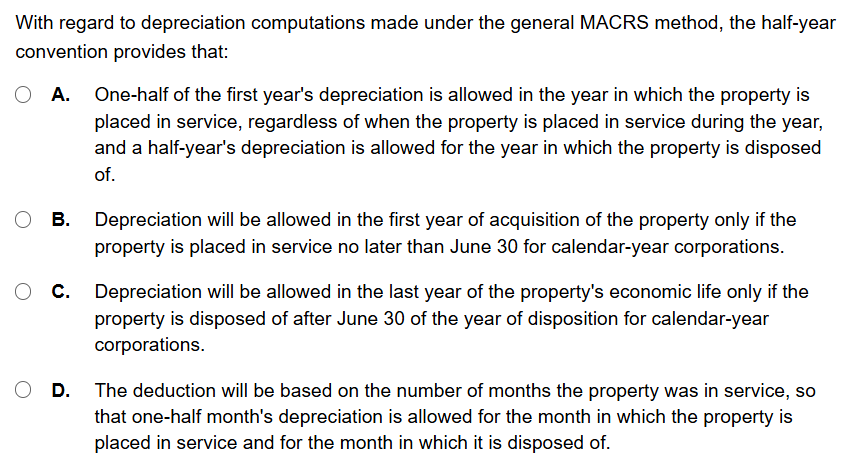


Choice "D" is correct. When a taxpayer places more than 40 percent of its property (other than certain qualifying real property) into service in the last quarter of the taxable year, the corporation must use the mid-quarter convention for MACRS depreciation purposes. With this method the acquisitions are segregated by quarter and treated as if placed in service in the middle of each respective quarter.

Choice "B" is correct. To qualify for the IRC Section 179 expense deduction, the property must be tangible personal property or qualified real property improvements acquired by purchase from an unrelated party for use in the active conduct of a trade or business.
Statements I and II are both correct statements concerning the criteria for property to qualify under IRC Section 179.

Choice "A" is correct. Under the Section 179 election to expense certain depreciable business assets, the taxpayer may expense the cost of qualifying depreciable property up to an annual limitation amount. Land is not depreciable property and does not qualify for Section 179, so only the cost of the depreciable personal property can be expensed ($100,000).
Choice "B" is incorrect. This answer choice only includes the land and not the depreciable personal property. Land is not a depreciable asset and is not eligible for the Section 179 expense deduction. Only the depreciable personal property is eligible for the Section 179 expense deduction.
Choice "C" is incorrect. This answer choice includes the land and the personal property; however, land is not a depreciable asset and is not eligible for the Section 179 expense deduction.
Choice "D" is incorrect. The taxpayer can only expense qualified business-use property which equals $100,000 in this scenario. Land does not qualify for the Section 179 deduction.


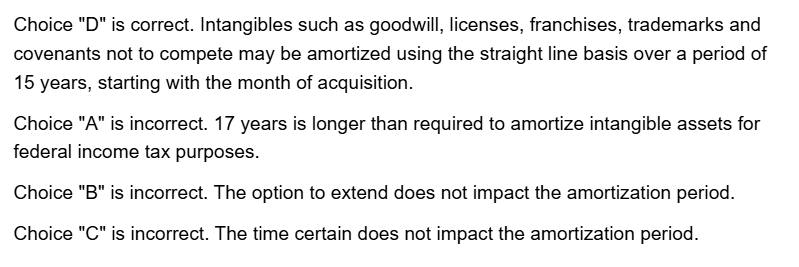


Choice "C" is correct. New Brands, Inc. is permitted to deduct $5,000 of organizational costs in Year 1 and is permitted to amortize the remaining organizational costs over 180 months, starting in September of Year 1. After the $5,000 is immediately deducted, New Brands, Inc. is left with $41,400 of organizational costs to be amortized. The portion that is amortized in Year 1 is $920: ($41,400 / 180 months) × 4 months. New Brands, Inc. will add this $920 to the $5,000 immediate deduction. Therefore, New Brands, Inc.'s total Year 1 organizational cost deduction is $5,920.
Choice "A" is incorrect. New Brands, Inc. is permitted to deduct $5,000 of organizational costs in Year 1 and will amortize the remaining amount ($41,400) over 180 months, starting in September of Year 1. It is important to note that New Brands will deduct a full month of amortization for the first month of business, even though the business did not start until the middle of the month (September 15). Therefore, New Brands, Inc. will deduct $920 [($41,400 / 180 months) × 4 months] in addition to the $5,000 immediate deduction. Accordingly, New Brands, Inc.'s total Year 1 organizational cost deduction is $5,920.
Choice "B" is incorrect. New Brands Inc. is permitted to deduct $5,000 of the organizational costs in Year 1 and will amortize the rest of the costs over 180 months, starting when business operations start. This answer choice disregards the immediate $5,000 deduction and calculates four months of amortization for the full organizational cost amount of $46,400: ($46,400 / 180 months) × 4 months = $1,031.
Choice "D" is incorrect. Not only is New Brands, Inc. permitted to deduct $5,000 of organizational costs in Year 1, but it must also amortize the remaining organizational costs over 180 months, starting in September of Year 1. After the $5,000 is immediately deducted, New Brands, Inc. is left with $41,400 of organizational costs to be amortized. The portion that is amortized in Year 1 is $920: ($41,400 / 180 months) × 4 months. New Brands, Inc. will add this $920 to the $5,000 immediate deduction, totaling $5,920.
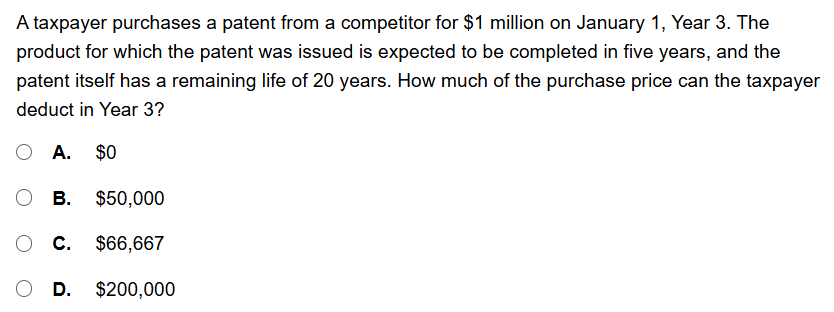

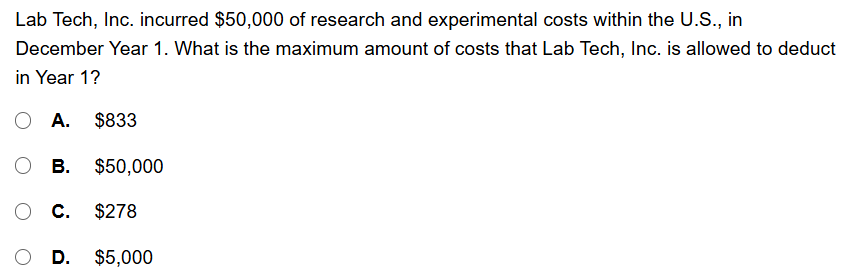
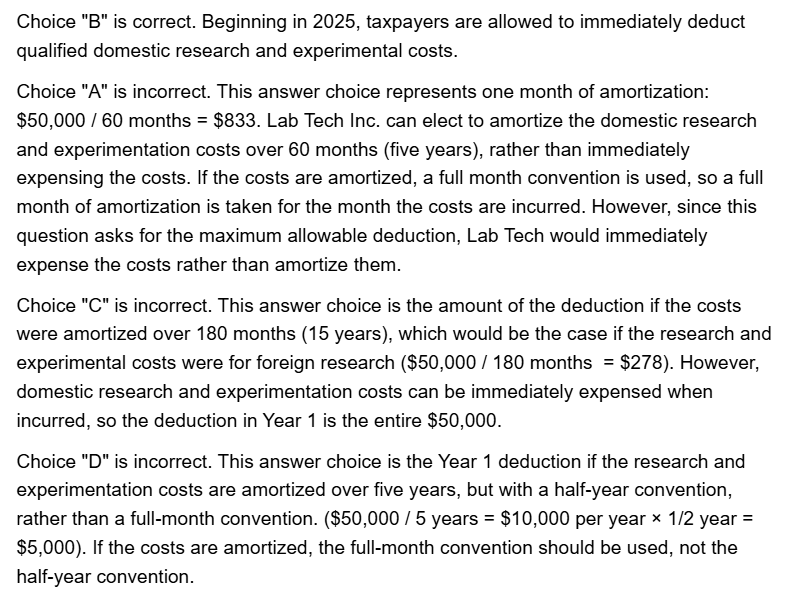

Choice "A" is correct. Up to $5,000 of organizational expenses may be deducted in the year business begins, with any remaining amount amortized over 180 months (15 years). The $5,000 allowance is reduced dollar-for-dollar when total costs exceed $50,000.
Total organizational expenses | $32,000 |
Less: amount immediately expensed in first year | (5,000) |
Remaining organizational expenses to be amortized | 27,000 |
Divided by total months of amortization | 180 |
Monthly amortization expense | 150 |
Multiplied by number of months of amortization in first year (July 1 to Dec. 31) | × 6 |
First year amortization | 900 |
Amount immediately expensed in first year | 5,000 |
Total first year deduction for organizational expenses | $5,900 |
Choice "B" is incorrect. The $3,200 amount appears to represent 10 percent of the total $32,000 for the first year deduction of organizational expenses, which is not the proper method for computing the deduction. The correct amount is an immediate expense of $5,000 plus $900 of amortization ($27,000 × 6 months / 180 months), for a total deduction in the first year of $5,900.
Choice "C" is incorrect. The $6,400 amount includes 10 months (March 1–December 31) of amortization in the first year, along with the $5,000 immediately expensed in the first year ($32,000 – $5,000 = $27,000 × 10 months / 180 months = $1,800 + $5,000 = $6,800). Amortization begins with the month business operations start (July 1), not the first month in which organizational expenses are incurred (March 1).
Choice "D" is incorrect. The $6,800 amount includes 12 months (January 1–December 31) of amortization in the first year, along with the $5,000 immediately expensed in the first year ($32,000 – $5,000 = $27,000 × 12 months / 180 months = $1,800 + $5,000 = $6,800). Amortization begins with the month business operations start (July 1), not the month of incorporation (January 1).
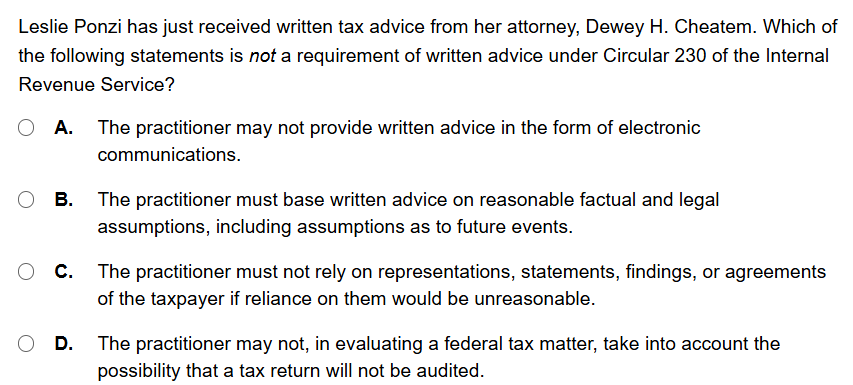


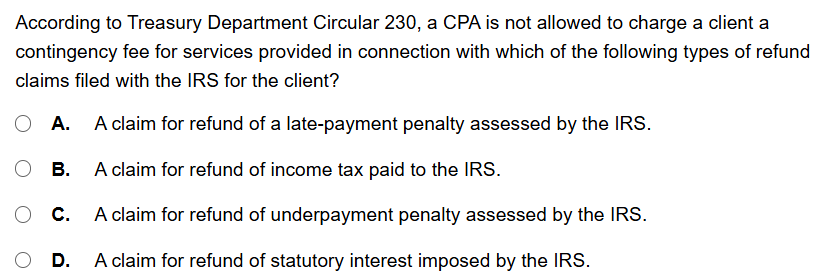


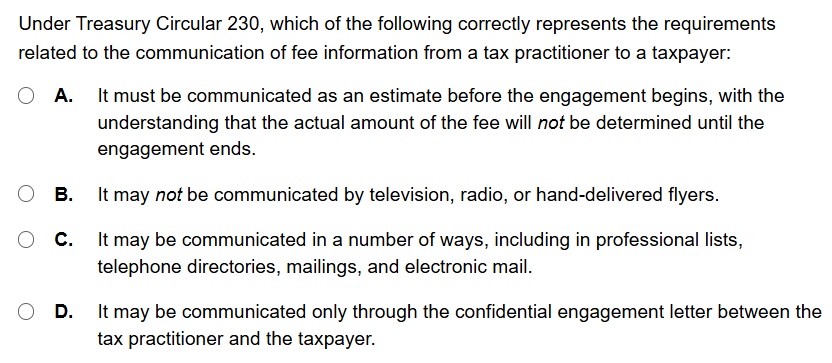




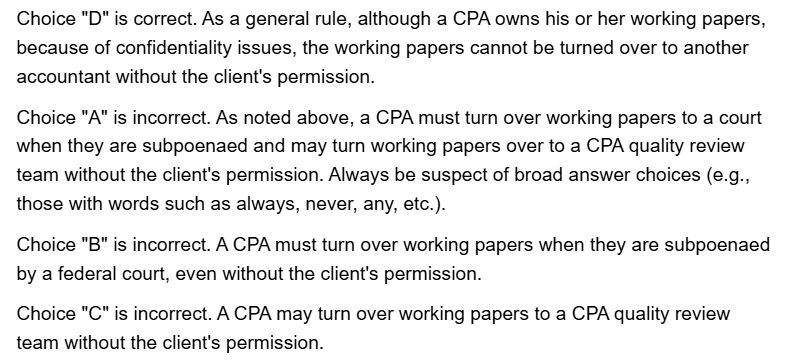
Choice "D" is correct. The CPA generally cannot give out a client's confidential information to anyone without the client's consent. However, exceptions are generally made for court subpoenas and state CPA society quality control panels.
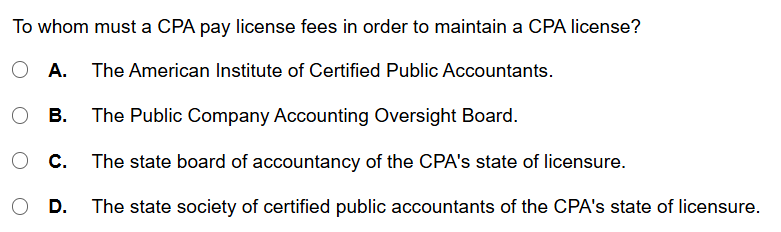
Choice "C" is correct. State boards of accountancy have the sole power to license CPAs; thus, the only body to which the CPA must pay fees in order to maintain the CPA license is to the state board of accountancy for the state in which the CPA is licensed.
Choice "A" is incorrect. The American Institute of Certified Public Accountants develops the CPA Exam and sets auditing standards and ethical standards for CPAs, but it is not involved in the licensing of CPAs.
Choice "B" is incorrect. The Public Company Accounting Oversight Board oversees the audits of public companies; it is not engaged in the licensing of CPAs.
Choice "D" is incorrect. State societies of CPAs are dedicated to the development and strengthening of the CPA profession within their states, but they are not engaged in the licensing of CPAs.
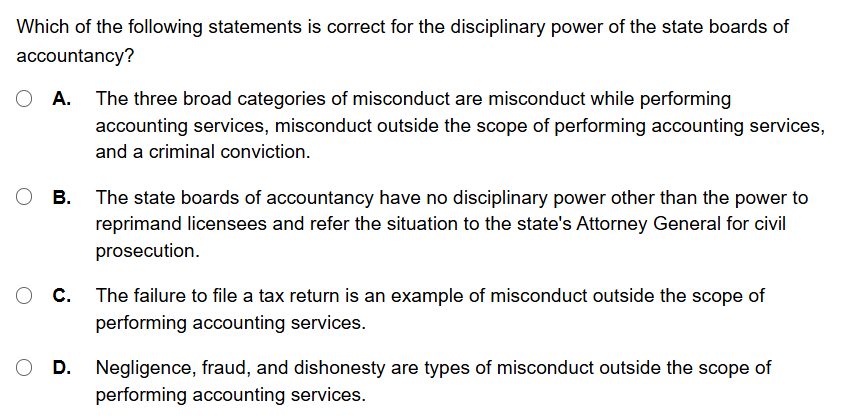
Choice "A" is correct. The three broad categories of misconduct are misconduct while performing accounting services, misconduct outside the scope of performing accounting services, and a criminal conviction.
Choice "B" is incorrect. The state boards of accountancy have considerable disciplinary power other than the power to reprimand licensees. The Attorney General of the various states will not be interested in civil prosecution.
Choice "C" is incorrect. The failure to file a tax return is an example of a criminal conviction (assuming that a conviction actually occurred), not misconduct outside the scope of performing accounting services.
Choice "D" is incorrect. Negligence, fraud, and dishonesty are types of misconduct while performing accounting services, not types of misconduct outside the scope of performing accounting services.

Choice "A" is correct. The National Association of State Boards of Accountancy (NASBA) coordinates the state boards of accountancy in the licensing and regulation of CPAs.
Choice "B" is incorrect. The Public Company Accounting Oversight Board (PCAOB) oversees the audits of accounting firms auditing public companies.
Choice "C" is incorrect. The Financial Accounting Standards Board (FASB) establishes financial accounting and reporting standards for public and private companies that follow Generally Accepted Accounting Principles (GAAP).
Choice "D" is incorrect. The American Institute of Certified Public Accountants (AICPA) is a national professional organization representing CPAs. The AICPA develops and scores the Uniform CPA Exam but does not coordinate the state boards of accountancy in the licensing and regulation of CPAs.

Choice "A" is correct. Membership in the AICPA can be suspended or terminated without a hearing for certain offenses. These offenses include but are not limited to (1) proof of conviction of a crime punishable by imprisonment for more than one year, (2) proof of conviction for willful failure to file any income tax return, (3) proof of conviction for filing a false or fraudulent income tax return or aiding in the preparation of a false or fraudulent income tax return of a client.
Choice "B" is incorrect. The Joint Trial Board of the AICPA can expel a member by a two-thirds vote, not a majority vote.
Choice "C" is incorrect. The AICPA can suspend or terminate membership for failure to pay dues and for failure to meet CPE and other membership retention requirements (such as practice-monitoring).
Choice "D" is incorrect. The AICPA and state CPA societies can sanction their members but cannot suspend or permanently revoke a CPA's license.

Choice "A" is correct. The Internal Revenue Code (IRC) provides for criminal penalties for any person, including a tax return preparer who prepares a tax return in a fraudulent or false manner with regard to any material matter. In this scenario, the CPA appropriately reported the client's income from drug dealing on the tax return and did not take a deduction for the kickbacks paid to city employees. These actions are not likely to result in imprisonment or a penalty.
Choice "B" is incorrect. The CPA knowingly made false statements on a material matter to help his client. This action would likely result in the imposition of the false and fraudulent statement penalty of up to $500,000 and/or imprisonment under IRC Section 7206.
Choice "C" is incorrect. Because the CPA fraudulently omitted the income from the material exercise of statutory stock options, the CPA would likely be subject to the false and fraudulent statement penalty of up to $500,000 and/or imprisonment.
Choice "D" is incorrect. The CPA deliberately did not report the cash that the client received from illegal activities on the client's estate tax return. This fraudulent omission would result in a false and fraudulent statement penalty of up to $500,000 and/or imprisonment if the CPA is found guilty.

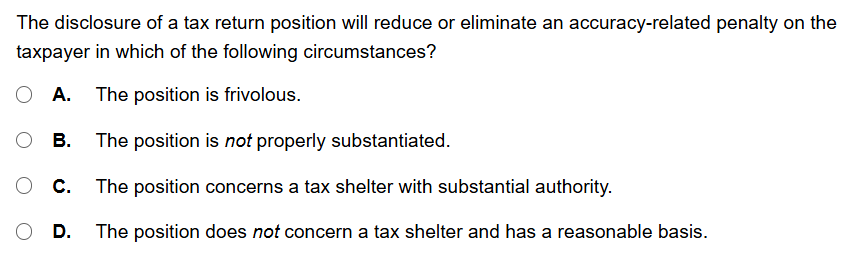
Choice "A" is correct. The more-likely-than-not standard involves a position that has a more than 50 percent chance of succeeding.
Choice "B" is incorrect. Reports issued by the U.S. Congress, IRS regulations, rules, and releases, and U.S. court case decisions, but not foreign court case decisions, constitute substantial authority for the substantial authority standard.
Choice "C" is incorrect. The reasonable basis standard involves a position that is arguable but fairly unlikely to prevail in court. A numerical statement of this standard has at least a 20 percent chance, not a 10 percent chance, of succeeding.
Choice "D" is incorrect. The substantial authority standard involves a position that has a more than 40 percent chance, not a one-in-four chance, but a less than 50 percent chance of succeeding.

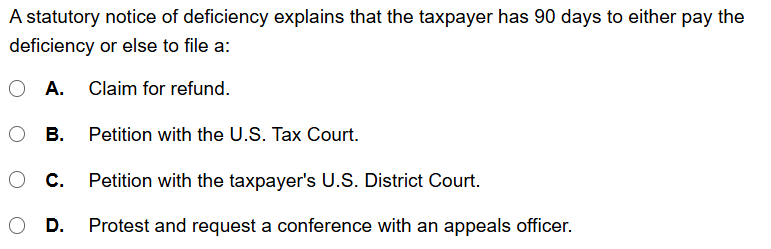
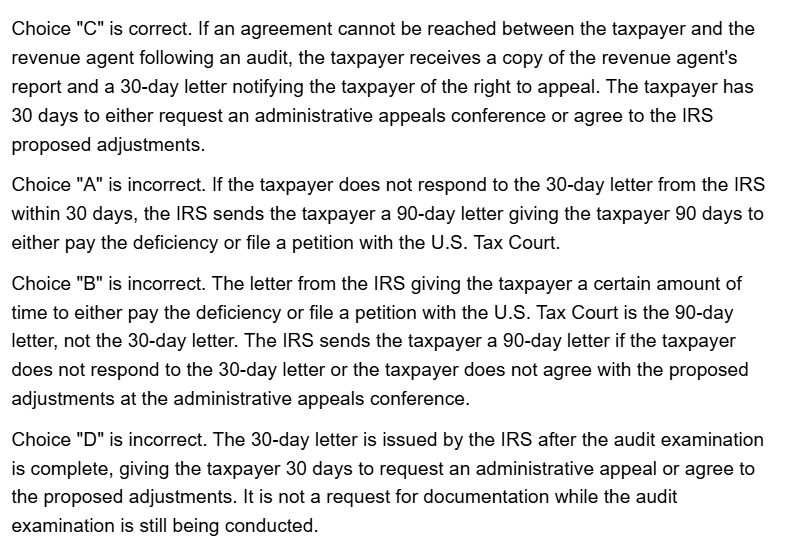
Choice "C" is correct. If an individual taxpayer rejects the IRS examiner's findings in an audit of the taxpayer's tax return, the IRS will issue the taxpayer a 30-day letter (preliminary notice) notifying the taxpayer of the right to appeal. The taxpayer has 30 days to request an administrative appeals conference with the IRS Office of Appeals.
Choice "A" is incorrect. If an individual taxpayer rejects the IRS examiner's findings in an audit of the taxpayer's tax return, the IRS will issue the taxpayer a 30-day letter notifying the taxpayer of the right to appeal. However, the taxpayer does not have to request an administrative appeals conference with the IRS Office of Appeals nor does the IRS refer the case to the IRS Office of Appeals.
Choice "B" is incorrect. The IRS issues a statutory notice of deficiency (90-day letter) if the taxpayer does not request an administrative appeals conference after receipt of the 30-day letter or if the taxpayer and the IRS still do not agree on the revenue agent's proposed adjustment after the appeals conference.
Choice "D" is incorrect. The IRS does not begin immediate collection action when an individual taxpayer rejects the IRS examiner's findings in an audit of the taxpayer's tax return. The taxpayer is first provided with the right to an administrative appeal (30-day letter), then the right to file a petition with the U.S. Tax Court (90-day letter).

Choice “D” is correct. If the taxpayer agrees with the conclusions reached by the IRS agent in an audit, the taxpayer will sign Form 870 and pay any additional tax assessed (plus interest and penalties).
Choice “A” is incorrect. An offer in compromise generally pertains only to cases in which the taxpayer is financially unable to pay the amount owed to the IRS. Offers in compromise allow the taxpayer to work out a payment plan with the IRS, which may include either a reduction in the amount of tax owed and/or an extension of time over which to pay the tax owed. There is no indication in this problem that the taxpayer is financially unable to pay the amount owed to the IRS.
Choice “B” is incorrect. If the taxpayer agrees with the conclusions reached by the IRS agent in an audit, the taxpayer will simply sign Form 870 and pay the additional amount owed; filing an amended return to reflect the changes proposed by the IRS agent is not necessary.
Choice “C” is incorrect. An appeal to the IRS Appeals Division is only appropriate if the taxpayer does not agree with the conclusions reached by the IRS agent in an audit. In this case, the taxpayer agreed with the conclusions and thus an appeal is not appropriate.


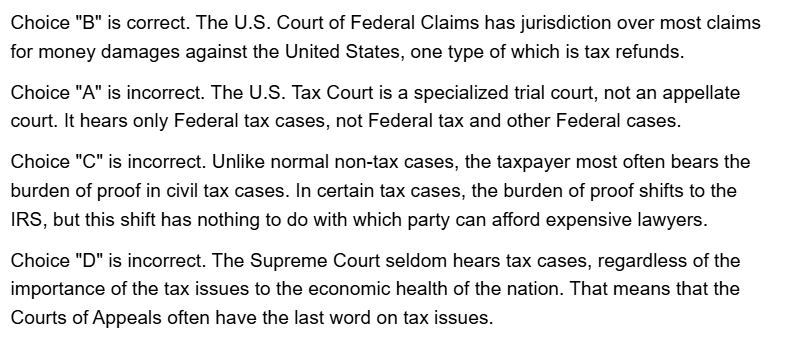






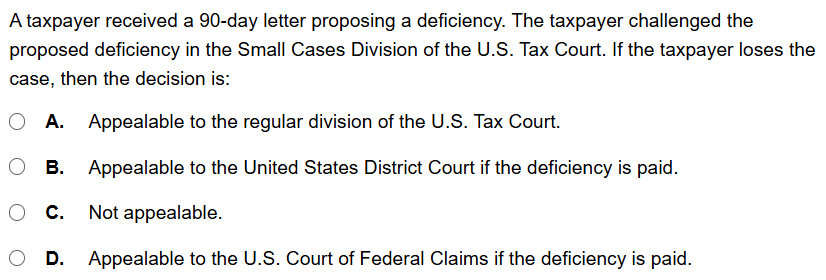
Choice "C" is correct. Decisions of the U.S. Tax Court Small Claims Division cannot be relied on as precedent and cannot be appealed.
Choices "D", "B", and "A" are incorrect. Decisions of the U.S. Tax Court Small Claims Division cannot be used as precedent by any other taxpayer in any court.








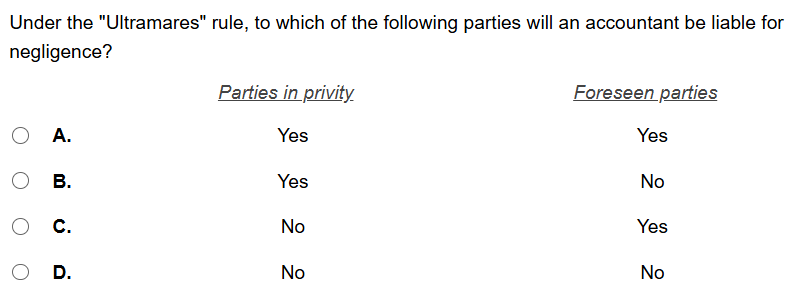
Choice "B" is correct. Ultramares limits the accountant's liability for negligence to: (i) parties in privity and (ii) intended third party beneficiaries; parties who are merely "foreseen" cannot recover.



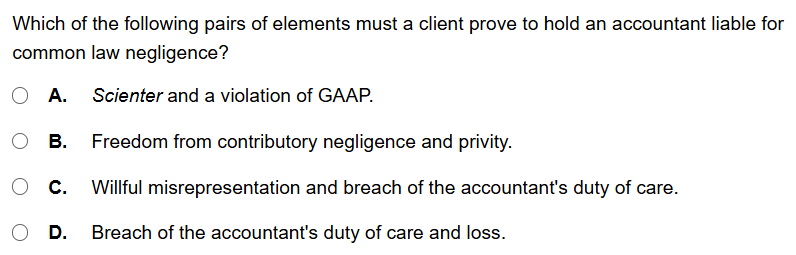
Choice "D" is correct. A plaintiff must show four elements to make a case for negligence against a CPA. The plaintiff must show that the defendant owed a duty of care to the plaintiff, the defendant breached that duty by failing to act with due care, the breach caused the plaintiff's injury, and damages.
Choices "B", "C", and "A" are incorrect, per the above explanation.


Choice "D" is correct. Negligence has 4 elements: duty of care, breach (which is lack of due care), causality and injury.
Choices "A", "B", and "C" are elements of negligence.

Choice "C" is correct. In order to prove fraud, National must prove the five elements of fraud. These are a misrepresentation of a material fact, intent to deceive, actual and justifiable reliance on the misrepresentation, an intent to induce that reliance, and damages. A defense by Baker that there was no intent to deceive would be a valid defense against a claim of fraud.
Choice "A" is incorrect. A lack of privity is not a defense to fraud.
Choice "B" is incorrect. Conducting an audit with due diligence is not the best defense to fraud.
Choice "D" is incorrect. A disclaimer in the engagement letter is not a defense to fraud.

Choice "B" is correct. A CPA owes a duty to his client and to third parties within a limited, foreseeable class of persons whom the CPA knows will be relying on the CPA's work to refrain from doing the work negligently. Negligence is the failure to act with due care. Phillips was engaged to perform an audit, and Phillips knew Ryan would be relying on the audit in making an investment decision. However, even assuming that Phillips owed a duty to Ryan, Phillips cannot be held liable because Phillips exercised reasonable care, and reasonable care is the care that is due; that is, the exercise of reasonable care is proof of the lack of negligence.
Choice "A" is incorrect. Mere reliance on an inaccurate financial statement that was audited is not a sufficient basis for liability under a negligence theory. Negligent conduct is also required (that is, there must be a breach of the duty of reasonable care), and there was no breach here.
Choice "C" is incorrect. As indicated above, a CPA's duty to refrain from negligence can extend beyond the client to a foreseeable class of persons whom the CPA knows will be relying on the CPA's work. Nevertheless, there was no negligence here, as explained above.
Choice "D" is incorrect. Although it might or might not be true that Ryan is a third-party beneficiary of the audit contract (the parties made the contract knowing that Ryan would see the audit report, but it is not clear that Phillips owed any contract duties to Ryan), it does not matter. A cause of action in negligence requires negligent conduct, and here the facts make clear that Phillips exercised reasonable care and so was not negligent

Choice "B" is correct. A CPA who commits fraud is liable to anyone who is injured by the fraud.
Choice "A" is incorrect. Actual and justifiable reliance are necessary elements of fraud.
Choice "C" is incorrect. A CPA's liability for fraud is not limited to known users of the CPA's work product.
Choice "D" is incorrect. A CPA's liability for fraud is not limited by privity.
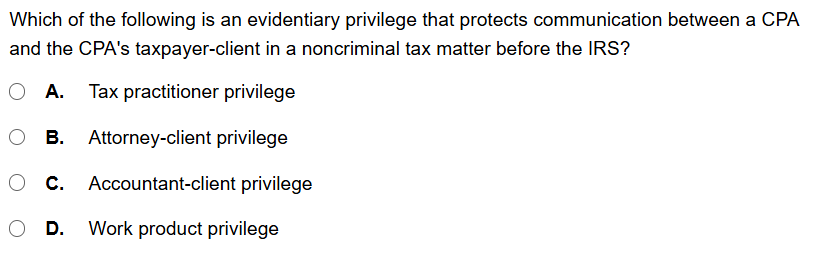
Choice "A" is correct. The tax practitioner privilege in the Internal Revenue Code provides that the same common law protections of confidentiality that apply to a communication between a taxpayer and an attorney shall also apply to a communication between a taxpayer and any federally authorized tax practitioner. A federally authorized tax practitioner is anyone authorized to practice before the IRS, including CPAs and enrolled agents. The privilege can only be asserted in a noncriminal tax matter before the IRS or a noncriminal tax proceeding in federal court brought by or against the United States.
Choice "B" is incorrect. The attorney-client privilege is a privilege that protects the confidentiality of communications between an attorney and the attorney's client, not a CPA and client.
Choice "C" is incorrect. There is no common law accountant-client privilege like there is for attorney-client, although some states provide a statutory accountant-client privilege.
Choice "D" is incorrect. The work product privilege protects tangible materials produced by a CPA in preparation for litigation as requested by an attorney but not communications between the attorney and the accountant about the product.