biology flashcards
 Call Kai
 Learn
Learn Practice Test
 Spaced Repetition
 Match
Match Flashcards
 Knowt Play
1/54

There's no tags or description
Looks like no tags are added yet.
Name | Mastery | Learn | Test | Matching | Spaced | Call with Kai | Chat |
|---|
No analytics yet
Send a link to your students to track their progress
55 Terms
Give two uses of the energy released in respiration.
muscle contraction
respiration
Describe two differences between aerobic and anaerobic respiration in humans
Do not refer to oxygen in your answer.
aerobic produces carbon dioxide and anaerobic does not
anaerobic produces lactic acid and aerobic does not

A scientist investigated respiration and photosynthesis using some pondweed and a pond snail.
Explain why the concentration of carbon dioxide in the tube stayed the same between day 0 and day 5
pondweed takes in CO2 for photosynthesis
snail and pondweed are respiring producing CO2
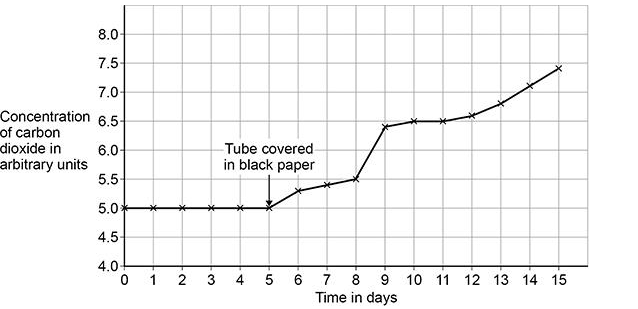
On day 10, the pond snail died.
Explain why the death of the pond snail caused the concentration of carbon dioxide to increase after day 10
pondweed takes in CO2 for photosynthesis
snail and pondweed are respiring producing CO

How should the student decide where to place the quadrat?
Give the reason for your answer.
grid and coordinates
to achieve randomness
Describe how energy for the photosynthesis reaction is gained by plants.
light
light is absorbed by chlorophyll
Explain the ‘lock and key theory’ of enzyme action.
Use information from the diagram above in your answer.
enzyme binds to the substrate because they are complementary shapes
so substrate is broken down into products
so products are released
Describe how the students would find out if the liquid from the leaf contained glucose.
add Benedict’s solution to the liquid
apply heat
(if glucose is present the blue) colour changes to yellow/green/brick red
Describe how the students would find out if the liquid from the leaf contained starch.
add iodine solution to the liquid
if starch is present it changes colour to blue / black to brown/orange
Explain why the leaf in the light for four days contained both glucose and starch.
glucose from photosynthesis
excess glucose converted to starch
Explain why the leaf left in a cupboard with no light for two days did contain glucose but did not contain starch
starch stores have been converted to glucose
so the glucose can be used for respiration
because there is no light to make new glucose by photosynthesis
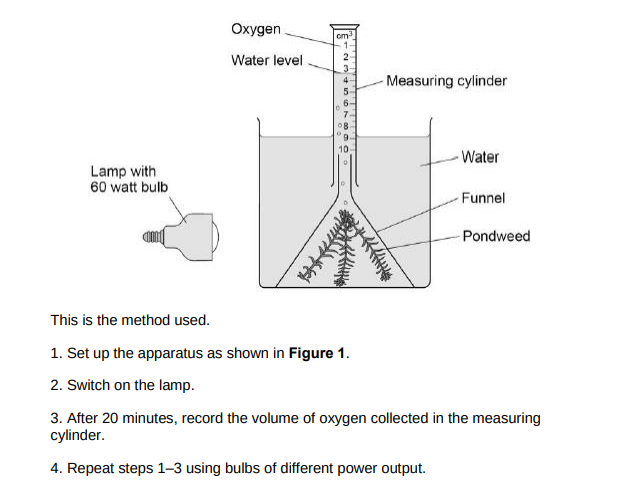
Suggest two ways the method could be improved so the results would be more valid.
repeat and calculate a mean
control the concentration of carbon dioxide

Describe the change in biomass of adult herring from 1977 to 1990.
Use data from Figure 2 in your answer.
increase in biomass of herring
from 0.1 to 1.8 million tonnes
Explain how the control of mesh size of fishing nets has helped to conserve stocks of herring.
smaller 4-yr-old fish not caught
so escaping fish can reproduce
The roots of the gorse plant have bacteria that turn nitrogen gas into nitrate ions.
Explain why nitrate ions are needed by the gorse plant.
nitrate ions are needed to make proteins
which are needed for growth

How would you investigate the effect of light intensity on the rate of photosynthesis?
You should include details of:
• how you would set up the apparatus and the materials you would use
• the measurements you would make
• how you could make this a fair test.
Apparatus: Place a fixed length of pondweed into a beaker of water with a lamp shining directly on it.
Vary light intensity: Change the light intensity by altering the distance of the lamp from the pondweed.
Control variables: Keep the same piece of pondweed, use a water bath or heat screen to control temperature, and use a fixed amount of sodium hydrogencarbonate to control \(CO_{2}\).
Acclimatisation: Leave the plant for a sufficient amount of time at each new distance before taking measurements.
Measurement: Measure the rate of photosynthesis by counting the bubbles of gas released (or collecting gas in a syringe to measure volume) for a set period of time.
Repetition: Repeat the measurements at each distance to calculate a mean.

A teacher said: “The model does not represent the human breathing system very well.”
Give two reasons why the teacher is correct
alveoli not represented
bronchioles not represented
Explain why the man’s breathing rate increased when he was running.
to get more oxygen into the blood
for releasing energy for muscle contraction

Describe the trend for breathing rate shown in graph.
Use data from the graph in your answer.
increased at first
until 4 minutes
then stayed constant from 4 minutes
Explain the ways the man’s body has responded to the exercise.
Use information from the graph above
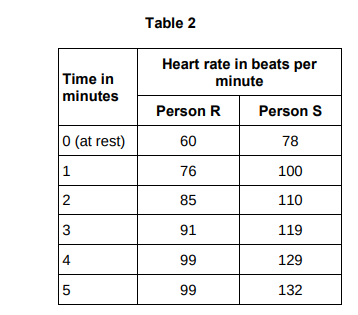
Describe two differences in the response of person R and person S to the exercise.
Use information from Table 2
person R heart rate rose more slowly than person S
person R heart rate levelled off whereas person S continued to increase
A student made the following hypothesis about the heart rate of smokers and non-smokers during exercise.
“During exercise, the heart rate of smokers increases more than the heart rate of non-smokers.”
Design an investigation that would allow you to test this hypothesis.
Groups: Compare smokers vs. non-smokers (minimum 5 people per group).
Controls: Keep age, gender, health status, exercise type, and exercise time identical.
Data: Record heart rate before and after a named exercise.
Analysis: Calculate individual heart rate increases and compare group results.

Limewater goes cloudy when carbon dioxide is added to it.
After 10 minutes the limewater in flask B was cloudy, but the limewater in flask A remained colourless.
Explain why.
atmospheric air contains less carbon dioxide than exhaled air
flask B goes more cloudy because carbon dioxide is produced in aerobic respiration by woodlice
Exercise cannot be sustained when anaerobic respiration takes place in muscle cells.
Explain why.
muscles stop contracting
because not enough energy is transferred
Describe how you could use tube B to measure the rate of the reaction in tube A.
count the bubbles
in a given time
Describe how glucose from the small intestine is moved to a muscle cell.
glucose is absorbed by diffusion into the bloodstream
then blood delivers glucose to muscles in capillaries

Suggest how the experiment could be changed to give a reproducible way to measure the rate of the reaction.
Include any apparatus you would use.
collect the CO2 gas with a gas syringe
volume collected in a certain time using a timer
Compare anaerobic respiration in a yeast cell with anaerobic respiration in a muscle cell.
yeast produces ethanol but muscles produce lactic acid
yeast produces CO2 but muscles do not
both release small amounts of energy
Explain how the change in blood flow to the athlete’s muscles helps him to run.
supplies more oxygen
supplies more glucose
for more respiration
releases more energy for muscle contraction
Explain two effects of anaerobic respiration on the person’s body.
oxygen debt occurs caused by build-up of lactic acid
continued increased heart rate to provide the oxygen needed to break down built-up lactic acid
Design an investigation to show the effect of different types of exercise on the heart rate of athletes.
Method:
Group: Test a large group of 30 or more athletes, or have one group do all tests.
Before: Record resting heart rate for each athlete.
Exercise: Do two or more different exercise types or intensities for the exact same duration.
After: Record heart rate immediately after and calculate the increase.
Analyze: Calculate and compare the mean heart rate increase for each exercise.
Control Variables:
Same age, biological sex, and fitness level.
No health issues or caffeine/drug intake.
Allow heart rate to fully return to resting levels between tests.
Explain how taking anabolic steroids could improve an athlete’s performance
athlete is stronger
because more muscle mass so more muscle contractions
Describe how scientists make monoclonal antibodies using the cell created when a mouse lymphocyte and a tumour cell combine.
cell is cloned
many identical cells are produced
all the cells make the same antibody

Describe the evidence in Figure 2 that shows the test for athlete B has not worked.
Suggest one reason why the test did not work.
no visible blue dye in control area
because no free monoclonal antibodies bound to control area

Explain the effect of increasing temperature and increasing carbon dioxide concentration on the rate of photosynthesis shown in Figure 2
increasing temperature while keeping the carbon dioxide concentration constant increases the rate of photosynthesis
increasing the temperature increases the movement of the particles
increasing carbon dioxide concentration increases the concentration of reactants
all rates plateau at a certain point due to another factor being limiting

The leaf discs were placed in a beaker of sodium hydrogencarbonate (NaHCO3) solution.
Explain why sodium hydrogencarbonate solution was used instead of water.
sodium hydrogencarbonate releases carbon dioxide
carbon dioxide is used for photosynthesis

Explain why the leaf discs moved to the surface of the solution during the investigation.
oxygen was produced in photosynthesis
oxygen gas is trapped in the leaf discs

Explain the results in Table 1 for blue light and for green light.
Use data from Figure 3 and Table 2.
chlorophyll absorbs alot of blue light
chlorophyll absorbs very little green light
so discs in blue light took the least time to rise to surface because they photosynthesised faster
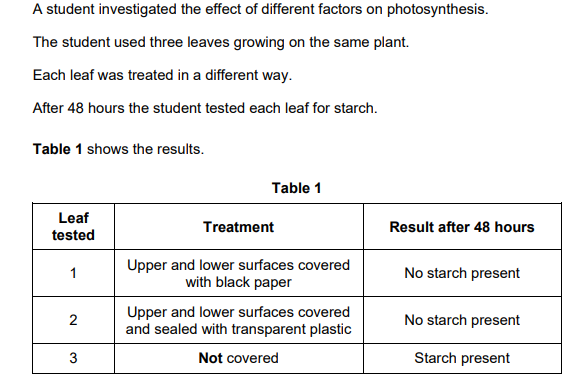
Explain the results for the three leaves.
leaf 1 - no light so no photosynthesis (occurs)
leaf 2 - no carbon dioxide so no photosynthesis
leaf 3 - light and carbon dioxide present so leaf can photosynthesise
leaf 1 / 2 - so glucose is not made and therefore glucose cannot be converted to starch
What does the motor neurone do?
carries impulses from the central nervous system to the effector
What happens at a synapse?
A chemical diffuses across the gap and triggers an electrical impulse in the next neurone
Define homeostasis
Regulation of internal conditions to maintain optimum conditions for function, in response to internal and external changes.
Why must conditions inside the body stay optimum?
Enzymes and cells work best at optimum conditions.
Three ways to investigate the brain
studying patients with brain damage, seeing which abilities they lost
MRI scans which show the brain structure and activity
electrical stimulation: an electrode stimulates a part of the brain and the body part that responds shows what that area controls.
what does the iris do
coloured muscle that controls how much light enters the eye by changing the size of the pupil
What does the lens do?
refracts (focuses) light onto the retina
What is the pupil?
the hole in the middle of the iris that lets light in
Whats the path of light through the eye?
cornea, pupil, lens, retina; impulses then go along the optic nerve to the brain.
what does the lens do?
refracts (focuses) light onto the retina
Bright light: what happens?
circular muscles contract
radial muscles relax
pupil gets smaller
Dim light: what happens?
radial muscles contract
circular muscles relax
pupil gets larger
Focussing on a near object: what happens?
ciliary muscles contract
suspensory ligaments loosen
lens become thicker and more curved
Focussing on a distant object: what happens?
ciliary muscles relax
suspensory ligaments tighten
lens become thinner and flatter
what causes short sight (myopia)?
caused by lens/cornea refracting too much
distant objects are blurry
corrected with a concave lens
what causes long sight (hyperopia)?
caused by lens/cornea refracting too little
near objects are blurry
corrected with a convex lens