4. Diagnosis of Hard Tissue Diseases and Abnormalities Dental caries
 Call Kai
 Learn
Learn Practice Test
 Spaced Repetition
 Match
Match Flashcards
 Knowt Play
1/16

There's no tags or description
Looks like no tags are added yet.
Name | Mastery | Learn | Test | Matching | Spaced | Call with Kai | Chat |
|---|
No analytics yet
Send a link to your students to track their progress
17 Terms
Part 1. Diagnosis of Dental Caries and Sequelae (Dental Decay, Carious Lesions and their Complications)
“Management of dental caries demands early detection of carious lesions to identify patients who require intensive preventive intervention. It is not to justify premature restorative intervention”.
Therefore, it is essential to link patient’s systemic health status for diagnosis and management of dental caries and its sequelae.
oral diagnosis process

Where are we in the diagnostic process for the diagnosis of hard tissue diseases and abnormalities?
Health history, physical examination, and specialized exams
Caries and its sequelae are the most common hard tissue diseases in dentistry
Need to differentiate caries and its sequelae from other hard tissue diseases or abnormalities, e.g. dental fluorosis, erosion, attrition, tooth fracture (traumatic (S02.5), cracked tooth (nontraumatic) (K03.81), and others. S02.5 must have extension e.g.,S02.5XXA
fracture is not same as tooth fracture
Often use specialized examination methods (radiographic examination)
traumatic vs non traumatic fracture
traumatic: ball to the face, fall on the floor
non-traumatic: bruxism, hard occlusion
Definition of trauma
acute injury
Symptoms and Signs of Dental Caries
What are patient’s CC and HPI?
What does it look like?
Is there any pattern? (characteristics: smooth surface vs pit and fissure lesions)
What are the contributing factors?
What is the complete diagnosis for each lesion?
What is the comprehensive diagnostic list for a dental patient regarding his/her dental caries?
(Whole Person Healthcare-diagnosis for a person)
ICD-10-CM Names and codes for Dental Caries

Dental Caries limited to Enamel; Caries on pit and fissure surface limited to enamel
Caries on pit and fissure surface limited to enamel
No symptom because enamel is not live tissue
Signs (findings):
Inspection with or without instrumentation with traditional methods
Stained or discolored fissure and/or pit, matted enamel (not glossy) when the surface is cleaned and dried, shepherd’s explore sink to a hole.
Inspection with modern illumination methods
Important- the tooth surface must be clean and dry.
Dental Caries limited to Enamel; Caries on smooth surface limited to enamel-K02.61
Caries on smooth surface limited to enamel-K02.61
No symptom
Signs (findings):
Traditional Inspection with or without instrumentation Stained or discolored tooth surface, matted enamel (not glossy) when the surface is cleaned and dried, shepherd’s explore side-soft on touch. Hard on touch? Arrested decay.
Inspection with modern illumination methods
Bitewings may help for proximal surface caries limited to enamel
Important- the tooth surface must be clean and dry.
Detection by color change and with or without tactile sensation
for tactile sensation (use shepherd’s explore), use the side of it dont jab

to diagnose you must have symptoms you cannot say it is one of these without that
different illumination methods
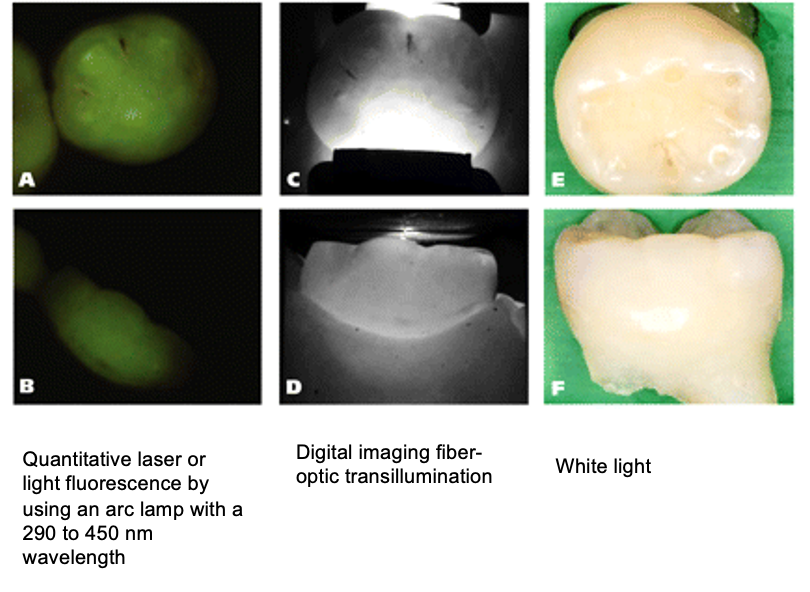
Dental Caries Penetrating into Dentin: Dental caries on pit and fissure surface penetrating into dentin
Dental caries on pit and fissure surface penetrating into dentin
Symptom(s):sensitive to or painful on cold, hot, or sweet. (physical or chemical stimuli), stimuli induced sensitivity can be a finding as well by reproducing it
Signs (findings):
Inspection with or without instrumentation
Stained or discolored fissure and/or pit, matted enamel (not glossy) when the surface is cleaned and dried, shepherd’s explore sink to a hole.
Visible hole(s) and greyish or chalky discoloration of enamel.
Bite-wing radiograph may show D1 or D2 below enamel
Important- the tooth surface must be clean and dry.
Dental Caries Penetrating into Dentin: Caries on smooth surface penetrating into dentin
Caries on smooth surface penetrating into dentin
Symptom(s):sensitive to or painful on cold, hot, or sweet. (physical or chemical stimuli) Transient pain on stimuli.
Signs (findings):
Inspection with or without instrumentation
Stained or discolored tooth surface, matted enamel (not glossy) when the surface is cleaned and dried, shepherd’s explore sink to a hole.
Visible hole(s) and greyish or chalky discoloration of enamel.
Bitewings may help for proximal surface caries D1, D2
Radiograph is not helpful for other smooth surface caries penetrating into dentin, e.g. cervical surface decay.
Important- the tooth surface must be clean and dry.
Arrested Dental Carious
White or brown spots which are hard on instrumentation on the tooth surface can be caries lesions that have self-arrested as part of the natural process of the disease or have arrested owing to a change in the local environment.
These lesions can be considered scars from disease activity occurring years or even decades earlier.
Arrested lesions are more resistant to subsequent cariogenic challenges than sound enamel and, thus, should not receive restorative treatment unless the patient has esthetic concerns.

smooth surface limited to enamel
use instrument to see if it is arrested (hard) or not (soft)
chalky white is arrested
for this pt it is due to hyposalivation
get pts information to determine risk factor

caries into pulp

characteristic