Photosynthesis Core Concepts and Vocabulary
 Call Kai
 Learn
Learn Practice Test
 Spaced Repetition
 Match
Match Flashcards
 Knowt Play
1/39

Earn XP
Description and Tags
Vocabulary flashcards covering core concepts, leaf and chloroplast anatomy, light reactions, Calvin cycle, and key biochemical processes of photosynthesis.
Name | Mastery | Learn | Test | Matching | Spaced | Call with Kai | Chat |
|---|
No analytics yet
Send a link to your students to track their progress
40 Terms
Autotroph
An organism (such as plants, algae, cyanobacteria) that produces organic food from inorganic raw materials using external energy (e.g., sunlight).
Heterotroph
An organism that must consume organic nutrients made by other organisms.
Photosynthesis
The chemical process by which autotrophs convert solar energy into chemical energy stored in carbohydrates like glucose, taking in CO2 from the air and H2O from soil.
Mesophyll
Inner leaf tissue rich in chloroplasts.
Stomata
Microscopic pores on the leaf epidermis for gas exchange (CO2 in, O2 out); singular form is stoma.
Leaf Veins
Leaf structures that transport water and nutrients from roots.
Cuticle / Epidermis
The outer protective layer of a leaf that reduces water loss.
Stroma
The fluid-filled interior space and matrix of a chloroplast surrounding thylakoids; site of the Calvin cycle.
Thylakoid
A flattened, sac-like membrane compartment inside a chloroplast containing chlorophyll; site of the light reactions.
Granum
A stacked column of thylakoid membrane discs inside a chloroplast; plural form is grana.
Thylakoid Space
The inner lumen of a thylakoid where H+ builds up.
Light Reactions
The primary stage of photosynthesis occurring in thylakoid membranes that splits H2O using light energy to produce ATP, NADPH, and O2.
Calvin Cycle
The primary stage of photosynthesis occurring in the stroma that uses ATP and NADPH to reduce CO2 into G3P/glucose.
Photosynthesis Chemical Equation
6CO2+6H2O+Solar Energy→C6H12O6+6O2, wherein H2O is oxidized into O2 (loses e− and H+) and CO2 is reduced into C6H12O6 (gains e− and H+).
Chlorophyll a & b
Photosynthetic pigments in thylakoids that absorb blue and red light while reflecting green light.
Carotenoids
Photosynthetic pigments in thylakoids that absorb blue-green light while reflecting yellow, orange, and red light.
Absorption Spectrum
A graph showing the percentage of light absorbed by different photosynthetic pigments (e.g., Chlorophyll a, Chlorophyll b, Carotenoids) across various wavelengths of visible light.
Light Reactions Inputs
Inputs: Solar energy, H2O, ADP+Pi, NADP+;
Light Reaction Outputs
Outputs: O2 , ATP, NADPH.
Calvin Cycle Inputs
Inputs: CO2, ATP, NADPH;
Calvin Cycle Outputs
Outputs: G3P (3-carbon sugar derivative), ADP+Pi, NADP+.
Electron Transport Path
The sequential flow of an electron in photosynthesis: H2O (split at PS II)→PS II→Electron Transport Train→PS I→NADPH→Calvin Cycle (G3P)→Glucose .
Photosystem II (PS II)
A protein-pigment complex in the thylakoid membrane that absorbs light, splits water, and feeds e− to the initial ETC to drive ATP chemiosmosis.
Photosystem I (PS I)
A protein-pigment complex in the thylakoid membrane that re-energizes e− to pass them to NADP+ reductase to yield NADPH.
Photolysis
The light-driven splitting of a water molecule (H2O) at Photosystem II, producing electrons to replenish PS II, hydrogen protons (H+), and oxygen gas (O2).
NADP+ / NADPH
A major coenzyme that acts as an electron carrier in photosynthesis; oxidized NADP+ accepts 2 high-energy e− and 1 proton (H+) during light reactions to become reduced NADPH.
ATP Synthase
An enzyme and channel protein complex located in thylakoid/mitochondrial membranes that synthesizes ATP from ADP and inorganic phosphate as protons (H+) flow through it down their gradient.
Chemiosmosis
The mechanism of ATP production wherein energy stored in a transmembrane electrochemical gradient of hydrogen ions (H+) is used by ATP synthase to phosphorylate ADP into ATP.
Carbon Dioxide Fixation
The chemical process of capturing inorganic atmospheric carbon dioxide (CO2) and covalently bonding/fixing it into an organic compound (RuBP) at the beginning of the Calvin cycle.
RuBP (Ribulose-1,5-bisphosphate)
The 5-carbon acceptor molecule that binds atmospheric CO2 during carbon fixation in the Calvin cycle. Without its regeneration, the Calvin cycle stops and no continuous sugar synthesis can occur
G3P Versatility
The synthetic capacity of plants to convert G3P into glucose/sucrose, starch, cellulose, fatty acids & glycerol, and amino acids. It is when RuBP is fixed with carbon and when it is reduced. After that six more times, it becomes glucose
Calvin Cycle Step 1
CO2 Fixation (CO2 attaches to RuBP via RuBisCO),
Calvin Cycle Step 2
CO2 Reduction (3PG converted to G3P using ATP and NADPH),
Calvin Cycle Step 3
RuBP Regeneration (5 G3P use ATP to regenerate 3 RuBP)
Upper Right Hand Box
Photosynthesis

Right Middle Box
Glucose and O2
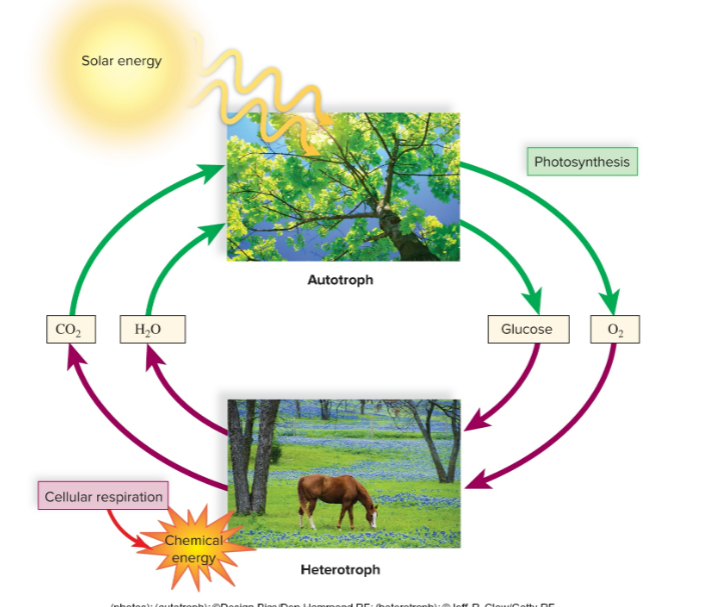
Lower Middle Box
Heterotroph

Lower Left Box
Cellular Respiration

Left Side Box
H20 and CO2

Upper Middle Box
Autotroph
