I&I B5
 Call Kai
 Learn
Learn Practice Test
 Spaced Repetition
 Match
Match Flashcards
 Knowt Play
1/54

There's no tags or description
Looks like no tags are added yet.
Name | Mastery | Learn | Test | Matching | Spaced | Call with Kai | Chat |
|---|
No analytics yet
Send a link to your students to track their progress
55 Terms
Naïve T cells recirculate through…
blood and T cell areas of secondary lymphoid organs
Naïve T cell recirculation in lymph node (7 steps)
Enter LNs through high endothelial venules (HEVs).
CD62L (L-selectin) on naïve T cells bind to PNAd (peripheral node addressin) on HEV.
Chemokine receptor CCR7 on naïve T cells binds chemokine CCL21 on HEV.
Integrin LFA-1 on T cells and ICAM-1 on HEV mediate firm arrest.
T cells browse APCs in LN for antigen
If they don’t encounter: S1PR1+S1P interaction→ Leave through efferent lymphatic vessels → rejoin the bloodstream at thoracic duct
If they encounter: lose the ability to exit LN→ proliferate → differentiate into effector cells
How do T cells migrate through spleen?
CCR7 : CCL19/21 controls T cell zone positioning BUT entry/exit is passive; arterioles filtering directly into PALS
How do T cells migrate through intestinal tissue?
α4β7 : MadCAM-1 binding mediates entry into Peyer’s patch in small intestine
leave by efferent lymphatics→ mesenteric lymph nodes→ lymphatic ducts
How can T cells be primed to enter mucosal tissue?
Priming in mucosal secondary lymphoid tissue will cause T cells to express receptors for entering mucosal tissues
What are the three signals necessary for T-cell activation?
Ag specific TCR engagement
costimulatory ligand engagement
cytokines (autocrine and paracrine)
TRUE OR FALSE: Costimulatory ligand interactions can either promote or inhibit T cell activation and proliferation
TRUE
What are the a) positive (2) and b) negative (3) T cell costimulatory molecules?
a) CD28, ICOS
b) BTLA, CTLA-4, PD-1
a) Purpose and b) general structure of the immunological synapse
a) allow T cells and APCs to effectively engage
b) central supramolecular activating complex: TCR/MHC-peptide complexes and coreceptors
Peripheral supramolecular activating complex: Adhesion molecules/bound ligands
a) what are the professional APCs and b) what feature do they have?
a) Dendritic cells, macrophages, and B cells
b) only cells with MHC class II (as well as MHC class I)
What kind of T cells can a) Dendritic cells, b) macrophages, and c) B cells activate?
a) naive; only APC to express sufficient costimulatory molecules for full activation
a+b+c) differentiated memory/effector T cells
T cell clonal anergy
absent or insufficient costimulatory signal from T cell:APC interaction means no microbial danger signal is generated, so the T cell becomes unresponsive forever. This helps provide peripheral tolerance
Cytotoxic CD8 cells induce cell death via…
apoptosis
During T cell activation, IL-2 is produced by … to act on … in a …crine manner, inducing…
During T cell activation, IL-2 is produced by T cells to act on T cells in an autocrine manner, inducing proliferation
Cytotoxic T cell (CTL) generation (3 steps)
priming naïve CD8+ T cell by APC with antigen-specific MHC class I/TCR complex and CD28/B7 co-stimulatory ligand interactions
signals from IL-2 (autocrine) and IFNγ (autocrine + paracrine) promote proliferation and differentiation
CTLs leave lymphoid organ to enter inflamed tissues and mediate effector functions
TRUE OR FALSE: All positive T cell interactions require costimulation
FALSE: For instance, CTL recognition of infected cells doesn’t
What are the two methods of CTL cell killing? Describe molecules
SECRETORY: perforin assembles into protein barrel pore on cell allowing for entry of granzyme which triggers apoptotic pathways
NON-SECRETORY: interaction of membrane-bound FasL of CTL with FAS on cell
What environmental cytokines will cause a CD4+ cell to differentiate into a) Th1, b) Th2, c) Th17, d) Treg, e) Tfh?
a) IL-12, IFN-γ
b) IL-4
c) IL-6 and TGFβ
d) TGFβ
e) IL-6, IL-21
What are the signature cytokines produced by a) Th1, b) Th2, c) Th17, d) Treg, e) Tfh?
a) IFNγ
b) IL-4, IL-5 and IL-13
c) IL-17
d) IL-10 and TGFβ
e) IL-4, IL-21
What cells are acted on by (cytokines produced by) a) Th1, b) Th2, c) Th17, d) Treg, e) Tfh?
a) macrophage, NK cell, CD8+ cell→ CTL, B cell→ IgG2
b) eosinophil, mast cell, B cell→ IgG4, IgE
c) neutrophil, epithelial cell
d) lymphocytes
e) B cell
What effector functions are mediated by a) Th1, b) Th2, c) Th17, d) Treg, e) Tfh?
a) cell mediated immunity against intracellular pathogens; killing of infected host cells
b) response to macroparasites and allergens
c) inflammatory; response to fungi and extracellular bacteria
d) anti-inflammatory; Inhibits function of T and non-T cells when no longer needed (when infection cleared)
e) high affinity antibody production
What is the master transcription factor of a) Th1, b) Th2, c) Th17, d) Treg, e) Tfh?
a) T-bet
b) GATA3
c) RORγT
d) Foxp3
e) Bcl6
When B cell recirculate through lymph how do they a) enter and b) leave?
a) HEVs that open into LN follicle
b) efferent lymphatic vessels→ bloodstream
What determines whether a primary lymphoid follicle will contain a secondary lymphoid follicle?
If antigen activates B cell a secondary follicle where activation and differentiation occurs is formed
How do B cells encounter a) small, b) large and c) concentrated/ recognised by Ig antigens?
a) afferent lymph drainage directly into follicles to meet with B cells
b) capture and presentation by subcapsular sinus macrophages
c) follicular DCs (related to image)

Thymus-independent responses (do/don’t) require T-cell help and are generated in response to…
Thymus-independent responses don’t require T-cell help and are generated in response to polymerized Ag
What are the types of thymus independent response?
TI-1: Ag bind to B cells through PRRs and mIgs
TI-2: Ag cross-link large numbers of BCRs/co-stimulatory molecules
What cells mediate responses to Thymus independent Ag?
innate-like B cells; B1-B, marginal zone B cell
Thymus-dependent responses (do/don’t) require T-cell help and are generated in response to…
Thymus-dependent responses do require T-cell help and are generated in response to B cell presentation of antigen peptides to CD4+ T cells on MHC-II
Process of T-dependent antigen response (11 steps)
B cell recognize Ag…
internalize…
process…
Express pro-apoptotic factor Bad and CCR7 which dictates migration to the border of T cell zone
T cells expressing CXCR5 after activation by DCs in the paracortex move towards the follicle
B cell present peptides via MHC II to CD4+ T cells
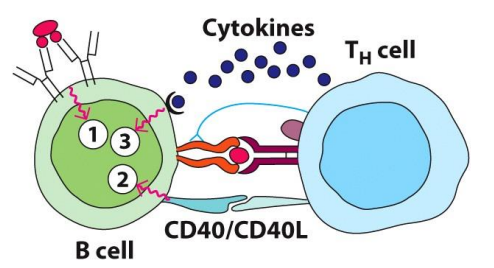
Co-stimulatory signals from T cells via CD40L/CD40 interaction
Cytokines ie. IL-21 from T cell direct B cell differentiation
Bcl2 expressed to promote B cell survival
Extrafollicular response
germinal centre formation
What processes can T-dependent activation induce in B cell? (3)
somatic hypermutation (of antibodies)
cytokines from T cell cause class switching recombination
memory generation
What is the a) early and b) late outcome of T-dependent B cell activation?
a) low affinity IgM from extrafollicular plasma cells
b) Class switch recombination to change Ig type OR affinity maturation from somatic hypermutation leads to very high affinity antibodies being produced
What are the outcomes (2) of the transcription factors (4) involved in the extrafollicular response of B cells?
Pax5, Bcl-6 → germinal center B cells
BLIMP-1, IRF-4 → plasma cell

What is the a) dark and b) light zone in the germinal center?
Dark zone: proliferating B cells (centroblasts)
Light zone: B cells (centrocytes) and TFH cells interspersed/ interacting with follicular DCs
Somatic hypermutation induces point mutations in the (light/heavy) chains of immunoglobulin
Somatic hypermutation induces point mutations in the light & heavy (both!) chains of immunoglobulin
a) What enzyme is produced for somatic hypermutation in B cells and b) how can it induce changes?
a) Activation-induced cytidine deaminase
b)
replication based on AID produced mismatch; G-U → A-T
error prone polymerases following excision of mismatched base/segment

How do higher affinity B cells outcompete lower affinity B cells for survival?
There are limited T cells, which provide necessary signals for survival; high affinity B cells bind, process, and present more Ag to T cells, therefore getting more help and directly outcompeting
What sites does class swith recombination occur at and why?
S regions are tandem repeats of short, G-rich sequences therefore contain targeting sites for AID
What cytokine signals (4) from TFH cells determines which isotype Ig will be produced (7) in class switching?
IL-4: IgG1, IgE
IL-5: IgA
IFN-γ: IgG3/2a
TGFβ: IgA, IgG2b
Germinal center B cells that mature into long lived memory plasma cell, what do they express and what purpose does it give?
express CXCR4 specific to CXCL12 found in bone marrow; allows targeting and long-term persistence in niche
function of long lived plasma cell
Constitutively secrete antibody in the absence of antigen that can provide immediate protection against reinfection
function of memory B cells
Rapidly proliferate and differentiate into antibody-secreting cells and/or re-enter germinal centres following antigen re-exposure
TRUE OR FALSE: Memory B cells can arise through Germinal Centre-dependent and Germinal Center-independent pathways
TRUE
Germinal Centre-independent memory BC generally undergo (less/more) somatic hypermutation and (less/more) affinity maturation and Germinal Center-dependent pathways
Germinal Centre-independent memory BC generally undergo (less/more) somatic hypermutation and (less/more) affinity maturation and Germinal Center-dependent pathways
a) Do memory B cells that arose independent or dependent of the germinal centre have a more diverse repertoire of BCR and b) how does this help immunity?
a) independent
b) may be specific to mutated version of antigens
immune imprinting/original antigenic sin
Exposure to a new variant preferentially of a previously encountered virus can result in a response that is biased toward epitopes encountered during earlier exposures
What overlooked aspect of memory B cells can T cell memory cover and how?
protection against antigenically drifted variants because T cells recognise peptide epitopes that may remain conserved
What is the action of memory a) CD4 and b) CD8 T cells?
a) promotes the generation and maintenance of high-quality CD8 T cell memory
b) rapidly regain effector functions, ie. cytotoxicity and cytokine production
Cytokines controlling memory T cell survival and maintenance (3)
IL-2 (clonal expansion)
IL-7 (all stages)
IL-15 (maintenance)
CD45 is a receptor-type protein tyrosine phosphatase a) expressed by which leukocytes and b) how does expression differ?
a) all
b) Alternative splicing generates different CD45 isoforms
What is upregulated (compared to the other phenotype) in a) central memory (2) and b) effector memory (3) T cells?
a) proliferation, self-renewal
b) GranzymeB/ Perforin/ IFNγ expression
a) what are the 2 subsets of circulating memory T cells based on and b) what are both the identifying features?
a) trafficking phenotype
b)
effector memory: 2o lymphoid organs —lymph→ blood→ non-lymphoid tissue —lymph→ 2o LO
central memory: 2o lymphoid organs —lymph→ blood→ 2o LO
tissue resident memory T cells a) movement and b) function
a) establish long-term residence in previously infected peripheral tissues and don’t leave
b) rapid, local protection against pathogen re-exposure in the tissue
Which T cell can establish tissue-resident memory populations?
both CD4 and CD8
What effect does trained immunity have on the innate immune response?
persistent epigenetic and metabolic reprogramming that alters responses (enhance or suppress) to subsequent stimulation