BSC2010 - Chapter 12 Vocabulary
 Call Kai
 Learn
 Practice Test
 Spaced Repetition
 Match
 Flashcards
 Knowt Play
1/54

There's no tags or description
Looks like no tags are added yet.
55 Terms
gene expression
The process by which information encoded in DNA directs the synthesis of proteins or, in some cases, RNAs that are not translated into proteins and instead function as RNAs.
protein-coding genes
Genes that encode instructions for making proteins.
non-protein coding genes
genes that code for RNA that do not get translated into proteins
transcription
synthesis of an RNA molecule from a DNA template

mRNA
messenger RNA; type of RNA that carries instructions from DNA in the nucleus to the ribosome
translation
Process by which mRNA is decoded and a protein is produced

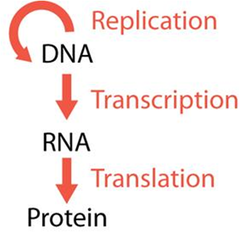
central dogma
DNA -> RNA -> Protein
RNA modification
A step in the processes of creating a mature mRNA in which 5' caps and poly-A tails are added, and introns are spliced out and exons are joined together.

pre-mRNA
precursor mRNA; the first strand of mRNA produced by gene transcription that contains both introns and exons
Transfer RNA (tRNA)
An RNA molecule that functions as an interpreter between nucleic acid and protein language by picking up specific amino acids and recognizing the appropriate codons in the mRNA

Ribosomal RNA (rRNA)
type of RNA that makes up the major part of ribosomes
promoter
specific region of a gene where RNA polymerase can bind and begin transcription
terminator
A special sequence of nucleotides in DNA that marks the end of a gene. It signals RNA polymerase to release the newly made RNA molecule, which then departs from the gene
regulatory sequences
sections of DNA that are involved in controlling the activity of genes
initiation of transcription
RNA polymerase attaches to the promoter region on the DNA and begins to unzip the DNA into two strands.
sigma factor
a protein that associates with RNA polymerase that facilitates its binding to specific promoters
RNA Polymerase
enzyme that links together the growing chain of RNA nucleotides during transcription using a DNA strand as a template
open complex
the region of separation of two DNA strands produced by RNA polymerase during transcription
elongation (transcription)
RNA polymerase traverses the template strand and uses base pairing complementarity with the DNA template to create an RNA copy
template strand
The DNA strand that provides the template for ordering the sequence of nucleotides in an mRNA transcript.
coding strand
the strand of DNA that is not used for transcription and is identical in sequence to mRNA, except it contains uracil instead of thymine
termination of transcription
The third, and last, phase of transcription in which the mRNA transcript is released when RNA polymerase reaches the terminator sequence
transcription factors
Collection of proteins that mediate the binding of RNA polymerase and the initiation of transcription.
preinitiation complex
cluster of eukaryotic transcription factors and other proteins that recruit RNA polymerase II for transcription of a DNA template
mature RNA
Eukaryotic RNA that has been spliced and processed and is ready for translation
5' cap
The 5' end of a pre-mRNA molecule modified by the addition of a cap of guanine nucleotide.

poly A tail
Modified end of the 3' end of an mRNA molecule consisting of the addition of some 50 to 250 adenine nucleotides.

introns
A noncoding, intervening sequence within a eukaryotic gene.

exons
Coding segments of eukaryotic DNA.

splicing
the process of removing introns and reconnecting exons in a pre-mRNA

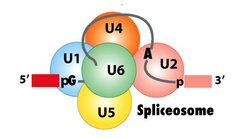
spliceosome
A large complex made up of proteins and RNA molecules that splices RNA by interacting with the ends of an RNA intron, releasing the intron and joining the two adjacent exons.
ribozyme
a type of RNA that can act as an enzyme
genetic code
collection of codons of mRNA, each of which directs the incorporation of a particular amino acid into a protein during protein synthesis

codons
The three-base sequence of nucleotides in mRNA

start codon
AUG; codes for the amino acid methionine

stop codons
UAA, UAG, UGA
reading frame
The way a cell's mRNA-translating machinery groups the mRNA nucleotides into codons
anticodon
group of three bases on a tRNA molecule that are complementary to an mRNA codon

N-terminus
the end of a polypeptide or protein that has a free amino group

C-terminus
the end of a polypeptide or protein that has a free carboxyl group

peptide bonds
Bonds between amino acids
aminoacyl-tRNA synthetase
An enzyme that joins each amino acid to the correct tRNA.

charged tRNA
A transfer RNA molecule with an amino acid attached to its 3' end.

ribosome
site of protein synthesis
peptidyl site (P site)
The site on the ribosome where amino acids are joined by a peptide bond.
aminoacyl site (A site)
binds a new tRNA molecule containing an amino acid to be added to the growing polypeptide chain
exit site (E site)
a site on the ribosome from which an uncharged tRNA exits
initiation of translation
brings together mRNA, a tRNA with the first amino acid, and the two ribosomal subunits
initiation factors
proteins that bring in the large subunit that completes the translation initiation complex
elongation (translation)
codon recognition, peptide bond formation, translocation
elongation factors
Proteins involved in the elongation phase of translation, assisting ribosomes in the synthesis of the growing peptide chain.
peptidyl transfer reaction
During translation, the transfer of the polypeptide from the tRNA in the P site to the amino acid at the A site.
polyribosome (polysome)
A group of several ribosomes attached to, and translating, the same messenger RNA molecule.
release factor
the protein that binds to the stop codon during termination of translation
termination of translation
occurs when a stop codon in the mRNA reaches the A site of the ribosome