plsci2110 prelim 2
 Call Kai
 Learn
 Practice Test
 Spaced Repetition
 Match
 Flashcards
 Knowt Play
1/187

There's no tags or description
Looks like no tags are added yet.
188 Terms
Farming vs cropping system
Farming system: the entire farm or region, multi-year, multi-species
Cropping: Single field over time
Mono vs polyculture
A single field and year
Differ in # of species grown together
Continuous cropping vs rotation
Same field over multiple years
Differ in # of species across years
Strip cropping
Arrangement subtype of polyculture
Single year and field
Distinguished by spatial organization
Multiple cropping (double and relay)
Single year and field
Distinguished by timing within year
Farming system
A complex inter-related unit of soil, plants, animals, implements, power, labor, capital, and other inputs controlled in parts by farming families. It is also influenced by degrees by political, economic, institutional, and social forces that operate at many levels
Characteristics of farming system
Single measures like cover crops & green manure, crop rotation, reduced tillage, intercropping, agroforestry, structural elements
Combined practices like conservation ag, mixed crop-livestock, organic agriculture
Advantages to farming system
Advantages to such a farming ecosystem
Stable income and better risk management: less risk to uncertain market prices and stressful weather
Labour efficiency: spread labor demands to broader time-frames
Cost reduction: farm waste replaces expensive inputs (e.g. using animal manure instead of buying chemical fertilizers)
The whole farm is an integrated ecosystem -maximize profit, reduce waste and financial risk
Cropping (or livestock-pasture) system
the combination of the type of crop planted, growing and management methods, and the sequence of crops planted on the same land
Unlike farming system, cropping system focuses strictly on crops and their management
Advantages of cropping system
specialization
More efficient use of specialized equipment and machinery
Farmers develop knowledge and deep expertise on narrow set of crops and problems
Easier to integrate digital tools like GPS, precision ag, etc
Low cost per unit: farmers can buy inputs in massive volumes thus reducing input costs
Disadvantages of continuous cropping
Reduced fertility
Same nutrients are removed each year
Increased erosion and runoff
Poor soil results in wind and water erosion, soil compaction, runoff, etc
Increased pest pressure
Pests (weeds, disease, insects) thrive in same environment year after year
Degradation of soil structure
Same planting, tilling pattern year after year hurts soil structure
Advantages of crop rotation
Disease prevention
Disturbs root rot complex
Weed control
Most perennial weeds susceptible to late-summer, fall herbicide applications
Insect control
Rotations disturb life cycle of insects and other invertebrate pests
Reduced inputs
Fewer crop inputs when growing crops in rotation (corn after soybean, save on N inputs)
Soil tilth
Forages and pasture crops add OM and remediate soil structure, improving infiltration
Nutrient use efficiency
More efficient use of plant nutrients
Growth and yield
In most cases crop rotations improve yield
Why do farmers do monoculture
Ease of management
Benefits from specialized production
Highly responsive to technological innovations
Increased amount of agricultural produce
Disadvantages of monoculture
Deforestation
Most monoculture land comes from deforestation
Loss of biodiversity
Decline of pollinators
Pollution
Reliant on synthetic chemicals
Susceptibility to pest
Acres and acres of pest breeding grounds with plentiful food and no controls
Pesticides sometimes make pests more resistant and aggressive
Degradation of soil quality
Polyculture (intercrop) definition and advantages
Growing two or more crops together on the same land during the growing season
Advantages
Yield stability (responses to weather, biotic pests)
Better use of resources - complementarity
Polyculture management challenges
Differing growth optima
Differences in resource requirements
Varying harvesting time and equipment
Differing prices
Herbicide challenges
Polyculture complementarity examples
N2 fixing legume + non legume
Planting species with differences in rooting depth: so one crop draws water andnutrients from a different soil layer than the other
Light capture: tall with vertical leaves, short with horizontal leaves
Insect and disease pest control by harboring beneficials
Ecosystem services: where the 2nd species provides erosion and weed control, or prevents leaching of NO3 rather than market income
Three sisters: corn bean squash/pumpkins
Hazel nuts and beans
Banana and cowpea
Soybean, corn, wheat in adjacent strips
Maize and cowpea
Forage example: alfalfa, orchard grass
Strip cropping further details (beyond just being spatial complexity)
Growing crops in monocultures in adjacent stirps within a field
Lessens direct competition
Adds complexity to mechanical harvesting, but new equipment is being developed
Types primarily based on the soil topography and the type of erosion to be controlled - wind strip, contour strip cropping, buffer strip and field strip
Corn and soybeans, corn and alfalfa, wheat and cotton
Contour strip cropping
Double cropping vs and relay cropping - definitions
Double - one in succession after another
Relay - second is sown before first is harvested
Most often practiced in long growing season areas
Utilize both summer and winter annual crops
Pair soybeans with winter wheat
Most prevalent in SE/SW US
Relay cropping advantages
Potential reduced nitrate leaching
Potential SOC increases
Increase farm income if favorable land equivalent ratio
Relay cropping disadvantages
Soybean planting process (2nd crop) stresses wheat crop (1st crop), reduces yield
Wheat harvest stresses soybean growth
Relay cropping requires greater level of management and equipment adjustment
Pest management and control practices must account for more crops being grown in close sequence. System may not have enough time for herbicide carryover to decline and may increase potential for disease or pest infestations if these pests have more than one host in the crop sequence
Time
Crop insurance problems
How do we know if a cropping system is beneficial?
Land equivalent ratio (LER)
With two crops A and B grown together as an intercrop
LER = yield of A in intercrop / yield of A as pure stand (monoculture) + yield of B in intercrop / yield of B as pure stand
With an LER of 1.43 (correct answer for problem on slides) - more efficient to crop as an intercrop, need 43% more land for the same yield in a monoculture
Crop equivalent yield (CEY)
CEY = yield (kg) of main crop + (yield of intercrop x price of intercrop / price of main crop)
Converting price of intercrop to equivalent in main crop
Fallow system for drylands
Arable land left unseeded and uncultivated for one or more growing seasons
Restoring fertility; accumulating soil moisture; starves out pests and break life cycles
Great plains: Winter wheat→ grain sorghum → fallow (3 year rotation)

Soil tillage
a practice of mechanically turning, breaking up, and loosening the top layer of earth to prepare a seed bed
Soil tillage goals
Incorporate residue (controls diseases and insects)
Incorporation of manures, fertilizers, lime
Alteration of soil physical properties: less compact; more porosity, aeration, drainage channels
Weed control (cut and bury plants)
Preparation of seedbed: uniform, smooth surface so depth of planting is more accurate; achieve a firm soil/seed contact
Seeds safe from birds/rodents
Evolution of plow
8000 BC → digging tools: hand tools (digging sticks, hoes, thick mollusk shells, sharp edged stones, etc)
6000 BC → draft animals replaced humans in powering the implements for tillage
3500 BC → plowshare, a wedge-shaped implement tipped with iron blade used to loosen top layer of soil
Plows that scratch surface, not inverting soils
1100 AD → horse and oxen drawn wooden moldboard plow with curved blade (moldboard) used to invert soil and bury weeds and residues
Mid 1800s → first smooth steel moldboard plow designed, patented and marketed by multiple people including John Deere; advantage of more easily cutting through the soil and breaking through sod; led to end of walking plows in the US; allowed plowmen to ride on a seat framed onto the plow with adjustable wheels to control a steady plow depth
Early 1900s → building of implements like tractors with multiple plows that allowed intensive cultivation of vast areas of earth
Conventional tillage
Type of tillage practiced for 100s of years, intensive form with soil inversion as a key feature
Key stages or steps of conventional tillage
Primary tillage or plowing: invert soil, expose it to surface. Displaces and shatters soil, buries and mixes plant materials, pesticides, fertilizers in tillage layer
Secondary tillage: break up or smooth out mounds created by moldboards and create a fine textured seedbed for planting. Also includes performing shallow post-planting tillage like loosening the soil and/or by mechanical eradication of undesired vegetation
Plowing - primary tillage
Disking with harrow - primary/secondary tillage
Row-crop cultivator - secondary tillage
Equipment used - refer to link on slides for details of diverse equipment used
Problems with conventional tillage
Soil erosion
Environmental issues caused by soil erosion
Dust bowl
Soil crusting
Definition: plowing breaks pre-existing soil aggregates and exposes them to rain. Force from raindrops breaks up aggregates, forms a structureless fine soil that forms a crust on the field surface as it dries
Soil compaction
Pollution due to agricultural runoff
Loss of soil organic carbon
Exposes SOM to atmosphere, leading to decomposition and conversion to CO2
Economic losses
Increased need for fertilizers
No-till
Type of conservation tillage method where ½ to 3 inch across grooves are created in planted row and seeds are sown directly in these grooved resulting in minimal soil disturbance
Key steps generally include: apply herbicide → plant → apply herbicide → harvest
Requirements /facilitators of no tillage:
Modern herbicides for weed control
Innovations in no-till equipment like seeders
No till planting requirements to cut and penetrate residue?
Heavy equipment
Requires more pressure
Requires more residue moving and cutting
Double disk openers are typically used in no-till or high residue systems
They are mounted parallel and equidistant to each other and form a “V” shaped slot in to which the seed is dropped as the planter moves along
Benefits to no-till
Reduced soil compaction
Reduced soil erosion
Conservation of soil water
Improved soil quality and fertility
Reduced pollution
Increased carbon sequestration
Economic advantages to farmers
Improved yields
Challenges to no-till adoption
Alternate use of crop residues (Africa + Asia problem) - munch or mulch
Equipment cost
Learning curve
Changes in crop diseases
Problematic in fine-textured and poorly drained soils
Cooler soils
Need for new herbicides
Benefits seen in longer terms
Strip or zone tilling - implementing no-til
Strip (or zone) tilling combines no-till and conventional tillage practices
Conservation farming system that tills only narrow bands in the soil where seeds are planted, while leaving the rest of the crop residue and soil between the rows completely undisturbed
Width of strips corresponds to type of crop and width of the planter row
Seeds, and fertilizers, are usually applied into the strip tilled areas
Strip till implement
Generally done in the fall but also spring
Generally with herbicide weed control
GPS/RTK important
Advantages to strip tillage
Many of same benefits to no till:
Less soil disturbance
Less erosion potential
Less SOM breakdown
Less tractor energy
Better seedbed in tilled strips
When used as fall tillage:
Deep rip (6-8 inches) drains water from surface during snowmelt and rain in spring, creates microclimate
Soil warms faster in spring
Dark tilled soil absorbs spring sunshine
Earlier planting
Drainage
Warming
Importance of N in crop productivity
Constituent of biomass -protein, nucleic acids, chlorophyll, etc
Soils often N-limiting - almost always the case in agricultural systems
Phosphorus in tropical systems
Affects protein productivity of crops, nutritive value, quality
Losses of N from soils and efficiencies of N use by crops pollute ground water, lakes, streams, release NOx to atmosphere
N assimilation represents a high proportion of plant energy expenditure, therefore impacting yield
Provision of N needs for crops, whether by fertilizer or organic residues, represents one of the largest input costs of crop production
3 types of nitrogen fixation, N cycle
Inputs: Biological, industrial, atmospheric (lightning) fixation
Biological and atmospheric fixation added to OM
OM mineralized into ammonium
Ammonium nitrifies into nitrate NO3—
Nitrate denitrifies into nitrite, or leaches

Ammonium loss pathways

Nitrate loss pathways

Nitrogen fertility, denitrification losses
Low lying areas of fields may flood easily
Denitrification in water-saturated soil a function of temperature
Higher temps and more days saturated = more denitrification losses

Nitrogen chemical changes in soil and in plant assimilation
Green: plants
Blue: bacteria in O2
Red: bacteria, hypoxic/saturated soil conditions
Higher on this image: reduced substances (GER)
Lower on this image: oxidized substances (LEO)

How plants convert N to organic forms

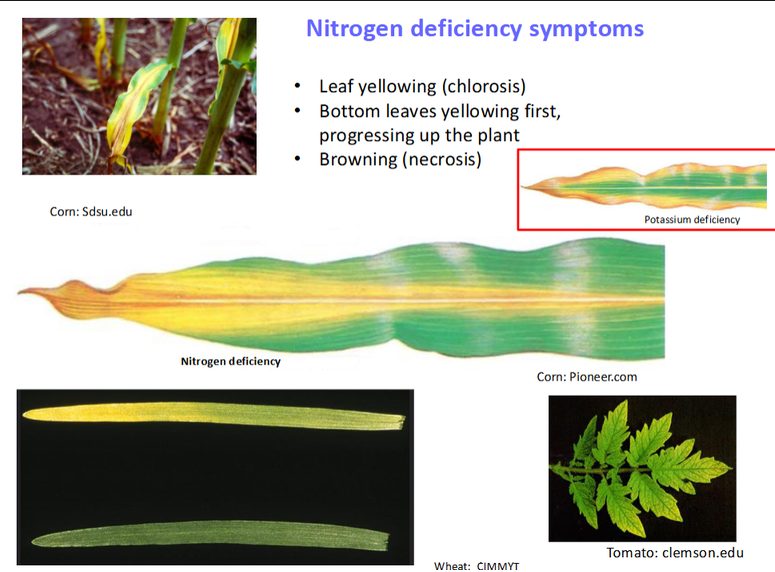
N deficiency symptoms
N deficiency is especially apparent on lower leaves
N mobility results in N transport from older to younger leaves
Lower leaves display deficiency symptoms
Monitoring N status in upper leaves might be less effective monitoring on lower leaves
Types of N fertilizers
82% N: Anhydrous ammonia - gaseous, everything needs to be handled right
Midwest: apply it after harvest, lower temps later in year means lower microbial activity, and nitrogen can be inert over winter
Global warming: soils are getting too warm
Knifed into soil
Inexpensive, but transport and handling is pricey
46% N: Urea
Cheapest, more common in developing countries
28-32% UAN (urea ammonium nitrate) - can burn leaves
34% N Ammonium nitrate
N fixation by rhizobia
Atmosphere N2 converted to ammonium
Plants supply C and host environment
N enters vascular system
Nodulation of rhizobia
Issues
cross inoculation groups
Inoculation via seed
High soil NO3 or NH4 inhibit nodulation and N2 fixation
High energy cost
Soybean planted in areas where N already exists: plants will not nodulate to save energy

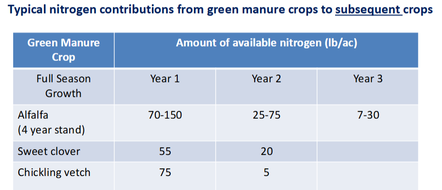
Important sources of N, timed release
Livestock and green manures
Mineralization - “timed release” 50% in year 1 (10 tons of manure applied, only 5 tons would be available the year it is applied)
Lignin, phenol
Manure - N and P imbalances, to get enough N you end up with too much P
Overapply manure for N since it is timed release, then P is in excess - NYS soils
Yield based N recommendations
Left graph: 1970s, 1980s
Right graph - shows yield vs N rate was actually not very effective for recommending N rates

N fertilization rate and economic response
New approach called MRTN in midwest - maximum return to N
Data-driven recommendations sensitive to measured N response and grain responses

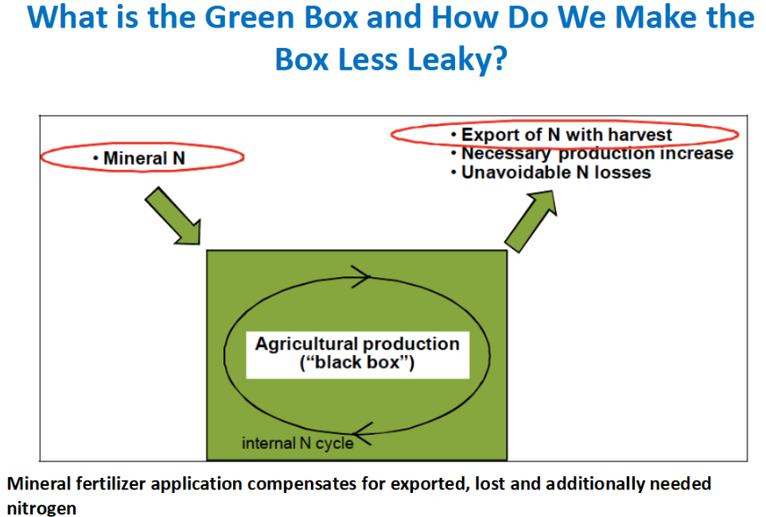
“Black box” of N cycle
Black box - many factors affecting nitrogen efficiency
Very hard to attach firm numbers to, varies across landscape
Unavoidable losses of N when harvest is moved off the farm, and other losses: never get 100% efficiency
What makes estimating available soil N diffciult?
Dynamic cycling
Mineralization timed releases
Denitrification losses
Weather
Rainfall
Temp
Soil characteristics
Drainage
Percolation
OM content and quality
Plant needs for N vary over the season
Highest during stem elongation
Methods for estimating nitrogen
Soil testing inadequate
Cycling dyanmic
Plant tissue testing
Stem NO3 test
Leaf color
Calculate N supply with model of dynamic cycling (AdaptN)
Simulation with weather, soil, history, crop needs accounted for
Obstacles to better N management
Recommendations state based, sometimes outdated and fertilizer focused
Unease and unresolved issues between public and private sectors and regulations
Cannot assess how much N being lost off individual farms, violates privacy laws
skepticism about technologies

Adapt-N

Grey, green, blue nitrogen
Grey ammonia - produced as is
Blue ammonia - given carbon capture storage, practicality dubious (some call it a “fantasy” and impractical at scale)
Green ammonia - renewable electricity, electrolysis for hydrogen, thus green ammonia has significantly less emissions
Higher cost at present
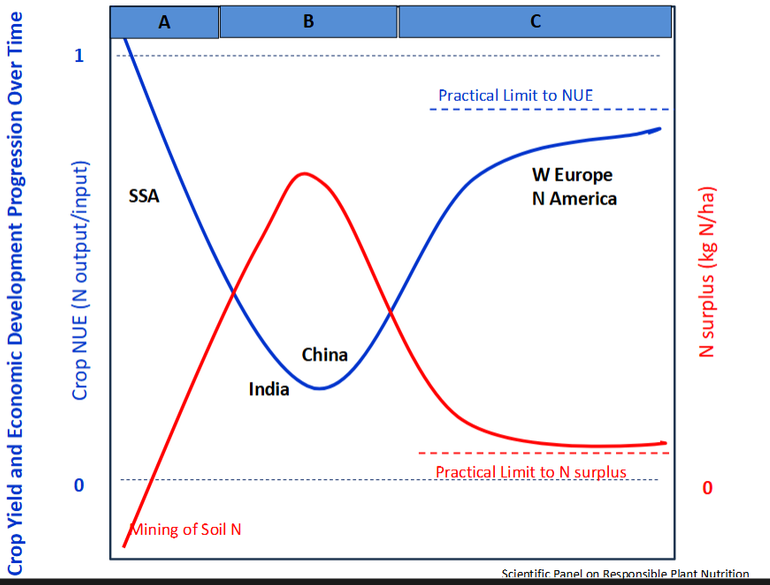
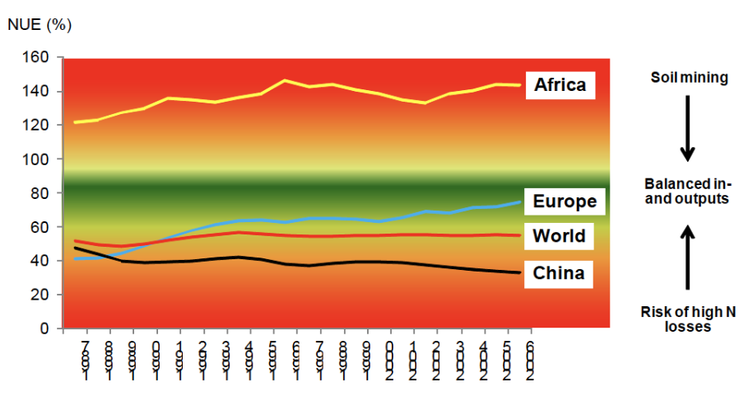
Crop yield and economic development progression over time graph
(NUE, N surplus vs practical limit to NUE)
SSA - NUE over 1, N outputs > inputs, more nitrogen in grain than nitrogen applied, mining soil for nitrogen
Global NUE graph
Nitrogen functions
Component of amino acids, nucleic acids, protein and chlorophyll; promotes vegetative growth
Phosphorus
Energy transfer (ATP) and protein metabolism; seed germination, root growth, essential for N fixation in legumes
Potassium
Regulates stomata, enzyme activation for starch and protein metabolism; water balance, drought tolerance, disease resistance
Calcium
Cell wall constituent, cell division, regulates nutrient transport, increases fruit set
Cornell media mix deficient in it
Mg
Major constituent of chlorophyll and ribosomes, enzyme activation for carbohydrate metabolism
Sulfur
Synthesis of amino acids, chlorophyll formation, promotes nitrogen fixation in legumes
Micronutrients
Essential constituents of numerous enzymes or key in activating enzymes
Nutrient acquisition
very little gaseous form may enter through stomata
Mostly through mass flow or diffusion
Mass flow (NO3, SO4,Ca, Mg, K, micros) - order of centimeters
Diffusion (P, K, S, Fe, Zn) - order of millimeters
Must be near site of uptake (i.e the root)

Plants assimilate mineral nutrients as ions

Factors affecting nutrient availability to plants
Parent material
Soil pH
On acid soils, H+ overwhelms exchange sites, leading to issues with Mg, Ca
Moisture content
Temperature
Redox conditions
How plant respiration impacts soil pH
CO2 released from respiration by plants, and H+ pumped into the soil by roots, acidify the soil solution and trigger cation exchange
Consider for fertility
What is the pH
Can you modify it?
Where are the charges coming from: OM, clay?

Impacts of pH on nutrient availability

Global soil pH

Nutrient constraints to crop productivity
N - most limiting worldwide
P - highly weathered soils, esp. In tropical areas
K - intensive cropping systems with high residue removal
S - particularly in reduced, paddy rice agroecosystems
Ca, Mg - highly weathered and acidic soils
Zn - micronutrient deficiency especially in paddy rice
B - problem for grain legumes, wheat and vegetables (high pH)
Temporal patterns and remobilization
Most uptake during vegetative period: N, K and Mg
Season-long uptake: P, S and Zn
Remobilization from leaves, stalks: N, P
Less remobilization: K, Mg, S
Determining crop nutrient status
Hard to apply so many macronutrients to reach toxicity, but micronutrients have a more narrow optimal concentration range

Approaches toward identifying deficiencies
Deficiency Symptoms - simple, no cost diagnostic based on characteristic visual symptoms and novel approaches such as remote sensing
Symptoms can be confused with non-nutrient stresses (diseases, drought, flood)
Plant Analysis - nutrient analysis of specific plant parts at specified growth stages
Nutrient concentrations compared to known sufficiency ranges
Good for monitoring crop nutrition status; effectiveness of fertilizer applications
May come too late in the plant life cycle
Soil Testing - measurement of soil nutrient/pH status to use as basis for fertilizer/lime recommendations
Nutrient status before planting; supplement level
Functional relationship between soil nutrient extracted & crop yield
Must be used before deficiencies occur
Symptoms of major nutrient deficiencies

Mobile vs immobile nutrient deficiency symptoms - mobile nutrient deficiency symptoms appear in old plants

Physiological functions of beneficial mineral elements

Plant breeding definition
Plant breeding is the genetic improvement of plants for human benefit
Plant breeding is the art and science of the genetic improvement of plants
Why breed plants?
Yield - food for rising population
Evaluate performance of diverse varieties in diff places
G x E x M
Genotype x env x management
Increase disease and insect resistance
Enhance abiotic stress resistance
Quality – taste, nutritional value
Harvestability
Lodging resistance, uniform maturity, shatter resistance, dry down rate; adaptable to mechanical harvest
Persistence
Esp for perennials that winterkill e.g alfalfa
How do we know how much of yield increase is from breeding?
Era study
More than half of yield gains in major cereal crops are a result of genetic improvement
Genetic yield gain / total yield gain = % genetic gain

How diverse are crop species
Based on DNA sequence we now know that, on average, two maize lines are as genetically different as humans are from chimpanzees
Toolbox of genes to utilize
Driver of new genetic combinations?
Meiosis
Regular plant cell is diploid - 2 copies of each chromosome, one from each parent
Recombination leads to genetic diversity
Plant breeders make use of this process of recombination

Mendelian genetics 3 principles
Paired factors
Every gene has variant forms i.e alleles
Individual inherits a pair of alleles for each gene, one from egg and one from pollen parent
Law of segregation
Offspring receive one copy of each gene from each parent via egg or sperm gametes (haploid)
Law of Independent assortment
Genes inherited from each parent are passed independently to offspring, conferring separate traits
Used mathematical ratios rather than microscope to develop these 3 principles
Think of punnett squares
What shapes breeding strategy?
Reproductive strategy
Self pollinating plants
Naturally homozygous
Selfed inbreds reveal their true character – more predictable, easier to study
Open pollinating plats
Floral structure facilitates outcrossing
Self-incompatibility genes in some species
Hybrids are crosses of two inbred lies
Inbreds made in self-pollinating or open-pollinating crops
Inbreeding depression
Many crops vegetatively propagated as clones
Sweet potato, sugarcane, cassava, potato
Plant breeding steps
Identify breeding goals
Identify parent germplasm
Create variable population
Select from variable population
If selections are unfavorable, back to step 2
Test progeny
If progeny is unfavorable, back to step 2
Release new cultivar
Distribute seed to growers
Identify breeding goals expanded
Shape, flavor, color, storage capacity, disease/pest resistance
Identify germplasm
Seed sources, genetic resources from other programs, varieties, seed banks, wild relatives (e.g queen anne’s lace), potential parent lines provided by collaborators
Variable population
Control pollen movement, so that only desired parents contribute genes
Select from population
Select a group of desirable plants from population
Bulk seed and intimate in next generation
Repeat for several generations
Family selections - rather than individual plants, breeders keep track from a family of plants, assess sibling performance
Among and within families
Evaluate progeny
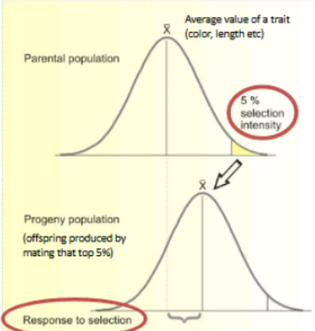
After several generations of selections, how do breeders know if they are making progress?
5% selection intensity from parent (highlighted yellow) used for the progeny population
Entire progeny population has shifted to the right, indicating improvement
6 and 7: release cultivar, distribute seed
Seed production
Marketing
Intellectual property
Genetic modification - engineering/transformation vs editing
Key breeding steps of step 3 - create variable population
Gene modification to change genes of interest
Genetic Engineering / Transformation: moving a gene from one species to another
Gene Editing: deleting or changing particular nucleotide(s) within a species’ DNA
Small number of genes at a time
For traits determined by one or a few genes, like herbicide and insect resistance
Differences in the level of regulatory approval
Significant approval process required to release a "genetically engineered" variety (e.g., RoundUp Ready soybean or Bt cotton)
Gene edited varieties require minimal regulatory oversight (e.g. non-browning mushroom, Arctic apple (non-browning), seedless blackberry, pitless cherry).
Genetic engineering/transformation

Gene editing

Marker assisted selection
Accelerates step 4. Selection from variable population
DNA marker is a landmark - a sequence close to gene of interest, often inherited together with gene of interest
Genomic selection
Effective for complex traits controlled by many genes
Uses genome-wide markers
Trains genomic prediction model on a population that associates genotype with phenotype
Predicts genomic estimated breeding values for individuals without needing to wait for phenotypes to be exhibited
Predict variety performance without field trial

Ecological vs weed science vs agronomical definition of a weed
Ecology def of weed - a plant thriving on human disturbance of growing unchecked
Weed science: a plant interfering with any human objective
Agronomy: a plant interfering with crop productivity or harvest
Essentially: a plant at the wrong place at the wrong time
Common characteristics of weeds
Rapid growth rate
Abundant reproduction
Effective dispersal
Persistent propagules (ability to emerge over time)
Weed seedbank
Vegetative growth (tuber, tiller)
Phenotypic plasticity
Can change physiology/morphology in response to environmental changes
“ideal” (biggest pain) weed
Flexible in
Germination (seed dormancy e.g in Chenopodium album)
Pollination (generalists or some self-compatibility) (e.g Thlaspi arvense)
Seed production (high when favorable, limited when unfavorable) (e.g Amaranthus sp.)
Dispersal (seeds + rhizomes) (e.g Cirsium arvense)
Losses from weeds
Production
Constraints on limited resources (light, nutrients, water)
Increased cost
Control (herbicides, fuel)
Crop reseeding
Product quality or spoilage
Dockage e.g weed seeds in wheat harvest
Forage contamination
Disease or insect hosts
Powdery mildew from wild oats
Physical weed control
Uproot, severing, burying
TIllage (5-10” deep)
Primary: uproot established weeds and stubble
Moldboard
Secondary: for soil tilth and seedbed prep or incorporating herbicides or fertilizer
Tine weeding
Flicking weeds between crop rows
Mowing
Heat
Flame weeding
Steam
Mulching
Flooding