LC Plant Structure and Transport
 Call Kai
 Learn
 Practice Test
 Spaced Repetition
 Match
 Flashcards
 Knowt Play
1/44

Earn XP
Description and Tags
45 Terms
Tissue
A group of similar cells that together perform a specialized function.

Root
An organ that anchors the plant to the soil, absorbs minerals and water, and often stores carbohydrates.

Tap root
Type of root that consists of a main root that gives rise to many smaller lateral roots.

Transpiration
The controlled release of excess water from the stomata of the leaf
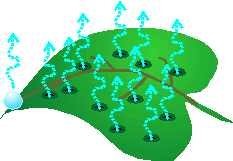
Warm , Dry , Sunny , Breezy Day
Name 4 environmental factors to maximise the rate of photosynthesis
Carbon Dioxide Absorption
Environmental factor which effects the opening / closing of stomata ( Transpiration )

Root Pressure created by Osmosis
Cohesion ( Water to Water )
Adhesion ( Water to Xylem )
Transpirational Pull caused by Evaporation
4 stages of the transpiration stream

Dixon and Jolly
Scientists who developed the Cohesion / Tension Model
Size of the Leaf ( Bigger = More Stomata )
Stomatal Size
Presence of a cuticle reduces transpiration
Name 3 structural features on a plant which can affect the rate of transpiration
Lateral roots
Roots that branch off from the taproot.
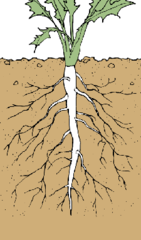
Root hairs
A tiny extension of a root cell, growing just behind the root tip and increasing surface area for absorption of water and minerals.

Stem
Organ of the plant which provides structure and support to the plant

Petiole
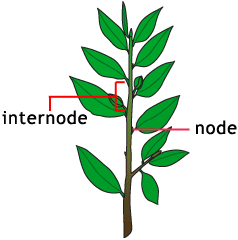
The points at which leaves are attached to the stem.

Internodes
The distance between 2 nodes.
Apical bud/terminal bud
A bud at the tip of a plant stem.

Leaf
The main photosynthetic organ.

Parallel Veination
Veination typical in Monocotyledons

Netted / Reticulate Veination
Veination typical in Dicotyledons

Dermal tissue
Type of tissue that makes up the plant's outer protective covering

Epidermis
A layer of tightly packed cells that surrounds and protects the outer parts of the plant.
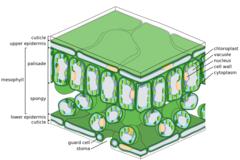
Cuticle
This waxy coating on the epidermal surface, helps prevent water loss.
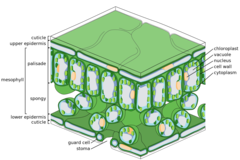
Vascular tissue
tissue made up of Xylem and phloem. Allows transport of materials through the plant
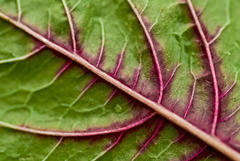
Xylem
Cells that transport water and dissolved minerals upward from roots into the shoots.

Phloem
Cells that transports glucose from the leaves to the rest of the plant

Ground tissue
Plant tissues that acts as storage and support.
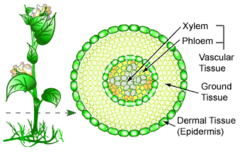
Lignin
Found in xylem cells for added structure and support

Tracheids (Xylem)
A type of xylem cell with long, thin cells with tapered ends.

Xylem Vessels
A type of Xylem cell that is formed by the end to end connection of cylindrical elements.

Dead Cells
Are xylem cells living or dead cells?
Sieve-tube elements
A living cell that transports nutrients in the phloem .Connected end to end they form sieve tubes.

Sieve plates
Have pores that facilitate the flow of fluid from phloem cell to phloem cell

Companion cell
Along with sieve tube element and sieve plates , these form the phloem

Meristems
Cells responsible for growth in plants.

Zone of Differentiation
The part of a root / shoot where plant cells get allocated a specific function ( like stem cells )
Root cap
Part of the root that protects the delicate meristem as the root pushes through the soil

Stomata
Pores that allow exchange of CO2 and O2 .Found on the under surface of the leaf

Herbaceous
A flowering plant that doesnt develop secondary thickening ( form wood )

Monocotyledon
A plant whose seed develops into 1 seed leaf

Dicotyledon
A plant whose seed develops into 2 seed leaves
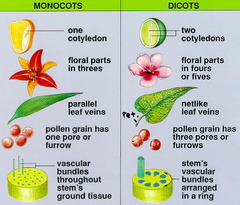
Cotyledon
Acts as a food source for the developing seed

Dicot root
Name this structure

Monocot Stem
Name this structure

Geranium
Name the dicot stem you looked at under a light microscope
Dicot stem
Name this structure

Guard cells
Regulate the opening and closing of the stomata
