Topic 12 - Properties of Populations
 Call Kai
 Learn
 Practice Test
 Spaced Repetition
 Match
 Flashcards
 Knowt Play
1/27

There's no tags or description
Looks like no tags are added yet.
28 Terms
Ecological Consequences
• Distribution
• Demographics (age structure, birth rate, death rate)
• Population size,
• Population growth
Evolutionary Consequences
• Change in genetic / phenotypic frequencies in a population
• Adaptations
• Macroevolution
Ecology
study of organisms and their interactions with their environment
Population Ecology
study of populations and their interaction with the environment
Population
group of individuals of the same species that live in the same place at the same time.
Fundamental Properties of a Population:
1. Density
2. Dispersion
3. Demographics
4. Life History
Density
Absolute Population size (N) = # of individuals in the population
Population Density = # individuals / unit area
- preferred
Dispersion
pattern of spacing of individuals in population
dispersion - clumped
individuals aggregated into patches (most common)
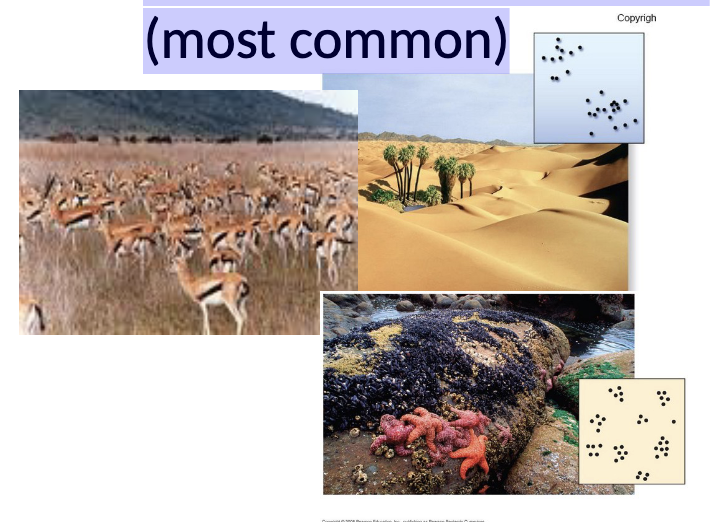
dispersion - uniform
individuals are evenly spaced

dispersion - random
individuals are spaced randomly, unpredictable spacing (least common)

Demography
Study of vital statistics
(- Death rate - Birth rate - Age class structure - Sex Ratio)
Life Table
Summary of survival and reproductive rates for each age cohort in a population
Cohort
A group born at the same time (of the same age)
Survivorship Curve
plots # of individuals (or proportion of individuals alive at each age)

Survivorship curve - type 1
- low mortality of juveniles
- high mortality in oldest individuals
Survivorship curve - type 1 - Causal Factors
- Relatively small number of offspring
- Parental care

Survivorship curve - type 2
uniform death rate across age classes
Survivorship curve - type 2 - Causal Factors
Age-independent predation / parasitism

Survivorship curve - type 3
- mortality high for juveniles
- low mortality for older age classes
Survivorship curve - type 3 - Causal Factors
- Many, relatively small offspring produced
- Little to no parental care

Life History
physiological, behavioral features that affect reproduction, growth, and survival (Age of sexual maturity (rate of development), Size of adult, Parental Care, Longevity)
Principle of Allocation
Energy invested (used) in one life history trait/characteristic can’t be used for another. Results in trade-offs
Life History Strategy
Pattern of growth, development, and timing of events in organism’s life
Semelparity
Produce many offspring once in life
Iteroparity
Produce few offspring many times in life
Density-Dependent Regulation
biotic, a natural process where the impact of resource limits on a population’s births and deaths grows stronger as the group becomes more crowded (competition, predation, diseases)
Density-Independent Regulation
any force or factor in the environment that affects the size or growth rate of a population regardless of how dense or large that population is (natural disaster, weather, human made)