PBP I Caries
 Call Kai
 Learn
Learn Practice Test
 Spaced Repetition
 Match
Match Flashcards
 Knowt Play
 Podcast
1/106

There's no tags or description
Looks like no tags are added yet.
Name | Mastery | Learn | Test | Matching | Spaced | Call with Kai | Chat |
|---|
No analytics yet
Send a link to your students to track their progress
107 Terms
Operative Dentistry
The art and science of dentistry relating to the diagnosis, treatment planning, and prognosis of defects not requiring “full coverage”
What are the goals of operative dentistry?
Restoring proper tooth form, function, esthetics, and physiological integrity of teeth
In operative dentistry, we restore teeth in harmonious relationship with what?
the adjacent hard and soft tissues
In operative dentistry, we promote
the health and welfare of the patient
Placing a restoration in a tooth requires the dentist to do ___ things
4
When placing a restoration, a dentist must use
applied biology
mechanical engineering
highly developed technical skills
artistic abilities
A cavity preparation has a certain shape that depends on
the tooth requiring restoration
A cavity preparation follows _______ configuration
geometric
A cavity preparation follows certain ________ and specifications
dimensions
Why is a cavity preparation needed?
To remove caries, defective tooth structure, and defective fillings
A cavity preparation also
maintains the strength of the tooth
A cavity preparation prevents
fracture or failure of the restorative material selected
Cavity preps are also needed to correct malformed, fractured, or ________ teeth
discolored
Cavity preps are also needed to correct _______, fractured, or discolored teeth
malformed
To detect a dental caries, what examination is required?
Oral
To detect a dental caries, what oral examinations are used?
Direct Vision
Radiographs
In direct visualization, you can see large carious lesions involving what surfaces?
O, B, L, F, P

In an oral examination, a dentist will use what tool to feel the insit of carious pits or fissures?
An explorer
In an oral examination, caries will feel
sticky or tacky

What is the primary form of radiographic examination for detecting interproximal caries?
Bitewing Radiographs

What are the name of the caries shown in the radiograph?
Interproximal Caries
Interproximal Caries will be worked on once they touch
dentin
Who classified Class I through V caries?
G.V. Black
Which Caries did Black not describe?
Class VI
Caries classification are also known as
operative prep classification
Class I carious lesions typically occur on what posterior tooth?
Maxillary 1st Molar
In a Class I carious lesions on the Maxillary 1st molar, where do the caries typically occur?
Lingual Pit
Class I carious lesions occur on the occlusal, buccal, and/or lingual surfaces of what teeth?
Posteriors
Class I carious lesions occur where on maxillary anterior teeth?
Lingual/ Palatal pits
What maxillary anterior teeth can you likely find Class I carious lesions on?
Lateral incisors
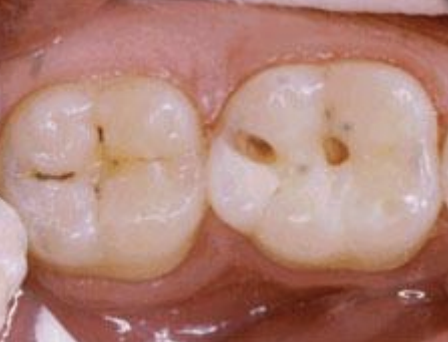
What surface are these carries located on?
Occlusal

What class are these caries?
Class I

What class are these caries?
Class I

Where are these caries located?
Buccal Pit

What class are these caries?
Class I

What surfaces are these caries on?
OL
Class II carious lesions typically involve what surfaces?
Proximal surfaces
Class II carious lesions typically involve which teeth?
Posteriors
When attempting decay removal on a class II carious lesion, what is the most typical access?
Occlusal surface
Class II carious lesions are most easily detected with what examination?
Radiography (Bitewing)

What Class are these lesions?
Class II
If tooth #31 has a carious lesion on the distal and #32 has not erupted, what class will the lesion be?
Class II
If a carious lesion is M, O, B to the buccal pit, what class is the lesion?
Class II
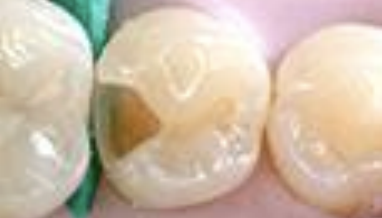
What caries are shown?
Class II
Class III carious lesions do not include what?
Incisal angle or edge
Class III carious lesions occur on the proximal surfaces of what teeth?
anteriors
Class III carious lesions are generally restored with what?
composite
Class III carious lesions are generally accessed from what surface?
lingual
Class III carious lesions occur on what surfaces of anterior teeth (without the incisal angle/edge)?
proximal surfaces

What class are these caries?
Class III

What class are these caries?
Class III

What caries are shown on the left?
Class III

What caries are shown on the right?
Class I
Which carious lesions used to be restored with gold?
Class III

What Class are these caries?
Class IV

What Class are these caries?
Class IV
What class are typical of children under the age of 13?
Class IV
Class IV caries are also known as
fracture
Which caries are typically from a traumatic incident?
Class IV
Class IV caries are generally restored with
composite
Class IV caries involves what angle of an anterior tooth?
Incisal Angle
Class IV caries are similar to what Class? Class IV involves the incisal angle
Class III

What Class is this carious lesion?
Class IV

What is the gray shadow on the caries?
Decay
What caries are very different than all of the others?
Class V

What Class are the caries shown?
Class V
What class of caries grow in a specific direction?
Class V
Class V carious lesions occur where on any tooth of the mouth?
Gingival 1/3
Class V carious lesions are usually on the ______ surface
facial/buccal
_______ carious lesions can also occur on lingual or proximal surfaces.
Class V
Class V carious lesions can be restores with what?
Composite or alloy (amalgam)
In Class V carious lesion, the lesions spread ________.
Laterally (M-D Direction)
In Class V carious lesion, the lesions spread laterally along
the CEJ
In Class V carious lesions are frequently found on the
buccal
Class VI carious lesions are often the result of what?
developmental defect
Class VI carious lesions occur on the ______ of anterior teeth.
incisal edges
Class VI carious lesions occur on the ______ of canines
cusp tip
Class VI carious lesions occur on the _______ of posteriors
cusp tip

What class is the indicated caries?
Class VI

What class is the indicated caries?
Class VI

What tooth number is the tooth shown?
#19
If your explorer makes a clicking sound over discoloration what is it?
stain
If an area feels sticky, what is the diagnosis?
caries
Recurrent caries always starts at the
margin
The weakest point (with attribution to caries) is where?
The margin (cavo surface)
What is convenience form?
Shape of the cavity that allows for adequate observation, accessibility, and ease of operation in preparing the cavity
When preparing a class I prep the isthmus is
convergent
When preparing a class I prep the buccal and lingual walls are
convergent
When preparing a class I prep what will happen if there is undercuts?
the tooth will be weak
When preparing a class I prep we want to be
conservative
When preparing a class I prep you wnat your bur oriented _______ to the occlusal table
perpendicular
What bur is an upside down pear?
330
What is the head length of a 330 bur?
1.5 mm

What bur is this?
330
What tool can you use to confirm your depth?
perio probe
In a class I prep, your pulpal floor should be ______ to the occlusal table.
parallel
Dovetails should be ______ to their according surface.
parallel
When dovetails are parallel to their according surface it creates
divergence
When doing a class I prep we want to maintain the
marginal ridges
If the tooth has an undercut from its class I prep, it is prone to what?
fracture