5. Ligand Binding
 Call Kai
 Learn
 Practice Test
 Spaced Repetition
 Match
 Flashcards
 Knowt Play
1/4

There's no tags or description
Looks like no tags are added yet.
5 Terms
Protein/Ligand Interactions
Ligand binding = many proteins will bind other molecules REVERSIBLY
bound molecules = ligands
ligands can be small molecules (ex. metal ions) or other proteins
NON-covalent - bc we need it to be reversible
occurs at the binding site, which is COMPLEMENTARY to the ligand
via: H-bonds, ionic interactions, phobic interactions, van Der Waals interactions
ex. (+) ligand, thus expect (-) charge in binding site
may be cooperative:
NON-cooperative: see hyperbolic binding curves
Cooperative: see sigmoidal binding curves (allostery), multiple binding sites (4° structure)
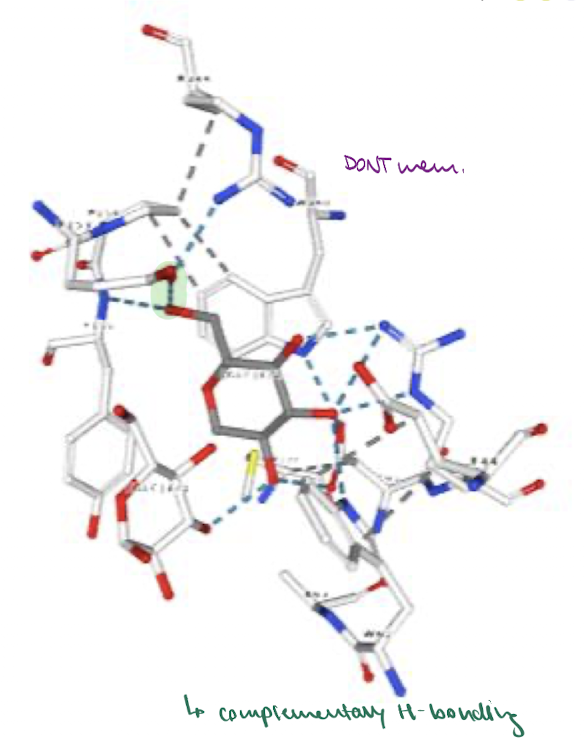
Protein Binding site Complementary
→ binding sites will have complementary interactions for the ligand:
charge
H-bonding
non-polar/PHOBIC
shape/size
ex.

ex. complementary H-bonding
Equation for Describing the Binding of Ligands
→ think of simple dissociation & association equilibrium

Kd = [ L ] needed to have 50% of ligand bound to protein
dissociation constant
expresses the strength of interaction, thus reflects affinity
increased affinity of ligand to protein = decreased Kd
thus, less dissoc. bc protein & ligand have high affinity

note: changing PH/buffer affects Kd/affinity
Fraction of protein bound to ligand: θ “theta”
generates a hyperbolic relationship b/w [ligand]
as [L] increases = θincreases
limit: θ = 0-1
θ NEVER = 1, thus fraction of protein bound to ligand NEVER = 1
→ derivation:

→ formula for relationship b/w Kd ([L] at 50% bound) & θ (fraction of protein bound to ligand):

ex. if [ L ] = Kd, meaning 50% of ligand is bound, then θ = 1Kd / 2Kd =0.5

Graphical Representation of Ligand Binding

→ shows that as [ligand] increases, the fraction bound to the protein (θ) increases & that Kd is when 50% of protein is bound to ligand
fraction of protein bound to ligand NEVER reaches 1 - thus the protein is never fully bound
Q. In the presence of 2.0µM Ni2+, a nickel-binding protein is found to be 25% saturated with nickel ( θ = 0.25 ). What is the value of Kd?
talking about ligand binding
only 25% of protein is bound
if it was 50% bound it would be equal to Kd → THUS, Kd here ≠ [ L ] = 2.0µM
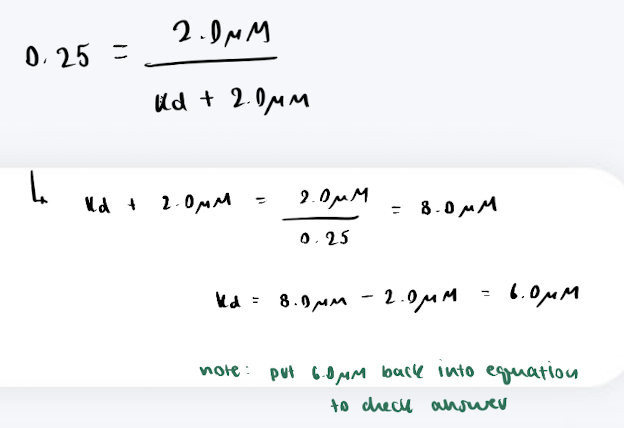
Kd = 6.0µM
[ L ] needed to have 50% of ligand bound to protein