Study Guide / TA Exam Review
 Call Kai
 Learn
Learn Practice Test
 Spaced Repetition
 Match
Match Flashcards
 Knowt Play
1/124

There's no tags or description
Looks like no tags are added yet.
Name | Mastery | Learn | Test | Matching | Spaced | Call with Kai | Chat |
|---|
No analytics yet
Send a link to your students to track their progress
125 Terms
The anomeric carbon of one sugar to the carbon bearing the OH group of another sugar
In a glycosidic linkage, which carbons are joined?
Proteoglycans primarily consist of glycosaminoglycans (long, unbranched polysaccharide chains)
Glycoproteins consist mainly of short, branched oligosaccharide chains
What’s the difference between glycoproteins and proteoglycans?
N-linked or O-linked
What are the two ways that sugars attach to proteins?
Asn side chain and the reducing end of the sugar molecule
In an N-linked glycoprotein, what two things are attached?
Ser or Thr side chain and the reducing end of the sugar molecule
In an O-linked glycoprotein, what two things are attached?
They have a negative charge that attracts a lot of water to make give them the gel-like, shock-absorbing properties
What gives glycosaminoglycans their properties in the matrix?
a carboxyl head group with a long hydrocarbon tail
What is the structure of a fatty acid?
one glycerol backbone attached to three fatty acid tails via ester bonds
What is the structure of a triacylglyercol?
less fluidity / higher boiling point
What is the effect of a fatty acid having a long chain on the amount of fluidity and the boiling point?
more fluidity / lower boiling point
What is the effect of a fatty acid having a short chain on the amount of fluidity and the boiling point?
They store energy without extra water weight because they are hydrophobic, as compared to glycogen.
Their structure allows them to pack tightly in adipose cells
Why do triacylglyercols store energy so well?
a phosphate head with a hydrocarbon (fatty acid) tail
What is the structure of a phospholipid?
a glycerol backbone connected to a phosphate head group and two fatty acyl groups
What is the structure of a glycerophospholipid?
sphingosine backbone connected to a head group and one fatty acyl group
What is the structure of a sphingolipid?
a sphingosine but with an extra fatty acid chain joined by an amide linkage
What is the structure of a ceramide?
ceramides with one or more sugars in beta-glycosidic linkage at 1-hydroxyl-group
What is the structure of glyosphingolipids?
glycosphingolipids with one sugar residue
What is the structure of cerebrosides?
sialic acid + other sugars
What is the structure of gangliosides?
isoprene units (isoprene is 2-methyl-1,3-butadiene)
What is the unit that builds terpenes?
terpenes
What is the unit that builds cholesterol?
D-glucose
What monosaccharide is this? (Include D or L in your answer)
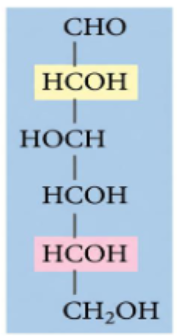
D-fructose
What monosaccharide is this? (Include D or L in your answer)
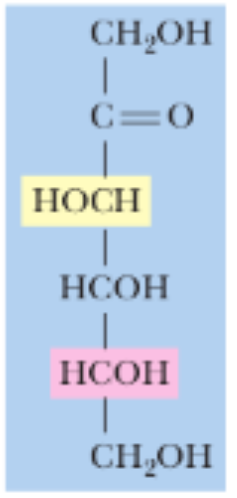
D-galactose
What monosaccharide is this? (include D or L in your answer)

micelle
Will a cone-shaped lipid form a bilayer or micelle?
bilayer
Will a cylinder-shaped lipid form a bilayer or a micelle?
It allows the membrane to have different properties on its two sides.
Why is lipid asymmetry between leaflets important?
Loosely; high salt concentrations or mild detergent treatment
Are peripheral proteins loosely or strongly associated to the membrane? Because of this, what can be used to extract them from the membrane?
Strongly; organic solvents or strong detergents
Are integral proteins loosely or strongly associated to the membrane? Because of this, what can be used to extract them from the membrane?
simple diffusion
a type of passive transport where small, nonpolar molecules just pass right through the membrane
facilitated diffusion
a type of passive transport where large, polar, or charged molecules pass through either a transporter (open on one end, then closed entirely, then opens on the other end) or a channel (open both ends always)
primary active transport
transport against a solute’s concentration that requires energy directly from ATP hydrolysis
secondary active transport
transport against a solute’s concentration that needs energy, but uses the energy from another solute going down it’s concentration gradient; uses a coupled transporter
yes, because if you add enough solute, eventually all of the channel / carrier proteins will be full
Does facilitated diffusion saturate?
yes, because if you add enough solute, eventually all of the channel / carrier proteins will be full
Does primary active transport saturate?
yes, because if you add enough solute, eventually all of the channel / carrier proteins will be full
Does secondary active transport saturate?
no
Does simple diffusion saturate?
pumps 2 K+ in and 3 Na+ out so that they naturally want to move the opposite way they are pumped. This gradient has stored potential energy
How does the Na+ / K+ ATPase build a gradient?
Example: Glucose is able to enter a cell against ITS concentration gradient because Na+ also enters that same cell going with ITS concentration gradient
How does a symporter spend the energy stored in a gradient?
Sodium Potassium pump is not able to maintain low intracellular Na+, and then glucose is not able to enter the cell via symport with Na+
What happens if the pump is blocked?
cytidine
What is the name for a cytosine nucleoside on ribose?
deoxycytidine
What is the name for a cytosine nucleoside on deoxyribose?
uridine
What is the name for a uracil nucleoside on ribose?
thymidine
What is the name for a thymine nucleoside?
adenosine
What is the name for an adenine nucleoside on ribose?
deoxyadenosine
What is the name for an adenine nucleoside on deoxyribose?
guanosine
What is the name for a guanine nucleoside?
inosine
What is the name for a hypoxanthine nucleoside?
Nucleotide has phosphate group, sugar, and nitrogenous base
Nucleoside doesn’t have a phosphate
What’s the structural difference between a nucleoside and nucleotide?
5’ to 3’
In what direction does nucleic acid synthesis proceed (from what prime to what prime?)
the 3’ OH of one sugar connects to the 5’ phosphate of the next nucleotide
Between what two parts of nucleotides is the phosphodiester bond?
260 nm
At about what wavelength do bases strongly absorb UV light?
they have aromatic structures, and aromatics can absorb UV light
How are nitrogenous bases able to strongly absorb UV light?
They allow proteins to read DNA sequence without opening the helix
Why are major and minor grooves in DNA’s double helix important?
topoisomerases
What are enzymes that temporarily break DNA strands and then reseal them to introduce or remove supercoils?
type 1 topoisomerase
type of topoisomerase that cuts 1 strand and doesn’t require ATP
type 2 topoisomerase
type of topoisomerase that cuts 2 strands and requires ATP
DNA gyrase in bacteria that adds negative supercoils
What is an example of type 2 topoisomerase?
sticky ends
What does EcoR1 produce?
restriction enzymes
enzymes that cut DNA at a specific recognition site?
3
How many carbons must an aldose have for it to have a chiral center?
4
How many carbons must a ketose have for it to have a chiral center?
diastereomers
What category do epimers and anomers fall under?
On a fischer projection, it’s the carbon that contains the OH that you look at when determining D or L configuration
What is the penultimate carbon?
ketose
Is fructose a ketose or aldose?
aldose
Is glucose a ketose or aldose?
aldose
Is galactose a ketose or aldose?
Look at C5 (ring carbon to the left of the oxygen); if the CH2OH group is up, it’s D; if the CH2OH group is down, it’s L
How do you know if a monosacharide is D or L if it’s in a Haworth projection?
beta-glucose
What are the subunits found in cellulose?
alpha-glucose
What are the subunits found in amylose?
alpha-glucose
What are the subunits found in amylopectin?
alpha-glucose
What are the subunits found in glycogen?
1-4
What are the bonds in cellulose?
1-4
What are the bonds in amylose?
1-4 and 1-6
What are the bonds in amylopectin?
1-4 and 1-6
What are the bonds in glycogen?
amide linkage
What type of bond connects a fatty acid to a sphingosine in a ceramide?
An example of a terpene that is an antioxidant and a red pigment in foods like tomatoes
What is lycopene?
an example of a terpene that is a precursor to cholesterol
What is lanosterol?
inner; functions as an “eat me” apoptotic signal
Is phosphatidylserine found in the inner or outer leaflet? What are its functions?
outer; builds cell membranes, support liver / brain / gut function
Is phosphatidylcholine found in the inner or outer leaflet? What are its functions?
The 2’ OH group on RNA promotes alkaline hydrolysis; DNA, however, doesn’t have this OH group (because it’s DEoxy) so it’s more stable in basic conditions
Why is RNA less stable than DNA in basic conditions?
alpha is the phosphate right next to the sugar, beta is the next one to the right, and gamma is the one furthest to the left.
In dNTP, which phosphates are the alpha, beta, and gamma?
Because of their aromatic character
Why are purines and pyrimidines insoluble on their own?
They become incorporated into a hydrophilic, charged sugar-phosphate backbone
How do purines and pyrimidines become soluble with DNA or RNA?
260 nm
What wavelength absorbs DNA best?
280 nm
What wavelength absorbs proteins best?
tryptophan and tyrosine
Which amino acids in proteins is largely responsible for their ability to absorb wavelength?
supercoiled state
the state that DNA may be in if it has more or less than 10 base pairs per turn
positive supercoiling
When DNA is overwound
negative supercoiling
When DNA is underwound
11
How many base pairs per turn is A-form DNA?
10
How many base pairs per turn is B-form DNA?
12
How many base pairs per turn is Z-form DNA?
right
Is A-form DNA right or left handed?
right
Is B-form DNA right or left handed?
left
Is Z-form DNA right or left-handed?
snRNA
What type of RNA functions in various nuclear processes?
snoRNA
What type of RNA facilitates chemical modifications of RNAs?
miRNA and IncRNA
What type of RNA regulates gene expression?
siRNA
What type of RNA silences gene expression