chapter 8
 Call Kai
 Learn
 Practice Test
 Spaced Repetition
 Match
 Flashcards
 Knowt Play
1/141

There's no tags or description
Looks like no tags are added yet.
142 Terms
8.1 What is molecular gastronomy?
A style of cooking that uses chemical processes to transform ingredients and create particular textures, shapes, and eating experiences.
8.1 What is an aqueous solution?
A homogeneous mixture in which water is the solvent. Examples include seawater, vinegar, and solutions inside biological cells.
8.1 What is spherification?
A technique used in molecular gastronomy in which a precipitation reaction forms a thin, solid-like layer around a liquid, creating an edible sphere.
8.1 How does the spherical olive demonstrate a precipitation reaction?
Calcium ions from calcium chloride react with alginate ions in a sodium alginate bath, forming an encapsulating layer around olive juice.
8.2 What is a solvent, and what is a solute?
The solvent is the major component of a solution that dissolves the other substance. The solute is the substance dissolved in the solvent.
8.2 What is the difference between a concentrated and a dilute solution?
A concentrated solution contains a relatively large amount of solute compared with the solvent; a dilute solution contains a relatively small amount.

8.2 What is molarity, and what is its formula?
Molarity (M) measures moles of solute per liter of total solution. M = moles of solute ÷ liters of solution.
8.2 Why is molarity based on liters of solution rather than liters of solvent?
The solute contributes to the final volume. Molarity uses the total volume after the solute and solvent have been combined.
8.2 How do you prepare 1.00 L of a 1.00 M NaCl solution?
Dissolve 1.00 mol NaCl in some water, then add more water until the total solution volume is exactly 1.00 L.
8.2 How do you calculate moles from molarity and volume?
Rearrange M = mol/L to obtain moles = M × volume in liters. Convert milliliters to liters before calculating.
8.2 How do you calculate solution volume from molarity and moles?
Volume in liters = moles ÷ molarity. Convert the result to milliliters by multiplying liters by 1000 if needed.
8.2 How do you calculate molarity when given the mass of a solute?
Convert grams of solute to moles using molar mass, convert solution volume to liters, and divide moles by liters.
8.2 What is the difference between molarity of a compound and molarity of one of its ions?
Ion molarity accounts for the number of each ion produced per formula unit. For example, 0.200 M CaCl₂ produces 0.400 M Cl⁻ if it dissociates completely.
8.2 What ion concentrations result from 0.225 M NaNO₃?
NaNO₃ produces Na⁺ and NO₃⁻ in a 1:1 ratio, so each ion has a concentration of 0.225 M.
8.2 What ion concentrations result from 0.225 M Mg(NO₃)₂?
Each formula unit produces one Mg²⁺ and two NO₃⁻ ions. [Mg²⁺] = 0.225 M; [NO₃⁻] = 0.450 M.
8.2 What ion concentrations result from 0.225 M Al(NO₃)₃?
Each formula unit produces one Al³⁺ and three NO₃⁻ ions. [Al³⁺] = 0.225 M; [NO₃⁻] = 0.675 M.
8.2 How do you calculate moles of KCl in a solution?
Multiply the molarity of KCl by the solution volume in liters. If the answer is needed in grams, multiply the resulting moles by KCl's molar mass.
8.2 How do you calculate the mass of solute in a solution?
Calculate moles using n = M × V, with V in liters, then multiply the moles by the solute's molar mass in g/mol.
8.2 What is dilution?
Dilution decreases a solution's concentration by adding more solvent. The amount of solute stays constant, but the total solution volume increases.

8.2 What equation describes dilution?
M₁V₁ = M₂V₂, where M₁ and V₁ are the initial concentration and volume, and M₂ and V₂ are the final concentration and volume.
8.2 Why does M₁V₁ = M₂V₂ work for dilution?
The number of moles of solute does not change when solvent is added. The initial moles equal the final moles, so M₁V₁ = M₂V₂.
8.2 How do you prepare a dilute solution from a concentrated stock solution?
Calculate the stock volume with M₁V₁ = M₂V₂, measure that volume, and add solvent until the final solution reaches the required volume.
8.2 Self-assessment: What is the molarity of 55.8 g MgCl₂ in 1.00 L of solution?
Molar mass MgCl₂ ≈ 95.21 g/mol. Moles = 55.8 ÷ 95.21 = 0.586 mol. Molarity = 0.586 mol ÷ 1.00 L = 0.586 M.
8.2 Self-assessment: What mass of Mg(NO₃)₂ is in 145 mL of 0.150 M solution?
Moles = 0.150 mol/L × 0.145 L = 0.02175 mol. Molar mass Mg(NO₃)₂ ≈ 148.31 g/mol. Mass = 0.02175 × 148.31 = 3.23 g.
8.2 Self-assessment: What volume of 1.50 M HCl makes 2.00 L of 0.100 M HCl?
Use M₁V₁ = M₂V₂. V₁ = (0.100 M × 2.00 L) ÷ 1.50 M = 0.133 L, or 133 mL.
8.3 What is solution stoichiometry?
A calculation method that uses solution volume and molarity to find moles, then uses a balanced chemical equation to relate moles of different reactants or products.
8.3 What is the general procedure for solution stoichiometry?
Convert the known solution volume to liters, calculate moles using molarity, apply the balanced equation's mole ratio, then convert the resulting moles into the requested quantity.
8.3 Why must a chemical equation be balanced before stoichiometry calculations?
The coefficients give the correct mole ratios between reactants and products. An unbalanced equation gives incorrect ratios and therefore incorrect calculations.
8.3 How do you calculate the moles of a reactant when its solution volume and molarity are known?
Use moles = molarity × volume in liters. These moles are then used with the balanced equation to calculate other quantities.
8.3 How do you find the volume of a solution needed to react with another solution?
Calculate the known reactant's moles, use the balanced equation to find the required moles of the second reactant, then divide by its molarity to obtain liters.
8.3 What is the limiting reactant in a solution reaction?
The reactant consumed first according to the balanced equation. It determines the maximum amount of product that can form.
8.3 Conceptual practice: For 2 A(aq) + B(aq) → C(aq), equal volumes of 1.0 M A and 1.0 M B are mixed. Which reactant is limiting?
A is limiting. Equal volumes at equal molarity contain equal moles, but the reaction requires twice as many moles of A as B.
8.3 Self-assessment: What minimum volume of 0.200 M KI reacts with 155.0 mL of 0.112 M Pb(NO₃)₂?
Equation: 2 KI + Pb(NO₃)₂ → 2 KNO₃ + PbI₂. Moles Pb(NO₃)₂ = 0.1550 L × 0.112 M = 0.01736 mol. KI needed = 2 × 0.01736 = 0.03472 mol. Volume = 0.03472 ÷ 0.200 = 0.174 L = 174 mL.
8.4 How does an ionic solid such as NaCl dissolve in water?
Water molecules attract the Na⁺ and Cl⁻ ions strongly enough to separate them from the crystal and surround them in solution.
8.4 What are solute–solute interactions?
Attractive forces between particles of the solute itself. In an ionic solid, these include attractions between oppositely charged ions.
8.4 What are solvent–solute interactions?
Attractive forces between solvent molecules and solute particles. Dissolving is favored when these interactions can overcome the attractions holding the solute together.
8.4 Why is water able to dissolve NaCl?
Water is polar. Its partially negative oxygen end attracts Na⁺, while its partially positive hydrogen ends attract Cl⁻, helping separate the ions.
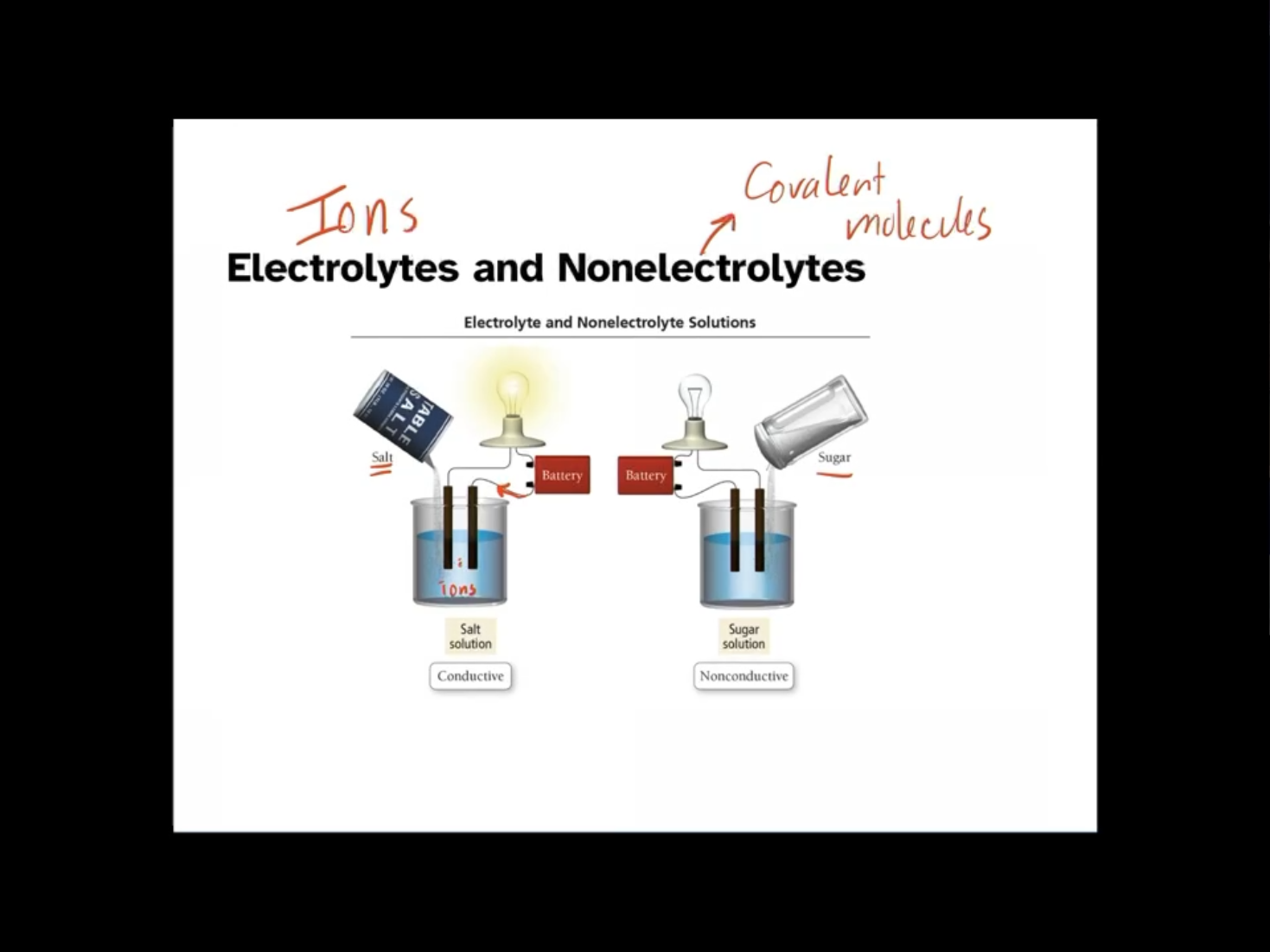
8.4 What is a strong electrolyte? (Ions)
A substance that forms a solution containing many freely moving ions because it dissociates or ionizes essentially completely. Such a solution conducts electricity well.

8.4 What is a weak electrolyte? (Still ions)
A substance that produces ions only partially in solution. It conducts electricity less effectively than a strong electrolyte at comparable conditions.
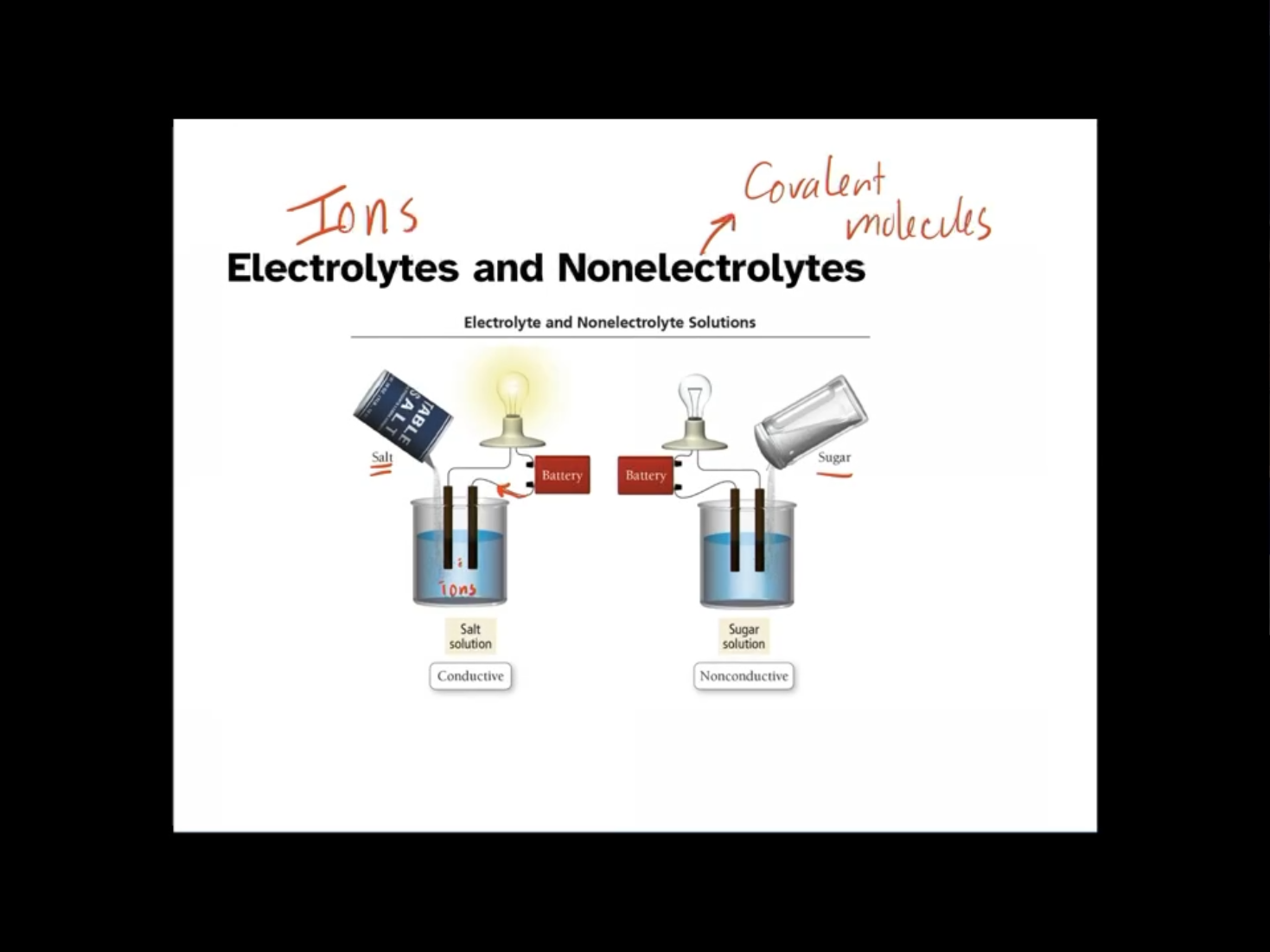
8.4 What is a nonelectrolyte?
A substance that dissolves without forming appreciable ions. Its solution conducts electricity poorly; dissolved sugar is a common example.
COVALENT MOLECULES
8.4 Why does dissolved NaCl conduct electricity but dissolved sugar generally does not?
NaCl separates into mobile Na⁺ and Cl⁻ ions that carry charge. Sugar dissolves mainly as neutral molecules, so it does not supply comparable mobile ions.
8.4 What is the difference between dissociation and ionization?
Dissociation separates ions already present in an ionic compound. Ionization forms ions from neutral molecules, as when a molecular acid reacts with water.
8.4 What does it mean for a compound to be soluble?
It dissolves sufficiently in a solvent to form a solution. Solubility describes how much can dissolve under specified conditions.
8.4 What does it mean for a compound to be insoluble?
Only a very small amount dissolves under the conditions being considered. Insoluble does not necessarily mean that absolutely none dissolves.
8.4 What are solubility rules used for?
They predict whether ionic compounds are generally soluble or insoluble in water, helping determine whether mixing two solutions will form a precipitate.
8.4 What is the key solubility rule for compounds containing Group 1A ions or NH₄⁺?
Compounds containing Group 1A cations, such as Na⁺ or K⁺, and ammonium, NH₄⁺, are generally soluble in water.
8.4 What is the solubility rule for nitrate and acetate compounds?
Nitrates (NO₃⁻) and acetates (C₂H₃O₂⁻) are generally soluble in water.
8.4 What is the general solubility rule for chloride, bromide, and iodide compounds?
Compounds containing Cl⁻, Br⁻, or I⁻ are generally soluble, but important exceptions include compounds of Ag⁺, Pb²⁺, and Hg₂²⁺.
8.4 What is the general solubility rule for sulfate compounds?
Most sulfates are soluble, but exceptions include compounds such as BaSO₄, SrSO₄, and PbSO₄; calcium sulfate is only slightly soluble.
8.4 Which common anions usually form insoluble compounds?
Carbonate (CO₃²⁻), phosphate (PO₄³⁻), and hydroxide (OH⁻) compounds are generally insoluble, except when paired with cations covered by the applicable solubility rules.
8.4 How can you predict whether mixing two ionic solutions forms a precipitate?
Exchange the ions to identify possible products, write their formulas correctly, and apply the solubility rules. A precipitate forms if a product is insoluble.
8.5 What is a precipitation reaction?
A reaction in which dissolved substances react to form an insoluble solid that separates from the solution.
“Two aqueous solutions mixed → Solid (precipitate)
If the product isn’t a solid, all we did was dilute the solutions; no reaction occurred”
8.5 What is a precipitate?
The solid product formed from a solution during a precipitation reaction.
8.5 How does sodium carbonate help reduce hard-water soap scum?
CO₃²⁻ ions react with dissolved Ca²⁺ and Mg²⁺ to form insoluble CaCO₃ and MgCO₃, removing those ions from the water.
8.5 What happens when KI(aq) and Pb(NO₃)₂(aq) are mixed?
A bright yellow PbI₂(s) precipitate forms. The balanced equation is 2 KI(aq) + Pb(NO₃)₂(aq) → PbI₂(s) + 2 KNO₃(aq).
8.5 What are the steps for writing a precipitation-reaction equation?
Identify the ions in the reactants, exchange cations and anions to predict products, write correct neutral formulas, determine solubility, and balance the equation with state symbols.
8.5 What does (aq) mean in a chemical equation?
The substance is dissolved in water. Soluble ionic compounds in aqueous solution are represented as separated ions when writing complete ionic equations.
8.5 What does (s) mean in a chemical equation?
The substance is a solid. In a precipitation reaction, the (s) product identifies the precipitate.
8.5 Self-assessment: Which solution forms a precipitate when mixed with Na₂CO₃(aq): KNO₃, NaBr, NH₄Cl, or CuCl₂?
CuCl₂. Its Cu²⁺ ions react with CO₃²⁻ ions to form insoluble CuCO₃(s). The other listed combinations remain soluble under the usual solubility rules.
8.6 What is a molecular equation?
An equation that shows complete, neutral compound formulas for the reactants and products, even when soluble ionic compounds actually exist as ions in water.
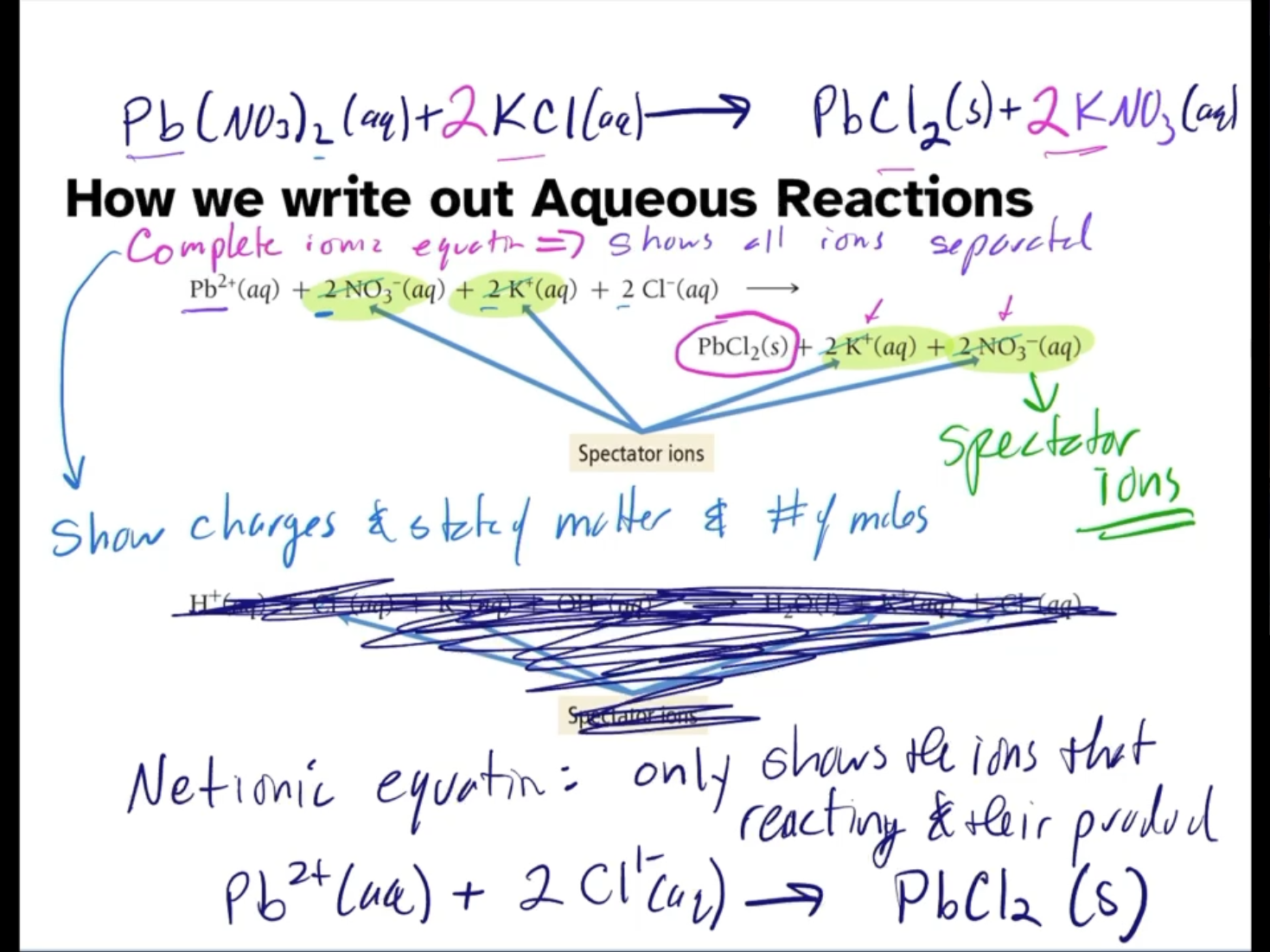
8.6 What is a complete ionic equation?
An equation that shows the dissolved strong electrolytes as their individual aqueous ions while keeping solids, liquids, gases, and weak electrolytes intact.
Complete: “Shows all ions separated.” Write out moles, charges, and states of matter
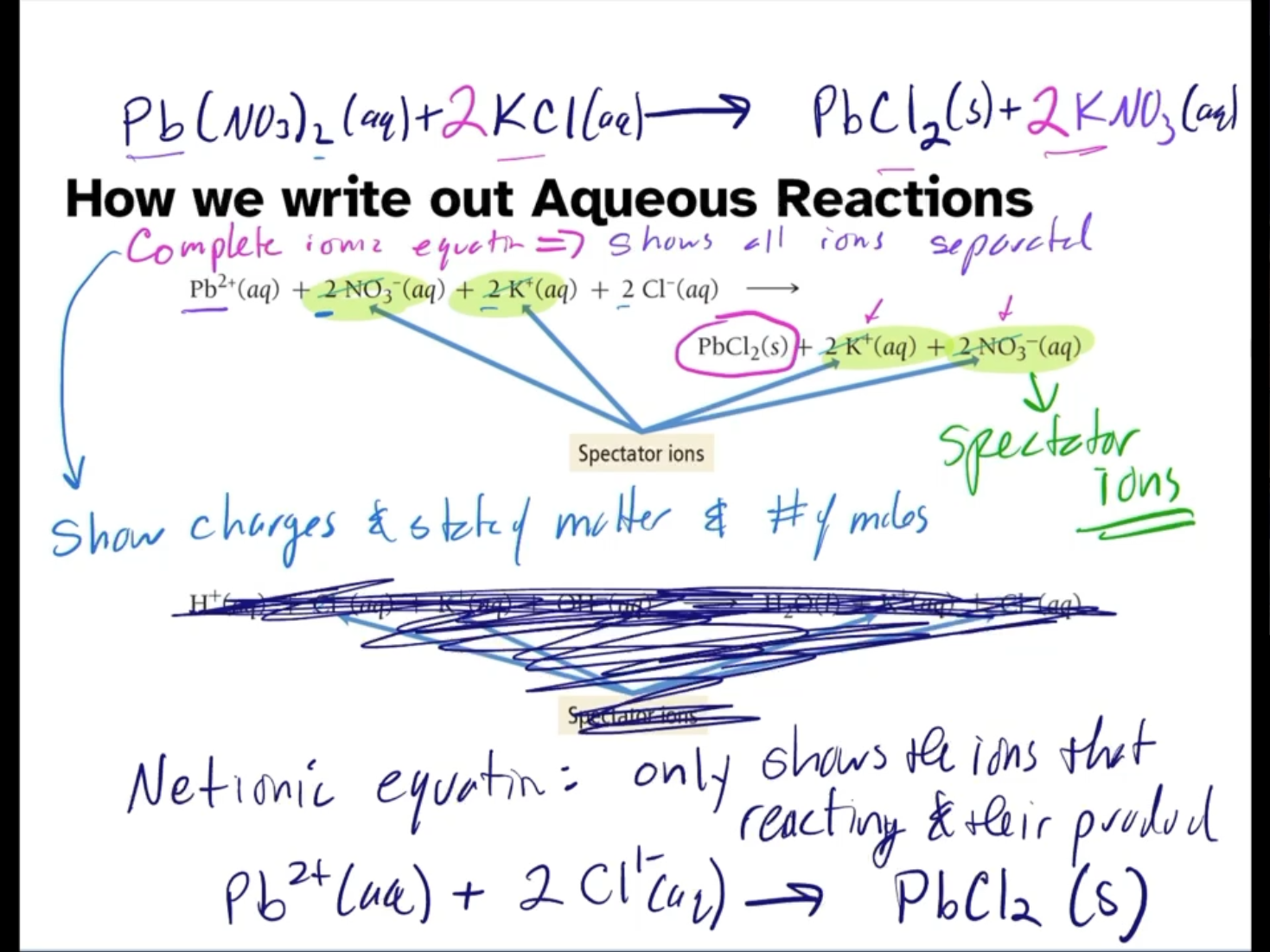
8.6 What is a net ionic equation?
Net: An equation that shows only the particles that actually change during the reaction, omitting spectator ions.
“Only shows the ions that are reacting with the products.” Essentially, if there are ions that are soluble on both sides (spectator ions), we can omit them and write a net equation instead of a complete equation.
Complete: “Shows all ions separated.” Write out moles, charges, and states of matter8.6 What are spectator ions?
Ions that remain unchanged in solution during a reaction. They appear on both sides of a complete ionic equation and are removed when writing the net ionic equation.
“Any ions that are soluble on both sides”
See image and what is highlighted in green of the ionic equation
8.6 How do you convert a molecular equation into a complete ionic equation?
Split soluble strong electrolytes labeled (aq) into their constituent ions, including the correct coefficients. Do not split solids, liquids, gases, or weak electrolytes.
Complete: “Shows all ions separated.” Write out moles, charges, and states of matter8.6 How do you convert a complete ionic equation into a net ionic equation?
Cancel identical ions appearing on both sides, including their charges and coefficients. Check that the remaining atoms and total charge are balanced.

8.6 What is the net ionic equation for forming solid PbCl₂ from aqueous Pb²⁺ and Cl⁻?
Pb²⁺(aq) + 2 Cl⁻(aq) → PbCl₂(s). The ions combine in a 1:2 ratio to form the neutral solid.
8.6 What is the net ionic equation for a strong acid reacting with a strong base?
H⁺(aq) + OH⁻(aq) → H₂O(l). The hydrogen and hydroxide ions form water; spectator ions are omitted.
8.6 Self-assessment: What is the net ionic equation when KOH(aq) and HNO₃(aq) react?
H⁺(aq) + OH⁻(aq) → H₂O(l). K⁺ and NO₃⁻ remain dissolved and are spectator ions.
8.7 What is the Arrhenius definition of an acid?
An acid is a molecular compound that produces H⁺ ions when dissolved in water. In water, these protons normally associate with water molecules.
8.7 What is the Arrhenius definition of a base?
A base is a substance that produces OH⁻ ions when dissolved in water.
8.7 What is a hydronium ion?
H₃O⁺, formed when a proton associates with a water molecule: H⁺(aq) + H₂O(l) → H₃O⁺(aq). H⁺(aq) is commonly used as shorthand for this in solution.
8.7 What is the difference between a strong acid and a weak acid?
A strong acid ionizes essentially completely in water. A weak acid ionizes only partially, so both ionized and un-ionized acid are present.
8.7 What is a polyprotic acid?
An acid that can release more than one ionizable proton per molecule. It releases the protons sequentially; each step can have a different extent of ionization.
8.7 What is the difference between a monoprotic and a diprotic acid?
A monoprotic acid can release one proton per molecule; a diprotic acid can release two. For example, H₂SO₄ is diprotic.
8.7 How do you name a binary acid?
For a binary acid containing hydrogen and a nonmetal, use hydro- + the nonmetal root + -ic acid. For example, HCl(aq) is hydrochloric acid.
8.7 How do you name an oxyacid from an oxyanion ending in -ate?
Change -ate to -ic acid. For example, nitrate (NO₃⁻) becomes nitric acid (HNO₃).
8.7 How do you name an oxyacid from an oxyanion ending in -ite?
Change -ite to -ous acid. For example, nitrite (NO₂⁻) becomes nitrous acid (HNO₂).
8.7 Self-assessment: What is the name of HNO₂(aq)?
Nitrous acid. HNO₂ contains the nitrite ion (NO₂⁻), whose -ite ending changes to -ous acid.
8.7 What is an acid–base or neutralization reaction?
A reaction between an acid and a base. It commonly produces water and an ionic compound called a salt; some reactions involving weak electrolytes require a different net ionic equation.
8.7 What is a salt in acid–base chemistry?
An ionic compound formed in an acid–base reaction. The term includes many ionic compounds, not just table salt, NaCl.
8.7 What is the net ionic equation for a strong acid reacting with OH⁻?
H⁺(aq) + OH⁻(aq) → H₂O(l). The acid supplies H⁺ and the base supplies OH⁻.
8.7 How does a weak acid change the net ionic equation for neutralization?
The weak acid is kept intact because it is not completely ionized. For example, HF(aq) + OH⁻(aq) → H₂O(l) + F⁻(aq).
8.7 What is an acid–base titration?
A method for determining an unknown solution concentration by reacting it with a solution of known concentration and measuring the amount required for reaction.
8.7 What is the equivalence point in a titration?
The point at which the reactants have been mixed in the exact stoichiometric proportions required by the balanced chemical equation.
8.7 What is a titration indicator?
A substance that changes color over a particular range of conditions, helping identify the endpoint of a titration. The endpoint should closely indicate the equivalence point.
8.7 How do you solve an acid–base titration calculation?
Write and balance the reaction, convert known volume and molarity into moles, use the equation's mole ratio, and calculate the unknown concentration or volume.
8.7 What is the difference between a titration endpoint and its equivalence point?
The equivalence point is the stoichiometric completion point. The endpoint is the observed indicator change; a good indicator changes color close to the equivalence point.
8.8 What is a gas-evolution reaction?
A reaction in which a gaseous product forms and escapes from the solution, often producing visible bubbling.
8.8 How can a gas-evolution reaction form gas directly?
The ions from two reactants can combine to form a gaseous product directly. For example, an acid reacting with sulfide can produce H₂S(g).
8.8 How can a gas-evolution reaction form gas indirectly?
The reactants first produce an unstable intermediate that decomposes into a gas and other products. For example, H₂CO₃ decomposes into H₂O and CO₂(g).
8.8 What happens when hydrochloric acid reacts with sodium bicarbonate?
HCl(aq) + NaHCO₃(aq) → NaCl(aq) + H₂CO₃(aq), followed by H₂CO₃(aq) → H₂O(l) + CO₂(g). Overall, water and carbon dioxide form.
8.8 What intermediate commonly forms when an acid reacts with a carbonate or bicarbonate?
Carbonic acid, H₂CO₃, which is unstable and decomposes into water and carbon dioxide gas.
8.8 What gas is commonly released when an acid reacts with limestone, CaCO₃?
Carbon dioxide, CO₂. The reaction produces carbonic acid as an intermediate, which decomposes into CO₂(g) and H₂O(l).
8.8 Why do gas-evolution reactions often bubble?
A gaseous product forms in the liquid and escapes into the surroundings as bubbles.
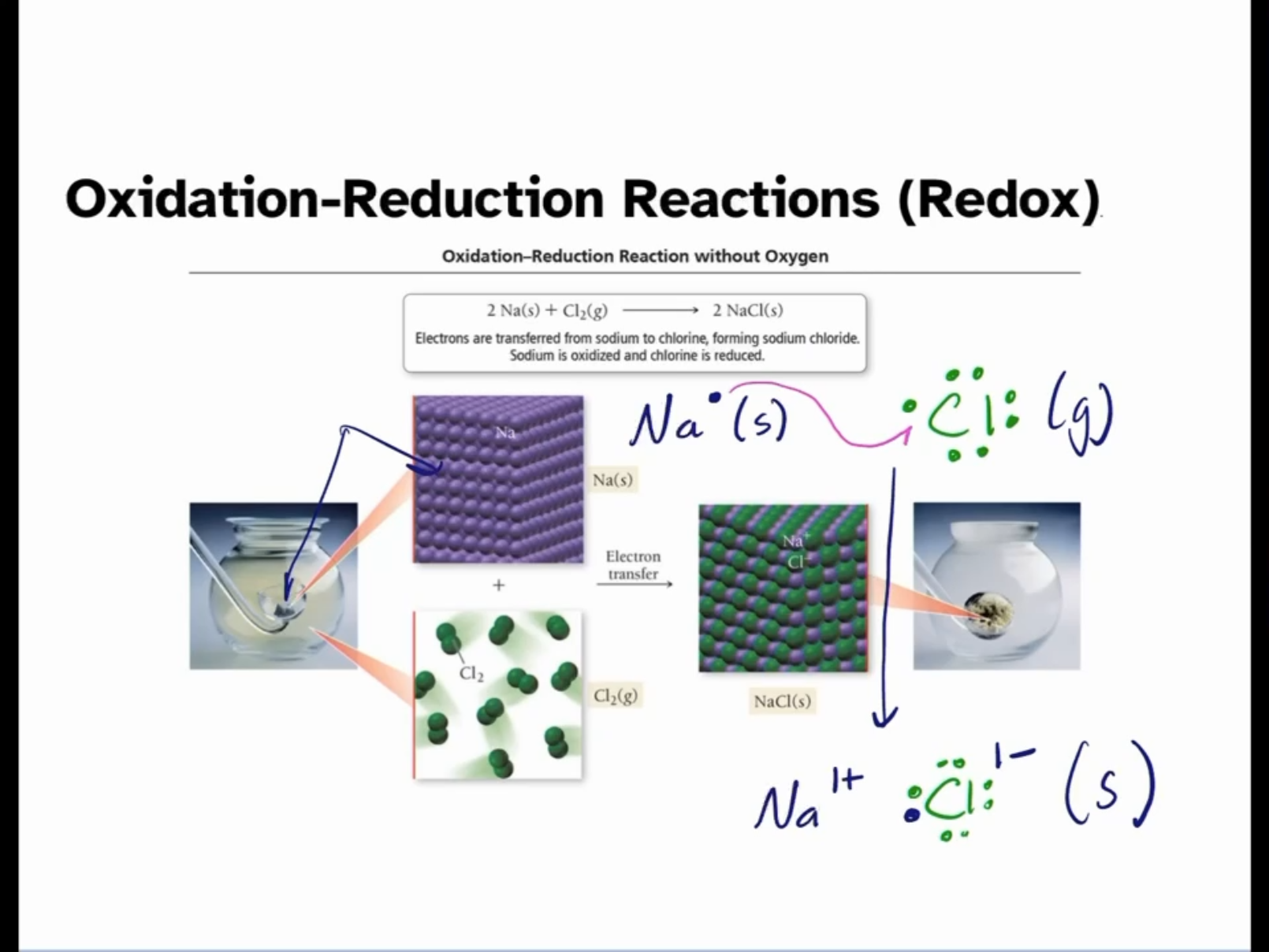
8.9 What is an oxidation–reduction (redox) reaction?
A reaction in which electrons transfer from one reactant to another, or electron ownership changes. Oxidation and reduction always occur together.
“Moving electrons around”
“Oil Rig”
8.9 What does OIL RIG mean?
Oxidation Is Loss of electrons; Reduction Is Gain of electrons. A substance that loses electrons is oxidized, while one that gains electrons is reduced.
8.9 Does a redox reaction have to involve oxygen?
No. Redox reactions involve electron transfer or changes in oxidation states. For example, sodium reacting with chlorine to form NaCl is a redox reaction without oxygen.
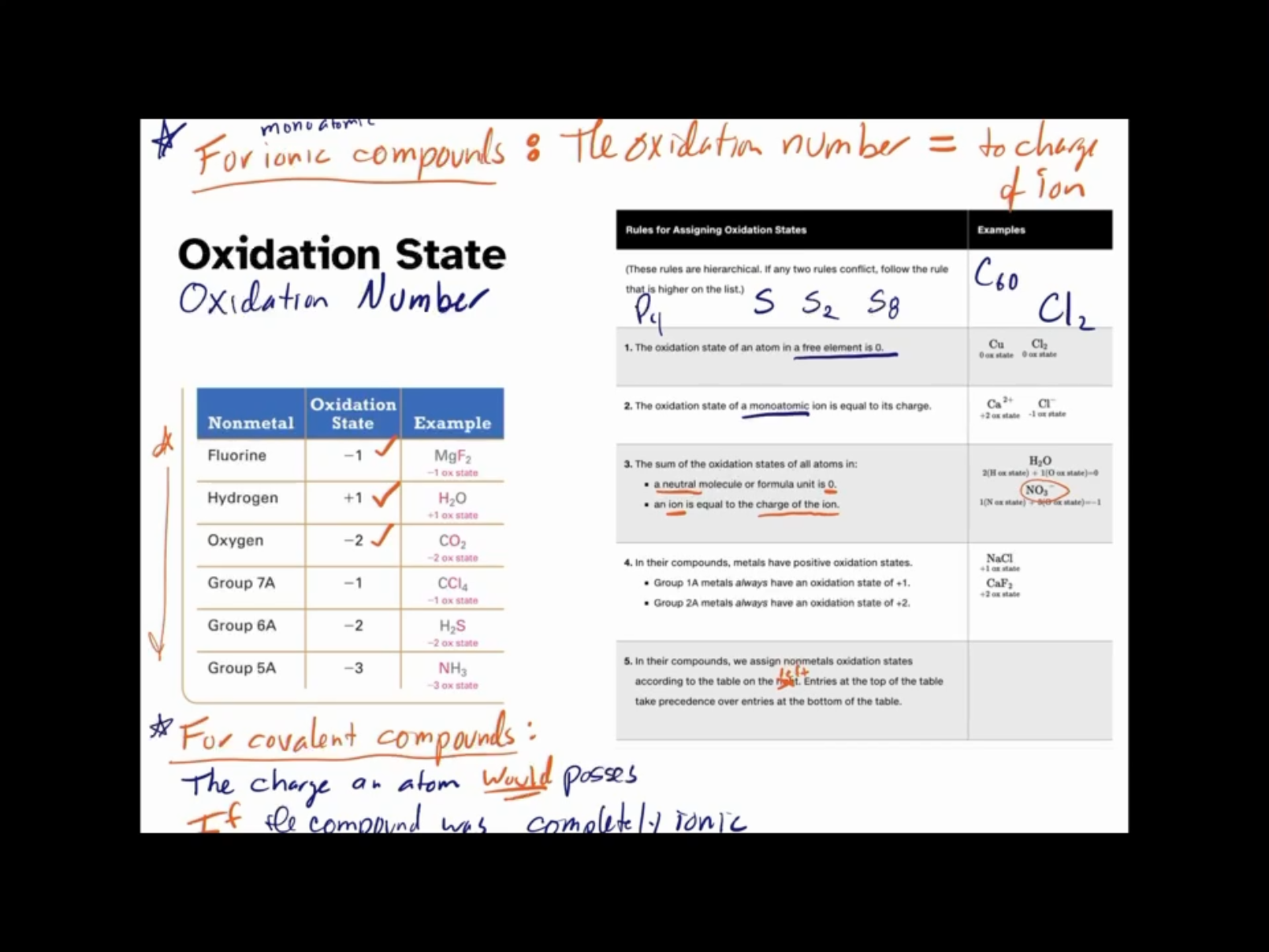
8.9 What is an oxidation state/number?
A bookkeeping number assigned to an atom based on how bonding electrons are assigned. Changes in oxidation states help identify oxidation and reduction.
“For monoatomic ionic compounds, the oxidation number is equal to the charge”
“For covalent compounds, the charge the atom would have IF the compound were completely ionic”
SEE IMAGE FOR RULES
8.9 What is the oxidation state of an element in its free, uncombined form?
Zero. Examples include Na(s), Fe(s), H₂(g), and O₂(g).
8.9 What is the sum of oxidation states in a neutral compound?
The oxidation states of all atoms must add to zero because the compound has no net charge.