alkene mechanisms (simplified)

0.0(0)
Studied by 0 people
call kaiCall Kai
learnLearn
examPractice Test
spaced repetitionSpaced Repetition
heart puzzleMatch
flashcardsFlashcards
GameKnowt Play
Card Sorting

1/19

encourage image

There's no tags or description

Looks like no tags are added yet.

20 Terms

1
New cards
<p>acid-catalyzed hydration</p>

acid-catalyzed hydration

regiochemistry: markovnikov

stereochemistry: N/A (mixed)

Caveats: carbocation intermediate subject to rearrangements

<p>regiochemistry: markovnikov</p><p>stereochemistry: N/A (mixed)</p><p>Caveats: carbocation intermediate subject to rearrangements</p>
2
New cards

overall reaction category: hydration of alkenes

hydration of alkenes: addition of H and OH. includes…

  • acid-catalyzed hydration

  • oxymercuration-demurcuration

  • hydroboration-oxidation


3
New cards
<p>oxymercuration-demurcuration</p>

oxymercuration-demurcuration

Regiochemistry: Markovnikov

Stereochemistry: anti

Caveats: Nucleophiles other than water can attack the mercurinium ion

<p>Regiochemistry: Markovnikov</p><p>Stereochemistry: anti</p><p>Caveats: Nucleophiles other than water can attack the mercurinium ion</p>
4
New cards
<p>hydroboration-oxidation</p>

hydroboration-oxidation

regiochemistry: anti-markovnikov

stereochemistry: syn
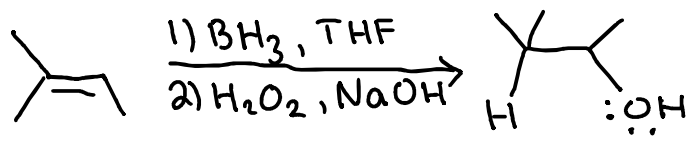
<p>regiochemistry: anti-markovnikov</p><p>stereochemistry: syn</p>
5
New cards

overall addition reactions on pi bonds (with alkenes) + regio and stereochemistry definitions

Regiochemistry: which group adds to which carbon ?

  • H adds to less substituted carbon (Markovnikov)

  • H adds to more substituted carbon (anti-Markovnikov)

Stereochemistry: do the groups add to the same side of opposite sides of the pi bond ?

  • same side (syn addition)

  • opposite sides (anti addition)


<p>Regiochemistry: which group adds to which carbon ?</p><ul><li><p>H adds to less substituted carbon (Markovnikov)</p></li><li><p>H adds to more substituted carbon (anti-Markovnikov)</p></li></ul><p>Stereochemistry: do the groups add to the same side of opposite sides of the pi bond ?</p><ul><li><p>same side (syn addition)</p></li><li><p>opposite sides (anti addition)</p></li></ul><p></p>
6
New cards

overall reaction category: hydrohalogenation of alkenes

hydrohalogenation of alkenes: addition of H and X. Includes…

  • nonradical hydrohalogenation

  • radica hydrohalogenation


7
New cards
<p>non radical hydrohalogenation</p>

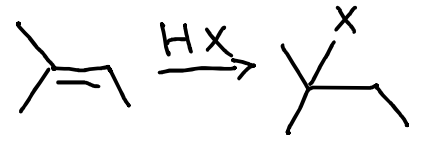
non radical hydrohalogenation

Regiochemistry: markovnikov

Stereochemistry: N/A (mixed)

Caveats:

  • X = Cl, Br, or I

  • carbocation intermediate is subject to rearrangements

<p>Regiochemistry: markovnikov</p><p>Stereochemistry: N/A (mixed)</p><p>Caveats:</p><ul><li><p>X = Cl, Br, or I</p></li><li><p>carbocation intermediate is subject to rearrangements</p></li></ul><p></p>
8
New cards
<p>radical hydrohalogenation</p>

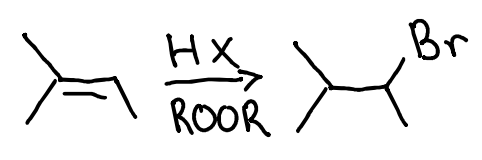
radical hydrohalogenation

Regiochemistry: anti-markovnikov

Stereochemistry: N/A (mixed)

Caveats:

  • only works for X = Br

  • radical intermediate subject to rearrangements

<p>Regiochemistry: anti-markovnikov</p><p>Stereochemistry: N/A (mixed)</p><p>Caveats:</p><ul><li><p>only works for X = Br</p></li><li><p>radical intermediate subject to rearrangements</p></li></ul><p></p>
9
New cards
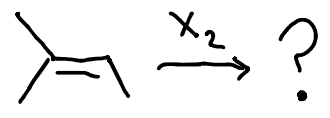
<p>dihalogenation of alkenes: addition of X and X</p>

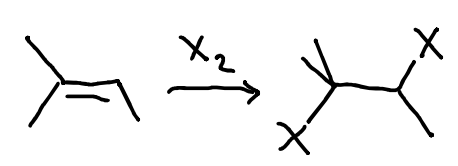
dihalogenation of alkenes: addition of X and X

Regiochemistry: N/A (adding same group to both carbons)

Stereochemistry: Anti

Caveats: Works for X = Cl, Br
<p>Regiochemistry: N/A (adding same group to both carbons)</p><p>Stereochemistry: Anti</p><p>Caveats: Works for X = Cl, Br</p>
10
New cards
<p>halohydration of alkenes: addition of X and OH</p>

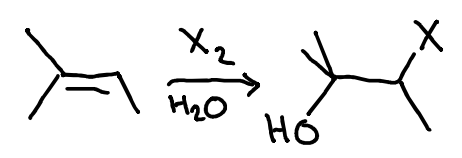
halohydration of alkenes: addition of X and OH

Regiochemistry: Markovnikov-like

  • less substituted carbon receives X; more substituted carbon receives OH

Stereochemistry: anti

Caveats:

  • works for X = Cl, Br

  • Polar protic solvents other than water can serve as the nucleophile that attacks the halonium ion

<p>Regiochemistry: Markovnikov-like</p><ul><li><p>less substituted carbon receives X; more substituted carbon receives OH</p></li></ul><p>Stereochemistry: anti</p><p>Caveats:</p><ul><li><p>works for X = Cl, Br</p></li><li><p>Polar protic solvents other than water can serve as the nucleophile that attacks the halonium ion</p></li></ul><p></p>
11
New cards

overall reaction category: Dihydroxylation of alkenes

Dihydroxylation of alkenes: addition of OH and OH. Includes…

  • Anti dihydroxylation


12
New cards
<p>anti dihydroxylation</p>

anti dihydroxylation

regiochemistry: N/A (adding the same group to both carbons)

Stereochemistry: anti

Caveats:

  • nucleophiles other than water can be used to attack the epoxide

  • mCBPA is a common peroxy acid (RCO3H)


<p>regiochemistry: N/A (adding the same group to both carbons)</p><p>Stereochemistry: anti</p><p>Caveats:</p><ul><li><p>nucleophiles other than water can be used to attack the epoxide</p></li><li><p>mCBPA is a common peroxy acid (RCO<sub>3</sub>H)</p></li></ul><p></p>
13
New cards

overall reaction category: halohydration of alkenes

halohydration of alkenes: addition of OH and OH. Includes…

  • Syn dihydroxylation (osmium tetroxide)

  • Syn dihydroxylation (potassium permanganate)


14
New cards
<p>Syn dihydroxylation (osmium tetroxide)</p>

Syn dihydroxylation (osmium tetroxide)

Regiochemistry: N/A (adding same group to both carbons)

Stereochemistry: Syn

<p>Regiochemistry: N/A (adding same group to both carbons)</p><p>Stereochemistry: Syn</p>
15
New cards
<p>Syn dihydroxylation (potassium permanganate)</p>

Syn dihydroxylation (potassium permanganate)

Regiochemistry: N/A (adding same group to both carbons)

Stereochemistry: Syn

<p>Regiochemistry: N/A (adding same group to both carbons)</p><p>Stereochemistry: Syn</p>
16
New cards

overall reaction category: oxidative cleavage

oxidative cleavage: cleavage of an alkene to form carbonyl compounds (not addition !). Includes…

  • Ozonolysis

  • potassium permanganate cleavage


17
New cards
<p>Ozonolysis</p>

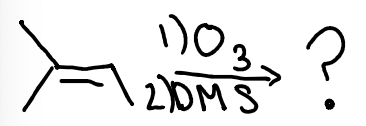
Ozonolysis

Regiochemistry: N/A

Stereochemistry: N/A

Caveats:

  • disubstituted alkene carbons become ketones

  • monosubstituted alkene carbons become aldehydes

  • unsubstituted alkene carbons become formaldehyde


<p>Regiochemistry: N/A</p><p>Stereochemistry: N/A</p><p>Caveats:</p><ul><li><p>disubstituted alkene carbons become ketones</p></li><li><p>monosubstituted alkene carbons become aldehydes</p></li><li><p>unsubstituted alkene carbons become formaldehyde</p></li></ul><p></p>
18
New cards
<p>Potassium permanganate cleavage</p>

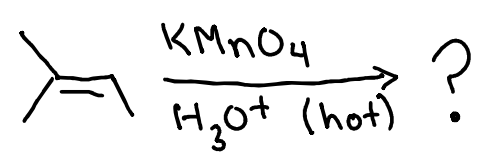
Potassium permanganate cleavage

Regiochemistry: N/A

Stereochemistry: N/A

Caveats:

  • disubstituted alkene carbons become ketones

  • monosubstituted alkene carbons become carboxyls

  • Unsubstituted alkene carbons become CO2


<p>Regiochemistry: N/A</p><p>Stereochemistry: N/A</p><p>Caveats:</p><ul><li><p>disubstituted alkene carbons become ketones</p></li><li><p>monosubstituted alkene carbons become carboxyls</p></li><li><p>Unsubstituted alkene carbons become CO<sub>2</sub></p></li></ul><p></p>
19
New cards

overall reaction category: hydrogenation (reduction) of alkenes

hydrogenation (reduction) of alkenes: Addition of H and H

20
New cards
<p>hydrogenation (reduction) of alkenes: addition of H and H</p>

hydrogenation (reduction) of alkenes: addition of H and H

Regiochemistry: N/A (adding same group to both carbons)

Stereochemistry: Syn

<p>Regiochemistry: N/A (adding same group to both carbons)</p><p>Stereochemistry: Syn</p>