Cells & Life
 Call Kai
 Learn
Learn Practice Test
 Spaced Repetition
 Match
Match Flashcards
 Knowt Play
1/29

There's no tags or description
Looks like no tags are added yet.
Name | Mastery | Learn | Test | Matching | Spaced | Call with Kai | Chat |
|---|
No analytics yet
Send a link to your students to track their progress
30 Terms
What are the 7 characteristics of living things?
Movement
Respiration
Sensitivity
Growth
Reproduction
Excretion
Nutrition
Example of movement IRL?
Sunflowers moving and facing towards sunlight
Example of respiration IRL?
aerobic respiration in cells to release energy
Example of sensitivity IRL?
Pupils constricting in light (reaction to stimuli)
Example of growth IRL?
A seedling increasing in height over time
Example of reproduction IRL?
A bacterium diving by binary fission
Example of excretion IRL?
body filters liquid waste from your blood through urine
Example of nutrition IRL?
Process of photosynthesis in plants
What are three aspects of cell theory?
All cells come from pre-existing cells
Cells are the basic unit of life and structure and function of living organisms
Every living organism is made up of atleast one or more cells
How did Pasteur disapprove of spontaneous generation?
His experiment with pasteurization shows that the microorganisms did not appear spontaneously in the mixture, showing how cells only come from pre-existing cells
What makes a virus not alive?
1.Viruses are non-cellular
Needs to control the machinery of a host cell to reproduce
Cannot carry out any of the life processes independently (inactive without host cell)
Not in any kingdom as its non-cellular
Microscope structure
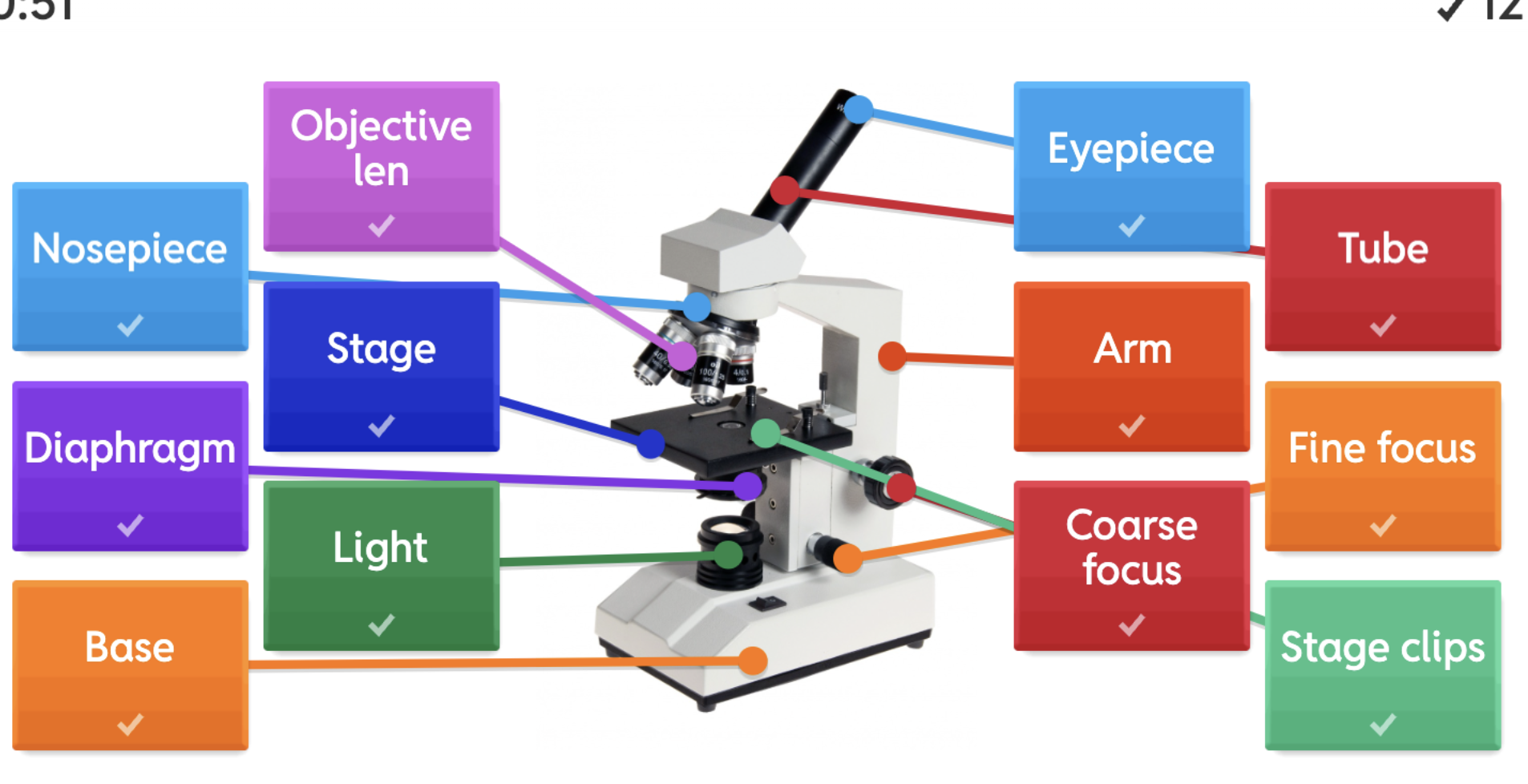
Nucleus function
contains DNA and controls cell activities
Cytoplasm function
site of chemical reactions that occur in the cell
Cell membrane function
controls movement into and out of the cells
mitochondria function
site of aerobic respiration, releases energy
ribosomes function
protein synthesis
cell well function
cellulose support layer in plant cells
chloroplasts function
site of photosynthesis and contain chlorphyll
vacuole function
contain cells sap and helps plant cells stay turgid
Rough ER function
folds and transport proteins, has ribosomes
golgi apparatus function
modifies, sorts, and packages proteins
lyosome function
digestive enzymes break down nutrients
vesicle function
small membrane sac that transports substances
similarities of prokaryotic and eukaryotic
Have dna, ribosomes, cell membrane, and cytoplasm
prokaryotic features (bacteria)
smaller than eukaryotes, quick&effective reproduction with binary fission, no membrane-bound organelles, unicellular, have looped DNA in nucleoid, no nucleus
eukaryotic cells
has nucleus, unicellular/multicellular, membrane-bound organelles
Define osmosis
movement of water particles through a partially permeable membrane from a high water potential to low water potential until concentration is in equilibrium (requires no energy -ATP)
Define diffusion
Net movement of particles from a high-concentration to a low-concentration area (moving down the concentration gradient) until reaching in equilibrium (requires no energy - ATP)
Define active transport
Movement of particles from a low to high concentration area (against the concentration gradient) requires energy (ATP) (e.g., useful substances are absorbed from the kidney tubules back into the blood using energy)