Fatty acid metabolism (pt 2- FA synthesis, TAG, and eicosanoids)
 Call Kai
 Learn
 Practice Test
 Spaced Repetition
 Match
 Flashcards
 Knowt Play
1/299

There's no tags or description
Looks like no tags are added yet.
300 Terms
DE NOVO SYNTHESIS OF FA’S INTRO
what is the starting point for de novo synthesis of lipids? (what molecule)
acetyl CoA
what FA will we be focusing on synthesizing?
palmitic acid (16:0)
what enzymes are important for FA synthesis?
Acetyl CoA carboxylase and fatty acid synthase
acetyl CoA is derived from what in the body?
glucose or AA metabolism
mostly glucose metabolism
when is FA synthesis promoted (what energy state)?
high energy (excess high CHO feeding)
high CHO feeding will elevate what? (2)
glucose and insulin
elevated glucose and insulin will stimulate
lipogenesis (FA synthesis)
in a typical diet (adequate energy needs), glucose is used for (2 options)
oxidation or stored as glycogen
leaves little available for lipogenesis
in a typical diet (adequate energy needs), what happens to AA are used for (2 options)
primarily for protein synthesis or catabolized for energy
in the western diet, how much de novo lipogenesis occurs? why?
Little de novo lipogenesis occurs because Western diets supply enough fat (no need to make lipids from scratch)
once palmitic acid is synthesized, what can happen to it? (not regarding storage)
it can be elongated or desaturated in the liver
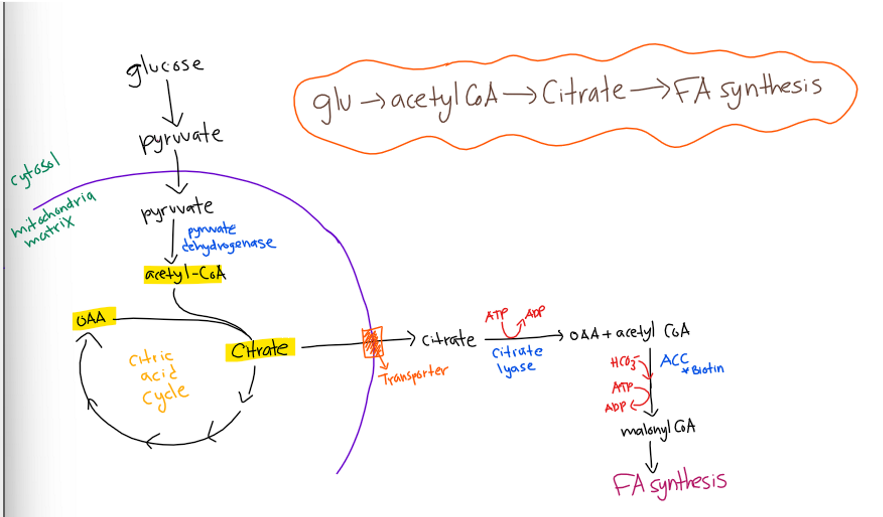
GLUCOSE --> ACETYL COA--> CITRATE--> FA SYNTHESIS
FA synthesis occurs in what main organs?
liver and adipose tissue
FA synthesis occurs in what part of the cell?
cytosol
(recall: b-oxidation occurs in mitochondria)
what is the starting substrate for FA synthesis?
malonyl CoA
malonyl CoA is made from what molecule?
acetyl CoA
where is acetyl CoA made? (in the cell)
in the mitochondria
therefore, prior to starting FA synthesis what must occur?
acetyl CoA needs to be transported to the cytosol somehow
how is acetyl CoA transported into the cytosol (as what compound)?
citrate
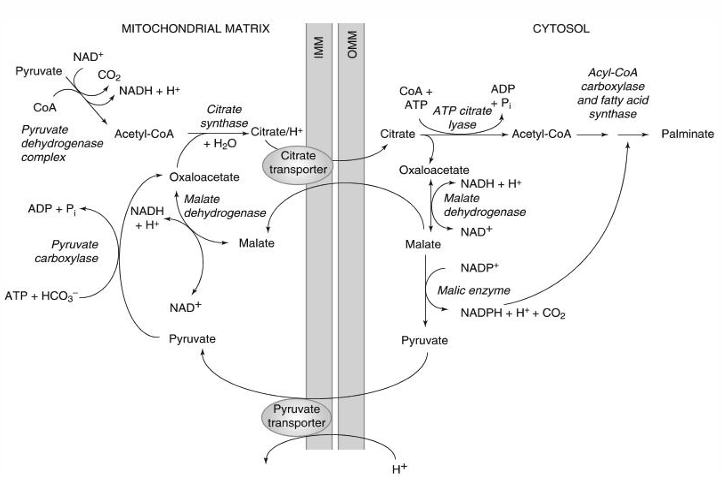
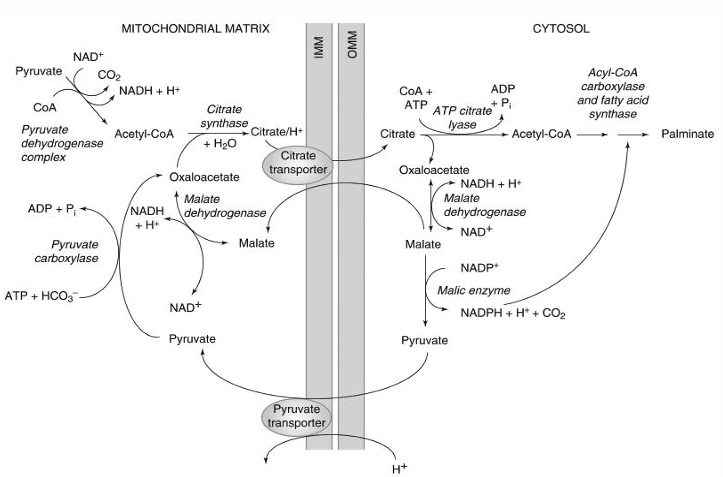
Transport of acetyl CoA for FA synthesis starting from glucose (overview)
glucose —> pyruvate via glycolysis in cytosol
pyruvate enters the mitochondria and is converted into acetyl CoA
acetyl CoA + OAA —> citrate via CAC
citrate leaves the mitochondria and enters the cytosol
citrate in the cytosol is broken down into OAA and acetyl CoA
Acetyl CoA is then converted into malonyl CoA and can start FA synthesis

starting with glucose in the cytosol, it is converted into
pyruvate via glycolysis

pyruvate made in cytosol via glycolysis will go where
into the mitochondria

pyruvate in the mitochondria will converted into
acetyl CoA
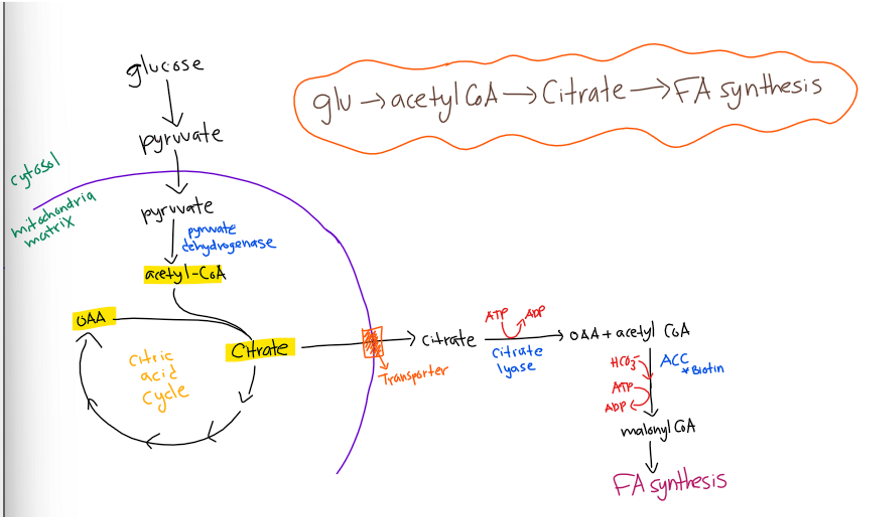
pyruvate —> acetyl CoA via
pyruvate dehydrogenase
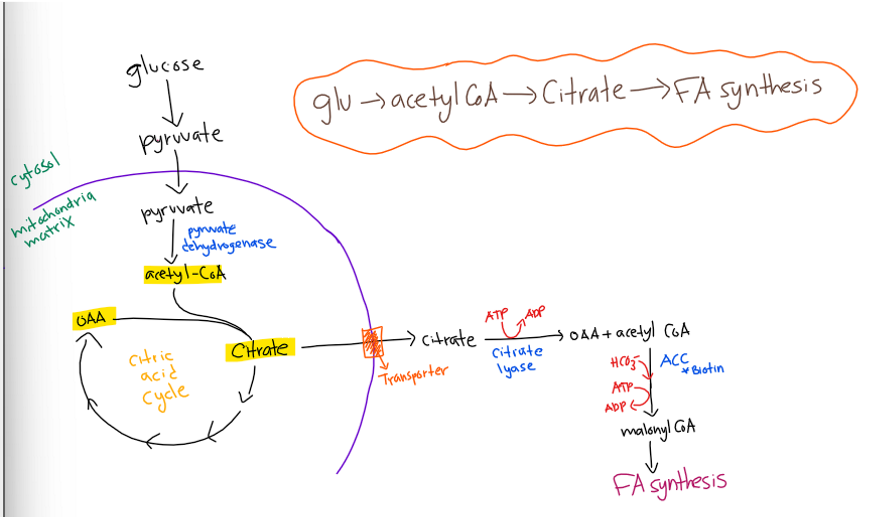
can acetyl CoA in the mitochondria enter the cytosol for FA synthesis?
NOOOOOOO (too big and lacks transporter)

acetyl CoA in mitochondria must be converted into
citrate

how is acetyl CoA converted into citrate?
combined with OAA via citric acid cycle to make citrate
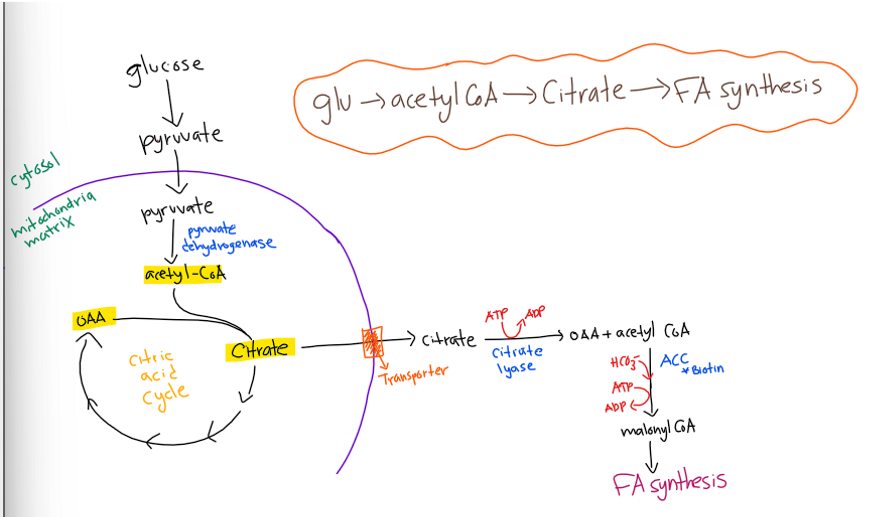
when is acetyl CoA and OAA combined to make citrate (what energy state and hormones)
high energy state and insulin present

what will happen to citrate in the CAC?
will be shuttled out of the CAC

when will citrate be shuttled out of the CAC? (like why not continue in CAC?)
Due to high levels being produced (more than is oxidized)

citrate will go where?
the cytosol

how does citrate enter the cytosol?
via citrate/malate transporter

once citrate is in the cytosol, what will happen to it?
it will be broken back down to OAA and acetyl CoA

what enzyme will cleave citrate —> acetyl CoA + OAA?
citrate lyase

acetyl CoA in mitochondria will then be converted into
malonyl CoA

acetyl CoA —> malonyl CoA via
acetyl CoA carboxylase

malonyl CoA can now do what
be substrate for FA synthesis

therefore, what is the molecule that transports acetyl CoA from mitochondria to cytosol?
citrate
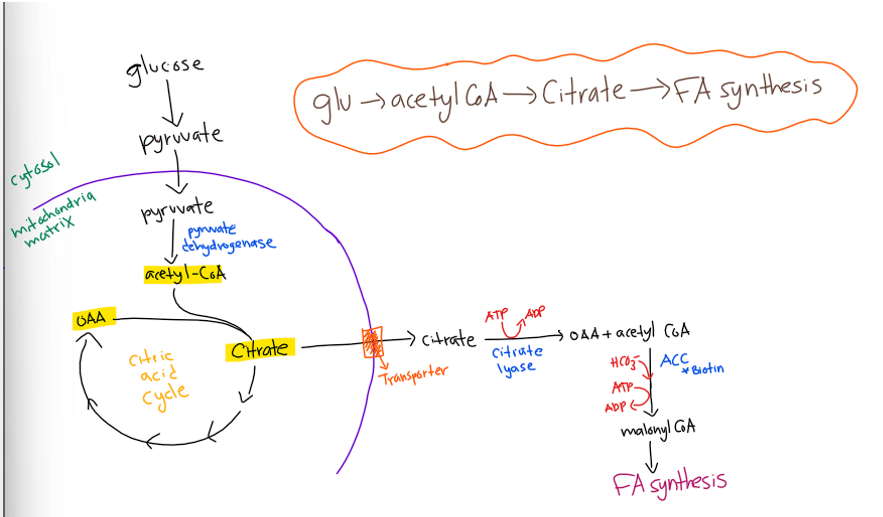
CITRATE/MALATE TRANSPORTER

what is the citrate/malate transporter?
transporter that transports citrate from mitochondria into the cytosol
why do we not just transport acetyl CoA from mitochondria to cytosol?
There is NO transporter for Acetyl CoA (too big)
citrate/malate transporter transports citrate from where to where? malate?
Transports citrate from mitochondria --> cytosol
Transports malate from cytosol --> mitochondria

once citrate is transported from mitochondria to cytosol, what happens to it?
it will be cleaved into acetyl CoA and OAA

what enzyme cleaves citrate into acetyl CoA and OAA
citrate lyase

what happens to the OAA released?
will be converted into malate

OAA —> malate via
malate dehydrogenase
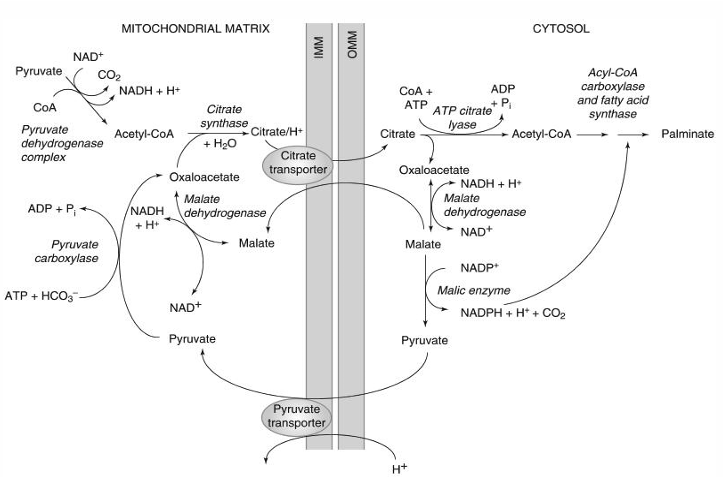
OAA —> malate uses what?
1 NADH
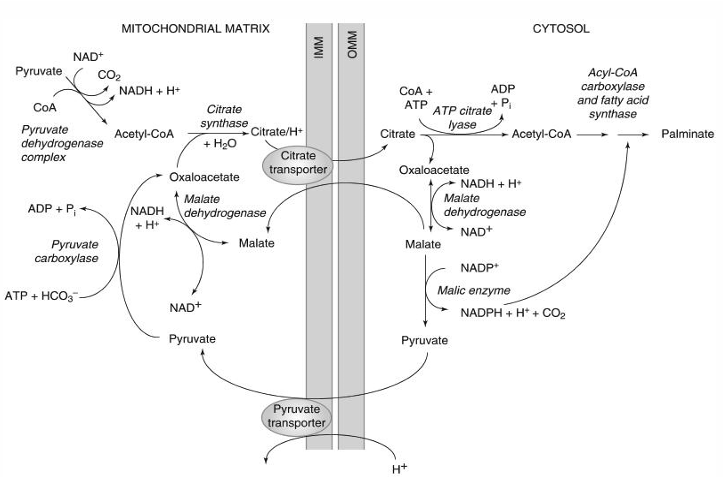
malate can then have what 2 options of paths?
Be transported back into mitochondria via citrate/malate transporter
Be converted into pyruvate which is transported into mitochondria via pyruvate transporter

If OAA is transported as malate back into the mitochondria, it will do so by what transporter?
citrate/malate transporter
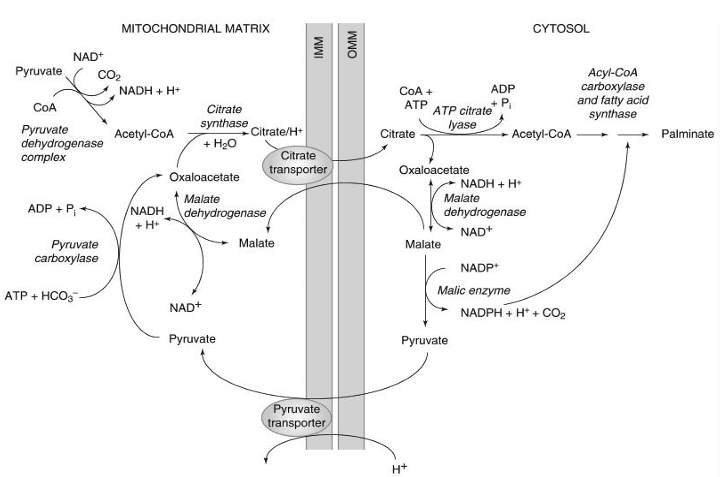
once malate is transported into the mitochondria, it can be converted into
OAA

malate —> OAA via
malate dehydrogenase

malate —> OAA in mitochondria produces what?
NADH

if malate is converted to pyruvate before being transported into mitochondria, what enzyme converts malate —> pyruvate?
malic enzyme
malic enzyme makes what?**
NADPH**

the NADPH produced from malic enzyme (malate —> pyruvate) can be used for what?
FA synthesis

pyruvate will be transported into the mitochondria how?
via pyruvate transporter

pyruvate can then be converted into what to enter the CAC cycle?
OAA

pyruvate —> OAA via
pyruvate carboxylase

converting pyruvate to OAA requires
1 ATP
FIRST STEP OF FA SYNTHESIS
what is the first step of FA synthesis? (activation step)
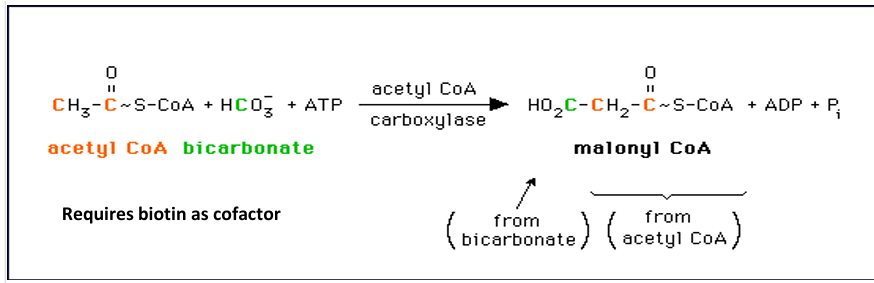
conversion of acetyl CoA to malonyl CoA

acetyl CoA —> malonyl CoA via
acetyl CoA carboxylase (ACC)
what does acetyl CoA carboxylase do to acetyl CoA
will add a bicarbonate

acetyl CoA carboxylase requires what cofactor**
biotin

the conversion of Acetyl COA (2C)--> malonyl CoA (3C) requires
1 ATP**

what is the second step(s) of FA synthesis?
malonyl CoA donates 2C to existing chain (aka FA synthesis cycle)
what enzyme specifically builds up FA chain?
fatty acid synthase

what 2 enzymes work together in FA synthesis?
ACC and fatty acid synthase
ACC does what?
makes malonyl CoA from acetyl CoA
fatty acid synthase does what?
adds 2C from malonyl CoA to grow the FA chain

fatty acid synthase usually build up until how many carbons?
16C
FA synthesis requires what reducing equivalent?
NADPH**
16:0 FA SYNTHESIS

FA synthesis overall reaction (equation)
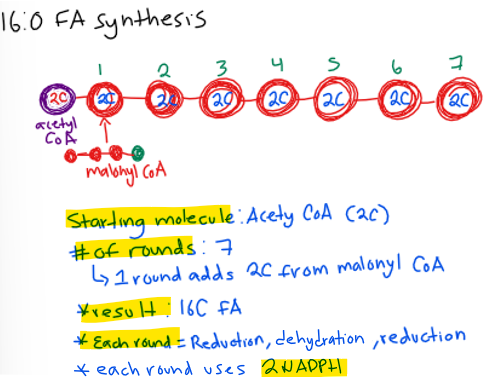
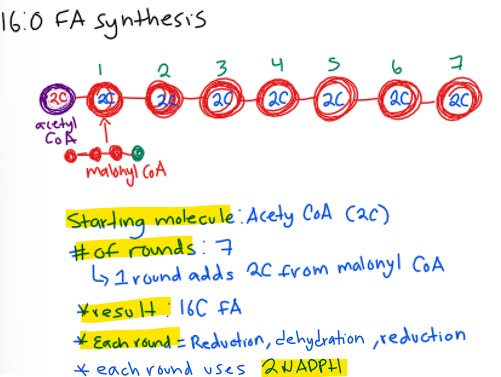
1 Acetyl CoA + 7 Malonyl CoA + 14 NADPH + 14 H+ = 1 palmitic acid + 8 CoA + 7 CO2 + 14 NADP+ + 6 H2O
for FA synthesis of 16:0 (palmitate), how many FA synthesis cycles occur?
7 cycles
for FA synthesis of 16:0 (palmitate), what is the starting molecule?
1 acetyl CoA
for FA synthesis of 16:0 (palmitate), how many malonyl CoAs will be used?
7 malonyl CoA’s

each malonyl CoA will do what?
add 2C to the FA chain

what enzyme adds 2Cs to the FA chain?
fatty acid synthase
fatty acid synthase has what that allows for the addition of 2C’s to chain?
acyl carrier domain/protein
how does FA synthase add 2C’s to FA chain?
through a series of reactions (it shuffles intermediates from one molecule to the next)
each FA synthesis cycle has how many reactions?
4

what are the reactions in each cycle of FA synthesis?
condensation —> reduction—> dehydration—> reduction
what is the first reaction for each cycle of FA synthase?
condensation

at occurs via condensation reaction of FA synthesis?
FA synthase adds 2 C at a time from malonyl CoA to the chain

what are the 3 following reactions of the FA synthesis cycle?
Reduction/dehydration/reduction

the reduction reactions require what?
NADPH

per FA synthesis cycle, how many NADPH are used?
2 NADPH (2 reduction reactions)
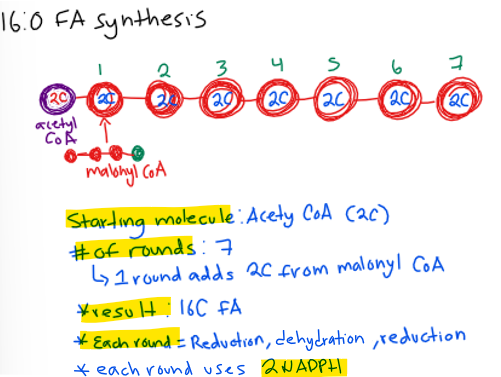
the Reduction/dehydration/reduction reactions, do what?
desaturate the growing chain

FA chain is released when it reaches how many C’s
16C’s

how much energy is used in the synthesis of palmitate (16:0)?
15 ATP

the 15 ATP consumed come from which reactions?
7 ATP consumed directly via ACC (7 acetyl CoA's --> 7 malonyl CoA's)
8 ATP consumed via citrate lyase (8 citrates --> 8 acetyl CoA's + 8 OAA)

how many NADPH are used in the synthesis of palmitate (16:0)?
14 NADPH
each cycle uses 2 NADPH —> 7 cycles —> 14 NADPH
FA SYNTHESIS REGULATION
FA synthesis occurs during _________ conditions
lipogenic
what are lipogenic conditions? (what things are present)
high glucose, high insulin, high citrate --> high energy state
what enzyme is highly active during FA synthesis?
acetyl CoA carboxylase (ACC)
ACC regulates what pathway(s)?
FA synthesis and beta oxidation
how does ACC regulate beta oxidation and FA synthesis
via malonyl CoA production