analysing DNA and RNA by hybridisation and sequencing
 Call Kai
 Learn
 Practice Test
 Spaced Repetition
 Match
 Flashcards
 Knowt Play
1/21

There's no tags or description
Looks like no tags are added yet.
22 Terms
a map of DNA genomes can be generated using what two mechanisms?
restriction enzyme digest
agarose gel electrophoresis
why is it easier to map out small genomes than larger ones?
Digestion of larger more complex genomes will create thousands of fragments differing by size and many of the same size
Appears as a smear on the agarose gel -> many DNA fragments migrating very close together
Harder to distinguish DNA fragments
how can we identify a specific DNA fragment in the complex mixture?
by hybridising a labelled probe to the DNA fragment
hybridisation
Combining different single strands/fragments of DNA/RNA together
Used to detect specific DNA/RNA fragments in agarose gels
hybridisation can be used to synthesise (?)-stranded DNA
double
probes
single stranded labelled DNA
hybridised to single stranded DNA or RNA
why are high temperatures needed for hybridisation?
to ensure only complementary strands completely anneal together
when the temperature isn't high enough, non-complementary strands can hybridise
loops can form in regions when temp isn’t high enough
name two types of hybridisation techniques
southern blotting → DNA
northern blotting → RNA
DNA vs RNA gel electrophoresis
DNA
Isolate DNA from cells and digest with a restriction enzyme
Agarose gel electrophoresis → separate using 0.5% - 2.0% agarose gel
Negatively charged DNA migrates towards positive electrode
Separated by size -> migrates as double stranded DNA
RNA
Isolate RNA from cells -> RNA molecules don't need to be digested
Agarose gel electrophoresis → separate using 1%-1.5% agarose gel
Denaturing agent added to agarose gel -> removes secondary structures from RNA (structures that base pair with itself)
Ensures that RNA migrates as a single stranded molecule
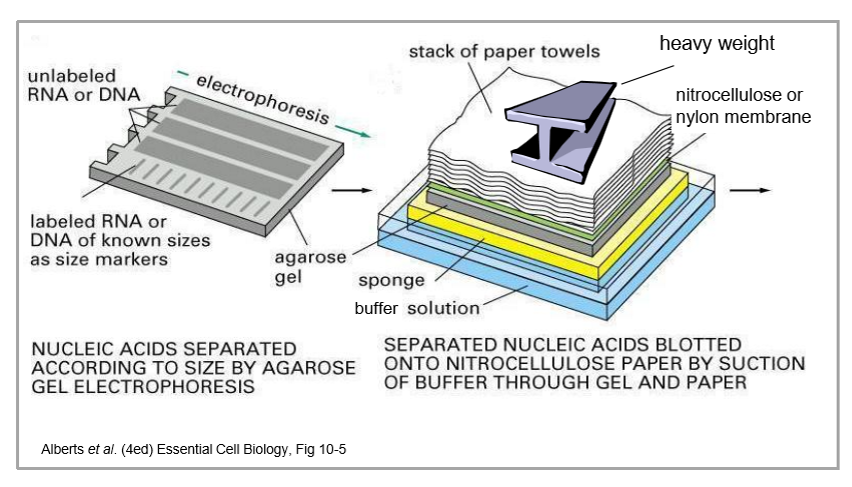
southern blotting process
Denature DNA in alkaline solution -> separates double stranded DNA into single stranded DNA
Transfer overnight using buffer solution -> buffer carries DNA from gel to the nylon membrane
DNA adheres to membrane whilst the buffer is soaked up by the paper towels
northern blotting process
No need to denature RNA -> already single stranded
Transfer overnight using buffer solution -> buffer carries RNA from gel to the nylon membrane
RNA adheres to the membrane whilst the buffer is soaked up by the paper towels

hybridising a labelled probe to the DNA or RNA of interest after blotting (explain)
Remove nylon membrane with adhered DNA or RNA
Labelled probe added in a buffer to the membrane -> leave overnight
Labelled probe hybridised to complementary DNA (southern) or RNA (northern)
Probes that did not hybridise rinsed off
Allows for detection of DNA or RNA that hybridised with labelled probes
synthesis of labelled DNA probe
Double stranded DNA denatured to single stranded DNA templates
Add DNA primers -> DNA polymerase synthesise new strand with labelled dNTPs
Synthesis of labelled probe
southern blotting used for DNA analysis
identify and quantify related genes
determines size of related genes
construction of restriction maps
northern blotting used for RNA analysis
identify and quantify related RNA
determine size of related RNA
determines patterns of gene expression

in situ hybridisation
Uses labelled complementary DNA or RNA probe to localise a specific DNA or RNA sequence in a portion or section of tissue or cell (in situ)
Labelled probes inserted into cell/tissue in opposition to blotting which is inserted into gel electrophoresis
in situ hybridisation to mRNAs (antisense vs sense probe)
Used to determine expression patterns of specific genes in tissues during development
1. Antisense probe
Labelled probe that is complementary to the transcript
Hybridisation occurs
Sense probe
Same sequence as transcript and therefore no hybridisation
Used as a negative control
fluorescent in situ hybridisation is used to:
detect specific DNA sequences on isolated chromosomes
ddNTPs stand for:
dideoxyribonucleotide triphosphates
ddNTPs can cause chain (?) during DNA synthesis
termination → due to the lack of a 3’ OH on the sugar of ddNTPs
sanger sequencing in 4 reaction tubes
4 reaction tubes -> each tube contains all dNTP type + primer + single stranded template DNA + DNA polymerase but only one of four ddNTPs
the ddNTP determines at which nucleotide chain termination occurs → different for each reaction tube
sanger sequencing in one tube
