Muscular System: Axial Muscles and Kinesiology
 Call Kai
 Learn
 Practice Test
 Spaced Repetition
 Match
 Flashcards
 Knowt Play
1/28

Earn XP
Description and Tags
Comprehensive vocabulary flashcards covering the axial muscles of the human body, including muscles of facial expression, mastication, the neck, the vertebral column, respiration, and the abdominal wall, along with fundamental kinesiological motions and muscle mechanics.
29 Terms
Functions of the Muscular System
The four primary functions of muscles: produce movement, stabilize body positions, store substances using sphincters, and generate heat.
Origin
The attachment of a muscle's tendon to the stationary, usually proximal bone.
Insertion
The attachment of a muscle's tendon to the moveable bone; when the muscle contracts and shortens, the insertion is pulled towards the origin.
Biceps brachii
A muscle originating on the scapula and inserting on the radius whose action is to flex the forearm.

Flexion
A decrease in the angle between articulating bones, usually occurring in the sagittal plane.
Extension
An increase in the angle between articulating bones, usually occurring in the sagittal plane.
Abduction
Movement of a bone away from the midline, usually occurring in the frontal plane.
Adduction
Movement of a bone toward the midline, usually occurring in the frontal plane.
Orbicularis Oculi
A muscle of facial expression that closes the eye.

Orbicularis Oris
A muscle of facial expression that closes the mouth and protrudes the lips.

Buccinator
A muscle of facial expression that pulls in the cheeks against the teeth.

Platysma
A broad, flat, superficial muscle starting on the upper chest and proceeding up the neck; it depresses and wrinkles the skin of the lower face and mouth, pulls the corners of the mouth down, and tenses the skin of the neck.

Muscles of Mastication
Muscles, including the temporalis and masseter, that move the mandible to assist with chewing, eating, and talking.
Masseter
One of the strongest muscles in the body relative to size, located on the side of the mandible; originates on the zygomatic arch, inserts on the ramus of the mandible, and elevates and protracts the mandible.

Temporalis
A muscle of mastication located on the temporal aspect of the cranium that attaches broadly to the frontal, temporal, and parietal bones and acts to elevate and retract the mandible.

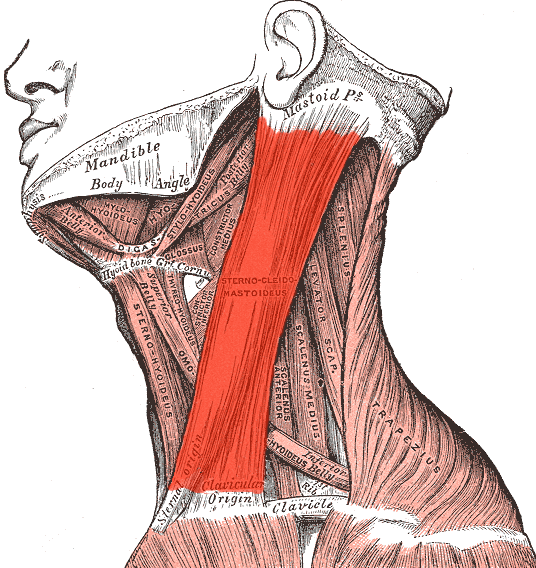
Sternocleidomastoid
A muscle located on the lateral and anterior portion of the neck; originates on the manubrium and medial 1/3 of the clavicle, inserts on the mastoid process of the temporal bone, and acts bilaterally to flex the neck or unilaterally to laterally flex to its own side and rotate the head to the opposite side.
Scalenes
A group of three muscles (anterior, middle, and posterior) located between the sternocleidomastoid muscle and the anterior portion of the trapezius that move the head and neck.

Erector Spinae Group
A collection of vertebral column muscles consisting of the iliocostalis, longissimus, and spinalis ('I Love Spaghetti') that collectively extend the trunk.
Iliocostalis
The most lateral column of the erector spinae group that functions collectively with the other columns to extend the trunk.

Longissimus
The intermediate column of the erector spinae group that assists in extending the trunk.

Spinalis
The most medial column of the erector spinae group, lying closest to the vertebral column, that assists in extending the trunk.

Diaphragm
The primary muscle of respiration separating the thoracic and abdominal cavities; originates on the lower 6 costal cartilages, ribs, lumbar vertebrae 1–3, and xiphoid process, and inserts into the central tendon to increase the volume of the thoracic cavity during inhalation.

External Intercostals
Respiratory muscles between the ribs that contract during inspiration to expand the thoracic cavity and relax during expiration.

Rectus Abdominis
An abdominal muscle originating on the superior pubis and pubic symphysis and inserting on rib cartilages 5–7 and the xiphoid process; acts to flex the lumbar vertebral column and compress the abdomen.

Linea Alba
A connective tissue 'white line' on the anterior abdominal wall that divides the rectus abdominis muscle.

Abdominal Aponeurosis
A wide, flat tendon found in the abdominal wall.
External Oblique
An abdominal muscle originating on ribs 5–12 and inserting on the linea alba and anterior iliac crest; acts bilaterally to flex the vertebral column and unilaterally to laterally flex and rotate the trunk to the opposite side.

Internal Oblique
An abdominal muscle originating on the inguinal ligament, iliac crest, and lumbar fascia, and inserting on the linea alba, pubic crest, and costal cartilages 8–10; acts bilaterally to flex the vertebral column and unilaterally to laterally flex and rotate the trunk to the same side.

Transversus Abdominis
The deepest muscle of the abdominal wall, located deep to the obliques; acts to compress the abdomen and provide protection and stability to the spine.
