BPD: Tools and agents of tooth cleaning
 Call Kai
 Learn
 Practice Test
 Spaced Repetition
 Match
 Flashcards
 Knowt Play
1/11

Earn XP
Description and Tags
Gå gjennom PP for sikkerhetsskyld
12 Terms
Plaque control
Plaque control prevents dental plaque accumulation and reduces the risk of oral diseases.
Mechanical plaque control: Physically removes deposits from tooth surfaces.
Home care: Removes soft deposits (debris, materia alba, plaque and partially acquired pellicle).
Professional care: Scaling and polishing can also remove hard deposits (calculus).
Chemical plaque control: Uses chemical agents to prevent/delay plaque formation and reduce bacteria in existing plaque, but does not physically remove plaque.
Basic and supplemental tools for home dental cleaning
Basic:
Toothbrush: Manual or electric.
Toothpaste: Supports brushing and provides additional protective effects.
Supplemental:
Interdental cleaning instruments: Clean between teeth.
Tongue scraper: Cleans the tongue.
Manual toothbrush
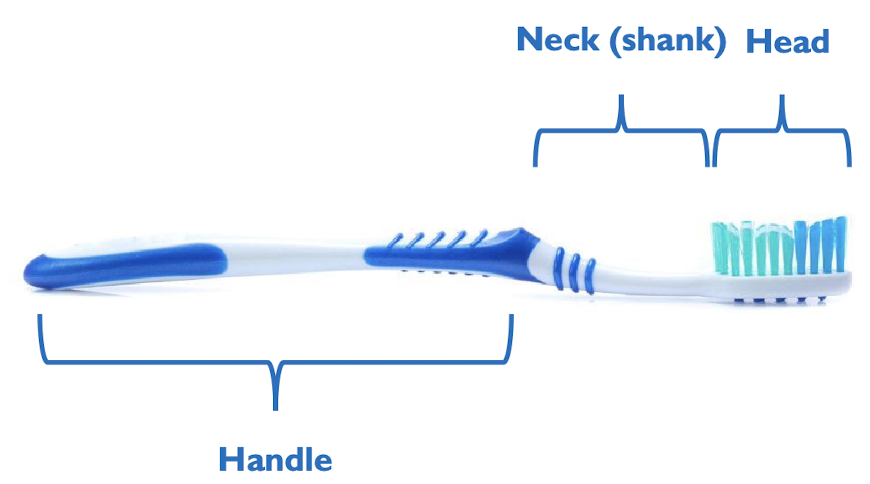
A manual toothbrush consists of three parts:
Handle: Provides grip; available in different designs.
Neck (shank): Connects the handle and head; may be straight, angled or offset.
Head: Contains bristles and varies in size, material, stiffness, number and arrangement.
Head size: Should fit the user’s mouth (e.g., 14 × 28 mm or 13 × 23 mm).
What determines toothbrush bristle stiffness and arrangement
Bristle stiffness: Hard, medium, soft, super-soft or ultra-soft, depending on:
Bristle material and diameter.
Filament length.
Angle of the bristle tufts.
Bristle arrangement:
Straight or angled/criss-cross bristles.
Rounded bristle ends.
Power tips and indicator bristles.
Important: Excessively hard bristles may damage both soft and hard dental tissues.
Main types of special and electric toothbrushes
Special manual toothbrushes:
Single-tufted toothbrush: For cleaning specific, difficult-to-reach areas.
Orthodontic toothbrush: Designed for cleaning around orthodontic appliances.
Electric toothbrushes:
Oscillating-rotating: Usually a small, round head that rotates back and forth. Important for not damaging the gingiva with a one-way rotation.
Sonic/ultrasonic: Usually an elongated head using rapid vibrations.
Toothbrush maintaince
Toothbrushes become contaminated with microorganisms from oral fluids.
Replace regularly: Approximately every 1–3 months.
Storage: Allow the toothbrush to dry in open air between uses, rather than keeping it in a closed container.
Cleaning/disinfection: The lecture mentions chemical disinfectants (e.g., CHX), UV radiation and other methods.
Main purpose: Reduce microbial contamination and maintain effective cleaning.
Toothpaste
Toothpaste supports toothbrushing and provides additional benefits.
May improve plaque removal.
Can freshen breath, whiten teeth, reduce sensitivity and delay plaque formation.
May contain agents that help prevent caries.
Important: A toothbrush can remove plaque without toothpaste, but toothpaste alone cannot effectively remove plaque.
Main ingredients of toothpaste and their functions

Abrasives and RDA
Abrasives are particles that help mechanically remove deposits and surface stains.
Examples: Calcium carbonate (CaCO₃) and silica (SiO₂).
RDA (Relative Dentine Abrasion) measures the abrasiveness of toothpaste.
According to the lecture:
0–70: Low.
70–100: Moderate.
100–150: High.
150–250: Potential risk of hard tissue damage.
Abrasiveness depends on the hardness, shape and concentration of abrasive particles.
Therapeutic toothpaste agents
Anti-caries/remineralising: Fluoride (concentration measured in ppm), calcium-phosphate compounds and CPP-ACP.
Buffers: Sodium bicarbonate (NaHCO₃) helps neutralise acids.
Anti-plaque: Triclosan, zinc/tin salts, essential oils and enzymes.
Anti-calculus: Pyrophosphates inhibit calcium-phosphate crystal growth.
Anti-sensitivity: Potassium salts, CPP-ACP and NovaMin.
Whitening: Abrasives, papain, peroxides and optical agents (blue covarine).
Fluoride concentrations mentioned in the lecture:
1000 ppm: Up to approximately 6 years.
1450 ppm: From the eruption of the first permanent tooth.
Toothbrushing effectiveness
Toothbrushing effectiveness depends mainly on:
Brushing technique.
Time spent brushing.
Patient motivation and consistency.
According to the lecture, these factors are more important than the specific type of toothbrush or toothpaste.
Interdental access probe (IAP)
An interdental access probe (IAP) is an instrument used to measure the space between adjacent teeth.
Procedure: Inserted horizontally into the interdental space.
Function: Measures the available interdental space to help select the correct size of an interdental brush.
Important: The IAP assesses interdental space, not periodontal pocket depth.
