Food Chemistry Exam Revision
 Call Kai
 Learn
 Practice Test
 Spaced Repetition
 Match
 Flashcards
 Knowt Play
1/8

Earn XP
Description and Tags
the ones I see that might be important
9 Terms
Vitamin A (pro vitamin, active form, function)
Fat soluble
Pro-vitamin: beta -carotene (found in carrots, sweet potato, spinach)
Active Form: Retinol
Function: Essential for vision and immune health
Antioxidant: Quenches reactive oxygen species with conjugated double bonds

Vitamin D (pro vitamin, active form, function)
Formation: Sunlight exposure on 7-dehydrocholesterol in the skin triggers a photolytic ring-opening reaction to form cholecalciferol (Vitamin D3)
Active Form: Calcitriol
Function: Promotes intestinal absorption of calcium, magnesium and phosphate for bone development9. Deficiency causes rickets.

Vitamin E (structure , function)
Structure: Comprises a family of tocopherols and tocotrienols[10].
Function: A major fat-soluble antioxidant that acts as a radical scavenger, inhibiting radical propagation in fatty acids within membrane phospholipids by donating H to radical[10][11]
Found in vegetable oil, leafy greens

Vitamin K
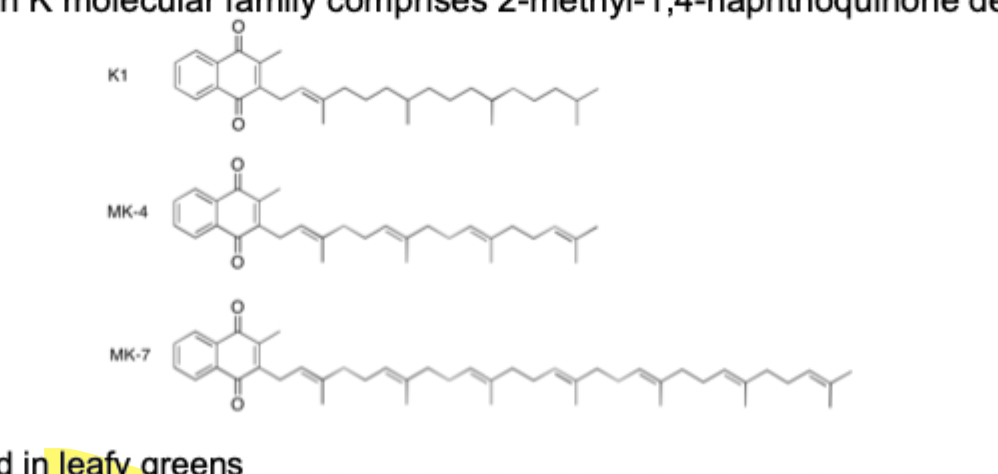
Structure: 2-methyl-1,4-naphthoquinone derivatives[12].
Forms: Vitamin K1 (phylloquinone) from leafy greens (involved in photosynthesis)[10][12]; converted by gut microbiota into Vitamin K2 (menaquinone)[12].
Function: Required for synthesizing proteins involved in blood coagulation and binding calcium in bones[12].
Found in leafy greens
Vitamin B
Vitamin B Family:
Broad family of co-enzymes and co-factors crucial for cell metabolism[
Key Rule: Vitamin B12 (cobalamin) is not available from plant produce; vegetarians/vegans rely on fortified functional foods or animal sources[
Every meat, fish etc
![<p><strong>Vitamin B Family:</strong></p><ul><li><p>Broad family of co-enzymes and co-factors crucial for cell metabolism<sup>[ </sup></p></li><li><p><strong>Key Rule:</strong> <strong>Vitamin B12 (cobalamin)</strong> is <strong>not available from plant produce</strong>; vegetarians/vegans rely on fortified functional foods or animal sources<sup>[</sup></p></li></ul><p></p><p></p><p>Every meat, fish etc</p>](https://assets.knowt.com/user-attachments/25fb697f-9a82-4b85-9755-cdc5b5ea20f9.png)
Vitamin C
Structure: Structurally resembles a monosaccharide; synthesized biochemically by plants and commercially from D-glucose[1
Function: Strong water-soluble antioxidant and reducing agent involved in tissue repair and collagen synthesis[ Easily oxidized by hydrogen atom donation
![<ul><li><p><span><strong>Structure:</strong> Structurally resembles a <strong>monosaccharide</strong>; synthesized biochemically by plants and commercially from D-glucose<sup>[1</sup></span></p></li><li><p><span><strong>Function:</strong> Strong water-soluble antioxidant and reducing agent involved in tissue repair and collagen synthesis<sup>[</sup> Easily oxidized by hydrogen atom donation</span></p></li></ul><p></p>](https://assets.knowt.com/user-attachments/9da2219b-908f-4aaf-aba2-bc0790a20e4d.png)
Macrominerals ("Can Papa Keep Some Salt Closely Managed?"
Ca, P, K, Na, S, Cl, M
Ca 2+ - stabilises casein micelles in milk
Na+ - Table salt
K+ - healthier alternative to sodium
Microminerals - All transition metals
Fe, I, Zn, Cu
Functional ingredients
Flavanoids, flavanones, flavanols - Phenolic compounds
Caratenoids, isoprenoids tocpherols -
Probiotics , microbial