Trypanosoma brucei
 Call Kai
 Learn
 Practice Test
 Spaced Repetition
 Match
 Flashcards
 Knowt Play
1/46

There's no tags or description
Looks like no tags are added yet.
47 Terms
What order is Trypanosoma in?
Order Kinetoplastida
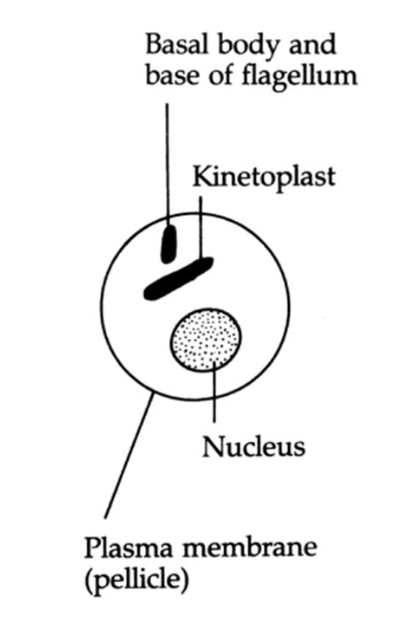
Where is the kinetoplast?
in the mitochondrion
What is the kinetoplast?
a disk of interlocking DNA circles (kDNA)
maxi-circles
mini-circles
concatenated mass
What is the function of the kinetoplast?
mitochondrial
transformation between life cycle forms
What is the basal body of Trypanosoma?
anchors flagellum
outer surface of mitochondrial membrane
always close to kinetoplast
What are the major human infections in Order Kinetoplastida?
Human African Trypanosomiasis (HAT)
Chagas’ disease
Leishmaniasis
What are the 4 morphological forms of Order Kinetoplastida?
amastigote (LD body)
promastigote
epimastigote
trypomastigote (Tryp)
amastigote
no flagellum
promastigote
flagellum (locomotion & attachment)
in insect vector

epimastigote
undulating membrane
in insect vector

What are the 4 basic types of trypomastigotes?
slender → in mammal
stumpy → in mammal, infective to insect
procyclic → in insect
metacyclic → in insect, infective to mammal
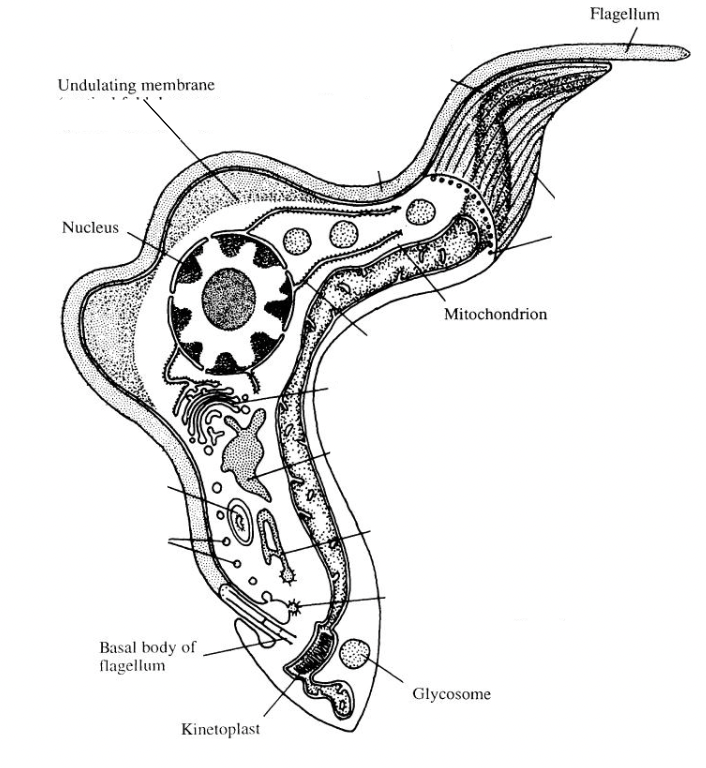
A glycosome contains…
glycolytic enzymes
bloodstream form of glycosome
generate ATP exclusively through glycolysis
mitochondrion repressed
lacks most components of CAC & ETC
lacks capacity for oxidative phosphorylation
normal blood glucose range
70 - 110 mg/100mL
insect form of glycosome
glucose levels drop very low
mitochondrial activity activated
glycolytic enzyme content of glycosomes decrease
Why is glycolysis compartmentalized?
allows for rapid adjustment to changing environmental conditions
draw the Trypanosoma brucei cycle of morphological forms including activity of mitochondrion and glycosomes

What are the 2 sections of Genus Trypanosoma?
Salivaria
Stercoraria
section Salivaria
anterior station development
anterior
Trypanosoma brucei
section Stercoraria
posterior station development
hindgut
Trypanosoma cruzi
What is the vector of Trypanosoma brucei?
Glossina = Tsetse fly
draw the life cycle of Trypanosoma brucei
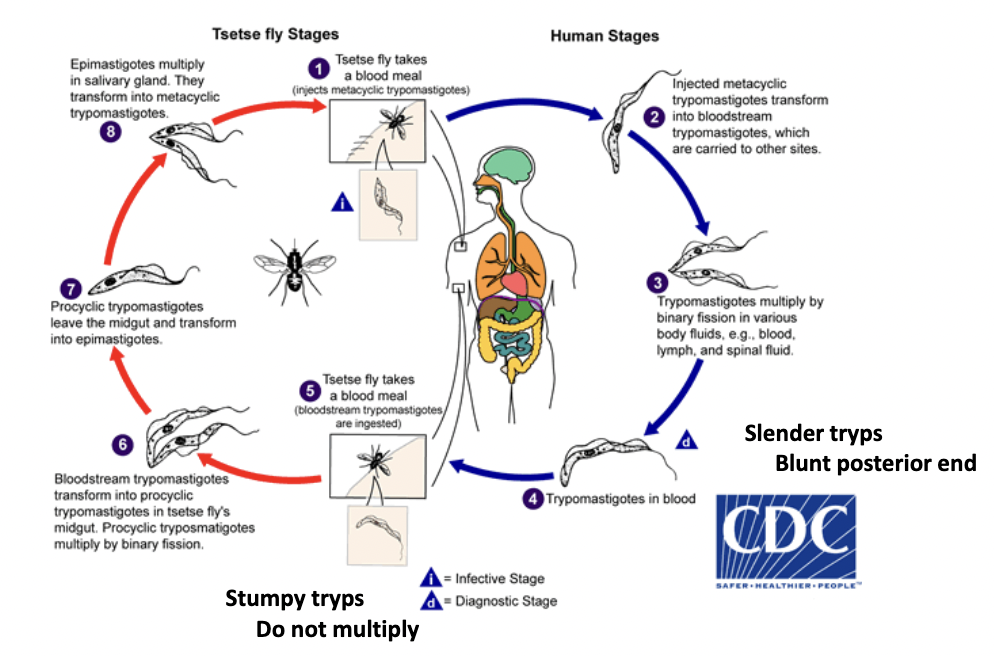
What are the steps in the life cycle of Trypanosoma brucei?
Tsetse fly takes a blood meal and injects metacyclic trypomastigotes
injected metacyclic trypanomastigotes transform into bloodstream trypomastigotes, which are carried to other sites
trypomastigotes multiply by binary fission in various body fluids
trypomastigotes in blood
Tsetse fly takes a blood meal and bloodstream trypomastigotes are ingested
bloodstream trypomastigotes transform into procyclic trypomastigotes in tsetse fly’s midgut
procyclic trypomastigotes leave the midgut and transform into epimastigotes
epimastigotes multiply in the salivary gland, then transform into metacyclic trypomastigotes
Trypanosoma brucei has 3 subspecies, which are…
morphologically identical
differ in geographical range, DH, and pathology
Where is the Glossina/Tsetse fly found?
tropical Africa;
between 15ºN and 15ºS = fly belt
What is significant about the wings of Tsetse flies?
has a meat cleaver cell in the wing
T. brucei brucei
Nagana
infects antelope & livestock
anemia, fever, paralysis, death
What are the 2 subspecies of Trypanosoma brucei that cause Human African Trypanosomiasis (HAT)?
T.b. rhodesiense
T.b. gambiense
T.b. rhodesiense
East African sleeping sickness
animal reservoirs (cattle & antelope)
T.b. gambiense
West African sleeping sickness
no animal reservoir
more common than Tbr
What are the 2 stages of Human African Trypanosomiasis (HAT)?
hemolymphatic stage (1st)
parasite in peripheral circulation & lymph system
enter tissue fluids of liver, spleen, heart, & eyes
has not invaded CNS
meningo-encephalitic stage (2nd)
crosses blood-brain barrier (BBB) & infects CNS
What does infection with HAT eventually lead to if not treated?
coma & death
T.b. rhodesiense infection
progresses rapidly
chancre → large sore at site of bite
within 1 - 2 weeks after bite → fever, headache, muscle/joint aches, enlarged lymph nodes
after a few weeks of infection → invades CNS → mental deterioration
death within months
T.b. gambiense infection
progresses slowly
chancre → large sore at site of bite
early in infection → fever, headache, aches, malaise, swollen lymph nodes, weight loss
after 1 - 2 years → CNS involvement → personality changes, daytime sleepiness, problems with balance/walking
untreated → death in ~ 3 years
How do you diagnose Trypanosoma brucei rhodesiense?
parasite load usually high → easily detected in blood, lymph fluid, & chancre
CSF examined to determine if in CNS
How do you diagnose Trypanosoma brucei gambiense?
parasite load usually low → difficult to detect in blood → ELISA to detect antibodies
CSF examined to determine if in CNS
What is the treatment for Human African Trypanosomiasis (HAT) dependent on?
type of infection (Tbg or Tbr)
disease stage
stage 1 → treatment usually effective
stage 2 → prognosis poor once in CNS
What does the post-treatment for Human African Trypanosomiasis (HAT) include?
serial exams of CSF for 2 years
detection of relapse
What are the 4 drugs that treat Human African Trypanosomiasis (HAT)?
Pentamidine
Suramin
Melarsoprol (MelB)
Eflornithine
Pentamidine
mode of action → inhibits synthesis of DNA & RNA
does NOT cross BBB
targets stage 1 Tbg
well tolerated :)
Suramin
mode of action → inhibits oxidation of NADH
does NOT cross BBB
targets stage 1 Tbg & Tbr
toxic → kidney failure
Melarsoprol (MelB)
mode of action → inactivates pyruvate kinase (inhibits ATP synthesis)
crosses BBB
targets stage 2 Tbg & Tbr
arsenic based (seizures)
1 in 20 die of treatment
Eflornithine
mode of action → inhibits ornithine decarboxylase (cell growth)
crosses BBB
targets stage 2 Tbg
“Resurrection drug” (late-stage comatose)
not effective against Tbr
expensive
How do you control for Human African Trypanosomiasis (HAT)?
long sleeves & pants
vehicle inspection
insect repellent
fly traps & insecticides
sterile insect technique (SIT)
sterile insect technique (SIT)
males sterilized by irradiation
3 - 4 generations + spraying → eliminate local populations
antigenic variation
host produces antibodies against specific VSG → destroy 99% of tryps by agglutination & lysis
some tryps shed 1st VSG & produce 2nd VSG (different antigen) → escape antibody attack
long slender trypomastigotes
surface coat = single protein = variant surface glycoprotein (VSG)