Bio 213 Chapter 8
 Call Kai
 Learn
Learn Practice Test
 Spaced Repetition
 Match
Match Flashcards
 Knowt Play
1/27

There's no tags or description
Looks like no tags are added yet.
Name | Mastery | Learn | Test | Matching | Spaced | Call with Kai | Chat |
|---|
No analytics yet
Send a link to your students to track their progress
28 Terms
Compare and contrast the main types of energy.
Potential energy is stored energy, such as energy in chemical bonds, concentration gradients, or charge imbalances.
Kinetic energy is the energy of movement
Energy can be converted from one form to another.
Define metabolism.
the sum total of all chemical reactions occurring in a biological system at a given time.
What is the difference between anabolic and catabolic reactions? (2 Metabolic reactions?)
Anabolic reactions: require energy and build larger molecules
Catabolic reactions: release energy and break molecules down
Define the 1st law of thermodynamics.
Energy cannot be created or destroyed
Define the 2nd law of thermodynamics.
Entropy increases
Energy becomes less concentrated and energy is released as heat;
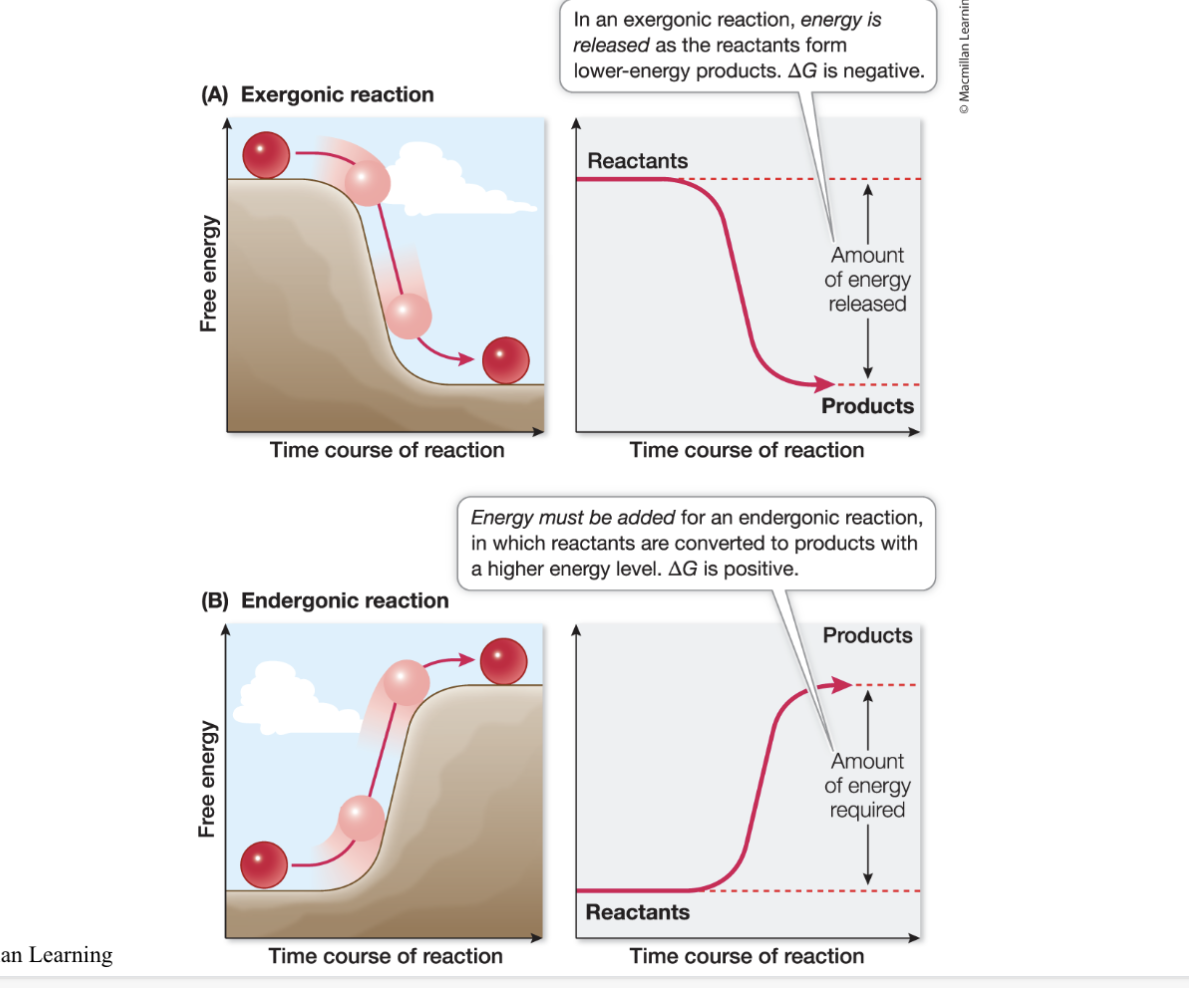
Compare exergonic and endergonic reactions.
Exergonic reaction: release energy and have a negative ΔG.
Endergonic reaction: require energy and have a positive ΔG.
what is entropy?
a measure of the disorder in a system.
ATP is hydrolyzed into _____ & ______?
ADP and Pi
________________ increase the rate of chemical reactions
Catalysts increase the rate of chemical reactions
Activation energy puts the reactants in a reactive mode called the _________ state
Transition
Molecules of substrate converted to product per unit time is called _____________________
Turnover rate (1-40)
What is the free-energy equation and what does each variable mean?
G = H − TS.
G = usable free energy,
H = total energy
T = absolute temperature
S = entropy.
What is ΔG and what does a negative vs. positive ΔG mean?
ΔG is the change in free energy.
Negative ΔG: energy is released and the reaction is exergonic.
Positive ΔG means energy is required and the reaction is endergonic.
What are the main parts of ATP and where is its usable energy released?
Adenine, ribose, and 3 phosphate groups.
Hydrolysis of ATP to ADP + Pi
What is activation energy?
energy required to start a reaction and reach the transition state.
What do enzymes do to activation energy?
lower it, allowing reactions to occur faster.
Name two ways enzyme activity is controlled.
Regulating how much enzyme is produced
Regulating the activity of enzymes that already exist.
2 Factors that effect Enzyme activity ?
Temperature, pH
What are three ways an enzyme can help catalyze a reaction?
orient substrates
Strain substrate bonds
add chemical groups.
Compare competitive and noncompetitive inhibition.
Competitive inhibitors: bind the active site and compete with the substrate
Noncompetitive inhibitors bind elsewhere and change the enzyme's shape.
What is competitive inhibition?
binds the active site and competes with the substrate for binding.
What is noncompetitive inhibition?
binds somewhere other than the active site, changing enzyme shape and activity.
What is reversible enzyme inhibition?
inhibitor binds noncovalently, so the inhibition can be reversed.
What is irreversible enzyme inhibition?
An inhibitor covalently binds to the enzyme and permanently inactivates it
What is uncompetitive inhibition?
The inhibitor binds to the enzyme-substrate complex and prevents product release.
What is induced fit?
The enzyme changes shape when the substrate binds, improving interactions at the active site.
Define allosteric regulation.
A molecule binds at a site other than the active site and changes the enzyme's shape and activity.
How does ATP hydrolysis help drive an endergonic reaction?
releases energy and can transfer a phosphate group to another molecule, helping drive an energy-requiring reaction.