Atomic Structure
 Call Kai
 Learn
 Practice Test
 Spaced Repetition
 Match
 Flashcards
 Knowt Play
1/64

Earn XP
65 Terms
Scientific Model
A simplified representation of reality used to understand, explain or predict phenomena
Continuous Spectrum
An unbroken band of colours produced when white light is separated into its component wavelengths.
Line Emission Spectrum
A series of separate coloured lines producced when light emitted by an excited element is separated into its component wavelengths.
Energy level
The fixed amount of energy of an electron in an atom.
Quantised energy
Energy that can have only particiular fixed values; values between these allowed amounts are not possible.
Ground state
The state in which the electrons occupy the lowest available energy levels.
Excited State
The state in which one or more electrons occupy higher energy levels than those available in the ground state.
Photon
A quantum, or discrete packet, of electromagnetic energy.
Energy Sublevel
A subdivision of a main energy level.
The different sublevels are…
… s, p, d and f
Heisenburg’s Uncertainty Principle
It is impossible to know both the exact position and the exact momentum of an electron at the same time.
Orbital
A region of space around the nucleus within which there is a high probability of finding an electron.
Why might a scientific model need to be changed?
When new experimental evidence cannot be explained by the existing model.
Particulate Nature of Matter
Proposed by Dalton.
The idea that all substances are made of tiny, indivisible particles.
Who proposed the Plum Pudding model?
J.J Thomson.
What was the Plum Pudding model?
The proposition that the atom was a sphere of positive charge with negatively charged electrons embedded throughout it.
The Plum Pudding model explained why the atom is electronically neutral, but…
it did not include a nucleus and was later contradicted by Rutherford’s evidence.
1st assumption of the Nuclear Model.
The atom is very dense, very small and positively charged.
2nd assumption of the Nuclear Model.
The atom is mostly empty space.
3rd assumption of the Nuclear Model.
The nucleus takes up most of the atoms mass.
4th assumption of the Nuclear Model.
The electrons are located in the space surrounding the nucleus.
1st limitation of the Nuclear Model.
Didn’t show the…
Did not show the arrangement of electrons.
2nd limitation of the Nuclear Model.
…why electrons didn’t…
Didn’t explain why electrons didn’t lose energy and spiral into the nucleus.
3rd limitation of the Nuclear Model.
It gave no clear account of…
It gave no clear account of electron behaviour.

Rutherford’s gold-foil experiment.
An experiment conducted by Rutherford in which positively charged alpha particles were directed at a thin sheet of gold foil.

Rutherford’s Gold foil experiment
Observation → 2. What it showed → 3. Conclusion 1
Most particles passed straight through
They met very little matter
Most of the atom is empty space
Rutherford’s Gold foil experiment
Observation → 2. What it showed → 3. Conclusion 2
Some particles were deflected.
They were repelled by positive charge.
Positive charge is concentrated in a small nucleus
Rutherford’s Gold foil experiment
Observation → 2. What it showed → 3. Conclusion 3
Very few particles bounced back
Very few particles bounced back
They met a very dense region
The nucleus is very dense and contains most of the mass.
Spectrometer
A tool used to examine line spectra. When an electric current is passed through a gas in a discharge tube, the gas emits light.
Continous Spectrum vs Line Spectrum
Continous spectrum contains every visible wavelength
Line spectrum contains only particular wavelengths
Why is each elements spectrum unique?
Each element has its own arrangement of electrons + set of allowed energy levels.
The energy gaps between these levels are therefore different.
Electron transitions in each element release a unique set of photon energies and frequencies, producing a characteristic line emission spectrum.
1st assumption of the Bohr Model.
Electrons move…
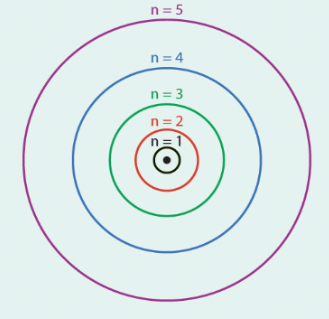
Electrons move in fixed orbits around the nucleus.
2nd assumption of the Bohr Model.
Each orbit corresponds to a particular energy level.
3rd assumption of the Bohr Model.
Electrons can only have certain fixed, quanties amounts of energy.
4th assumption of the Bohr Model.
Energy levels are labelled…
Energy levels are labelled n=1, n=2, n=3 and so on.
1st limitation of the Bohr Model.
Didn’t account for wave-particle duality

2nd limitation of the Bohr Model.
Worked well for hydrogen, but did not work so well for multi-electron atoms.
3rd limitation of the Bohr Model.
Didn’t account…
Didn’t account for sublevels
Electron transition step 1
An atom absorbs energy when it is heated or when electricity is passed through it. It becomes excited.
Electron transition step 2
An electron can move to a higher energy level only if it absorbs an amount of energy equal to the gap between the two levels.
Electron transition step 3
The excited state is unstable. The electron later loses energy and returns back to the lower energy level.
Electron transition step 4
The electron releases the energy difference as a photon of electromagnetic radiation.
Photon frequency
Because the allowed energy levels are fixed, electrons can release only particular amounts of energy.
Each photon therefore has a definite frequency and wavelength.
A photon in the visible region appears as a particular coloured line in the emission spectrum.
Eₘ - Eₙ = hf
Eₘ = energy of the higher energy level
Eₙ = energy of the lower energy level
h = Planck’s constant
f = frequency of the emitted photon
Higher photon frequency means…
Higher photon energy and a shorter wavelength.
Lower photon frequency means…
Lower photon energy and a longer wavelength.
Balmer series
The visible line spectrum
Excited electrons fall to n=2
Hydrogen Emission Spectrum
n=6 to n=2: Violet line
n=5 to n=2: Blue-violet line
n=4 to n=2: Blue-green line
n=3 to n=2: Red line
UV Lyman Series
Transitions ending at n=1
Infrared Paschen Series
Transitions ending at n=3
Potassium
Lilac
Sodium
Yellow-orange
Copper
Blue-green
Lithium
Crimson
Barium
Apple green
Strontium
Red
Method for the flame test
Soak separate wooden splints in water.
Crush a small sample of each salt using clean equipment.
Dip a damp splint into the salt and hold it in the blue Bunsen flame.
Record the flame colour and use a different splint for each salt.
Evidence for energy sublevels
Improved spectrometers showed that some lines that had appeared to be single lines were actually several very closely spaced lines.
Sodium’s yellow line is a doublet.
The small energy differences could not be explained by transitions between completely different main energy levels.
Scientists concluded that most main energy levels are divided into smaller, closely spaced energy sublevels.
1st assumption of the Orbital Model
Electrons do not follow fixed paths
2nd assumption of the Orbital Model
Electron behaviour…
Electron behaviour is described using probability.
3rd assumption of the Orbital Model
Electrons show…
Electrons show wave-particle duality
1st limitation of the Orbital Model
2D models cannot fully display the 3D structure
2nd limitation of the Orbital Model
The exact path and poisition of an individual electron is not provided.
3rd limitation of the Orbital Model
Orbital boundaries and their shapes are simplified probability representations.
Evidence leading to the orbital model
Electrons exhibit wave-particle duality; they show both particle-like and wave-like behaviour.
The splitting of spectral lines showed that main energy levels contain smaller sublevels.